

Champion Coaches - Including Local Legends - Unite to Restore Ravenna Glory
By
Scott DeCamp
Special for MHSAA.com
October 8, 2026
RAVENNA – Whether they want to or not, Ravenna seniors Joel Kantola and Colton Rolison hear about the glory days of Bulldogs football from their fathers.
 Kantola’s dad, Brandon, watches old games from the 1994 season when he was a two-way starter on Ravenna’s first MHSAA Finals championship team.
“He can’t remember very well, but he’ll see a play and he’s like, ‘Oh, I remember doing that play!’” Joel Kantola said. “It’s one of the best things to hear something (from that era). He loves it, too.”
Rolison’s dad, Willy, shares memorable stories from back in the day when he was a dynamic running back on the Bulldogs’ 1997 Class C title squad.
“It’s just insane that he still has all these stories that I’ve never heard. He’s still bringing them up, new ones every day,” Colton Rolison said with a smile.
Three decades have passed since the 1990s heyday of Ravenna football, when the Bulldogs won three of their program’s four Finals titles. But in the small town located on the eastern edge of Muskegon County, the band is back together, one might say.
Steve Czerwon was hired in March as Ravenna’s head football coach, coming from a highly successful 13-year tenure at his Muskegon Catholic Central alma mater where he guided the Crusaders to Division 8 championships all of his first four seasons (2013-16).
One of Czerwon’s first orders of business in Ravenna was securing the commitments of legendary coaches Dusty Fairfield and Randy Helsen – architects of the Bulldogs’ championship teams in 1994, 1996, 1997 and 2003 – to bring their wisdom and serve as a link from the storied era to this current one.
They agreed, others from the old guard hopped aboard, and a couple more experienced coaches joined Czerwon’s staff. Now, entering the final third of the 2026 regular season, the Bulldogs appear to have regained a little traction despite coming off three straight losing campaigns.
Ravenna carries a 5-1 overall record and five-game winning streak into this Friday’s West Michigan Conference Rivers home game against Hesperia.
Next week, Ravenna plays at North Muskegon with at least a share of the WMC Rivers title on the line. Should the Bulldogs win this Friday, they’ll take on the Norsemen for the outright league championship.
Since the WMC expanded and split into two divisions in 2022, North Muskegon has not lost a Rivers football game. Meanwhile, Ravenna has not won a conference title since sharing one with two teams in 2001.
In their football history, the Bulldogs have more Finals titles (four) than conference championships (three), illustrating the enduring strength of the West Michigan Conference.
This pack is hungry to etch its own history: Winning a conference title and making a run in the Division 7 playoffs. But, as Helsen laid out, there’s a price to pay.
“Steve addressed the fact (with the players),” Helsen recalled. “‘You wanted these guys to come back and you wanted what they had in the ’80s through the ’90s into the 2000s, and what it’s going to take is every effort you’ve got and even take it up from where you are. If you want to leave a legacy, that’s what you have to do. These guys (have) a legacy.’”
When Helsen says “these guys,” he’s referring to Fairfield and himself, but also other connections from the days of Ravenna football prominence.
In 20 seasons as Ravenna’s head coach covering two stints – the second ending in 2010 – Fairfield sported a 164-55 record. He’s a Michigan High School Football Coaches Association Hall of Famer.
Helsen served as Ravenna’s defensive coordinator for all of those seasons, and then some. He and Fairfield are both Ravenna Athletic Hall of Famers, their plaques side-by-side on the wall of the high school’s athletic wing.
Fairfield and Helsen are both retired and they’re volunteer assistants on Czerwon’s staff. They are not at every practice, but they fill critical roles: The former works with the secondary and quarterbacks, plus he’s on the headset in the press box on game days, while the latter coaches defensive linemen.
“They have so much knowledge, and I think it really does connect the past to the current,” said Czerwon, who did his student teaching at Ravenna in the early 2000s and was a member of the Bulldogs coaching staff during their most recent state title season in 2003. “A lot of kids here, they heard from their uncles and their fathers about some really good teams that Ravenna had in the ’90s and early 2000s, and those guys are the actual link.
“I talk to Dusty daily, and he just reinforces the importance of relationships you have with the kids,” Czerwon added. “He’s second to none at that, and it reinforces to me the importance of that.”
Geoff Nelson, who was a starting lineman on Ravenna’s 1994 team, coaches the offensive line. Neil Sladick, who helped the Bulldogs win Finals titles in 1996 and 1997, works with linebackers. Mark Jacobs, who starred on Ravenna’s first Finals group in 1988, helps coach defensive backs.
Canaan Groff is Ravenna’s defensive coordinator, and Nate Smith specializes in offense. Both bring experience to the table, including as head coaches. Czerwon, Groff, Sladick, and Smith all work in Ravenna school buildings, which is an advantage for coaches.
“I think that we’re bringing back a lot of accountability. I think we don’t settle,” Nelson said about Ravenna’s coaching staff. “This has been a great group. We had to break a lot of bad habits, but they’re starting to form new habits and starting to go in the right direction.”
Ravenna got a reality check to start the season in a 33-7 loss to Division 8 top-ranked Beal City, a perennial small-school power. Czerwon admitted he may have asked too much of his players right away in terms of new schemes and such.
Since then, the Bulldogs have exhibited gradual improvement, including winning a couple of one-point games, and now they’re starting to establish an identity of physical football. That was at its peak in last week’s 28-0 win at Mason County Central, which by the way is coached by Ravenna alumnus David Smith, a former Bulldogs head coach who was a member of Class C championship teams in 1994 and 1996.
Things are moving in the right direction for Ravenna.
“There hasn’t really been a lot of drama or anything like that. We love each other. That wins games,” said Rolison, a linebacker who suffered a fractured collarbone in Week 3. Chances of a return this season are up in the air, he said.
“(The coaches have all) worked together before and nobody motivates like Dusty Fairfield – there’s not a single person out there who does,” Rolison added. “Coach Randy Helsen, he knows his stuff. He knows more than I probably ever will about football.”
According to Helsen, getting to know young people at the ground level is Fairfield’s specialty: Types of music they like, their hunting spots, etc.
In terms of accountability, everybody is responsible for that.
“We get after them if they’re not getting it done,” Helsen said. “Kids that were not getting after it five, six weeks ago and kind of rolling their eyes at me when I’m coaching them on scout defense, they’re now in the starting lineup. I said, ‘You’re getting coached by a guy that coached defense here for 27 years. I’m giving you the same coaching that our all-staters and all-conference players got.’”
Fairfield’s goal in returning was to help lay building blocks for current and future success. He believes the overall health of football in Ravenna is strong considering participation numbers from high school to youth levels, especially at a time when similarly small communities across the state are canceling varsity seasons or not fielding enough players to form junior varsity squads.
“It’s been a good experience, and it’s made me realize, you know, what we did in the past really meant something, and it made me realize how hard we worked because I’m totally invested in the team right now. It is fun with the camaraderie with not just the boys but also the coaches,” Fairfield said.
“You know, it’s my last hurrah where I get to experience what I did for a living for over 30 years. I get to experience it one more time before I, you know, go off into the sunset,” he added with a chuckle.
For families such as the Kantolas and Rolisons, things are coming full circle – and they could not be more excited. Brandon Kantola is enjoying his son’s senior season while also reminiscing about the good ol’ days.
“I think he was invested back then,” said Joel Kantola, Ravenna’s starting center, “but he’s more excited for us than I think he was back then.”

Scott DeCamp has worked more than 25 years in sports media, including 21 at MLive Media Group as a reporter and editor. He is founder and owner of DeCamp Creative Solutions. Email him at [email protected] with story ideas for Lake, Mason, Mecosta, Muskegon, Newaygo, Oceana, and Oceola counties.
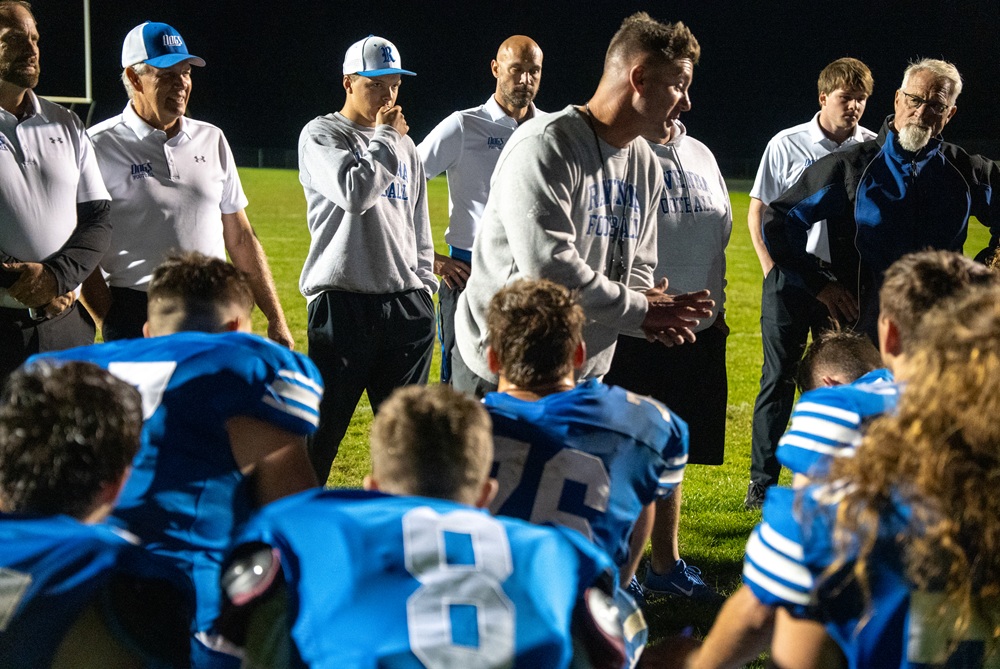
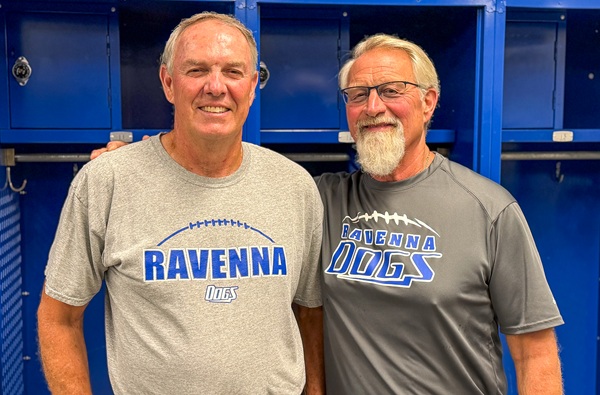
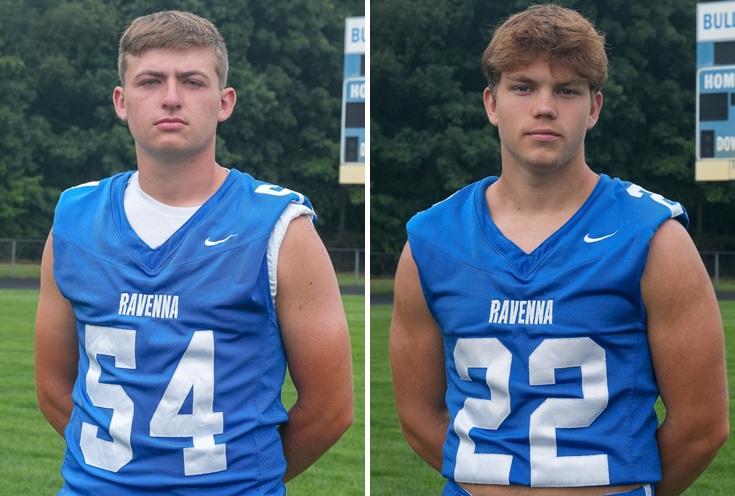
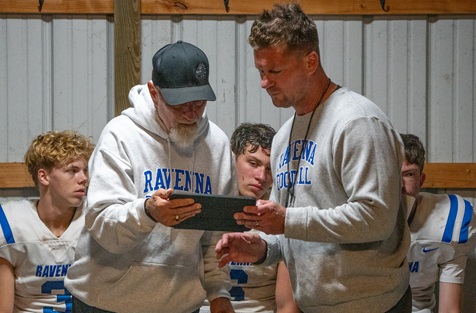
PHOTOS (Top) Ravenna head coach Steve Czerwon addresses the team following a 28-14 victory over Shelby on Sept. 25. (2) Ravenna assistant coaches Randy Helsen, left, and Dusty Fairfield are pictured in the Bulldogs' locker room in August. (3) Joel Kantola, left, is a senior center for the Ravenna football team, and Colton Rolison is a senior linebacker. (4) Fairfield, left, and Czerwon look at an iPad during halftime of a 28-0 victory over Mason County Central on Friday. (Photos by Scott DeCamp.)
Caledonia Football Set to Open Season by Welcoming Fans to New Home
By
Ron Pesch
MHSAA historian
August 25, 2025
Community banter dated back to April 1948, or before. Caledonia football followers were anxious for “an athletic plant of their own.” Members of the local Commercial Club were pushing to build a true place to call home.
At the time, home games were played on a clearing at Lakeside, a local county park in the heart of the village near Emmons Lake. Thanks to the success of the team and the popularity of games, locals felt the Scotties had outgrown the site.
Members of the Class C Bar-Ken-All league, coach Thornton K. Auwater’s squads started to win consistently, grabbing conference championships in 1945, 1946 and 1947. The league began in 1937 with the school as a charter member, along with Byron Center, Hopkins, Kelloggsville, Martin, and Wayland.
The Club proposed building a lighted field to the PTA with the thought that it could be done for between $12,000 and $15,000. According to an article in the area newspaper, the Grand Rapids Press, “It is expected the money will be raised by the sale of bonds locally.”
In 1949, a design was approved. However, in hopes of significantly lowering the cost, the plan was for volunteers to assist in the layout and construction of the site. According to the Press in April 1950, the race was on to finish the project before the arrival of the upcoming season:
“Sod, trucks, and tractors for the job have been donated by local residents. It is estimated that at least 100 more volunteers will be required to complete the field in time for regular season play.”
Auwater’s crew was expected to do well during the fall of 1950. The football team had fallen to Kelloggsville, 19-0, in the second game of the 1949 season, and the defeat meant the Scotties finished second in the league standings to the Rockets. But, of particular note, in the games that followed, Caledonia’s defense was flawless, shutting out its final six opponents. By all measures, it was an exciting time.
Come the new school year, and thanks to the efforts by the community, the field was ready for the team’s nonconference season home opener with Grant on Sept. 15.
Changes
The 1935 season was Caledonia’s first playing football, marking this as the school’s 91st year on the gridiron. Since the fall of 1970, the team has competed in the Ottawa-Kent Conference, and in 2016, moved to the league’s Red division.
Prior to the 1970s, the Scottish terrier – a breed of dog popularly known as the Scottie, originally bred to hunt vermin – was Caledonia High School’s mascot. Around 1974, students decided to change the nickname to the Fighting Scots – depicted by a Scottish warrior dressed in the school colors of purple and gold.
Fast forward to this 2025-26 school year and Caledonia is Class A and among the largest 65 high schools in the state based on enrollment. And 75 years after unveiling their first true home field, Caledonia Community Schools is debuting the team’s reimagined home.
Approved bond issues from 2020 and 2023 have funded the latest updates and renovations to the site. “Preserving the heritage” of the district, a synthetic turf system was added to the current site in 2023. This season, heated team rooms, updated seating, concessions, and restrooms will be unveiled.
For fans, the curtain opens Thursday when the team squares off against Holy Names Catholic from Windsor, Ontario.
“This stadium tells the story of Caledonia. It is a story of community, tradition, and pride,” said Kelly Clark, community and public relations coordinator for the district. “As we celebrate 75 years, we honor those who built the foundation and look forward to the next generation writing their own chapter on this field.”
A souvenir dedication program will be distributed at the home opener. Within, special thanks are extended to many who have helped bring the story to life: “We are especially grateful for the work Steve Poll has done to uncover and preserve so much of this history so that our community can fully appreciate the legacy we carry forward.”
Poll, himself, was a graduate of Grand Rapids South Christian. His dad, Gordon Poll, played right tackle and was a co-captain as a senior on the 1950 Caledonia team.
“He was not one to live in the past,” recalled Steve Poll, “so unless we were at a football game and something triggered a thought, he didn't talk much about the 1950 team accomplishments. … I met one of his teammates at my dad’s funeral, who shared a few things (with me). I intended to interview him (however) he passed away before that happened. I finally decided to dig in and find what I could.”
Poll captured details from old newspaper articles, photos, and memorabilia. “I started investigating before I knew anything about the current rebuild of the stadium,” he said.
Also planned for the celebration is a three-minute video featuring interviews with players – present and past – including a member of the 1950 team who recalled players laying sod on the field at their first practice that season.
MHSAA Executive Director Mark Uyl, a 1992 Caledonia graduate, will speak at the event.
A season to remember
“Grant High’s fighting team almost spoiled the dedication of a new lighted football field … last night,” reported the Press when covering the first game of the 1950 season, “throwing a real scare into the bigger, highly favored Caledonia High team before tumbling, 6 to 0.” A 30-yard pass from Bob Higley to Don Moffatt was the game’s only score.
In hindsight, it was perhaps the biggest play of the year.
A true stadium dedication ceremony was planned for the second game of the season. Among those scheduled to attend and speak were Caledonia Schools Superintendent Andrew B. Cherpes, Board of Education President Orlo Good, Village President Stan Stawski, and Coach Auwater. Also planning to make the trip from Washington was U.S. congressman Gerald R. Ford, Jr., who held Michigan’s 5th district seat in the House of Representatives. Unfortunately, due to scheduling issues, Ford was unable to attend but did send a telegram to explain his absence and, within, congratulated the community on its outstanding achievement. (Uyl will read the content during this year’s celebration.)
 The opponent was Middleville. For several years, the teams had scheduled a two-game nonleague “home-and-home” rivalry series. That continued in 1950, but this time, the Trojans were now members of the Bar-Ken-All. (Kelloggsville had left the league after the 1949-50 school year. The conference expanded, adding Middleville and Delton. To allow time for scheduling transition, the 1950 opening contest of the series did not count in the league standings.)
The Scotties emerged with another slim 7-0 win. According to the Kalamazoo Gazette, the result of the game “only added fuel to the rivalry which will reach a heated state at Middleville in a regular conference game Oct. 20.”
Caledonia plowed through the remaining games. Martin fell 27-0, Coopersville was trounced, 40-0, and Byron Center was easily defeated, 27-0. The highly-anticipated rematch with Middleville was close for the first half, as Caledonia clutched to a thin 7-0 lead at the break. It turned into a rout as “the Scotties flashed a passing attack that netted three more TDs and a 26-0 win.”
Wayland was disposed of 28-0, giving the Scotties possession of the “Cowbell Trophy” donated two years previous by a Wayland merchant. Then the team completely overwhelmed Hopkins in the season’s finale, 73-0. That margin was the state’s largest of the season, according to Dick Kishpaugh of Kalamazoo, who assembled season-ending totals for consumption by the state’s media. The Scotties were also statewide news as one of 26 teams that had posted unbeaten and untied marks on the year. Caledonia was one of just two to finish the year unbeaten, untied, and unscored upon. Garden City had done the same but had played just six games.
Although not rediscovered until recently, the team’s streak of 14 consecutive shutouts with no tie games included (six to end 1949, and eight in 1950) ranks second in the MHSAA football record book, just a single game behind North Muskegon teams that straddled three seasons, 1940-42.
Dedicated to a super volunteer
Besides location, one other item remains unchanged at the “athletic plant” in Caledonia.
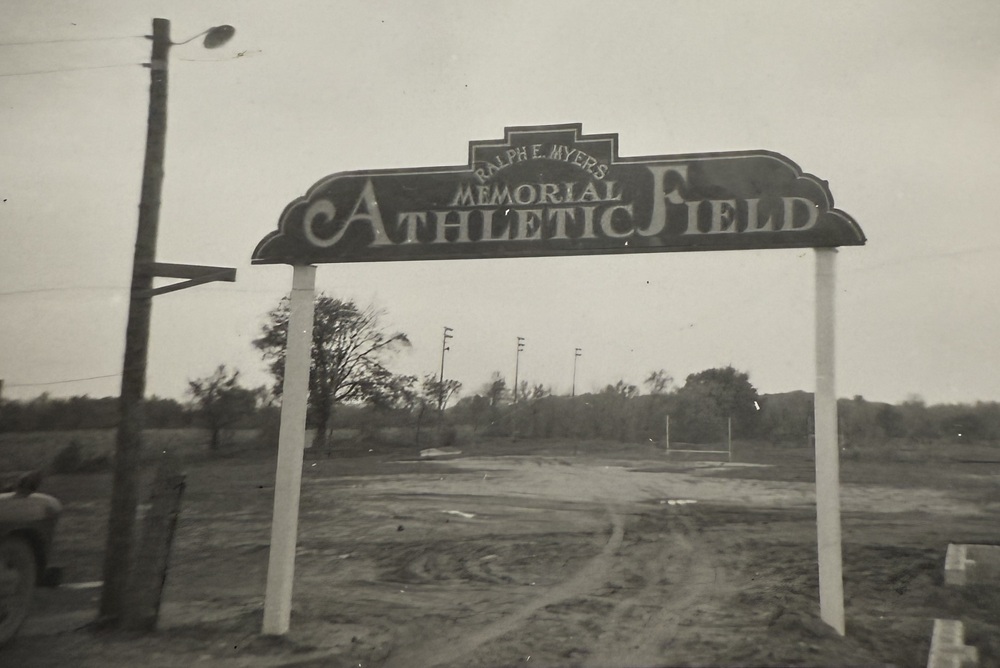
“Even though his children go to school in Middleville,” noted the Press back in 1950, Ralph E. Myers thought of Caledonia as “his town.” A member of the Commercial Club Committee that helped plan the project, he followed through as the site’s dedicated lead volunteer, working with others “to get the job done,” according to a community newsletter.
In July 1954, at age 46, Myers died tragically in an automobile accident. His wife, Henrietta, had died a year before. They left behind three daughters. That fall, Caledonia christened the site as Ralph E. Myers Athletic Field.
Over the years, proposals were made to rename the place in honor of others, but Caledonia Community School stood behind the original decision. In September 1998, after a $1.9 million renovation for football and track & field, the site was rededicated with new signage as Ralph E. Myers Memorial Stadium.
With the latest efforts by all involved to capture the stories and communicate the legacy, future students will have the opportunity to easily understand and appreciate the stadium’s humble beginnings and the importance of all, then and now, who pitched in to create a place to call home.
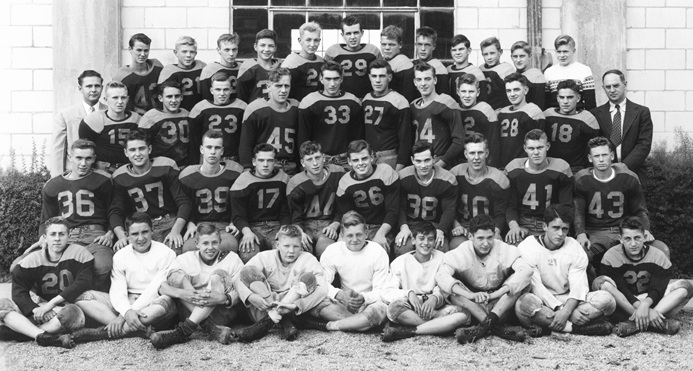
PHOTOS (Top) A sign welcomes visitors to Caledonia’s home field in 1954. (Middle) The 1950 Scotties: Back row William Price, Walter Jousma, Jack Moreland, Peterson, Harvey Jacobsen, Allan Vander Laan, Forrest Clark, Gerritt Nordhof, Arthur Benedict, Larry Schroder, Larry Lind, Donald Williams (Manager). Third row Assistant Coach Wisner, Donald Moffatt, Ramon Schantz, Bob Cisler, Bob Higley, Merle Maier, Wallace Lotterman, Bob Schultz, James Fitzsimmons, Fred Darling, Vern Kayser, Coach Thornton Auwater. Second Row Elmer Velthouse, Bernard Kilmartin, Donald Braendle, Louis Bellgraph, Marvin Eldridge, Allyn Niles, James Porritt, Benjamin Miller, Bill Jousma, Gordon Poll. First Row Gary Cherpes, Joseph Sleeman, Harold Olthouse, Rod Campbell, Garrit Keizer, Carl Yonkers, Clyde Barrett, James Ayers, Hosmer Parks. Not pictured Arnold Benedict, Bob Workman.