

Chippewa Valley Leads Macomb Charge
By
Tom Markowski
Special for Second Half
November 8, 2018
CLINTON TOWNSHIP – Since winning the Division 2 title in 2001, Clinton Township Chippewa Valley has played in the shadow of traditional Macomb County powers Macomb Dakota, Romeo, Sterling Heights Stevenson and Utica Eisenhower.
 Before this season, Chippewa Valley’s record against those four schools over the last 17 years was 26-52. The Big Reds did own a 10-8 record against Stevenson, but twice Stevenson reached MHSAA Finals while Chippewa Valley’s best showing since its championship season was a Semifinal appearance in 2003.
That trend started to change in 2017 as Chippewa Valley went 4-1 against these teams (including a second win over Dakota in the playoffs). This season, the Big Reds took another step forward posting a 6-0 mark and capturing their first outright title in the Macomb Area Conference Red.
And for the first time in program history, Chippewa Valley is 11-0. The Big Reds were 9-0 in 1975, the first season the MHSAA sponsored state playoffs, but did not qualify for the postseason (only four teams in each of the four classifications were selected for the playoffs that first year).
Scott Merchant is in his 10th season as head coach at Chippewa Valley, and the Big Reds have made the playoffs eight times during his tenure. These past two seasons have been his best by far. Last season, Chippewa Valley finished 10-2 losing to Detroit Cass Tech, 32-26, in a Division 1 Regional Final.
Most expected a rematch of that game this week. But Dearborn Fordson (10-1) upset Cass Tech last week, 41-14, and Chippewa Valley will host Fordson in the Division 1 Region 4 Final at 7 p.m. Friday. The teams have met just once before – and that game, in 2003, also took place in a Regional Final with Chippewa Valley claiming a 30-12 victory.
Merchant’s team is experienced, confident and loaded with talent. He has four three-year starters and eight seniors starting on defense.
“Dakota set the bar for the whole conference,” Merchant said of Chippewa Valley’s sister school (both are in the Chippewa Valley school system) and biggest rival. “In the mid- to late 2000s they had like five or six Regional titles. Our streak of losing to Dakota started in ’04, and I didn’t get here until ‘09. It was huge for us to win in 2014. It was the first time we beat them in 10 years. That was a big weight being lifted.”
When a team loses so often to another, especially a rival, the losses and the years often run together. For the record, here’s how bad it got for the Big Reds:
Beginning with a 7-0 loss to Dakota in a Division 1 Regional Final in 2004, the Big Reds lost 16 consecutive games to Dakota, and only six of the 16 were by 10 or fewer points. A 28-27 victory in a 2014 District Final ended this streak.
One loss stung most. In 2013, both teams were 7-0 and state-ranked. Dakota won 52-7.
“To this day I can’t explain what happened,” Merchant said. “It was one of the most disappointing losses I’ve had. A lot of it was mental.”
The tables have turned. Chippewa Valley has won five of the last six in the series and is two wins this month from reaching what would be the program’s second MHSAA Final.
The Big Reds’ success last season gave the players confidence and also fed their appetite for more. The 2017 team scored a school-record 463 points, and this season Chippewa Valley has scored 445.
The productivity is similar, but the means by which the offense this season has been successful is different. There’s a difference in personality. Last year Chippewa Valley was more of a finesse team that concentrated on the passing game. This team is more physical and its offense is geared more for the run, which is often more effective in November playoff games.
 Quarterback Tommy Schuster is a three-year starter who threw for 3,100 yards over his first two seasons. His numbers (1,400 yards) are down a tad this season, but he’s thrown 20 touchdown passes and just one interception. Schuster also is carrying the ball more as he showed last week by rushing for 60 yards in the 51-10 victory over Dakota.
This added dimension has become a fine complement to the Big Reds’ top two running backs, Andre Chenault and Ja’Von Kimpson. Chenault is the team’s leading rusher with 888 yards and 13 touchdowns on 107 carries while Kimpson, who also starts at cornerback, is more of a featured back in 3rd down situations. He’s scored nine touchdowns rushing and one receiving.
“Our run game has been dominant all season,” Schuster said. “The offensive line has gotten better and better. It took a little time. They’re all (first-year) starters, and they’re confident now.”
Replacing the entire offensive line was the main concern for Merchant and his staff coming into this season. With just one senior, this group grew up fast. In the opener, Chippewa Valley trailed Saline 13-0 before the offense began to click and the Big Reds won 31-26. Senior captain Ryan Cyrowski, the center, is the leader and juniors Charles Wesley, the left tackle, and Donovan McBride, the right guard, have developed nicely. The Big Reds rushed for an-eye-popping 445 yards last week.
Merchant’s top two players could well be linebacker Marcel Lewis, who also sees time at tight end, and David Ellis. Ellis rarely comes off the field as he starts at receiver and defensive back and is a dangerous kick returner. He has 33 tackles on defense, five rushing touchdowns, six receiving scores, three more on kickoff returns and he’s returned a punt for a touchdown.
“We don’t have any weaknesses,” Schuster said. “This team, all year, hasn’t panicked. We’re ready for whatever happens. Last year’s team was like that, too. The reason we’ve been so successful (the past two seasons) is we have great players and great coaches.
“Playing quarterback on this team is a lot of fun. There’s so many options. If the run game isn’t working, we have no problem throwing the ball.
“I’ve grown up a lot over these three years. I’ve gotten to work on my speed, and I’m able to help the younger guys out too. It’s easier for me now. There’s nothing that’s new to me.”
The experience Schuster and many of his teammates have is a big reason Chippewa Valley has come out on top in a number of close games. In addition to the victory over Saline, the Big Reds held on to defeat Romeo (41-34) and Dakota (24-17) during the regular season. All three of those games were on the road.
“We’ve had way more close games this year than last,” Merchant said. “It’s been great to see the program grow.”
 Tom Markowski is a columnist and directs website coverage for the State Champs! Sports Network. He previously covered primarily high school sports for the The Detroit News from 1984-2014, focusing on the Detroit area and contributing to statewide coverage of football and basketball. Contact him at [email protected] with story ideas for Oakland, Macomb and Wayne counties.
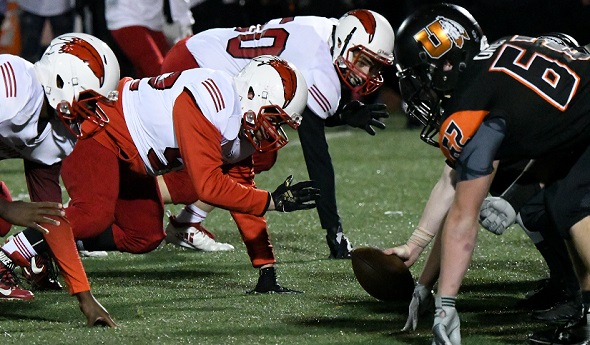
PHOTOS: (Top) Chippewa Valley’s defensive front lines up against Utica during a 49-0 Week 9 win. (Middle) David Ellis (8) follows his blockers into an opening against Utica Eisenhower in a 34-7 first-round playoff victory. (Photos courtesy of the Chippewa Valley athletic department.)
Western's White Enjoys 'Special' Career
By
Tom Markowski
Special for Second Half
May 4, 2016
WALLED LAKE – Seeking a higher level of performance, many high school athletes have channeled their energy to one sport.
Many refer to this concentration as specialization – and Cody White, for one, isn’t buying it.
White, a junior at Walled Lake Western, is a three-sport athlete and he loves every minute of it. He plays basketball during the winter, baseball in the spring and football in the fall. During the summer he competes in AAU basketball, travel baseball, 7-on-7 football games with his Western teammates, and he participates in a few summer football camps.
White has played these same sports all throughout high school. His freshman year he competed in track and field, along with baseball. White hasn’t ruled out returning to track and field, in addition to baseball, as a senior – but this season he’s sticking with just baseball.
It’s a hectic schedule but, again, White wouldn’t have it any other way.
“I couldn’t see myself not competing in those sports,” he said. “I love them so much. I want to finish my senior year playing all three.”
White estimates that he’ll have two days off, away from sports, in June. In July he’ll take a week off, between his summer baseball team schedule ending and the start of football practice.
There’s no question White is driven, but it’s more than that. In some high schools, and with some coaches, playing multiple sports can be a challenge. There are some coaches who would prefer the students to play one sport and only one sport.
According to Western football coach Mike Zdebski, that isn’t the case at his school.
“We encourage them to play more than one sport,” Zdebski said. “For one, we want them to get their money’s worth. We have a pay-to-play policy of $425. You play one sport and it costs $425. You play three sports and it costs the same. And, two, playing other sports helps them develop other skills. In basketball you create space. In baseball you chase fly balls, and that helps with depth perception. Besides you get to work with other coaches and other teams.
“We’re lifting weights during the summer. If a kid is playing summer baseball or AAU basketball, if they have time they can come by and lift weights. And what we always tell them, if you’re tired let us know. You can take a break.”
Zdebski – whose team finished 12-1 last fall – was quick to point out some excellent athletes in the past, like former Kansas City Royals outfielder/Oakland Raiders running back Bo Jackson, who were multiple-sport athletes. And, more recently, there’s Luke Glendenning of the Detroit Red Wings. Glendenning was an all-state running back at East Grand Rapids.
 When his high school career is done, White will play football in college. Two months ago he committed to sign with Michigan State this winter. At 6-foot-3 and 200 pounds, White played receiver, defensive back and also returned kicks last fall. He played a big role in Western’s run to the Division 2 Semifinals.
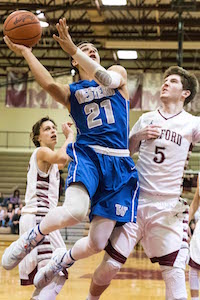
During baseball season, White pitches and plays middle infield and right field. He plays the wing and shooting guard in basketball.
His interest in playing a variety of sports came at an early age and, as is the case with most children, a family member was the one who introduced White to athletics. Former NFL player and Detroit Lions executive Sheldon White is his father, but the first sport White played, at age 3, was baseball. Two years later he began playing football and basketball.
Sheldon White also played three sports at his high school in Dayton, Ohio, (Meadowdale High) and helps his son manage his busy schedule, particularly during the offseason.
“Growing up was a little different (for me) than the usual kid,” Cody White said. “Going to Lions games and just being around football all the time. I think I love the game more because I was around it so much.
“But I think playing three sports helped me, too. The twisting of your hips in baseball, when you swing the bat, you’re using different muscles. And all the jumping you do in basketball. You have to move in tight spaces.
“With football, you’re with the football guys. By doing all three you meet different people.”
Playing multiple sports has definitely been the right road for White to follow. And his busy schedule hasn’t hindered his work in the classroom.
White has a 3.54 grade-point average pending his grades for this semester.
Tom Markowski is a columnist and directs website coverage for the State Champs! Sports Network. He previously covered primarily high school sports for the The Detroit News from 1984-2014, focusing on the Detroit area and contributing to statewide coverage of football and basketball. Contact him at [email protected] with story ideas for Oakland, Macomb and Wayne counties.
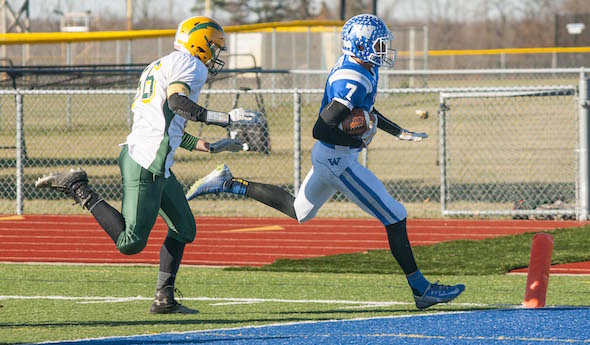
PHOTOS: (Top) Cody White (right) runs away from a Midland Dow defender during their Regional Final this fall. (Middle) White works for a shot against Milford. (Photos by Teresa Presty.)