

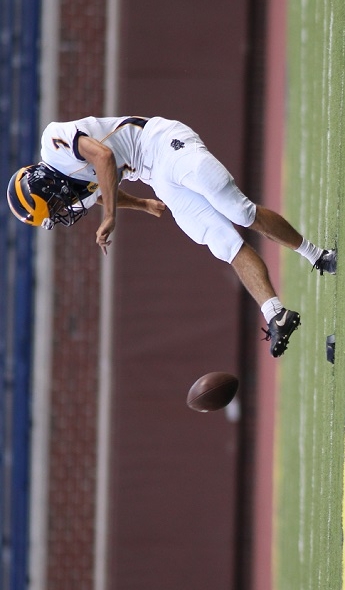
Clarkston Surges by Kicking it Forward
By
Tom Markowski
Special for Second Half
October 27, 2016
CLARKSTON – Coach Kurt Richardson held a disdain for kickers. He didn’t trust them. He contends that a poor kicking game cost his Clarkston football team the 2000 Division 1 Semifinal, a 17-15 loss to eventual champion Grand Ledge.
 Three years before, Clarkston had lost one-point games to Rochester (20-19) and Troy (21-20) that cost the Wolves an opportunity to play in the playoffs. Again, the kicking game had let him down.
“We didn’t have kickers,” Richardson said. “We made kickers. We tried a soccer player once back then, and it didn’t work.”
Enter the Breen brothers, Andrew and Ryan. Andrew Breen was Clarkston’s kicker in 2003. Ryan Breen followed and was the kicker in 2005 and 2006. Maybe it’s a coincidence, but Clarkston hasn’t missed the playoffs since 2002. You won’t get Richardson to say that.
Andrew Breen went on to kick for Tiffin University (Ohio), and every place-kicker since has gone on to college as a kicker – including his brother, Ryan, who went to Penn State.
The others include Alex Barta, who went on to kick for the U.S. Naval Academy. Then there’s Shane Hynes, the place-kicker on the 2013 Division 1 championship team, who is currently Kent State’s place-kicker. Alex Kessman was the place-kicker on the 2014 Division 1 title team, and he’s at Pittsburgh after graduating from high school this past June.
Zach Mansour is Clarkston’s place-kicker this season. And although he hasn’t decided what college he will attend next year, rest assured Mansour will be on a roster somewhere, whether it’s at the Division I level or below.
“Andrew kind of broke up the ice,” Richardson said. “It’s made a big difference. What also comes out of making field goals and having good kickers is now we’re kicking the ball in the end zone and teams are starting from their 20.”
Ryan Breen doesn’t remember exactly when it happened, but his life changed when he was a freshman at Clarkston High.
Breen and his brother were soccer players throughout their childhood. Then his freshman year his brother was a senior and Clarkston’s kicker, and something clicked. Ryan was just having fun working with his brother, shagging footballs, when he got the urge to try it.
Something clicked for the Clarkston football program as well.
“Coach Kurt realized, after a while, that kicking is so much part of the game,” Ryan Breen said. “He started to trust me my junior and senior years. He’d been let down so much (by kickers). It’s frustrating.
“It opened his eyes that (Clarkston’s) kicking game could be so good.”
 Ryan gives credit to his brother for starting what has become a fraternity of kickers at Clarkston. And it continues today with Ryan Breen giving back – or paying it forward, if you will.
Clarkston is a sports-crazed community with football and basketball taking the lead. The fan support these teams receive is as fervent as any in the Detroit area. When an athlete experiences success at a school like this, often that person is motivated to give back. That’s what Breen has done.
“My brother kind of got me into it,” Ryan said. “We were athletes first. My freshman year I’d help him, chasing the footballs after he kicked them. I figured I’d do it for him. I never thought I’d kick. We never thought we’d kick.”
At first, his experience in college led Ryan to go back to Clarkston and share his expertise with the next kicker in line, Barta.
“I got with Alex and his dad,” Ryan said. “I tried to lend the knowledge I had.”
After coaching as a volunteer, Ryan came on staff at the junior varsity level for three seasons. He was there to start this season, but was forced to leave due to the time commitment he had with his business in Oakland County. He’s hoping that soon, perhaps in a year or so, his business will become less demanding and he’ll return to Richardson’s staff.
But he’s left his mark, and others have picked up his lead. Those who have followed, like Mansour, are reaping the benefits.
Mansour handles the place kicking and kickoff duties for Richardson, and he’s 5 of 7 on field goal tries with a long make of 45 yards. A junior, Jermaine Roemer, is the punter and, at this point, it appears he will replace Mansour as the team’s place-kicker next season.
“I was close with Shane (Hynes) and Alex (Kessman),” Mansour said. “I got a ton of knowledge from them. And Shane learned from Barta. I’m close with Jermaine. And Tristan Mattson is on (junior varsity). I’ll be working with him after the season.
“We’ve gotten so good with our kicking. It puts us ahead of other teams. When I worked with Shane and Alex, they were brutally honest. They’ll break you down. They yelled at me. It’s not to hurt your feelings. It’s all for the game.
“Paying it forward? It’s kind of my job. Jermaine and I developed a good relationship. We’ve had that reputation of having good kickers, and we want to keep it that way.”
 Tom Markowski is a columnist and directs website coverage for the State Champs! Sports Network. He previously covered primarily high school sports for the The Detroit News from 1984-2014, focusing on the Detroit area and contributing to statewide coverage of football and basketball. Contact him at [email protected] with story ideas for Oakland, Macomb and Wayne counties.
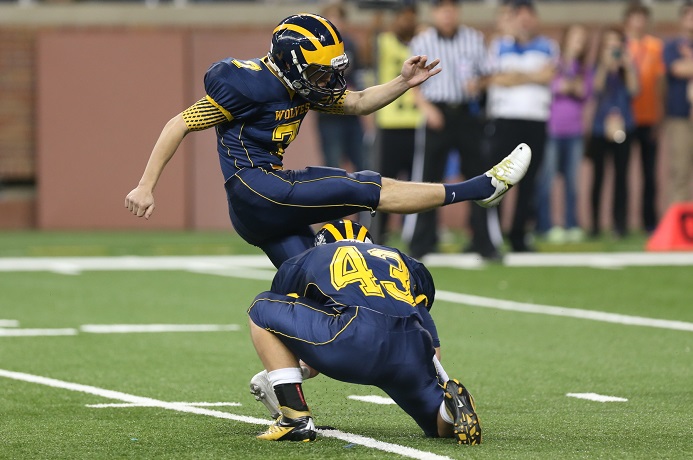
PHOTOS: (Top) Zach Mansour kicks off Clarkston's season against Lapeer on Aug. 26 at Michigan Stadium. (Middle) Shane Hynes follows through on a kick during the 2013 Division 1 Final at Ford Field. (Click to see more of top photo from HighSchoolSportsScene.com.)
1st & Goal: 2025 Playoffs Week 1 Review
By
Geoff Kimmerly
MHSAA.com senior editor
November 4, 2025
The phrase is “survive and advance” for a reason.
 For high school football teams this time of year, the next game always is earned. And that was especially evident as the 51st MHSAA Playoffs began over the weekend.
A total of 32 games – out of 143 total – were decided by seven points of fewer. Nine of those matchups were decided by a single point.
We glance at several of those below as we move on this week to District Finals in 11-player and 8-player Regional championship games.
11-Player Division 1
HEADLINER Brownstown Woodhaven 30, Belleville 29 Marquez McAdoo ran for two touchdowns and Woodhaven (8-2) blocked a late extra-point try to secure the program’s first playoff win since 2021 – and after missing the postseason the last two years. The Tigers’ run ended at 7-3.
🚨 UPSET ALERT! 🚨 Woodhaven stuns Belleville in the Division 1 @MHSAA District Semifinal, 30-29!
Senior Andrew Pridemore came up clutch, blocking the potential game-tying extra point late in the 4th quarter to seal the win. The victory marks Woodhaven’s first playoff win since… pic.twitter.com/pWsyGaxA4v— STATE CHAMPS! Michigan (@statechampsmich) November 1, 2025
District Digest East Kentwood 49, Grand Ledge 15 The Falcons (8-2) earned their first playoff win since 2019, slowing down a Comets attack that had scored 30 or more points seven times in finishing 7-3. Clarkston 52, Davison 14 The Wolves (9-1) opened the playoffs with arguably their most impressive win of a season with several, as Davison (8-2) was averaging nearly 44 points per game the night. Macomb Dakota 6, Utica 3 The Cougars (7-3) bounced back from a 26-17 loss to Utica (7-3) from Week 8.
11-Player Division 2
HEADLINER Traverse City Central 15, Traverse City West 13 Just a week after West won their Patriot Game rivalry game 21-20, these two returned to the same field but with Central (6-4) advancing with its first win over the Titans (5-5) since 2022 – and first playoff victory over any opponent since 2021. Click for more from the Traverse City Record-Eagle.
District Digest Grosse Pointe South 28, Roseville 27 These Macomb Area Conference White rivals met for a second time after South (9-1) won the first 47-25 in Week 5 – and after the Blue Devils also defeated Roseville (4-6) by just a point to open the 2024 playoffs. East Lansing 26, White Lake Lakeland 20 The Trojans (5-5) made the playoffs in part because of an incredible strength of schedule, and they showed they belong in extending their winning streak to four while ending the Eagles’ season at 7-3. Warren Cousino 28, Birmingham Seaholm 7 The Patriots (7-3) – after missing the postseason a year ago – claimed their first playoff win since 2007, ending the Maples’ run at 5-5.
11-Player Division 3
HEADLINER Zeeland West 30, Niles 21 The reigning champion Dux (7-3) sent a wave through the Division 3 bracket, handing Niles (9-1) its only loss of the season as the Vikings also aspired to get back to Ford Field after finishing Division 4 runners-up a year ago. West’s 30 points were the most Niles gave up in a game all fall. Click for more from the South Bend Tribune.
District Digest Middleville Thornapple Kellogg 28, Hastings 20 The Trojans (7-3) earned their first playoff win since 2020 and continued to impress after winning a combined eight games over the last four seasons – and opening this one with a 31-29 loss to Hastings (7-3). Warren De La Salle Collegiate 56, Warren Fitzgerald 34 De La Salle (4-6) was another qualifier that played a powerful schedule this fall, and the Pilots added to it with this win over the MAC Gold champion Spartans (8-2). Gaylord 38, Marquette 34 The Blue Devils’ 10-0 season has included now seven wins by seven points or fewer, and they kept it alive with the go-ahead score during the final minute to get past the Sentinels (6-4).
11-Player Division 4
HEADLINER Big Rapids 32, Ludington 31 Big Rapids opened the playoffs with a win over Ludington for the second-straight postseason, but this time handed the Orioles (9-1) their lone defeat as well – also with a go-ahead touchdown coming during the final minute. The Cardinals (9-1) additionally reached nine wins for the third straight season. Click for more from the Big Rapids Pioneer.
District Digest Portland 42, Grand Rapids South Christian 41 (OT) The Raiders (10-0) hadn’t had a game closer than 24 points all season, but emerged from this first matchup with South Christian since falling to the Sailors (4-6) in a 2023 Semifinal. Madison Heights Lamphere 7, Redford Union 6 Another one-pointer saw Lamphere (7-3) earn its first playoff win since 2022 and set up a rematch with Dearborn Divine Child, which eliminated the Rams a year ago. Impressive sidenote: After allowing 40 in its opener this fall, Union (7-3) gave up only 41 total over its final nine games. Three Rivers 21, Paw Paw 14 Just two weeks prior, Paw Paw (6-4) had defeated Three Rivers (6-4) in league play 43-0. The Wildcats are in the playoffs for the first time since 2022.
11-Player Division 5
HEADLINER Ogemaw Heights 29, Negaunee 28 (OT) The Falcons (9-1) advanced to a District Final for the third-straight season, advancing from their toughest challenge since a Week 2 loss to Traverse City St. Francis. The Miners ended their run at 6-4. Click for more from the Bay City Times.
District Digest Berrien Springs 34, Dowagiac 20 These Lakeland Conference rivals met for a second time for the second season in a row, and this time after sharing the league title. Berrien Springs (7-2) had won the first matchup as well. Dowagiac finished 5-4. Detroit Denby 18, Detroit Southeastern 16 Denby (8-2) ran its winning streak to eight with its first playoff victory since 2020, ending Southeastern’s season at 6-4. Richmond 14, Armada 10 These Blue Water Area Conference rivals met for the second time this season and it was nearly as close as the first, as Richmond (9-1) held on after also claiming the Week 4 matchup 24-17 – and after Armada (6-4) won regular-season and playoff games over the Blue Devils a year ago.
11-Player Division 6
HEADINER Kent City 28, Olivet 22 Kent City added its first playoff victory since 2019 to its first 10-0 start since 2017 as it went on the road to defeat the Eagles (8-2). Olivet’s only losses this season came to teams still undefeated. Click for more from Local Sports Journal.
District Digest Traverse City St. Francis 55, Boyne City 35 The Gladiators (7-2) added a second win this season over Boyne City (6-4) after winning the first 20-13, and with this one earned another rematch this week, against rival Kingsley. Durand 32, Flint Hamady 22 The Railroaders (8-2) will play in a District Final for the first time since 2009, and after missing the playoffs the last two years. Hamady finished 6-4. Napoleon 26, Buchanan 20 The Pirates (7-3) advanced with this win over Lakeland Conference co-champion Buchanan (6-4).
11-Player Division 7
HEADLINER Ithaca 24, Saginaw Valley Lutheran 12 A signature win during Saginaw Valley Lutheran’s historic fall was a 23-22 Week 6 victory over the Yellowjackets as the Chargers (9-1) went on to complete a perfect regular season. But Ithaca (7-3) got its revenge to open its 17th-straight playoff run. Click for more from the Saginaw News.
District Digest McBain 28, Charlevoix 27 The Ramblers (8-2) stopped a 2-point conversion attempt for the win after Charlevoix (8-2) scored with less than a minute to play. Clinton 36, Ottawa Lake Whiteford 20 Clinton (8-2) has lost only once more since falling opening night to Monroe St. Mary Catholic Central, and earned a rematch this week with the Falcons by defeating Whiteford (8-2) in a playoff opener for the second-straight season. Shelby 20, LeRoy Pine River 2 Shelby qualified for the playoffs for the first time since 2013 (not counting COVID-shortened 2020, when nearly all teams made the field), and followed that by winning a playoff game for the first time since reaching the Division 6 Semifinals 12 years ago.
11-Player Division 8
HEADLINER White Pigeon 22, Decatur 20 (OT) White Pigeon’s Week 8 loss to Decatur was its first to the Raiders since 2022, but the Chiefs (8-2) held on in overtime to avenge and earn a District title opportunity against undefeated Hudson this week. Decatur finished 7-3. Click for more from the Sturgis Journal.
District Digest Saginaw Nouvel Catholic Central 34, Saginaw Michigan Lutheran Seminary 28 These rivals met a second time in the playoffs for the second-straight season, but this time Nouvel (8-2) finished the sweep after MLS (6-4) won by a point in their 2024 playoff matchup. Riverview Gabriel Richard 34, Melvindale Academy for Business & Tech 6 Gabriel Richard started this season 1-3 after finishing Division 8 runner-up a year ago, but that early tough competition may have paid off again as the Pioneers (5-5) handed ABT (9-1) the lone defeat of its winningest season all-time. New Lothrop 19, Fowler 14 After a rare playoff miss a year ago, the Hornets (7-3) got off to the right start by getting past an Eagles team (6-4) that made last season’s Semifinals.
8-Player Division 1
HEADLINER Pickford 30, Indian River Inland Lakes 26 Reigning Division 1 runner-up Pickford (8-1) opened these playoffs on the road, but came home with one of the weekend’s most notable wins after handing Inland Lakes (9-1) its only loss this fall. The pair had split Semifinals matchups the last two seasons. Click for more from the Cheboygan Daily Tribune.
Regional Roundup Climax-Scotts 72, Gobles 62 These two produced not only for one of the highest-scoring games this season, but their combined 134 points will rank high on the all-time MHSAA 8-player list. Gobles (7-3) had won their opening-night meeting 54-32, but Climax-Scotts (8-2) has lost only once more. Capac 40, Brown City 38 Capac (8-2) kicked off its first playoffs since 2011 by avenging a 61-22 Week 3 loss to the Green Devils (7-3). Kingston 22, Bay City All Saints 14 Kingston (9-1) navigated its closest win this season to earn a rematch with Capac. All Saints finished 7-3, its defeats by a combined 15 points to teams that are a combined 28-2.
8-Player Division 2
HEADLINER Deckerville 27, Morrice 26 This looked incredible on paper, but might have been even better than advertised as Deckerville emerged from a matchup of teams that both reached championship games a year ago. The reigning Division 1 champion Eagles (9-1) opened a 20-point lead by halftime but had to hold off the Orioles (8-2), last year’s Division 2 runner-up. Click for more from the Huron Daily Tribune.
Regional Roundup Gaylord St. Mary 84, Mio 48 This will also make the all-time single-game scoring list, St. Mary’s 84 points its most since the 2020 playoffs as the Snowbirds moved to 8-2. Mio finished 8-2 as well, its best record since 2019. Lake Linden-Hubbell 50, Powers North Central 28 The Lakes (8-2) made this nearly a repeat of their 52-34 win over the Jets (7-3) in Week 6. North Central’s only other loss this fall came to undefeated Norway. Felch North Dickinson 40, St. Ignace 22 The Nordics (10-0) opened their first playoffs since 2016 by adding to their perfect run, downing the Saints (6-4) to earn a rematch with opening-night opponent Lake Linden-Hubbell – which gave North Dickinson its only single-digit game this fall.
MHSAA.com's weekly “1st & Goal” previews and reviews are powered by MI Student Aid, a division within the Department of Lifelong Education, Advancement, and Potential (MiLEAP). MI Student Aid encourages students to pursue postsecondary education by providing access to student financial resources and information. MI Student Aid administers the state’s scholarship and grant programs that help make college Accessible, Affordable and Attainable for you. Click to connect with MI Student Aid and find more information on Facebook and Twitter @mistudentaid.
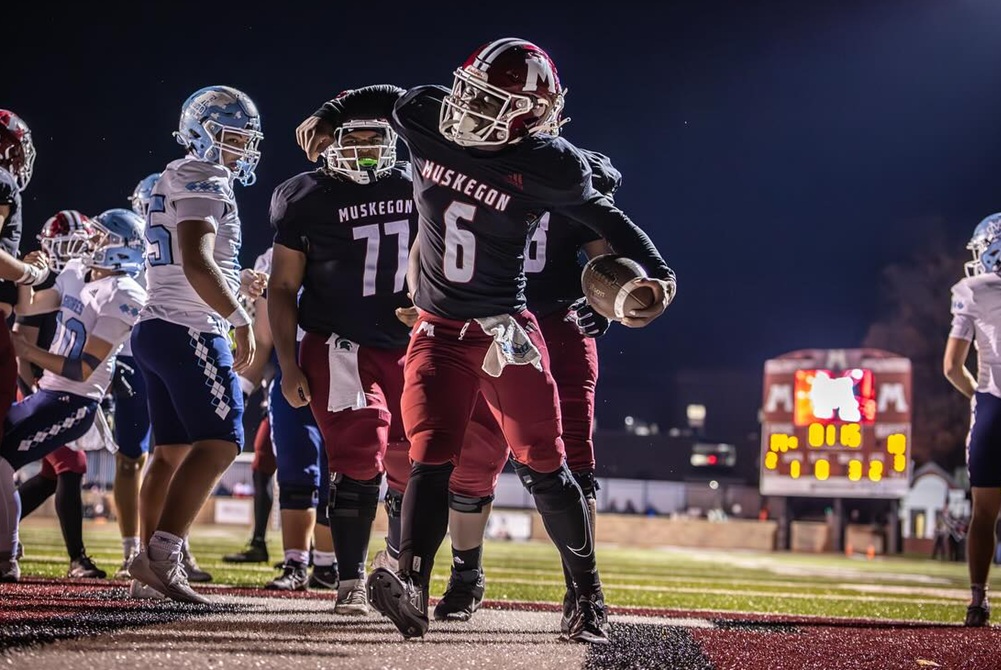
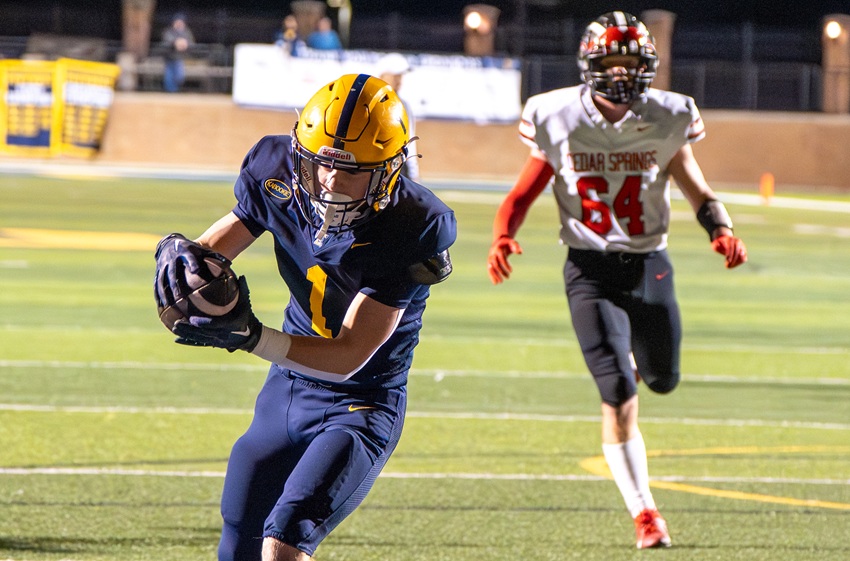
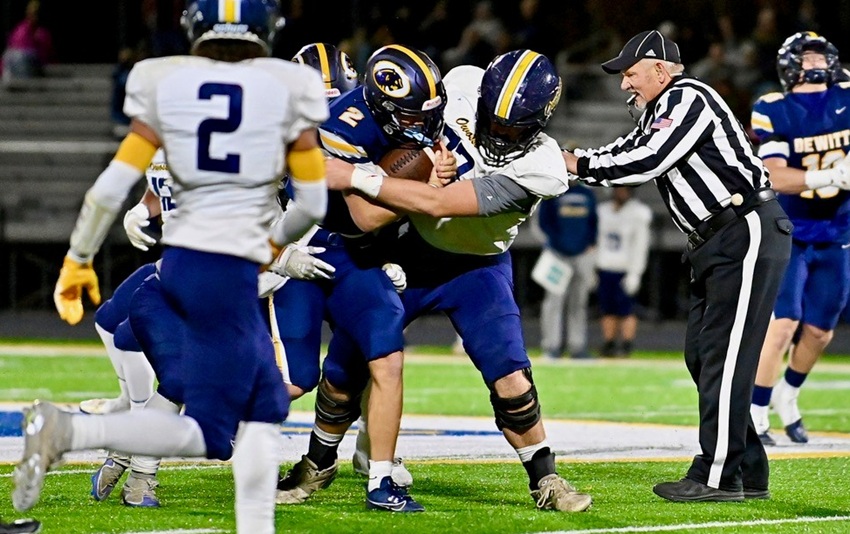
PHOTOS (Top) Muskegon's Lamar Bradford celebrates his touchdown run during the Big Reds' 39-34 win over Mona Shores on Friday. (Middle) East Grand Rapids' Tyler Blake (1) reaches the end zone as a Cedar Springs defender pursues during the Pioneers' 23-21 victory. (Below) An Owosso defender wraps up DeWitt's Trav Moore (2) during the Panthers' 70-13 win. (Muskegon/Mona Shores photo by Tim Reilly. EGR/Cedar Springs photo by Michigan Sports Photo. DeWitt/Owosso photo by Terry Lyons.)