

Clinton Works to Keep Running, Rising
By
Chip Mundy
Special for Second Half
September 22, 2016
By Chip Mundy
Special for Second Half
CLINTON – In 2012, Clinton football coach Scott McNitt had accomplished enough during his 27-year career that he was inducted into the Michigan High School Football Coaches Association Hall of Fame.
 Since then, McNitt, now in his 32nd year, has enjoyed the best on-the-field run of his career.
It doesn't happen often that a Hall of Fame coach reaches new heights after induction, but McNitt is proof it can happen.
Over the last three seasons, Clinton is 49-4 with three consecutive finishes with double-digit wins, two trips to the Division 6 championship game at Ford Field and one 40-game regular-season winning streak – the third longest regular-season winning streak by a Lenawee County football team since Hudson won 81 in a row from 1968-77.
All of that success – and especially the recent attention from the 40-game winning streak – has brought some unwanted credit to McNitt, who preaches the team concept and praises the work of his assistant coaches.
“It's a great accomplishment, but I can't stand hearing, 'McNitt did this,' or 'McNitt did that.' It's just that I have to be on the top line, but I've have tremendous assistants and some very, very good players,” he said.
McNitt has similar feelings about his induction into the Hall of Fame.
“The two biggest accomplishments for me have been the Hall of Fame and Ford Field,” he said. “That's every coach's dream. But this is a team thing, and there are coaches on our staff who work a lot harder than I do, and I get all the accolades.
“But it means a lot to me to stay at the same school for 32 years and outlast it. We had some seasons that weren't good. We had three 1-8 seasons in a row. We've been successful – but surviving for 32 years and keeping it going in the right direction, and I think what we have coming from our youth programs and middle school, it can continue – means a lot to me.”
Key to success
When McNitt interviewed for the Clinton job prior to the 1985 season, he was given some advice that has stuck with him for more than three decades.
“When I first got here 32 years ago, during the interview the superintendent said, 'Surround yourself with good people, and you won't have a problem,'” McNitt said. “So it's been a philosophy to put good people into the program.”
As is common with most high school programs, assistant coaches would come and go throughout the years at Clinton. But over the past eight seasons, Clinton has kept its coaching staff together – even down to junior varsity and middle school – and McNitt believes it’s no coincidence that his greatest run has happened under those circumstances.
“We've had changes over the years, and it is what it is, but this last eight years the staff we have in place now seems to jell together,” he said. “Jeremy Fielder came from Adrian College as a football coach and player. He brought a great philosophy and work ethic and new ideas.
“Our line coach, John Schuler, he was a player here in the 1980s and was on one of the best teams we had here. He's back there teaching and coaching, and he's an outstanding line coach. Joe Gillies and our JV coaches do a great job, and we also have volunteer coaches who are very familiar with the program and give us their time and dedication. We all work really well together.”
But coaches can't coach and have great success without talented players, right?
“Having good players is the other key,” McNitt said. “We've had a phenomenal run of outstanding players, and we saw it coming when they were in youth football in fifth and sixth grade. We watched them in seventh and eighth.
“They were a group of very fast kids with unbelievable speed. We watched them, and it was like, 'Holy Toledo, wait until we get ahold of these kids.'”
A trip to Ford Field – and back
From 1985-2009, Clinton made 12 playoff appearances under McNitt. The 1990 team made it to the Class C Semifinals, but more often than not, the Redskins were one-and-done in the postseason. After losing to rival Manchester in the 2012 Pre-District, Clinton was 7-13 in the playoffs.
Since then, Clinton is 9-3 in the postseason.
“I went to the Silverdome I don't know how many years and Ford Field, and we would sit there and go, 'It would be nice to get there,'” McNitt said. “But we were always in such a tough division, we'd always face Monroe Catholic Central in a District, and we could never get over that.
 “In 2013, we finally got a good draw, and we felt we could make a good run, and we did (finishing runner-up in Division 6). The next year we were even better, but we drew Catholic Central in the second round, and they kind of blew us out.”
That set the stage for last season. But when the playoff pairings were announced, McNitt and his staff faced an overwhelming road to Ford Field. The first assignment: A road game at reigning Division 6 champion Monroe St. Mary Catholic Central.
A 14-10 victory in the Pre-District proved to be the sparkplug that charged the Redskins’ run.
“To go down there and win a close one gave us great confidence,” Schuler said.
Next was Madison Heights Madison, making its 11th consecutive appearance in the playoffs. On the road again, Clinton scored a huge 43-20 victory to earn a home game in the Regional against eight-time MHSAA champion Jackson Lumen Christi.
“To play the Regional Final at home against Jackson Lumen Christi was just a thrill ride,” Schuler said of the 49-20 victory that earned a Semifinal matchup with undefeated Grand Rapids NorthPointe Christian, which was making its fifth consecutive appearance in the playoffs.
Clinton’s 42-20 victory over NorthPointe brought it back to Ford Field for its biggest test of all: Ithaca, which had won four of the previous five Division 6 titles and defeated Clinton 41-22 in the 2013 championship game.
“It was a murderer's row of opponents, and we did not want to play Ithaca,” McNitt said. “We wanted Traverse City St. Francis just for something new.
“We knew Ithaca and who they were, but we were hoping for something different. But we had a chance, we were up 13-0 in the third quarter, and Ithaca took over.”
Ithaca dashed Clinton's title hopes with a 27-20 victory, but the experience Clinton had gained two years earlier resulted in a calming effect.
“Personally, I thought we'd get one shot at Ford Field because normally these small towns get one shot, and it's over with,” McNitt said. “I wasn't sure we would get back. And then last year when we got there, it was just like another game.
“It wasn't as big of a hype as it was the first time, and the community loved it.”
It also added to the momentum that has been building.
“It was a momentum-builder for us, and if we stay as a team, we can make it back there,” senior running back Steve Laurell said. “It's just team effort and coaching for sure. It was a good feeling.”
New challenge
The good news at Clinton is that the Redskins are 4-0 and rolling again. The bad news is that the talented speed group has graduated. The 2016 Redskins lack the flashy skill players from the past but are a senior-orientated team boasting an experienced line.
Any coach will tell you that having an experienced, talented line is a big step toward success.
“We have some interior linemen back, but we're brand new everywhere else,” McNitt said. “We do have some senior players who have waited their turn, and we knew we'd be OK up front because we're big.”
Center Alex McIntosh is a third-year varsity player and is joined by Austin Popp and Josh Brown as key players in the trenches, while the senior backfield of Laurell at tailback and Cordell Hernandez at fullback has been “outstanding,” according to McNitt.
“We just don't have the burners, but we have solid, good players,” he said.
 Clinton has outscored its opponents by a combined 164-65 this season, with its next game tonight against a 2-2 Morenci team. It's easy to look at a matchup of a 4-0 team and a 2-2 team and assume the outcome, but that sort of mentality makes McNitt a little uneasy. The community has embraced the program, and its expectations can sometimes be a little too much too soon.
“It is erupting into a very big animal,” McNitt said. “We have to be careful, and we have to corral it before it gets too out of control. But it's nice for the football program, based on our current success – getting to Ford Field two out of three years – that is where the excitement comes from.
“The community support really has been incredible.”
The season already has had one milestone. Two weeks ago, McNitt reached 200 career victories, becoming the 61st high school football coach in Michigan to reach that number. He also is 12th among active coaches with 201 wins. His overall record is 201-113-1 for a .640 winning percentage.
“I remember when I got my 100th win. Some community supporters and fathers said, ‘That's quite a big deal, but if you get to 200, that puts you in a whole different group.’ It kind of stuck with me, but I never thought I'd get there,” McNitt said, “but the past four or five years did it.”
The future at Clinton
McNitt is very realistic about what lies ahead for Clinton. But he isn't discounting anything, either.
“Can we get back to Ford Field again? The chances are probably no, but we've gone twice in three years, so it's possible,” he said. “We focus on our rival up the road here, Manchester, just seven miles away, and then try to win our league. If you do those two things, you're going to be in the playoffs and then see what happens.”
It is a sensible approach that has worked at Clinton. He has surrounded himself with good assistants and let them do their thing on the field.
“Our assistant coaches do a phenomenal job, and there are times when I just sit back and watch them do their thing,” he said. “I'm very fortunate to have people like that around us.”
Fielder was hired in as defensive coordinator nine years ago, and he recognizes that there were some up-and-down moments along the way.
“To be given that trust was huge because he's a Hall of Famer,” Fielder said. “He hired me, and I had a big role, and there were some growing pains early on. I will always be thankful for him sticking with me once we got the system figured out and once we figured out how we were going to execute.”
The players come to the varsity having learned the system at a younger age, and their coach is a man who was coaching the varsity more than a decade before they were born. And he wins. That commands respect.
“We know that the coach knows what he's doing, and he's going to make the right call at the right time, and we just need to follow what he does,” said McIntosh, the senior center. “We have no question about it. He knows what he's doing.
“I think what it is is that our coaches push us. Through practice, they expect us to do things right, and if we don't get it right the first time, they expect that we won't make the same mistake twice.”
So, the obvious question looms. How much longer does McNitt expect to coach? He didn't dodge the question.
“I could be easily done this year, or I could go another 10 years,” he said. “I want to be able to turn it over to Jeremy Fielder, our really good defensive coach. He has waited, and he is probably going to take it farther than we ever dreamed of.
“Jeremy is a phenomenal football coach.”
Although Fielder likely would be thrilled to someday succeed McNitt, he seems comfortable in his current role, too.
“Times have changed for head coaches, and it is kind of nice to know your role and coach with people you trust and just be able to do your job,” said Fielder, who also is an English teacher at the high school. “When you look at coaching, yes, the head coach is the position and it's the title, but when you get down to the nitty gritty, you're a team within a team.
“If you have an outstanding team and coach with people you respect and admire, you're happy there no matter what your role is.”
 Chip Mundy served as sports editor at the Brooklyn Exponent and Albion Recorder from 1980-86, and then as a reporter and later copy editor at the Jackson Citizen-Patriot from 1986-2011. He also co-authored Michigan Sports Trivia. E-mail him at [email protected] with story ideas for Jackson, Washtenaw, Hillsdale, Lenawee and Monroe counties.
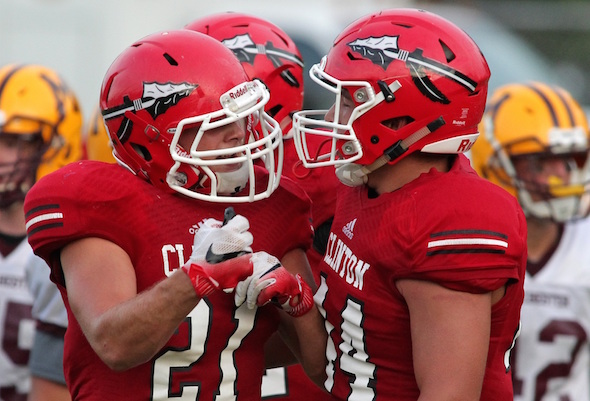
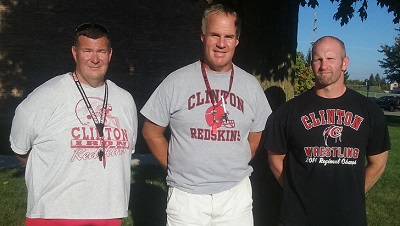
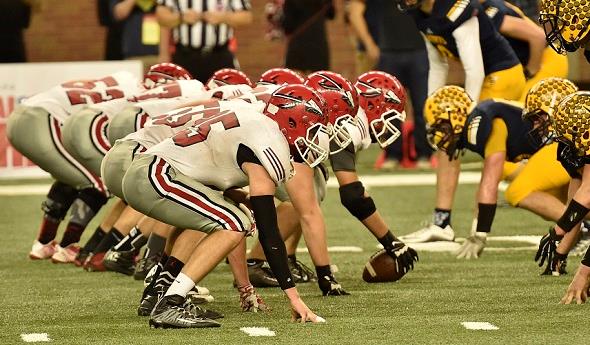
PHOTOS: (Top) Clinton’s Steve Laurell (left) and Cordell Hernandez, shown this season against Manchester, are two of the top returning players from the 2015 Division 6 runner-up. (Middle) From left: Clinton assistant coach John Schuler, head coach Scott McNitt, defensive coordinator Jeremy Fielder. (Below) Clinton also returns multiple contributors from the offensive line that took on Ithaca during last season's Final at Ford Field. (Top photo by John Discher/Adrian Daily Telegram.)
Ford Swaps Frustration for Focus
October 24, 2017
By Tim Robinson
Special for Second Half
Midway through the 2016 season, Marcus Ford was frustrated.
 He was on the Pinckney football team, but not playing much.
A big part of that was due to his size — 6-foot-5 and over 400 pounds — but then-defensive coordinator Rod Beaton sensed there was more.
“We feel that we coach very hard,” said Beaton, now Pinckney’s head coach. “We’re very aggressive (on the varsity), and sometimes it’s an adjustment for juniors to understand that when they come out here, there’s expectations.
“There were a couple times where Marcus was questioning … whether football was for him.”
“I didn’t want to be there,” Ford said. “I thought, ‘This is stupid. Why am I here so late?’”
And then came a change.
“It came to a point where he went home and took a day off to re-gather himself,” Beaton said. “Marcus came back and he said to me, ‘Coach, I really want to be a part of things here.’”
And Ford did more than that.
He grew from a young man who bristled when his coaches pointed out mistakes to one who doesn’t react as if it were a personal attack, from an overweight kid who admits he was on his way to weighing 600 pounds to a big kid who is a key part of Livingston County’s most successful football team as a senior.
He rarely comes out of games, his coach says, and the quiet giant who rarely interacted with his teammates has transformed into a happy, smiling kid who dishes out and takes teasing from them.
It’s a story of transformation that only football could have done for Marcus Ford, who couldn’t play youth football because of his size and whose options for high school athletics seemed limited to football for the same reason.
“I may sound a little clichéd and corny,” Beaton said, “but I think this is why every single coach in America coaches football, to watch the development of a young man, from freshman to sophomore to junior and to see what football has done for him.”
How did Ford do it?
He turned his mental approach 180 degrees and made drastic changes to his diet and work ethic.
One clue came in looking at Pinckney’s roster from 2016 compared to 2017. Last year, Ford was listed at 380, which was about 40 pounds less than his actual weight.
This year, he’s listed at 405, which is a dozen pounds more than what he weighs now.
Last year, he played mostly in mop-up roles.
This year, he is a starter on defense, regularly occupying two blockers at a time, which in turn frees linebackers Cauy Hendee and Levi Collins to make tackles.
“I can play a lot longer,” he said. “I was tired when we were out there, but we don’t believe in the word ‘tired.’ We prefer ‘winded.’ We just need to catch our breath. So I get ‘winded’ a lot less.”
The first thing Marcus decided to change was his diet, and he got his cues by looking in the mirror.
“I didn’t like the muffin cap that was hanging down,” he said. “I didn’t like my stomach hanging over. ... I thought, ‘I don’t what to have a heart attack at age 25.’ I was doing ‘diets,’ per se, but eventually I thought, ‘This is stupid. Cut out pop and eat better,’ And I did.
“The only thing I would eat that was green was green beans, and they had to be made a certain way,” he said. “Now, I’m more like ‘this is somewhat appetizing. Let me try that.’ I don’t eat candy bars anymore. I don’t eat ice cream when my family does. I drink a lot less milk than I used to, and I drink more water.”
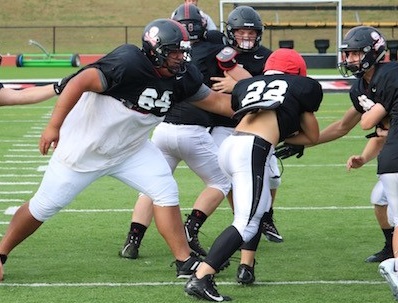 Pinckney offensive coordinator Cody Patton noticed.
“His mom came to me about getting a weight plan, and he stuck with it,” Patton said. “They can only do so much in the weight room. When they leave, there’s not much you can control what they put into their bodies.”
But Ford also changed his mindset about football and being coached.
“His first real commitment was ninth-grade high school football, and it was a big adjustment for him,” Beaton said. “We knew there would be days where he might be a little confrontational, there may be some days where he goes through the motions.”
But after that midseason meeting last year, Ford redoubled his efforts in practice and in the offseason.
The first hint that he was a different player came in June, when Ford earned the team’s first bone helmet sticker of the season for effort in a drill.
“It was our first pursuit drill,” Beaton said. “We go four downs, and those kids have to sprint. There’s no exception. Marcus stepped to his gap, made his reads, flew to the football and didn’t say a word, every single time. He did it four times in a row. It really set the stage. I could tell he was wanting do to things right this year.
“When you see a 6-5, 400-pound kid moving with effort and tenacity, you sit there and go, ‘That young man can help us.’”
And so he has.
As a result, Marcus Ford is part of a Pinckney defense that has lifted the Pirates to an 8-1 regular-season record and shared Southeastern Conference White championship. He has transformed from a player who had little stamina to one who can go from opening kickoff to final horn.
“He can play a whole football game,” Beaton said. “He can go through a whole practice. One of the challenges we were talking about in the offseason is he has to put his body and mind in a position to not come off the field.”
That moment came on a warm night early in the season.
“We were in a huddle at Chelsea, and it was late,” Beaton recalled. “He’s drenched in sweat, and I said, ‘Marcus, you need a breather?’ And he said, ‘No, coach. I’m ready.’ That’s pretty cool.”
Asked his ideal weight, Ford said, “I would like to be at 250 if I could,” then laughs. His bone structure is such that at his height, he would be almost gaunt at 250. “I would settle for 340. That’s the dream within a dream goal.”
Next year, he plans to attend college.
“I want to go into bartending or being a head chef, or get a business degree,” he said. “One other choice is going to a police academy. As long as I can run a mile within 15 minutes, I should be good.”
There’s no reason, now, to think he couldn’t accomplish that.
He got his first sack against Dexter.
‘I grabbed him and rolled him over on top of me,” Marcus said. “I would have liked to have landed on him, but I got him down in the backfield. It’s good.”
And football now is fun.
“A lot more fun,” he said.
“Marcus made a concerted effort to our strength and agility program,” Beaton said. “It wasn’t two days at a time, then not be there five or six days. Marcus was there. He would stay after everyone had left and get some extra lifts in or do some extra work to make sure he was putting himself in a (good) position.
“He said, ‘Coach, I want to be your starting nose (tackle).’ The first day of June camp, he ran out to the nose tackle, and we haven’t looked back.”
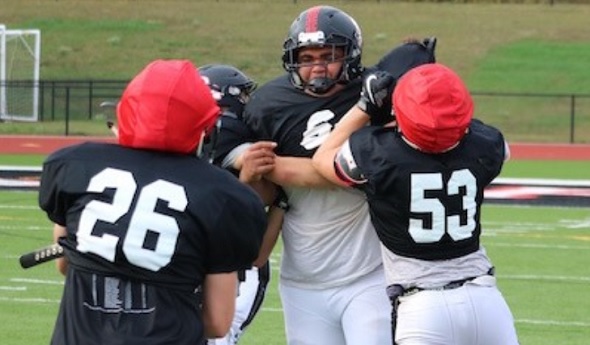
PHOTO: (Top) A pair of Pinckney blockers try to contain nose tackle Marcus Ford during a practice this season. (Middle) Ford breaks free to get an arm on a ball carrier. (Photos by Tim Robinson.)