

Clinton Works to Keep Running, Rising
By
Chip Mundy
Special for Second Half
September 22, 2016
By Chip Mundy
Special for Second Half
CLINTON – In 2012, Clinton football coach Scott McNitt had accomplished enough during his 27-year career that he was inducted into the Michigan High School Football Coaches Association Hall of Fame.
 Since then, McNitt, now in his 32nd year, has enjoyed the best on-the-field run of his career.
It doesn't happen often that a Hall of Fame coach reaches new heights after induction, but McNitt is proof it can happen.
Over the last three seasons, Clinton is 49-4 with three consecutive finishes with double-digit wins, two trips to the Division 6 championship game at Ford Field and one 40-game regular-season winning streak – the third longest regular-season winning streak by a Lenawee County football team since Hudson won 81 in a row from 1968-77.
All of that success – and especially the recent attention from the 40-game winning streak – has brought some unwanted credit to McNitt, who preaches the team concept and praises the work of his assistant coaches.
“It's a great accomplishment, but I can't stand hearing, 'McNitt did this,' or 'McNitt did that.' It's just that I have to be on the top line, but I've have tremendous assistants and some very, very good players,” he said.
McNitt has similar feelings about his induction into the Hall of Fame.
“The two biggest accomplishments for me have been the Hall of Fame and Ford Field,” he said. “That's every coach's dream. But this is a team thing, and there are coaches on our staff who work a lot harder than I do, and I get all the accolades.
“But it means a lot to me to stay at the same school for 32 years and outlast it. We had some seasons that weren't good. We had three 1-8 seasons in a row. We've been successful – but surviving for 32 years and keeping it going in the right direction, and I think what we have coming from our youth programs and middle school, it can continue – means a lot to me.”
Key to success
When McNitt interviewed for the Clinton job prior to the 1985 season, he was given some advice that has stuck with him for more than three decades.
“When I first got here 32 years ago, during the interview the superintendent said, 'Surround yourself with good people, and you won't have a problem,'” McNitt said. “So it's been a philosophy to put good people into the program.”
As is common with most high school programs, assistant coaches would come and go throughout the years at Clinton. But over the past eight seasons, Clinton has kept its coaching staff together – even down to junior varsity and middle school – and McNitt believes it’s no coincidence that his greatest run has happened under those circumstances.
“We've had changes over the years, and it is what it is, but this last eight years the staff we have in place now seems to jell together,” he said. “Jeremy Fielder came from Adrian College as a football coach and player. He brought a great philosophy and work ethic and new ideas.
“Our line coach, John Schuler, he was a player here in the 1980s and was on one of the best teams we had here. He's back there teaching and coaching, and he's an outstanding line coach. Joe Gillies and our JV coaches do a great job, and we also have volunteer coaches who are very familiar with the program and give us their time and dedication. We all work really well together.”
But coaches can't coach and have great success without talented players, right?
“Having good players is the other key,” McNitt said. “We've had a phenomenal run of outstanding players, and we saw it coming when they were in youth football in fifth and sixth grade. We watched them in seventh and eighth.
“They were a group of very fast kids with unbelievable speed. We watched them, and it was like, 'Holy Toledo, wait until we get ahold of these kids.'”
A trip to Ford Field – and back
From 1985-2009, Clinton made 12 playoff appearances under McNitt. The 1990 team made it to the Class C Semifinals, but more often than not, the Redskins were one-and-done in the postseason. After losing to rival Manchester in the 2012 Pre-District, Clinton was 7-13 in the playoffs.
Since then, Clinton is 9-3 in the postseason.
“I went to the Silverdome I don't know how many years and Ford Field, and we would sit there and go, 'It would be nice to get there,'” McNitt said. “But we were always in such a tough division, we'd always face Monroe Catholic Central in a District, and we could never get over that.
 “In 2013, we finally got a good draw, and we felt we could make a good run, and we did (finishing runner-up in Division 6). The next year we were even better, but we drew Catholic Central in the second round, and they kind of blew us out.”
That set the stage for last season. But when the playoff pairings were announced, McNitt and his staff faced an overwhelming road to Ford Field. The first assignment: A road game at reigning Division 6 champion Monroe St. Mary Catholic Central.
A 14-10 victory in the Pre-District proved to be the sparkplug that charged the Redskins’ run.
“To go down there and win a close one gave us great confidence,” Schuler said.
Next was Madison Heights Madison, making its 11th consecutive appearance in the playoffs. On the road again, Clinton scored a huge 43-20 victory to earn a home game in the Regional against eight-time MHSAA champion Jackson Lumen Christi.
“To play the Regional Final at home against Jackson Lumen Christi was just a thrill ride,” Schuler said of the 49-20 victory that earned a Semifinal matchup with undefeated Grand Rapids NorthPointe Christian, which was making its fifth consecutive appearance in the playoffs.
Clinton’s 42-20 victory over NorthPointe brought it back to Ford Field for its biggest test of all: Ithaca, which had won four of the previous five Division 6 titles and defeated Clinton 41-22 in the 2013 championship game.
“It was a murderer's row of opponents, and we did not want to play Ithaca,” McNitt said. “We wanted Traverse City St. Francis just for something new.
“We knew Ithaca and who they were, but we were hoping for something different. But we had a chance, we were up 13-0 in the third quarter, and Ithaca took over.”
Ithaca dashed Clinton's title hopes with a 27-20 victory, but the experience Clinton had gained two years earlier resulted in a calming effect.
“Personally, I thought we'd get one shot at Ford Field because normally these small towns get one shot, and it's over with,” McNitt said. “I wasn't sure we would get back. And then last year when we got there, it was just like another game.
“It wasn't as big of a hype as it was the first time, and the community loved it.”
It also added to the momentum that has been building.
“It was a momentum-builder for us, and if we stay as a team, we can make it back there,” senior running back Steve Laurell said. “It's just team effort and coaching for sure. It was a good feeling.”
New challenge
The good news at Clinton is that the Redskins are 4-0 and rolling again. The bad news is that the talented speed group has graduated. The 2016 Redskins lack the flashy skill players from the past but are a senior-orientated team boasting an experienced line.
Any coach will tell you that having an experienced, talented line is a big step toward success.
“We have some interior linemen back, but we're brand new everywhere else,” McNitt said. “We do have some senior players who have waited their turn, and we knew we'd be OK up front because we're big.”
Center Alex McIntosh is a third-year varsity player and is joined by Austin Popp and Josh Brown as key players in the trenches, while the senior backfield of Laurell at tailback and Cordell Hernandez at fullback has been “outstanding,” according to McNitt.
“We just don't have the burners, but we have solid, good players,” he said.
 Clinton has outscored its opponents by a combined 164-65 this season, with its next game tonight against a 2-2 Morenci team. It's easy to look at a matchup of a 4-0 team and a 2-2 team and assume the outcome, but that sort of mentality makes McNitt a little uneasy. The community has embraced the program, and its expectations can sometimes be a little too much too soon.
“It is erupting into a very big animal,” McNitt said. “We have to be careful, and we have to corral it before it gets too out of control. But it's nice for the football program, based on our current success – getting to Ford Field two out of three years – that is where the excitement comes from.
“The community support really has been incredible.”
The season already has had one milestone. Two weeks ago, McNitt reached 200 career victories, becoming the 61st high school football coach in Michigan to reach that number. He also is 12th among active coaches with 201 wins. His overall record is 201-113-1 for a .640 winning percentage.
“I remember when I got my 100th win. Some community supporters and fathers said, ‘That's quite a big deal, but if you get to 200, that puts you in a whole different group.’ It kind of stuck with me, but I never thought I'd get there,” McNitt said, “but the past four or five years did it.”
The future at Clinton
McNitt is very realistic about what lies ahead for Clinton. But he isn't discounting anything, either.
“Can we get back to Ford Field again? The chances are probably no, but we've gone twice in three years, so it's possible,” he said. “We focus on our rival up the road here, Manchester, just seven miles away, and then try to win our league. If you do those two things, you're going to be in the playoffs and then see what happens.”
It is a sensible approach that has worked at Clinton. He has surrounded himself with good assistants and let them do their thing on the field.
“Our assistant coaches do a phenomenal job, and there are times when I just sit back and watch them do their thing,” he said. “I'm very fortunate to have people like that around us.”
Fielder was hired in as defensive coordinator nine years ago, and he recognizes that there were some up-and-down moments along the way.
“To be given that trust was huge because he's a Hall of Famer,” Fielder said. “He hired me, and I had a big role, and there were some growing pains early on. I will always be thankful for him sticking with me once we got the system figured out and once we figured out how we were going to execute.”
The players come to the varsity having learned the system at a younger age, and their coach is a man who was coaching the varsity more than a decade before they were born. And he wins. That commands respect.
“We know that the coach knows what he's doing, and he's going to make the right call at the right time, and we just need to follow what he does,” said McIntosh, the senior center. “We have no question about it. He knows what he's doing.
“I think what it is is that our coaches push us. Through practice, they expect us to do things right, and if we don't get it right the first time, they expect that we won't make the same mistake twice.”
So, the obvious question looms. How much longer does McNitt expect to coach? He didn't dodge the question.
“I could be easily done this year, or I could go another 10 years,” he said. “I want to be able to turn it over to Jeremy Fielder, our really good defensive coach. He has waited, and he is probably going to take it farther than we ever dreamed of.
“Jeremy is a phenomenal football coach.”
Although Fielder likely would be thrilled to someday succeed McNitt, he seems comfortable in his current role, too.
“Times have changed for head coaches, and it is kind of nice to know your role and coach with people you trust and just be able to do your job,” said Fielder, who also is an English teacher at the high school. “When you look at coaching, yes, the head coach is the position and it's the title, but when you get down to the nitty gritty, you're a team within a team.
“If you have an outstanding team and coach with people you respect and admire, you're happy there no matter what your role is.”
 Chip Mundy served as sports editor at the Brooklyn Exponent and Albion Recorder from 1980-86, and then as a reporter and later copy editor at the Jackson Citizen-Patriot from 1986-2011. He also co-authored Michigan Sports Trivia. E-mail him at [email protected] with story ideas for Jackson, Washtenaw, Hillsdale, Lenawee and Monroe counties.
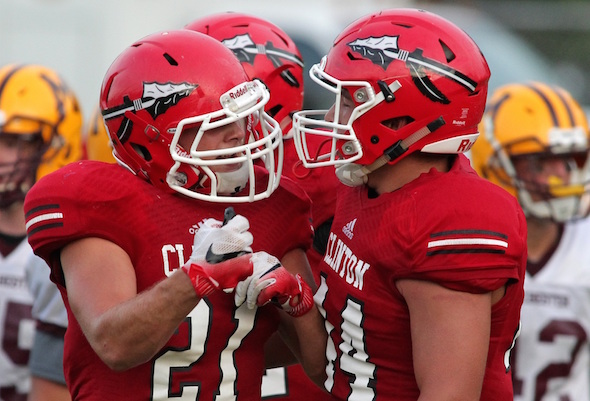
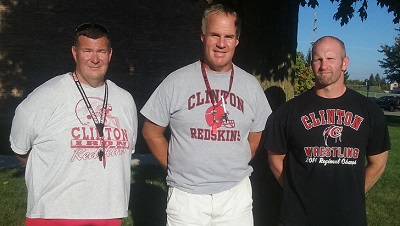
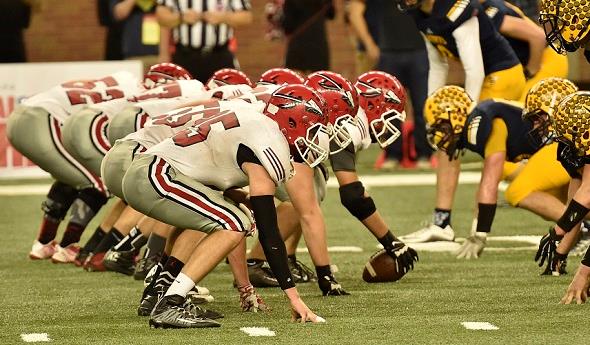
PHOTOS: (Top) Clinton’s Steve Laurell (left) and Cordell Hernandez, shown this season against Manchester, are two of the top returning players from the 2015 Division 6 runner-up. (Middle) From left: Clinton assistant coach John Schuler, head coach Scott McNitt, defensive coordinator Jeremy Fielder. (Below) Clinton also returns multiple contributors from the offensive line that took on Ithaca during last season's Final at Ford Field. (Top photo by John Discher/Adrian Daily Telegram.)

2 Quarterbacks Vault Muskegon to #1
November 1, 2016
By Tom Kendra
Special for Second Half
Stopping the Muskegon High School offense has never been easy.
 This year, it’s twice as tough.
The Big Reds, 9-1 and ranked No. 1 in the season-ending Associated Press Division 3 poll, are attacking opponents with a two-headed monster at quarterback – diminutive senior Kalil Pimpleton (5-7, 160) and physically imposing junior La’darius Jefferson (6-2, 210).
“I’m blessed with two great men, two great leaders, at quarterback,” said seventh-year Muskegon head coach Shane Fairfield, whose team won the Ottawa-Kent Conference Black title. “Using both of them makes us a better team. We don’t go into games with a specific plan for when each will play (quarterback). We see what the defense is doing and how our kids are responding and go from there.”
The result of the dual QB attack has been a Muskegon offense which is averaging 54 points and 428 total yards per game heading into Friday night’s Division 3 District championship game against visiting East Grand Rapids (8-2).
Pimpleton, who has run a 4.4 in the 40-yard dash and has verbally committed to Virginia Tech, has started all 10 games for the Big Reds.
He is primarily a running threat, regularly taking snaps out of the pistol formation from senior center Devin Sanders and then finding a seam somewhere along the line to squeeze through. “KP,” as he’s known, has carried 101 times for 1,081 yards and 17 rushing touchdowns. He also has been effective through the air, completing 34 of 66 passes for 639 yards and six more TDs.
“I look at the system we use as a chance for me to use all of my weapons,” said Pimpleton, who also has three punt returns for touchdowns on his resume. “It doesn’t matter if I am at QB or in the slot. My character doesn’t change, and my focus doesn’t change.”
As good as Pimpleton has been, there have been times in recent years where opponents have bottled up Muskegon’s running quarterbacks.
One example was the 2014 Division 3 championship game at Ford Field, where Orchard Lake St. Mary’s shut down the Big Reds in a 7-0 victory. Another was last year’s Division 2 Regional championship game at Lowell, where Pimpleton and the Muskegon attack got stuck in the mud in a 36-7 loss.
 If that same scenario begins to unfold this fall, Muskegon offensive coordinator Brent White has a Plan B.
And what a Plan B it is.
Jefferson, who has the look of Cam Newton and the big arm to match, presents a whole new set of challenges for opposing defenses when he enters the game, which is normally around the Big Reds’ third offensive series. Jefferson brings a deep vertical passing threat, mixed with the size and strength to run over linebackers.
“I always tell myself that I can’t be stopped – that’s the mentality I like to play with,” said Jefferson, who also has delivered some big hits this fall during limited playing time at outside linebacker. “I just want to thank my coaches for using a two-QB system. Now we’ve got two hungry guys trying to win a state title.”
The benefits of Muskegon’s dual quarterback offense were apparent in last week’s 63-14 Division 3 Pre-District victory over visiting Grand Rapids Forest Hills Northern.
Muskegon’s offense struggled briefly in the early going before Jefferson ignited the Big Reds and their crowd with a 56-yard TD pass to Pimpleton, who had moved out to slot receiver. Near the end of the first quarter, Jefferson scored on a 2-yard run.
In the second quarter, it was back to Pimpleton at QB and he led a scoring drive, ultimately sprinting in from five yards out. And then it was back to Jefferson, who hit standout senior wide receiver Jacorey Sullivan on a 44-yard bomb over the top to complete Muskegon’s first-half scoring.
“The idea is that we have a system and our kids know how to play with either quarterback,” explained Fairfield. “If we do it right, it puts much more pressure on the defense, not knowing what they are going to get.”
Jefferson finished the win over Forest Hills Northern 7 of 8 passing for 175 yards and three touchdowns, along with 11 rushes for 91 yards and two more touchdowns. For the season, Jefferson has completed 42 of 69 passes for 724 yards and 15 touchdowns, against just two interceptions. He has rushed 66 times for 534 yards and 10 TDs.
The two quarterbacks are by far Muskegon’s top two rushers in an offense that lines up with four receivers on most downs. The lone starter in the backfield is senior Division I linebacker prospect Andrew Ward (6-1, 210), who is a devastating lead blocker. In recent weeks, the Big Reds have started to hurt opponents with jet sweeps featuring speedy juniors Da’vion McCall, Clinton Jefferson and Lonnie Clark Jr.
Fairfield, whose team has ripped off eight straight wins after a Week 2 loss to pass-happy Lincolnshire (Ill.) Stevenson, has guided Muskegon to MHSAA Finals three times in his first six years as head coach. The Big Reds have failed to take that final step on each of those occasions, falling to Birmingham Brother Rice in 2012 and 2013 and Orchard Lake St. Mary’s in 2014.
Given that recent heartbreak, the Big Reds have made it clear since Day 1 that the only acceptable outcome this season is an MHSAA title. The next challenge is a dandy matchup in Friday’s District championship game between two of the top tradition-rich programs in Michigan high school football history.
Muskegon is the state’s winningest with 816 wins and 17 state titles, including five in the MHSAA playoff era. East Grand Rapids, meanwhile, has won 11 championships since the playoffs began in 1975, including five in a row from 2006 to 2010. The Pioneers have won seven straight this fall after stumbling to a 1-2 start.
The two powers have played only two times in history, with Muskegon winning both times.
“We need to come out and play our game,” said Pimpleton. “We believe in our coaches and that they will put us in the best spots to win. That’s really all that matters. We can’t lose sight that no matter who is out there, that is our one goal.”
 Tom Kendra worked 23 years at The Muskegon Chronicle, including five as assistant sports editor and the final six as sports editor through 2011. E-mail him at [email protected] with story ideas for Muskegon, Oceana, Mason, Lake, Oceola, Mecosta and Newaygo counties.
PHOTOS: (Top) Muskegon quarterback La'darius Jefferson picks up yards on the ground this season against Byron Center. (Middle) Kalil Pimpleton, here following through on a pass, also is a threat to run. (Jefferson photo courtesy of Muskegon football program, Pimpleton photo by Tim Reilly.)