


Committees Fail Critical Issues
June 7, 2013
Typically, each sport committee meets once each year for three to five hours, during which time it considers proposals that come from schools, leagues and the state’s coaches association for the sport; and the proposals most often deal with allowing more regular-season events and more qualifiers to the MHSAA postseason tournament.
Occasionally there is a proposal that might improve sportsmanship. But much more often the proposals would increase conflicts between academics and athletics and/or strain overstressed local budgets. And almost never is there a proposal that would address the health and safety of participants (the Wrestling Committee has been an occasional exception and the Competitive Cheer Committee is a routine exception).
While coaches associations must shoulder some of the blame because they’ve brought MHSAA committees “trivial” topics, at least in comparison to the tougher health and safety topics, much of the cause of MHSAA committee ineffectiveness is that the committees don’t meet long enough or often enough to research serious problems and develop well-thought-out solutions. That is forgivable because it is difficult to get commitments from busy people all across Michigan to be absent from their regular jobs and travel dozens or even hundreds of miles, and to do so multiple times each year – which is what it takes to more fully understand complex problems and more carefully construct solutions. Meetings have to be few and they have to be efficient.
However, facing the worst publicity football has seen since the mid-1970s, we knew we had to supplement the football committee process. We did so by appointing a special Football Task Force of optimum size and experienced, representative makeup to meet on however many occasions are necessary during 2013 to accomplish three purposes:
- Review practice policies to improve acclimatization of players and reduce head trauma.
- Review competition rules to reduce head trauma and the frequency of the sport’s most injurious game situations.
- Develop promotions that extol the value of football to students, schools and communities and the safety record of school-based football.
The promotional efforts have begun to be rolled out; game rule modifications are being investigated; and four proposals for changing football practice policies have been prepared. They will be the topic of our next posting.
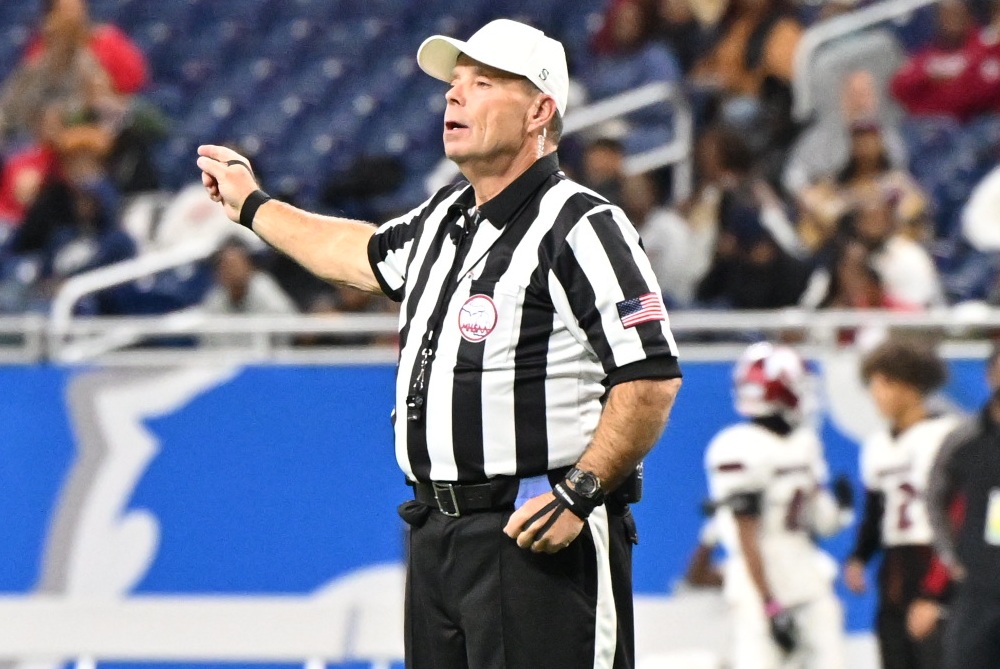
Be the Referee: Defensive Holding
By
Paige Winne
MHSAA Director of Brand Management
October 6, 2026
Be The Referee is a series of short messages designed to help educate people on the rules of different sports, to help them better understand the art of officiating, and to recruit officials.
Below is this week's segment – Defensive Holding - Listen
Team A has the ball on their own 20-yard line and its 4th-and-15. They decide to go for it. The quarterback drops back to pass and is sacked at his 15-yard line, a five-yard loss.
But during the play, Team B – the defense – is flagged for holding an eligible wide receiver.
How is the penalty administered?
- Is it 4th-and-5 from Team A’s 30?
- Is it 4th-and-10 from Team A’s 25?
- Is it 1st-and-10 from Team A’s 30?
- Or is it 1st-and-10 from Team A’s 25?
If you said it is 4th-and-5 from Team A’s 30 – you are correct.
Defensive holding is a 10-yard penalty from the previous spot – which was the 20-yard line. Team A now has possession at the 30, needing to get to the 35 for first down.
Previous 2026-27 editions
Sept. 29: Minimum Number of Volleyball Players - Listen
Sept 22: Soccer Changes - Listen
Sept: 15: Dead Ball Penalty - Listen
Sept. 8: Libero Ejected - Listen
Sept. 1: Soccer Foul After Shot on Goal - Listen
Aug. 25: Fumble Out of Bounds - Listen