


Committees Fail Critical Issues
June 7, 2013
Typically, each sport committee meets once each year for three to five hours, during which time it considers proposals that come from schools, leagues and the state’s coaches association for the sport; and the proposals most often deal with allowing more regular-season events and more qualifiers to the MHSAA postseason tournament.
Occasionally there is a proposal that might improve sportsmanship. But much more often the proposals would increase conflicts between academics and athletics and/or strain overstressed local budgets. And almost never is there a proposal that would address the health and safety of participants (the Wrestling Committee has been an occasional exception and the Competitive Cheer Committee is a routine exception).
While coaches associations must shoulder some of the blame because they’ve brought MHSAA committees “trivial” topics, at least in comparison to the tougher health and safety topics, much of the cause of MHSAA committee ineffectiveness is that the committees don’t meet long enough or often enough to research serious problems and develop well-thought-out solutions. That is forgivable because it is difficult to get commitments from busy people all across Michigan to be absent from their regular jobs and travel dozens or even hundreds of miles, and to do so multiple times each year – which is what it takes to more fully understand complex problems and more carefully construct solutions. Meetings have to be few and they have to be efficient.
However, facing the worst publicity football has seen since the mid-1970s, we knew we had to supplement the football committee process. We did so by appointing a special Football Task Force of optimum size and experienced, representative makeup to meet on however many occasions are necessary during 2013 to accomplish three purposes:
- Review practice policies to improve acclimatization of players and reduce head trauma.
- Review competition rules to reduce head trauma and the frequency of the sport’s most injurious game situations.
- Develop promotions that extol the value of football to students, schools and communities and the safety record of school-based football.
The promotional efforts have begun to be rolled out; game rule modifications are being investigated; and four proposals for changing football practice policies have been prepared. They will be the topic of our next posting.
Undefeated Mancelona Earns League Title, Playoff Possibilities
By
Tom Spencer
Special for MHSAA.com
October 8, 2021
Dan Derrer knows the highs and lows of coaching high school sports.
 He’s been at the helm of the Mancelona football team for 16 years. During that span, the Ironmen had back-to-back undefeated seasons, a few with a handful of wins, and a winless 2017 campaign.
Now, the Ironmen are 5-0 for the first time since 2012 and facing the biggest game of their season.
Tonight they’re hosting conference rival Boyne City, also undefeated in the Northern Michigan Football League Leaders division. A win puts Mancelona in the driver seat with a trip to Charlevoix and a hosting of Glen Lake left to round out the regular season.
A potential conference title, postseason qualification and a drive toward a state championship have been on the team’s list of goals since the summer. The Ironmen are coming off a 3-5 2020 finish.
“I’ve had some really, really good teams,” Derrer said. “I’ve had some teams that weren’t as talented and didn’t win as much.
“Every season is different … you never know.”
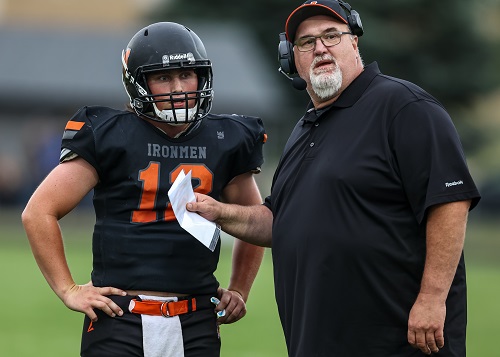 Winning and losing seasons, Derrer said the Ironmen always have given it their all.
“We’ve always taken the approach one game at a time, one practice at a time and try to get better every day,” he said. “Those years when you don’t win a lot takes a toll on the kids and the coaching staff.
“When the kids go out and play hard and they give you all they got, that is really all you can ask for,” he continued. “It’s definitely fun when you win — even those other teams – they gave you everything they had, and that’s all you can ask for.”
The Ironmen kept unbeaten this year with a 14-8 win in their last outing over Kalkaska. Jason Naumcheff connected with Oumar Sy on the game’s final play to earn the victory.
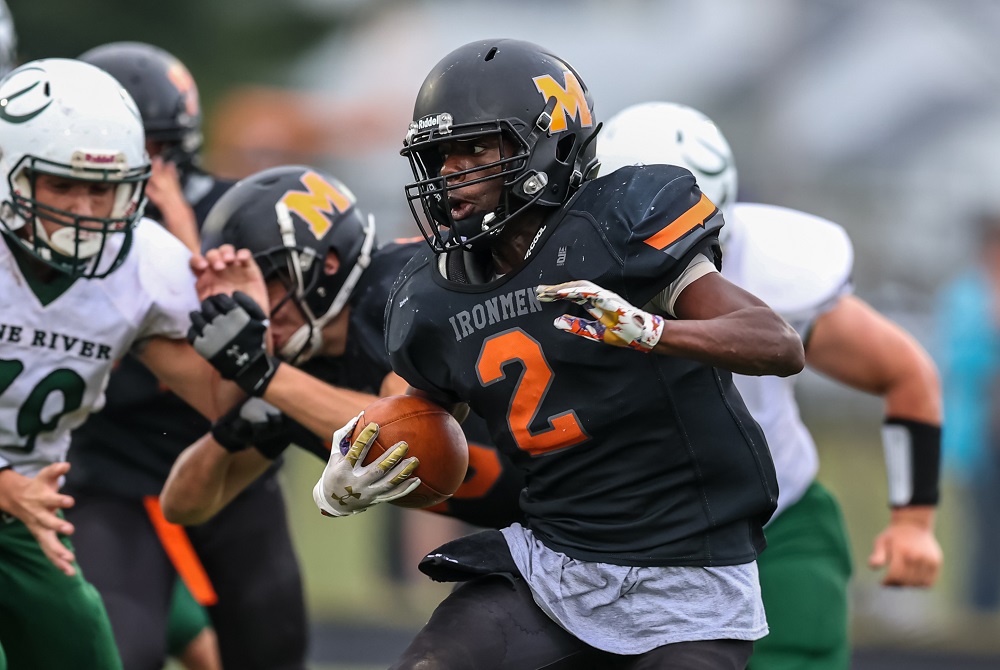
Seniors Justin and Adam Ackler and Mason Crandall have put together a handful off multi-touchdown games this year to lead the Ironmen. Naumcheff, a junior quarterback, is throwing regularly for touchdowns. The Ackler brothers, Naumcheff and Crandall also average around double-digit tackles per game to lead the stingy defense.
The Ironmen are bolstered by retuning linemen Jake Watson, Jason Kihn, Kacy Pinney, Trace Miller, Kaleb Myszak and Justin Johnston and starting defenders Aaron Anderson and Landon McCorry.
“We were pretty excited about what we had coming back, and these guys work hard,” Derrer said. “So far, so good.”
The Ironmen also are coming off a bye week. The break was expected to help the team get through injuries and better prepare for the big game with Boyne.
“We’ve been banged up,” Derrer acknowledged. “We’re trying to get guys healthy so hopefully we can be at full strength going into the Boyne game.”
Improved line play has helped the Ironmen this fall, Derrer points out. It has followed the addition of assistant coach Ralph Munger. He’s been focused on the trenches. Munger’s arrival follows Taylor Borst stepping in as the defensive backs and strength and conditioning coach in 2018.
Munger, one of the most successful high school football coaches in Michigan history, retired after the 2019 season with 335 victories at Rockford and Frankenmuth and three Division 1 championships with the Rams. His Rockford and Frankenmuth teams produced six undefeated regular seasons.
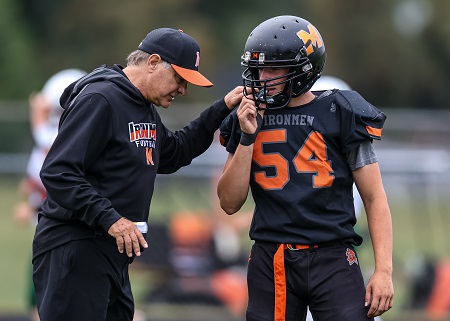 Borst and Derrer met Munger as the 2020 season started. They hit it off right away. Munger represents another one of the highs in Derrer’s coaching career.
“He’s a very knowledgeable guy, and he’s awesome to have around,” Derrer said. “He’s been a huge help to us.
“He’s done a great job working with our lines,” Derrer continued. “It’s been unbelievable – we’re very fortunate.”
The Mancelona coaching staff chose to end a practice early in August to go to Rockford. They all attended a rededication ceremony of the Rockford football stadium. The stadium’s name was officially changed in January from the Ted Carlson Memorial Stadium to the Carlson-Munger Stadium to honor two men whose contributions exemplify "Ram Pride."
Today Munger is grateful he’s had a chance to work the Mancelona student-athletes. They’re in the midst of playoff contention and a battle for a conference championship.
They’ll enjoy hometown support too.
“Two of our last three (games) are at home, and they’re all going to be big games,” Derrer said. “All those games are going to be critical for conference and playoffs.
“We’ll have our hands full, but hopefully we’re up for the challenge.”
 Tom Spencer is a longtime MHSAA-registered basketball and soccer official, and former softball and baseball official, and he also has coached in the northern Lower Peninsula area. He previously has written for the Saginaw News, Bay County Sports Page and Midland Daily News. He can be reached at [email protected] with story ideas for Manistee, Wexford, Missaukee, Roscommon, Ogemaw, Iosco, Alcona, Oscoda, Crawford, Kalkaska, Grand Traverse, Benzie, Leelanau, Antrim, Otsego, Montmorency, Alpena, Presque Isle, Cheboygan, Charlevoix and Emmet counties.
PHOTOS: (Top) Mancelona’s Adam Ackler (2) carries the ball during an opening-day win over LeRoy Pine River. (Middle) Ironmen coach Dan Derrer consults with quarterback Jason Naumcheff (12). (Below) Longtime Rockford coach Ralph Munger, here with Jason Kihn (54), joined the Mancelona staff this fall. (Photos by Miles Postema.)