


Committees Fail Critical Issues
June 7, 2013
Typically, each sport committee meets once each year for three to five hours, during which time it considers proposals that come from schools, leagues and the state’s coaches association for the sport; and the proposals most often deal with allowing more regular-season events and more qualifiers to the MHSAA postseason tournament.
Occasionally there is a proposal that might improve sportsmanship. But much more often the proposals would increase conflicts between academics and athletics and/or strain overstressed local budgets. And almost never is there a proposal that would address the health and safety of participants (the Wrestling Committee has been an occasional exception and the Competitive Cheer Committee is a routine exception).
While coaches associations must shoulder some of the blame because they’ve brought MHSAA committees “trivial” topics, at least in comparison to the tougher health and safety topics, much of the cause of MHSAA committee ineffectiveness is that the committees don’t meet long enough or often enough to research serious problems and develop well-thought-out solutions. That is forgivable because it is difficult to get commitments from busy people all across Michigan to be absent from their regular jobs and travel dozens or even hundreds of miles, and to do so multiple times each year – which is what it takes to more fully understand complex problems and more carefully construct solutions. Meetings have to be few and they have to be efficient.
However, facing the worst publicity football has seen since the mid-1970s, we knew we had to supplement the football committee process. We did so by appointing a special Football Task Force of optimum size and experienced, representative makeup to meet on however many occasions are necessary during 2013 to accomplish three purposes:
- Review practice policies to improve acclimatization of players and reduce head trauma.
- Review competition rules to reduce head trauma and the frequency of the sport’s most injurious game situations.
- Develop promotions that extol the value of football to students, schools and communities and the safety record of school-based football.
The promotional efforts have begun to be rolled out; game rule modifications are being investigated; and four proposals for changing football practice policies have been prepared. They will be the topic of our next posting.
1st & Goal: Playoff Week 4 in Review
January 10, 2021
By Geoff Kimmerly
Second Half editor
Every chance to compete is an opportunity to accomplish something never achieved before.
The return of MHSAA football Saturday loudly reminded us how much we’ve been missing those moments.
Among four 8-Player Semifinals winners, one earned the championship game trip for the first time and two more will get another chance at claiming a first title. Stories were unfolding as well all over the 11-Player Regional Finals as the sun seemed to shine extra brightly on teams playing the first January football games in Michigan high school history.
Below is a glance at all of those games, with highlights from those that especially jumped off the page. Keep up-to-date by visiting the MHSAA Football Playoff Home and watch many of this weekend’s games on demand on MHSAA.tv.
8-Player
Division 1
SEMIFINAL Adrian Lenawee Christian 47, Martin 12 The Cougars (10-0) will play for a championship for the first time after yet another big win – Lenawee Christian’s average margin of victory this season is 50 points. Martin (8-2), which was making its first Semifinal appearance since 1987, is a combined 18-3 over two seasons of 8-player. Click for more from the Adrian Daily Telegram.
VIDEO: Check out the highlights of the Martin vs. Adrian Lenawee Christian (@LCSCougars) | Division 1 8-Player Semifinal from this afternoon.
📽?@AdrianCollegeTV#StateChamps X @MHSAA pic.twitter.com/FUB7Wq0wsg— STATE CHAMPS! Michigan (@statechampsmich) January 10, 2021
SEMIFINAL Suttons Bay 1, Indian River Inland Lakes 0 The reigning Division 1 runner-up Norseman advanced to the championship game due to an Inland Lakes forfeit.
Division 2
SEMIFINAL Powers North Central 50, Marion 2 The Jets (10-0) launched to a 36-0 first-quarter lead to get back to the championship round for the first time since 2016. North Central has given up only 24 points total over four playoff games. Marion finished its winningest season since 1992 at 8-2. Click for more from the Iron Mountain Daily News.
VIDEO: Check out the highlights of the Marion vs. Powers North Central | 8-Player Division 2 @MHSAA Football Semifinal from Saturday.
📽?WJMN-TV#StateChamps X @hungryhowies pic.twitter.com/9cQFWvuaR5— STATE CHAMPS! Michigan (@statechampsmich) January 10, 2021
SEMIFINAL Portland St. Patrick 34, Kinde North Huron 12 The Shamrocks (10-0) will play in the championship round for the third time in four seasons and second straight. This was the third time in those four seasons these two met in the playoffs. North Huron finished 8-1, its best since 2017. Click for more from the Lansing State Journal.
>VIDEO: Check out the highlights of the Kinde-North Huron at Portland St. Patrick (@PortlandStPats) 8-Player Division 2 @MHSAA Football Semifinal from Saturday.#StateChamps X @MHSAA pic.twitter.com/lT89gOiNda
— STATE CHAMPS! Michigan (@statechampsmich) January 11, 2021
11-Player
Division 1
HEADLINER Davison 20, Detroit Catholic Central 7 Davison quarterback Brendan Sullivan (now at Northwestern) is one of the most high-profile seniors who has moved on to college football, and it’s fair to say most expected that to be an additional boost for Detroit Catholic Central (9-1). But the reigning Division 1 champion Cardinals (10-0) instead enjoyed an incredible breakout performance by new quarterback Dion Brown Jr. plus a defensive effort that held the Shamrocks 22 points below their season average. Click for more from the Flint Journal.
VIDEO: Check out the highlights of the Davison (@DavCardFootball) vs. Detroit Catholic Central | Division 1 @MHSAA Football Regional Final from this afternoon. @davisonwc @DavisonMade #StateChamps | @DMC_Rehab pic.twitter.com/jbzqxU57wl
— STATE CHAMPS! Michigan (@statechampsmich) January 10, 2021
Regional Roundup Belleville 43, Detroit Cass Tech 16 This was arguably the most high-profile Division 1 game heading into the weekend, and the Tigers (10-0) put up their most impressive victory of what’s now a fourth-straight double-digit win season, holding Cass Tech (9-1) to 25 points below its average. Rockford 40, Saline 17 The Rams (8-0) are headed to the Semifinals for the first time since 2012 after locking up a Saline offense that averaged 40 points per game during an 8-1 start. West Bloomfield 52, Romeo 14 The Lakers (9-1) clinched their first Regional title since 2017 with a third-straight scoring output of 50 points or more thanks in part to four Donovan Edwards touchdowns. Romeo (5-5) still has much to celebrate after entering the postseason 2-4.
Division 2
HEADLINER Muskegon Mona Shores 24, East Lansing 21 The reigning Division 2 champion Sailors (10-0) advanced by connecting on a 25-yard field goal as time expired. The Regional championship was Shores’ third straight. East Lansing (9-1) meanwhile came back to tie in the fourth quarter before falling short; the Trojans also had come up just three points short in its most recent previous Regional run in 2017. Click for more from the Muskegon Chronicle.
VIDEO: Check out the highlights of the Muskegon Mona Shores (@MSSailorFball) at East Lansing football game from Saturday. #StateChamps X @DACathlete pic.twitter.com/NUKKHepeyQ
— STATE CHAMPS! Michigan (@statechampsmich) January 10, 2021
Regional Roundup Oak Park 30, Livonia Churchill 23 The long break didn’t derail Oak Park’s dream postseason, as the Knights improved to 5-5 after entering the postseason 1-5 with only a forfeit win. Churchill (6-3) reached the Regional Finals for the second-straight season. Traverse City Central 50, North Farmington 22 The Trojans (9-1) are headed to the Semifinals for the first time since 1988, which came before the old Traverse City High split into Central and West. North Farmington (7-3) saw the end of its deepest tournament run since 1978. Warren De La Salle Collegiate 45, Warren Mott 3 The Pilots (6-4) entered the playoffs 2-4 and have outscored its four postseason opponents on average 44-6. Mott (8-2) can celebrate its winningest season since 2013, which came despite the abbreviated schedule.
Division 3
HEADLINER River Rouge 33, Detroit Martin Luther King 30 The reigning champion Panthers (13-1) won another classic matchup with King, which had won their 2018 playoff meeting by a point. Like Mona Shores in Division 2, River Rouge clinched its Regional title with a late field goal. King (6-4) had won five straight Regional titles. Click for more from the Detroit Free Press.
VIDEO: Check out the highlights of the River Rouge (@RougeFootball) at Detroit King | Division 3 @MHSAA Football Regional Final from Saturday afternoon.#StateChamps | @DMC_Rehab pic.twitter.com/BDqX6vIYuJ
— STATE CHAMPS! Michigan (@statechampsmich) January 10, 2021
Regional Roundup Muskegon 24, East Grand Rapids 0 The Big Reds (9-1) claimed a fifth-consecutive Regional title with their first shutout of the season, stopping the Pioneers (6-4) who had entered averaging 31 points per game. This was the third straight season Muskegon defeated EGR in the playoffs, and second straight in this round. Chelsea 38, Flint Kearsley 22 The Bulldogs (10-0) secured a third-straight Regional title and third-straight double-digit win season, while ending the deepest postseason run for the Hornets (6-4) since 1998. DeWitt 1, Stevensville Lakeshore 0 The Panthers advanced to the Semifinals as Lakeshore withdrew from the tournament.
Division 4
HEADLINER Cadillac 27, Ada Forest Hills Eastern 23 Less than 24 hours after Cadillac had to move its home game to Traverse City, the Vikings (7-2) came back to win its first Regional title in six tries. Forest Hills Eastern (6-4), playing for its first Regional title since 2015, led by 14 points at halftime. The Hawks did complete their best season since that 2015 run, with two more wins than a season ago. Click for more from the Traverse City Record-Eagle.
VIDEO: Check out the highlights of the Forest Hills Eastern at Cadillac (@cadillacviking1) | Division 4 @MHSAA Football Regional Final from Saturday night.
📽?WPBN-TV#StateChamps X @DACathlete pic.twitter.com/PicNfLvpQO— STATE CHAMPS! Michigan (@statechampsmich) January 10, 2021
Regional Roundup Edwardsburg 47, Grand Rapids South Christian 7 The Eddies (9-0) marched to their fourth Regional title in five seasons, continuing a streak of scoring at least 43 points in every game this season. South Christian (8-2) closed its winningest campaign since 2014. Williamston 38, Milan 21 The Hornets (9-1) won their second Regional title in three seasons with their second-highest scoring output of this one to get past Milan (8-2) as it played in a Regional Final for the second-straight season. Detroit Country Day 38, North Branch 0 The reigning Division 4 runner-up Yellowjackets (7-2) slowed a North Branch offense that was averaging 43 points per game during its first run to the Regional Finals. The Broncos finished 9-1, their winningest season since 2006.
Division 5
HEADLINER Frankenmuth 31, Marine City 7 The Eagles scored 24 unanswered points during the second half to clinch a third Regional title in five seasons and first since 2017. Frankenmuth (10-0) was able to get its running game going to break away, while the defense held Marine City (8-2) to 33 points below its average. Click for more from the Saginaw News.
VIDEO: Check out the highlights of the Marine City at Frankenmuth (@FMuthAthletics) | Division 5 @MHSAA Football Regional Final from Saturday.#StateChamps X @MHSAA pic.twitter.com/2sAe1gzWZe
— STATE CHAMPS! Michigan (@statechampsmich) January 10, 2021
Regional Roundup Grand Rapids Catholic Central 58, Muskegon Oakridge 7 Last season’s Division 4 champion, the Cougars (9-0) are in Division 5 for the first time and won their fifth straight Regional title. The loss was the second for Oakridge (7-3) to a team still undefeated this season. Lansing Catholic 28, Grosse Ile 5 The reigning Division 5 champion Cougars (8-2) pulled within two wins of a repeat with their third single-digit defensive performance of the playoffs and with Grosse Ile (6-4) averaging 33 points per game entering the afternoon. Freeland 1, Reed City 0 The Falcons advanced with a forfeit win.
Division 6
HEADLINER Clinton 13, Warren Michigan Collegiate 12 Defense dominated this matchup, especially during a scoreless second half. In the end, Clinton (9-1) held on for its second-straight win by three or fewer points and first Regional title since 2015. Michigan Collegiate (9-1) completed its fifth straight season with two or fewer losses, keyed by a defense that gave up only 3.1 points per game. Click for more from the Adrian Daily Telegram.
VIDEO: Check out the highlights of the Clinton (@ClinRedFball) at Warren Michigan Collegiate football game from Saturday. @ClinAthletics #StateChamps X @DMC_Heals pic.twitter.com/y1nLYJVPmb
— STATE CHAMPS! Michigan (@statechampsmich) January 10, 2021
Regional Roundup Grayling 56, Negaunee 26 After two straight three-win seasons, Grayling (7-3) is headed to the Semifinals for the first time after getting past the Miners (6-4). The Vikings found success against a Negaunee defense that had given up only 47 points total over its first three playoff games. Montague 41, Montrose 16 The Wildcats (10-0) reached 10 wins for the fourth-straight season with their third-straight Regional title, as the Rams (8-2) ended in this round for the second-straight season. Constantine 33, Michigan Center 14 The Falcons (9-1) ran their winning streak to nine and now have their winningest season since 2012 and first Regional title since that fall after downing Michigan Center (6-2), which also hadn’t lost since its season opener. The Cardinals can still celebrate bouncing back from their 4-5 finish in 2019.
Division 7
HEADLINER Cass City 50, Ithaca 24 Both entered undefeated, and Cass City (10-0) is moving on to the Semifinals for a second-straight season after getting more than a 100 yards rushing from a pair of backs and two touchdowns rushing and a third passing from quarterback Bryce Fernald. Despite the shortened schedule, Ithaca (9-1) finished with its winningest season in three, improving on eight victories in both 2018 and 2019. Click for more from the Bay City Times.
VIDEO: Check out the highlights of the Cass City (@cass_football) vs. Ithaca | Division 7 @MHSAA Football Regional Final from Saturday. #StateChamps X @DACathlete pic.twitter.com/rhNvliz1hM
— STATE CHAMPS! Michigan (@statechampsmich) January 10, 2021
Regional Roundup Schoolcraft 29, Jackson Lumen Christi 22 In its third-straight trip to the Regional Finals, Schoolcraft (9-1) broke through for its first win in this round since 2001. In the process, the Eagles ended Lumen Christi’s season at 5-5, bringing to a close a streak of 31 consecutive with winning records. New Lothrop 41, Detroit Loyola 7 After missing the Semifinals by a one-point Regional loss last season, New Lothrop is headed back thanks to its sixth single-digit defensive effort of this run. Loyola (8-2) did finish its winningest season since 2016, two victories better than in 2019. Traverse City St. Francis 1, Oscoda 0 The Gladiators advanced after Oscoda withdrew from the tournament.
Division 8
HEADLINER Johannesburg-Lewiston 7, Iron Mountain 6 The Cardinals (10-0) journeyed to the Superior Dome and held on after scoring their lone points during the final minutes of the first half. Iron Mountain (8-2) had gone for two on its touchdown early in the second quarter, but was unable to convert a two-point try. The Regional title was Johannesburg-Lewiston’s first since 1998. Click for more from the Gaylord Herald Times.
VIDEO: Check out the highlights of the Johannesburg-Lewiston at Iron Mountain | Division 8 @MHSAA Football Regional Final from Saturday.
📽?WJMN-TV#StateChamps X @DACathlete pic.twitter.com/ptvzS9n1NG— STATE CHAMPS! Michigan (@statechampsmich) January 10, 2021
Regional Roundup Ubly 36, Carson City-Crystal 6 The Bearcats missed making it to Ford Field a year ago by a one-point Semifinal defeat, and they’ve earned another chance with another impressive defensive effort – they’ve given up a combined 28 points over four playoff games. Carson City-Crystal (6-2) finished its deepest playoff run since 1999. Centreville 8, Sand Creek 0 The Bulldogs (9-0) put up their sixth shutout of the season, this one to earn their first Regional championship. Sand Creek (8-2) completed its deepest playoff run since 2007. Clarkston Everest Collegiate 35, Petersburg Summerfield 0 The Mountaineers (10-0) won their first Regional title, in the process reaching double-digit wins for the first time in the program’s eight-season history. Summerfield (4-6) entered the playoffs just 1-5 but reached the Regional Finals for the first time since 2011.
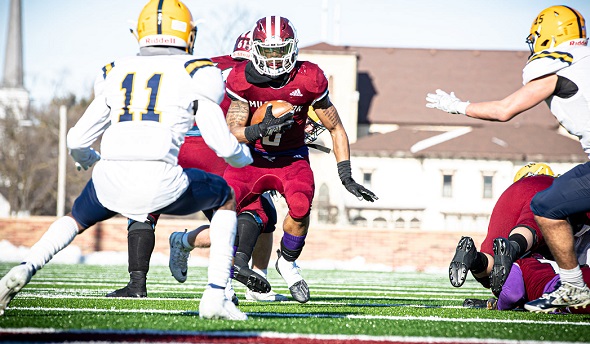
PHOTO: Muskegon, on offense, returned to the field Saturday with a Division 3 Regional Final win over East Grand Rapids. (Photo by Tim Reilly.)