

Community Backs Maple Valley's Surge
August 13, 2015
By Geoff Kimmerly
Second Half editor
VERMONTVILLE – It’s almost with disbelief that first-year coach Marty Martin considers the recent history of his once-feared Maple Valley football program.
“It’s been nine years since we’ve had a winning season,” said Martin, who was part of the team’s first outright league title as a senior in 1983. “It gives me goose bumps to think about that.”
But he’s had similar reactions to the outpouring of neighborly support his program has received as it works to start a revival.
Members of the community, made up of about 3,500 residents, have donated $46,000 to go with $15,000 allocated by Maple Valley's school board for the purchase of new equipment that will be used this fall. Some was necessary to fit an influx of players, but the additional funds allowed the program to update and replace some of its older gear as well.
Confidence. Comfort. Swagger. The players anticipate a little more of all three when Maple Valley opens against Fowler on Aug. 28 outfitted in new uniforms over new shoulder pads and with new helmets topping them off.
Those good feelings come with heightened expectations, of course – which are welcomed by a program that made the playoffs seven of eight seasons and played in an MHSAA Final during the stretch preceding its recent struggles.
“It’s coming back. You can feel it,” Maple Valley senior Isiah Garn said. “On the field, the coaches are expecting more … not letting you short yourself. And the community is jumping in on us; there is so much support there. Everyone wants us to be a success again.”
Dressed to impress
Martin is deeply rooted in the school. His father was a 1953 graduate of the former Vermontville High and started middle school basketball and football and summer league baseball programs in the community before also coaching at the new Maple Valley High School after it opened in 1963. Marty played football for Dan Watson on the Maple Valley varsity after playing junior varsity for Guenther Mittelstaedt, who followed Watson and led the varsity to a 173-70 record over 24 seasons through 2008.
After playing two years of baseball in junior college, Martin came back to the community to work as a postal worker and coach, and under Mittelstaedt helped the Lions to their first playoff appearance, in 1987. He remained on Mittelstaedt’s staff through 2000, then coached a year at Battle Creek St. Philip, four years at Battle Creek Lakeview where he also taught after earning his degree, then with Mittelstaedt again for two years at Lakeview in Montcalm County.
 Martin returned to teach at Maple Valley a year ago and became only the third varsity football coach in 30 years during this offseason.
Maple Valley is a little different place than even a decade ago. The school’s enrollment briefly passed 500 during the 2007-08 school year but fell to just over 370 students as of this spring – and Martin said there are fewer than 70 seniors in this fall’s class. The community’s economics also have changed, he added, with fewer families farming or enjoying jobs with General Motors in Lansing or Kellogg in Battle Creek.
Near the top of his to-do list was simply getting more players back into the program. Maple Valley had 40 last year, which at least worked for the amount of equipment the school had in stock.
But 69 students signed up to play this fall and 54 ended up at practice this week – good news, except for the helmet supply.
In addition to new helmets to outfit the new players, Martin also surmised eight more would need to be replaced at the end of this season, followed by 12 more needed after 2016 and 13 after 2017.
Instead, Martin began investigating if his program could get a better price by replacing the entire supply in bulk. After considering two helmets, he worked with his Riddell representative to get a deal on the helmets that included discounts on shoulder and girdle pads as well. The school board responded with its contribution – and then the community came on strong to help the rest of the way.
Martin was called out of class one day to receive a $5,000 check. Then came $1,500 from one family and $3,500 from another. He was at a graduation open house this spring when someone placed a $1,000 check in front of him. Longtime residents, some retired, gave $100; some who had graduated from Vermontville High or the other former school in Nashville, donated a few hundred as well.
Martin’s team spent parts of the summer (and will this Saturday as well) providing muscle to local service projects, but he’s never asked the community for financial help for the program. It just made sense to provide, said 1992 grad and former player and assistant coach Paul Adrianson, whose local business Hickey Electric was among the first to contribute.
“We want people to see the game of football doesn’t just necessarily survive. We think it can thrive if you put safety first or good fundamental education on it,” Adrianson said. “It can be a great sport for our future. … We really feel that if we get all behind and lead as a district and doing safety first, we think that’s going to set a positive trend for the game of football.”
Safety first
Maple Valley is one of 70 high schools statewide taking part in a pilot sideline concussion testing program sponsored this school year by the MHSAA. The Lions will work with XLNTbrain Sport, which incorporates baseline testing done at the start of the season to assist in return-to-play decisions after possible head injuries at practices and during games.
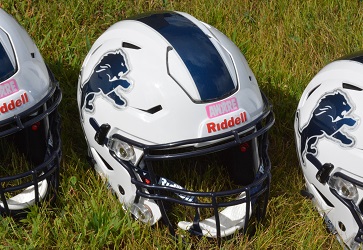
In addition, the Riddell SpeedFlex helmets Maple Valley purchased include the InSite Impact Response System, a series of sensors that alert sideline staff after a player’s helmet sustains what is considered a significant impact. That player will then be evaluated by training staff; Maple Valley also has a trainer this fall for the first time in 15 years, Martin said.
 “That was our initial thing. We want our kids to be the safest kids,” Martin said. “We want to be one of those leaders; we want to get this district, this community, out front so everyone in the state of Michigan and the United States knows in this area that people care about their kids to the extent they’re willing to invest $27,000 in purchasing helmets.”
The helmets require reconditioning each offseason and new batteries for the InSite sensors – to the tune of $2,200. But another donor stepped in with $22,000 – enough to keep the new helmets ready to wear for a decade.
“This community identifies with this football team,” Martin said. “So they were ready for a change, and they were looking for this opportunity. I’m very blessed and humbled to think they’re showing trust in my leadership and my coaching staff and in the fact we can turn things around.”
His players have heard the stories of successes past, some before they were born. They’ll try to extend the “look good, feel good” cliché into their play on the field this fall as they work to write a restart into Maple Valley’s winning history that goes with the other renovation projects that are popping up at the school and on its grounds.
“I think there’s going to be tons of people coming out,” senior Brock Weiler said. “It’s the new coach, everything getting re-done in the school. I think the pride’s coming back.”
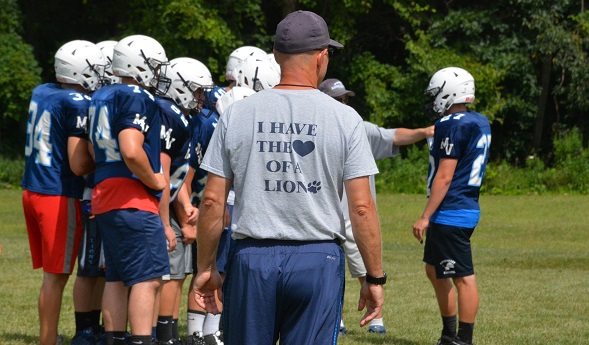
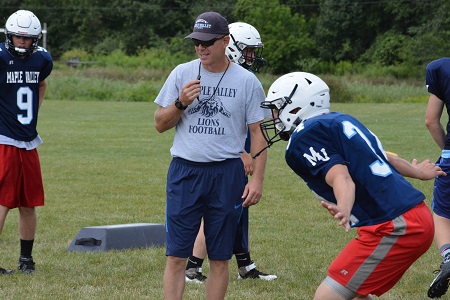
PHOTOS: (Top) Maple Valley huddles during offensive drills at Wednesday afternoon’s practice. (Middle) Coach Marty Martin leads the Lions through agility work. (Below) Maple Valley will wear new helmets this fall thanks in part to community donations.
Drive for Detroit: Week 6 in Review
October 2, 2017
By Geoff Kimmerly
Second Half editor
New powers continued to rise all over Michigan during Week 6 of the football regular season.
 A few did so with spectacular upsets, while others broke streaks that had grown to include multiple seasons – or in one case, stretched nearly two decades.
The Drive for Detroit report powered by MI Student Aid details the most intriguing 11-player results from eight regions across our state plus the best from 8-player every week – and this week’s headliners are the most riveting, as a group, so far in 2017.
Bay & Thumb
Midland 39, Davison 25
Among the state’s elite in the near past, Midland entered this fall with two 4-5 finishes over the last three seasons (surrounding a 7-3 in 2015). But this win made lots of noise as Davison (5-1) hadn’t lost a regular-season game since 2015 and shut out the Chemics 20-0 last fall. Midland (5-1) and Lapeer now sit atop the Saginaw Valley League Blue standings and meet Week 8. Click for more from the Midland Daily News.
This Methner TD with :12.5 left makes the score 39-25 and seals it for the Chemics. pic.twitter.com/R8NPrEmoql
— Midland Chemics (@midlandchemics) September 30, 2017
Also noted:
Goodrich 41, Corunna 27 – The Martians (5-1) held onto their chance to grab a share of the Genesee Area Conference Red title and will cheer for Corunna (3-3) this week as the Cavaliers take on leader Lake Fenton.
Richmond 17, Almont 7 – The Blue Water Area Conference is down to a two-team race as Richmond (6-0) and Algonac are in first and Almont (4-2) has lost to both; the leaders meet in Week 8.
Flint Carman-Ainsworth 41, Bay City Central 31 – These Cavaliers (4-2) have won three straight to move into first place alone in the SVL Red, with Central (3-3) and Week 8 opponent Midland Dow a win back.
Unionville-Sebewaing 30, Reese 14 – USA (4-2) put itself in position to create a two or even three-way tie for the Greater Thumb Conference West title with leader Elkton-Pigeon-Bay Port Laker up next; Reese (3-3) is fighting for a playoff spot.
Greater Detroit
Belleville 35, Dearborn Fordson 7
Belleville not only clinched a share of the Western Wayne Athletic Conference Red title and earned a playoff berth by downing the co-leading Tractors (5-1), but the Tigers (6-0) make an even louder statement as a contender in Division 1. They are 6-0 for the first time since 2002 after also making the playoffs the last two seasons, and they’ve now given up just 13 points over their last five games. Fordson hadn’t given up more than 14 in a game this season. Click for more from the Detroit News.
ICYMI: Belleville improved to 6-0 on the season with a 35-7 win over Fordson on Friday night! Watch the highlights here! @JermainCrowell pic.twitter.com/FC61NZ7VfY
— STATE CHAMPS! (@statechampsnet) September 30, 2017
Also noted:
Detroit Martin Luther King 27, Detroit Denby 6 – The Crusaders (5-1) earned a share of the Detroit Public School League Black division title while handing Denby (4-1) its first loss in league play and overall.
Rochester Adams 38, Southfield Arts & Technology 14 – The Highlanders (5-1) remain part of a three-team first-place tie in the Oakland Activities Association Red after handing this loss to what has to be one of the best 3-3 teams in the state in the Warriors.
Warren DeLaSalle 52, Dearborn Divine Child 14 – Both could finish first in their respective Detroit Catholic League divisions, and DeLaSalle (5-1) if it wins out would have little argument as the overall best after handing Divine Child (5-1) its only loss so far.
Romulus 31, Redford Thurston 22 – The Eagles (4-2), which finished second in the WWAC Red last year, clinched a share of the WWAC Blue title while sending Thurston (4-2) into a tie for second place
Mid-Michigan
Olivet 34, Lake Odessa Lakewood 6
Lakewood (5-1) had won 15 straight league games and the last two championships after Olivet won the first-ever Greater Lansing Activities Conference title in 2014. The Eagles (6-0) have been on the verge though, with their only league losses the last two seasons to the Vikings. Olivet can clinch the championship outright this week against Stockbridge. Click for more from FOX17.
Also noted:
Alma 21, Freeland 7 – The Panthers (6-0) broke a four-game losing streak to the Falcons (4-2), keeping alive a Tri-Valley Conference Central title showdown possibility against Saginaw Swan Valley in Week 8.
Belding 35, Grand Rapids NorthPointe Christian 21 – The Ottawa-Kent Conference Silver race got whittled down this weekend and Belding (5-1) remains one of two co-leaders, while NorthPointe (5-1) is poised to claim a share if both falter over the final three games.
Breckenridge 27, Carson City-Crystal 26 – The Huskies (5-1) remain perfect in the Mid-State Activities Conference since joining the league last season; a win by Carson City-Crystal (3-3) would’ve created a three-way tie for first.
Pewamo-Westphalia 32, Laingsburg 11 – The Pirates (5-1) got one win away from clinching a third straight Central Michigan Athletic Conference title by upending the second-place Wolfpack (4-2).
Northern Lower Peninsula
Maple City Glen Lake 48, Frankfort 34
A five-point loss to Frankfort cost Glen Lake (3-2) the Northern Michigan Football Conference Leaders title in 2016, even as the Lakers went on to play at Ford Field and finish runner-up in Division 6. But they clinched a share of the 2017 league title with this victory, and with only winless Mancelona standing in the way of an outright championship. Frankfort (4-2) had won 11 straight league games dating to the start of the 2014 NMFC schedule. Click for more from the Traverse City Record-Eagle.
Also noted:
Boyne City 34, Kalkaska 13 – The Ramblers (6-0) held on to a share of first place in the NMFC Legends division by handing Kalkaska (3-3) its third straight defeat.
Traverse City St. Francis 49, Grayling 22 – The Gladiators (6-0) kept pace with Boyne City, handing Grayling (4-2) a second straight loss as the leaders continued to point to a possible league decider in Week 9.
AuGres-Sims 54, Whittemore-Prescott 14 – The Wolverines (6-0) clinched a share of the North Star League title after finishing second a year ago, and may also have dealt the blow to end the Cardinals’ 10-year playoff streak; Whittemore-Prescott is 2-4 and must win out for a chance at an at-large bid.
Traverse City West 30, Benton Harbor 13 – The Titans (6-0) equaled their win total from last season and already their most victories since 2004, while also putting Benton Harbor (2-4) in a position where it must win out to have a hope of a third straight playoff berth.
Southeast & Border
Reading 36, Union City 12
The Rangers, coming off back-to-back 3-6 seasons, are one win from claiming a share of the Big 8 Conference title after downing second-place Union City. Reading (5-1) hasn’t lost this season since opening night, and its final two league opponents are a combined 2-10. Union City also is 5-1 and enjoying a great rebound after going 2-7 last fall and 4-5 in 2015. Click for more from the Hillsdale Daily News.
Also noted:
Ottawa Lake Whiteford 51, Morenci 8 – Whiteford turned away what looked to be its most formidable challenge so far in the Tri-County Conference, sending Morenci to 3-3 overall and second place in the standings.
Clinton 28, Petersburg-Summerfield 24 – Clinton (4-2) is tied for second in the TCC and stayed in line for a Week 8 title-deciding date with Whiteford by jumping above the Bulldogs (4-2), who fell to fourth place.
Pinckney 35, Tecumseh 10 – The Pirates (5-1) held on to a tie for first in the Southeastern Conference White while putting Tecumseh (3-3) in a spot to win out to guarantee a playoff berth for the first time since 2014.
Saline 42, Monroe 14 – The Hornets (5-1) clinched a share of the SEC Red title and face co-second place Ann Arbor Pioneer this week; Monroe (3-3) is aiming to win out to make it back to the playoffs after missing a year ago.
Southwest Corridor
Stevensville Lakeshore 30, Portage Northern 27
In its closest Southwestern Michigan Athletic Conference West game so far this season, Lakeshore clinched a share of the league title and avenged last season’s three-point loss to the Huskies. The Lancers also moved to 6-0 for the first time since 2012 and secured a 20th straight playoff berth. Northern (2-4) continued a heart-breaking string, with three of their losses by a combined nine points. Click for more from the St. Joseph Herald-Palladium.
Also noted:
Climax-Scotts 60, Adrian Lenawee Christian 29 – The Panthers (5-1) remained tied for first in the Southern Central Athletic Association by handing Lenawee Christian (4-2) its second loss in three weeks.
Berrien Springs 59, Parchment 6 – The Shamrocks (5-1) clinched a share of the Berrien-Cass-St. Joseph White title with their third game of 50 or more points; Parchment (4-2) remains two wins from guaranteeing its first playoff berth since 2013.
Schoolcraft 35, Constantine 8 – This rivalry win by the Eagles (5-1), combined with the result below, helped put Schoolcraft into a first-place tie with only Watervliet in the Southwestern Athletic Conference Valley; Constantine (3-3) must win out to guarantee adding to its 18-year playoff streak.
Kalamazoo United 28, Coloma 27 – After falling to Watervliet in Week 5, United (5-1) dealt a disappointing blow to the much-improved Comets (4-2).
Upper Peninsula
Escanaba 42, Menominee 21
The streak is over; the Eskymos (5-1) downed Menominee for the first time since 1998 in the 122nd meeting between the Great Northern Conference rivals. And the win was impressive – the reigning champion Maroons hadn’t given up 42 points in a league game since 2008. Although it was the GNC opener for Menominee, Escanaba had already played two league games and with this win set up a potential league title matchup with Kingsford in Week 9 – although the Flivvers, 2-0 in GNC play, must first face the Maroons in Week 8. Click for more from the Escanaba Daily Press.
Also noted:
Iron River West Iron County 53, Calumet 20 – The Wykons (5-1) remain the only team undefeated in West Peninsula Athletic Conference play, while reigning champ Calumet (3-3) has lost three of four and needs to win out to extend a three-year playoff streak.
Bessemer Gogebic 26, L'Anse 7 – The first half of this season was tough for the Miners (2-4), but they’ve doubled last season’s win total and still have a playoff shot after stunning the Purple Hornets (4-2).
Negaunee 21, Ishpeming 14 – What a turnaround for these Miners; after opening 0-3, Negaunee is 3-3 and put Ishpeming (2-4) in a position of needing to win out for a chance at an at-large playoff bid.
Lake Linden-Hubbell 24, Bark River-Harris 12 – The Lakes also are riding a comeback wave; they opened 0-3, but after having no game Week 4 have won two straight and this time put Bark River-Harris (3-3) into a must-win playoff situation.
West Michigan
East Grand Rapids 28, Grand Rapids Christian 7
Reigning champion East Grand Rapids (6-0) took command of the Ottawa-Kent Conference Gold again by beating the Eagles by an identical score as in last year’s game, which also ended up deciding the league title. EGR lowered its points allowed average to 8.2 per game this fall. Still, this may not be over. Christian (5-1) is one of three teams one win behind in the league standings, and the Pioneers still must play the other two. Click for more from the Grand Rapids Press.
Also noted:
Rockford 27, Grandville 0 – The Rams lined up an O-K Red battle for first place this week against Holland West Ottawa by handing Grandville (4-2) its first league loss; depending on how this week goes, all three could end up sharing the title after Rockford and Grandville did so with Hudsonville in 2016.
Cedar Springs 28, Lowell 14 – It’s odd to call this an upset when Cedar Springs is 4-2, but Lowell (also 4-2) hadn’t lost an O-K White game since 2014 and this season has wins over leaders of two other leagues.
Kent City 28, Morley Stanwood 0 – The Eagles (6-0) not only won a matchup of undefeated teams, but in doing so clinched a share of the Central State Activities Association Silver title against the now second-place Mohawks (5-1); the teams shared the title in 2016.
Wyoming Kelloggsville 21, Wyoming Godwin Heights 20 – This was the other half of the paring down in the O-K Silver; both entered undefeated, but Kelloggsville (6-0) is now tied with Belding atop the standings while Godwin Heights (5-1) fell a game back in a league with four of seven teams at 5-1 or better.
8-Player
Morrice 33, Deckerville 32
Deckerville, last season’s 8-player MHSAA runner-up, has been considered a championship favorite all fall and still may be. But the Orioles (6-0) are in position to claim the North Central Thumb 8-Man League Stars division title after scoring a last-minute touchdown and converting a two-point conversion to hand the Eagles (5-1) their first league loss since 2014. Morrice must beat either Kingston this week or Lawrence in Week 8 to clinch a share NCTL Stars championship. Click for more from the Owosso Argus-Press.
Also noted:
Camden-Frontier 30, Bellevue 26 – The Redskins (6-0) have turned away both second-place teams in the Southern Central 8-Man Football League and can clinch a share of the title this week against Burr Oak; Bellevue (5-1) and Battle Creek St. Philip will be back in the mix with an upset.
Flint International Academy 78, Lawrence 74 – This set the MHSAA record for most points in an 8-player game when both teams score at least 40; Flint International (5-1) is tied for second in the NCTL Stars, but Lawrence (3-3) has scored the most points of any league team this season.
Kinde-North Huron 36, New Haven Merritt Academy 18 – The Warriors (5-1) held on to a first-place tie in the NCTL Stripes with Bay City All Saints; the Mustangs (3-3) have lost to both over the last three weeks.
Rudyard 30, Engadine 20 – The Bulldogs (5-1) still trail leaders Cedarville and Pickford in the Bridge Alliance Conference, but put themselves in position to earn a share of the league title if both falter over the next three weeks; Engadine (4-2) fell to fourth place but gets Cedarville next.
Second Half’s weekly “Drive for Detroit” previews are powered by MI Student Aid, a part of the Student Financial Services Bureau located within the Michigan Department of Treasury. MI Student Aid encourages students to pursue postsecondary education by providing access to student financial resources and information, including various student financial assistance programs to help make college more affordable for Michigan students. MI Student Aid administers the state’s 529 savings programs (MET/MESP) and eight additional aid programs within its Student Scholarships and Grants division. Click for more information and connect with MI Student Aid on Facebook and Twitter @mistudentaid.
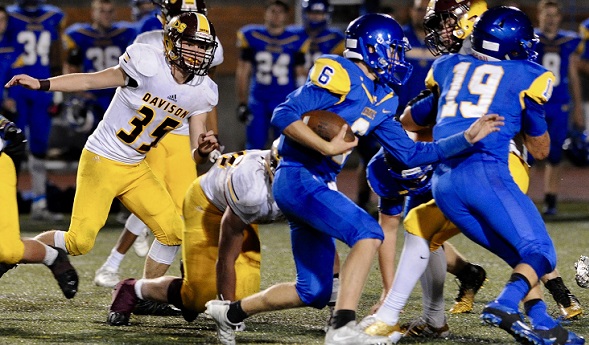
PHOTO: Davison defenders chase a Midland ball carrier during Friday's Chemics win. (Photo by Terry Lyons.)