

Community Backs Maple Valley's Surge
August 13, 2015
By Geoff Kimmerly
Second Half editor
VERMONTVILLE – It’s almost with disbelief that first-year coach Marty Martin considers the recent history of his once-feared Maple Valley football program.
“It’s been nine years since we’ve had a winning season,” said Martin, who was part of the team’s first outright league title as a senior in 1983. “It gives me goose bumps to think about that.”
But he’s had similar reactions to the outpouring of neighborly support his program has received as it works to start a revival.
Members of the community, made up of about 3,500 residents, have donated $46,000 to go with $15,000 allocated by Maple Valley's school board for the purchase of new equipment that will be used this fall. Some was necessary to fit an influx of players, but the additional funds allowed the program to update and replace some of its older gear as well.
Confidence. Comfort. Swagger. The players anticipate a little more of all three when Maple Valley opens against Fowler on Aug. 28 outfitted in new uniforms over new shoulder pads and with new helmets topping them off.
Those good feelings come with heightened expectations, of course – which are welcomed by a program that made the playoffs seven of eight seasons and played in an MHSAA Final during the stretch preceding its recent struggles.
“It’s coming back. You can feel it,” Maple Valley senior Isiah Garn said. “On the field, the coaches are expecting more … not letting you short yourself. And the community is jumping in on us; there is so much support there. Everyone wants us to be a success again.”
Dressed to impress
Martin is deeply rooted in the school. His father was a 1953 graduate of the former Vermontville High and started middle school basketball and football and summer league baseball programs in the community before also coaching at the new Maple Valley High School after it opened in 1963. Marty played football for Dan Watson on the Maple Valley varsity after playing junior varsity for Guenther Mittelstaedt, who followed Watson and led the varsity to a 173-70 record over 24 seasons through 2008.
After playing two years of baseball in junior college, Martin came back to the community to work as a postal worker and coach, and under Mittelstaedt helped the Lions to their first playoff appearance, in 1987. He remained on Mittelstaedt’s staff through 2000, then coached a year at Battle Creek St. Philip, four years at Battle Creek Lakeview where he also taught after earning his degree, then with Mittelstaedt again for two years at Lakeview in Montcalm County.
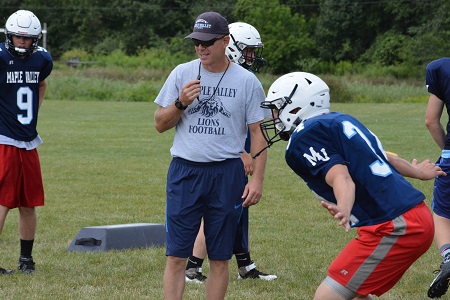 Martin returned to teach at Maple Valley a year ago and became only the third varsity football coach in 30 years during this offseason.
Maple Valley is a little different place than even a decade ago. The school’s enrollment briefly passed 500 during the 2007-08 school year but fell to just over 370 students as of this spring – and Martin said there are fewer than 70 seniors in this fall’s class. The community’s economics also have changed, he added, with fewer families farming or enjoying jobs with General Motors in Lansing or Kellogg in Battle Creek.
Near the top of his to-do list was simply getting more players back into the program. Maple Valley had 40 last year, which at least worked for the amount of equipment the school had in stock.
But 69 students signed up to play this fall and 54 ended up at practice this week – good news, except for the helmet supply.
In addition to new helmets to outfit the new players, Martin also surmised eight more would need to be replaced at the end of this season, followed by 12 more needed after 2016 and 13 after 2017.
Instead, Martin began investigating if his program could get a better price by replacing the entire supply in bulk. After considering two helmets, he worked with his Riddell representative to get a deal on the helmets that included discounts on shoulder and girdle pads as well. The school board responded with its contribution – and then the community came on strong to help the rest of the way.
Martin was called out of class one day to receive a $5,000 check. Then came $1,500 from one family and $3,500 from another. He was at a graduation open house this spring when someone placed a $1,000 check in front of him. Longtime residents, some retired, gave $100; some who had graduated from Vermontville High or the other former school in Nashville, donated a few hundred as well.
Martin’s team spent parts of the summer (and will this Saturday as well) providing muscle to local service projects, but he’s never asked the community for financial help for the program. It just made sense to provide, said 1992 grad and former player and assistant coach Paul Adrianson, whose local business Hickey Electric was among the first to contribute.
“We want people to see the game of football doesn’t just necessarily survive. We think it can thrive if you put safety first or good fundamental education on it,” Adrianson said. “It can be a great sport for our future. … We really feel that if we get all behind and lead as a district and doing safety first, we think that’s going to set a positive trend for the game of football.”
Safety first
Maple Valley is one of 70 high schools statewide taking part in a pilot sideline concussion testing program sponsored this school year by the MHSAA. The Lions will work with XLNTbrain Sport, which incorporates baseline testing done at the start of the season to assist in return-to-play decisions after possible head injuries at practices and during games.
In addition, the Riddell SpeedFlex helmets Maple Valley purchased include the InSite Impact Response System, a series of sensors that alert sideline staff after a player’s helmet sustains what is considered a significant impact. That player will then be evaluated by training staff; Maple Valley also has a trainer this fall for the first time in 15 years, Martin said.
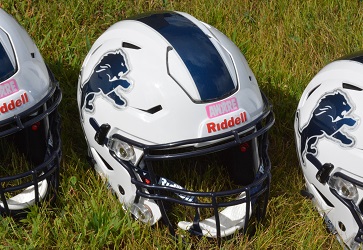 “That was our initial thing. We want our kids to be the safest kids,” Martin said. “We want to be one of those leaders; we want to get this district, this community, out front so everyone in the state of Michigan and the United States knows in this area that people care about their kids to the extent they’re willing to invest $27,000 in purchasing helmets.”
The helmets require reconditioning each offseason and new batteries for the InSite sensors – to the tune of $2,200. But another donor stepped in with $22,000 – enough to keep the new helmets ready to wear for a decade.
“This community identifies with this football team,” Martin said. “So they were ready for a change, and they were looking for this opportunity. I’m very blessed and humbled to think they’re showing trust in my leadership and my coaching staff and in the fact we can turn things around.”
His players have heard the stories of successes past, some before they were born. They’ll try to extend the “look good, feel good” cliché into their play on the field this fall as they work to write a restart into Maple Valley’s winning history that goes with the other renovation projects that are popping up at the school and on its grounds.
“I think there’s going to be tons of people coming out,” senior Brock Weiler said. “It’s the new coach, everything getting re-done in the school. I think the pride’s coming back.”
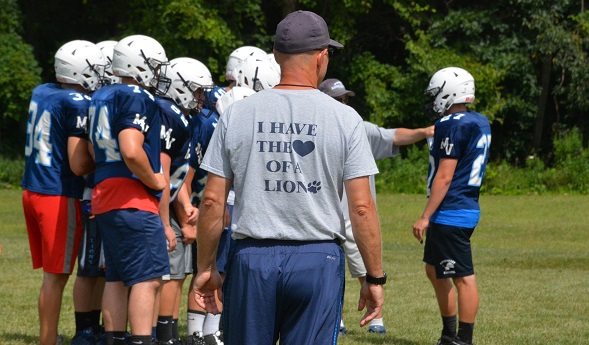
PHOTOS: (Top) Maple Valley huddles during offensive drills at Wednesday afternoon’s practice. (Middle) Coach Marty Martin leads the Lions through agility work. (Below) Maple Valley will wear new helmets this fall thanks in part to community donations.
2 Quarterbacks Vault Muskegon to #1
November 1, 2016
By Tom Kendra
Special for Second Half
Stopping the Muskegon High School offense has never been easy.
 This year, it’s twice as tough.
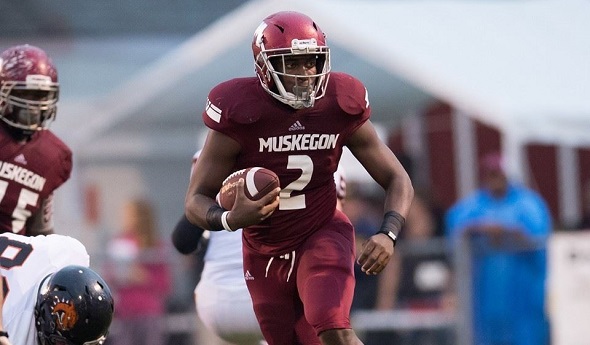
The Big Reds, 9-1 and ranked No. 1 in the season-ending Associated Press Division 3 poll, are attacking opponents with a two-headed monster at quarterback – diminutive senior Kalil Pimpleton (5-7, 160) and physically imposing junior La’darius Jefferson (6-2, 210).
“I’m blessed with two great men, two great leaders, at quarterback,” said seventh-year Muskegon head coach Shane Fairfield, whose team won the Ottawa-Kent Conference Black title. “Using both of them makes us a better team. We don’t go into games with a specific plan for when each will play (quarterback). We see what the defense is doing and how our kids are responding and go from there.”
The result of the dual QB attack has been a Muskegon offense which is averaging 54 points and 428 total yards per game heading into Friday night’s Division 3 District championship game against visiting East Grand Rapids (8-2).
Pimpleton, who has run a 4.4 in the 40-yard dash and has verbally committed to Virginia Tech, has started all 10 games for the Big Reds.
He is primarily a running threat, regularly taking snaps out of the pistol formation from senior center Devin Sanders and then finding a seam somewhere along the line to squeeze through. “KP,” as he’s known, has carried 101 times for 1,081 yards and 17 rushing touchdowns. He also has been effective through the air, completing 34 of 66 passes for 639 yards and six more TDs.
“I look at the system we use as a chance for me to use all of my weapons,” said Pimpleton, who also has three punt returns for touchdowns on his resume. “It doesn’t matter if I am at QB or in the slot. My character doesn’t change, and my focus doesn’t change.”
As good as Pimpleton has been, there have been times in recent years where opponents have bottled up Muskegon’s running quarterbacks.
One example was the 2014 Division 3 championship game at Ford Field, where Orchard Lake St. Mary’s shut down the Big Reds in a 7-0 victory. Another was last year’s Division 2 Regional championship game at Lowell, where Pimpleton and the Muskegon attack got stuck in the mud in a 36-7 loss.
 If that same scenario begins to unfold this fall, Muskegon offensive coordinator Brent White has a Plan B.
And what a Plan B it is.
Jefferson, who has the look of Cam Newton and the big arm to match, presents a whole new set of challenges for opposing defenses when he enters the game, which is normally around the Big Reds’ third offensive series. Jefferson brings a deep vertical passing threat, mixed with the size and strength to run over linebackers.
“I always tell myself that I can’t be stopped – that’s the mentality I like to play with,” said Jefferson, who also has delivered some big hits this fall during limited playing time at outside linebacker. “I just want to thank my coaches for using a two-QB system. Now we’ve got two hungry guys trying to win a state title.”
The benefits of Muskegon’s dual quarterback offense were apparent in last week’s 63-14 Division 3 Pre-District victory over visiting Grand Rapids Forest Hills Northern.
Muskegon’s offense struggled briefly in the early going before Jefferson ignited the Big Reds and their crowd with a 56-yard TD pass to Pimpleton, who had moved out to slot receiver. Near the end of the first quarter, Jefferson scored on a 2-yard run.
In the second quarter, it was back to Pimpleton at QB and he led a scoring drive, ultimately sprinting in from five yards out. And then it was back to Jefferson, who hit standout senior wide receiver Jacorey Sullivan on a 44-yard bomb over the top to complete Muskegon’s first-half scoring.
“The idea is that we have a system and our kids know how to play with either quarterback,” explained Fairfield. “If we do it right, it puts much more pressure on the defense, not knowing what they are going to get.”
Jefferson finished the win over Forest Hills Northern 7 of 8 passing for 175 yards and three touchdowns, along with 11 rushes for 91 yards and two more touchdowns. For the season, Jefferson has completed 42 of 69 passes for 724 yards and 15 touchdowns, against just two interceptions. He has rushed 66 times for 534 yards and 10 TDs.
The two quarterbacks are by far Muskegon’s top two rushers in an offense that lines up with four receivers on most downs. The lone starter in the backfield is senior Division I linebacker prospect Andrew Ward (6-1, 210), who is a devastating lead blocker. In recent weeks, the Big Reds have started to hurt opponents with jet sweeps featuring speedy juniors Da’vion McCall, Clinton Jefferson and Lonnie Clark Jr.
Fairfield, whose team has ripped off eight straight wins after a Week 2 loss to pass-happy Lincolnshire (Ill.) Stevenson, has guided Muskegon to MHSAA Finals three times in his first six years as head coach. The Big Reds have failed to take that final step on each of those occasions, falling to Birmingham Brother Rice in 2012 and 2013 and Orchard Lake St. Mary’s in 2014.
Given that recent heartbreak, the Big Reds have made it clear since Day 1 that the only acceptable outcome this season is an MHSAA title. The next challenge is a dandy matchup in Friday’s District championship game between two of the top tradition-rich programs in Michigan high school football history.
Muskegon is the state’s winningest with 816 wins and 17 state titles, including five in the MHSAA playoff era. East Grand Rapids, meanwhile, has won 11 championships since the playoffs began in 1975, including five in a row from 2006 to 2010. The Pioneers have won seven straight this fall after stumbling to a 1-2 start.
The two powers have played only two times in history, with Muskegon winning both times.
“We need to come out and play our game,” said Pimpleton. “We believe in our coaches and that they will put us in the best spots to win. That’s really all that matters. We can’t lose sight that no matter who is out there, that is our one goal.”
 Tom Kendra worked 23 years at The Muskegon Chronicle, including five as assistant sports editor and the final six as sports editor through 2011. E-mail him at [email protected] with story ideas for Muskegon, Oceana, Mason, Lake, Oceola, Mecosta and Newaygo counties.
PHOTOS: (Top) Muskegon quarterback La'darius Jefferson picks up yards on the ground this season against Byron Center. (Middle) Kalil Pimpleton, here following through on a pass, also is a threat to run. (Jefferson photo courtesy of Muskegon football program, Pimpleton photo by Tim Reilly.)