

Constantine Comeback Gets Running Start
By
Wes Morgan
Special for MHSAA.com
September 6, 2018
Shawn Griffith is fully aware of the fact he’s now coached fathers and sons, uncles and nephews during his tenure at Constantine High School.
 That doesn’t make him old, he says; it just means he’s “seasoned.”
It also means he’s now been around long enough to experience both the highs and lows of coaching. Traditionally one of the state’s small-school powerhouses, Constantine lost its way in 2017 with a 3-6 record — Griffith’s first losing season since taking over the program in 2007 and the school’s first sub-.500 season in 26 years.
With a pair of Division 6 championship game appearances (2011 and 2012) and a 114-36 overall record to his credit, last autumn’s fall from grace, though somewhat expected, he said, was a reminder that high school sports still have a cyclical nature.
Attrition, inexperience, lower participation numbers, defensive struggles and fractured team chemistry all attributed to the disappointing season. Still, the Falcons were four points away from five wins, which likely would have been enough to qualify for the playoffs. With a 5-4 regular-season record back in 2013, Constantine went on to advance to the Regional Finals, underscoring Griffith’s mantra of improving each week and what can be accomplished by doing so.
“We knew last year we were going to go through some growing pains,” Griffith said. “I think the 3-6 thing really helped these guys focus in the offseason, and they have done a great job coming together.”
Now the Falcons, 2-0 this year after blowout victories against Gobles (56-0) and Quincy (42-7), are out to reclaim their seat at the table, with expectations just as high as they’ve always been. A few players only need to look at their family trees to be reminded of what’s possible.
Senior fullback Brendon Schragg in particular has a bloodline that traces back to the most memorable year in Constantine football history, as his uncles literally carried the Falcons to their only MHSAA football championship.
 With Griffith then serving as offensive coordinator in 2004 — just the second season after he transitioned the offense from an I-Formation to the Wing-T — senior twins Jim and Mike Schragg lined up in the backfield for the Falcons and combined for nearly 3,800 rushing yards, fueling the team’s title run and 13-1 record.
Mike Schragg, a tailback, rushed for more than 100 yards in the championship game against Suttons Bay, a 34-13 Constantine victory. But it was fullback Jim Schragg’s legendary effort that put him atop the MHSAA record book list for yards in a Final after he went for 307, including an 89-yard run.
“We were loaded with backs,” Jim Schragg said. “It’s a fun offense to run. Some parents get ticked off that we don’t throw it enough, but you have three bad things that can happen with a pass and not too many bad things can happen with a run.
“It’s cool to have your name there with the record and all that. But the state championship is more important to me than the record and running for over 300 yards. The state finals was the whole goal for our senior class. It was state championship or bust. That was what every single kid played for on that team.”
Some things haven’t changed. Though going from a three-win season to a state title is extremely unlikely, Brendon Schragg and his teammates believe they can put together a pretty special year.
“They were superstars to me,” Schragg, who rushed for 575 yards and five touchdowns as a junior, said of his uncles. “I always had the dream that if you go to state, I want to go to state. That’s been a goal since I was 4 years old.
“In my opinion, come Week 5 when we start our (Southwestern Athletic Conference) games, I think we are going to come out and compete. There isn’t a doubt in my mind we can’t win a league title. I ask myself a question every day, ‘Why not us?’”
Brendon Schragg is a three-year starter and one of three returning backs this season. The Falcons haven’t needed complete games out of the trio in the victories so far this year, but Schragg has 145 yards and two TDs on 14 carries. He and teammates Hunter Lindbert and Josh Lawson will probably split the load the rest of the season. Lindbert has compiled 188 yards and 4 TDs on 14 carries, and Lawson has 235 yards and two TDs on 18 carries.
Of course, none of it would be possible without the big guys up front.
“We’re just more physical in the trenches this year,” Schragg said of linemen such as Trenton Stears, Marquise Wykle, Matt Hutton and Austin Loose. “Hutton, our center, both his uncles played on the state championship team, believe it or not.”
Part of Griffith’s job is to both encourage his players to shoot for the moon and to make sure they also have their feet firmly planted on the ground. He certainly understands there are challenges ahead with teams like Kalamazoo United, Watervliet and Schoolcraft.
“We look a lot better,” he said. “But we’re certainly not naïve; we see some pretty darn good football teams on our schedule here coming up. I think our guys have done a real good job of not blowing this out of proportion. It is what it is; it’s a good start. They have done a good job of concentrating and preparing week to week.”
 Wes Morgan has reported for the Kalamazoo Gazette, ESPN and ESPNChicago.com, 247Sports and Blue & Gold Illustrated over the last 12 years and is the publisher of JoeInsider.com. He can be reached at [email protected] with story ideas for Berrien, Cass, St. Joseph and Branch counties.
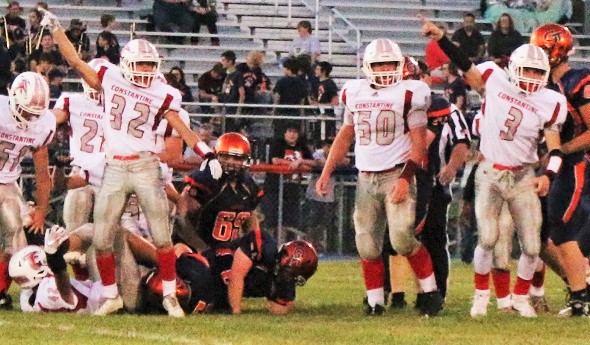
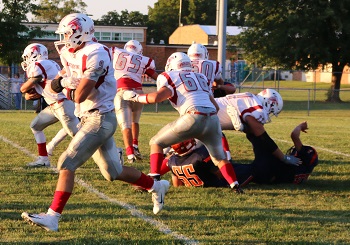
PHOTOS: (Top) Constantine defensive players motion for a turnover during their win over Gobles in Week 1. (Middle) Brendon Schragg, far left, breaks through the Gobles defense. (Photos courtesy of JoeInsider.com.)
Drive to Detroit: District Semis in Review
October 29, 2012
By Geoff Kimmerly
Second Half editor
Hopes are high for most of 242 teams heading into the first weekend of the MHSAA football playoffs.
But we see it every October – the unexpected and plain unbelievable take over in the postseason as teams raise their games to meet the urgency of do-or-be-done.
Seven of 34 undefeated teams lost for the first time this weekend and are now eliminated. All eight of last season's 11-player champions are still alive – but 8-player champion Carsonville-Port Sanilac is no longer.
Of course, at this time of year every game takes on critical meaning. So instead of saying the results below were the most signficant, rather, let's say they're the ones that jumped out most from the District Semifinals.
Division 1
Detroit Catholic Central 21, Hartland 15
The playoffs are when we find out just how strong the Detroit Catholic League Central was compared to the rest of the state each fall, and this provided a start on that comparison for 2012. The Shamrocks (6-4) opened with a close win over of the Kensington Lakes Activities Association West champion Eagles (8-2).
Click to read more from Novi Patch.
Also noted:
Holland West Ottawa 21, Grand Ledge 14 – The Panthers (8-2) avenged a 31-10 loss to the Comets (7-3) on Aug. 31.
Livonia Churchill 49, Livonia Stevenson 35 – These two met for the second week in a row; both times Churchill (10-0) scored 49 points, although Stevenson (6-4) cut the deficit to 14 this game after losing the first by 39.
Walled Lake Northern 41, Howell 27 – On top of playing in its first playoff game ever, Northern (8-2) also earned another by downing the Highlanders (6-4).
Dearborn 24, Dearborn Fordson 14 – The Pioneers (7-3) won a stunner after falling 35-0 to the Tractors (7-3) just five weeks ago.
Division 2
East Lansing 10, Lansing Everett 6
Life was good for the Vikings (9-1) after they completed their first 9-0 regular season ever – a run that included a 6-0 victory against East Lansing. But the Trojans (7-3), who struggled some and had to win in Week 9 just to make the playoffs, earned perhaps the biggest upset of District opener weekend. Click to read more from the Lansing State Journal.
Also noted:
Traverse City Central 48, Bay City Western 47 (2 OT) – Adding to its league title season, Central (9-1) won a playoff game for the first time since 1991. Western finished 8-2.
Lowell 21, Grand Rapids Northview 0 – The playoff-seasoned Red Arrows (8-2) made the first appearance for Northview (7-3) a quick one.
Fenton 22, Farmington Hills Harrison 19 – The Tigers (9-1) have now won a playoff games each of the last three seasons, and delivered Harrison (6-4) its only first-game postseason departure in its last 14 appearances.
Southfield 22, Detroit Martin Luther King 19 – The Bluejays (7-3) were a bit forgotten needing three straight wins just to make the playoffs, but got everyone's attention again by beating the Detroit Public School League champion Crusaders (6-4).
Division 3
Zeeland West 46, Zeeland East 0
That West won this game isn’t the stunning part – their first meeting this season was a 60-52 win by East, and West (6-4) is the reigning Division 4 champion. But consider the score this time, and also that East (9-1) had beaten Division 2 contender Muskegon by a point just a week ago and hadn’t lost this fall. Click to read more from the Holland Sentinel.
Also noted:
Hamilton 42, Edwardsburg 14 – The Hawkeyes (6-4) were among the last to make the playoffs, but got off to a good start against the Eddies (6-4).
Grand Rapids Christian 45, Fruitport 6 – The Eagles (9-1) continued to roll while handing Fruitport (8-2) its second loss of the season and second in a row.
DeWitt 34, Lapeer West 28 (OT) – The Panthers (8-2) extended their streak of winning at least one playoff game to seven seasons, while West finished 6-4 for the second straight fall.
Tecumseh 27, Chelsea 20 – Only three weeks prior, Chelsea (6-4) had beaten Tecumseh (8-2) in a game that decided the Southeastern Conference White championship.
Division 4
Grand Rapids South Christian 48, Paw Paw 0
South Christian’s losses this season came against three playoff teams, including two in Grand Rapids Christian and Grand Rapids Catholic Central that are expected to contend for MHSAA titles. So to figure this game might be close wasn’t too far off. But the Sailors (7-3) did more than that in handing Paw Paw (9-1) its only loss. Click for more from the Kalamazoo Gazette.
Also noted:
Richmond 24, Marine City 21 – Richmond (7-3) hung on again after also handing the Mariners (8-2) a 25-24 loss on opening night of the regular season.
Williamston 29, Marshall 8 – The Hornets (7-3) had to win three straight just to make the playoffs, and are rolling on four in a row with this defeat of the Redhawks (6-4).
Three Rivers 20, Battle Creek Pennfield 14 – This would qualify as an upset win by Three Rivers (7-3), as Pennfield (8-2) had been considered a contender all season.
Detroit Country Day 35, Clinton Township Clintondale 0 – The Yellow Jackets (8-2) handed Clintondale (9-1) its first and only loss of the season.
Division 5
Kingsford 36, Grayling 14
In the first season after the retirement of his legendary coach father Ken Hofer from Menominee, Kingsford coach Chris Hofer led his Kingsford team to one of the best opening wins of the playoffs. The Flivvers (9-1) intercepted four passes in handing Grayling (9-1) its first and only loss. Click to read more from the Iron Mountain Daily News.
Also noted:
Olivet 28, Lansing Catholic 14 – This one was equally stunning, as the Eagles (7-3) knocked out the reigning MHSAA runner-up Cougars (8-2).
Lake Fenton 41, Jackson Lumen Christi 20 – Maybe less of a shocker but still an intriguing result: Lake Fenton (8-2) handed the Titans (8-2) one of their earliest exits of the last two decades.
Grand Rapids West Catholic 19, Hopkins 13 (OT) – The Falcons improved to 7-3 while handing Hopkins (9-1) its lone loss of the season.
Muskegon Oakridge 16, Buchanan 8 – Oakridge moved to 10-0 by winning this clash of league champions; Buchanan finished 7-3.
Division 6
Manchester 37, Clinton 36
The Flying Dutchmen (7-3) fell to Clinton by 18 all the way back on Aug. 24. But they handed Clinton (9-1) its first – and now only – loss this season by scoring with less than a minute remaining in this District opener. Click to read more from The Oakland Press.
Also noted:
Maple City Glen Lake 28, Boyne City 16 – Glen Lake (8-2) rebounded from a Week 9 loss, while Boyne City (8-2) finished with a second straight defeat.
Hemlock 45, Montague 20 – The Huskies (9-1) made it two straight seasons with at least nine wins, while dropping Montague just shy at 8-2.
Montrose 7, Vassar 6 – The Rams (9-1) won by a point for the second straight week while dropping the Vulcans to 7-3.
Detroit Consortium 8, Madison Heights Madison 3 – Consortium (7-3) also won its first-ever playoff game; Madison finished 8-2.
Division 7
Flint Hamady 39, Burton Bendle 33
Hamady (7-3) is better known for its basketball prowess. But after four seasons of one, zero, three and four wins, respectively, Hamady made the playoffs this fall – and earned its first postseason victory ever by avenging a Week 3 loss to Bendle (7-3). Click to read more from the Flint Journal.
Also noted:
Decatur 27, Hartford 15 – It was closer this time, but Decatur (8-2) beat league foe Hartford (7-3) for the second time in a month.
Britton Deerfield 14, Reading 7 – From the maybe-didn’t-see-that-coming file, the Patriots (7-3) knocked out the Big Eight Conference champ Rangers (8-2).
Dansville 21, Ottawa Lake Whiteford 18 – Another testament to the strength of the Central Michigan Athletic Conference, the Aggies (8-2) went on the road and came back with a win over the Bobcats (8-2) – Dansville’s first in the postseason since 1992.
Flint Beecher 35, Rochester Hills Lutheran Northwest 21 – Beecher (6-4) got into the playoffs with two straight wins at the end of the regular season, but pushed the streak to three by downing Lutheran Northwest (5-4).
Division 8
L’Anse 34, Crystal Falls Forest Park 28
The Purple Hornets (8-2) might have fallen just short of a league title, but they did earn their first playoff win since 2007 by downing the perennially-powerful Trojans (7-3). L’Anse scored the go-ahead touchdown with 41 seconds to play. Click to read more from the Iron Mountain Daily News.
Also noted:
Stephenson 14, Pickford 12 – Only three Division 8 games this weekend were decided by eight points or fewer, and this win by Stephenson (8-2) over Pickford (7-3) was the closest.
Climax-Scotts 34, St. Joseph Lake Michigan Catholic 7 – Climax-Scotts (10-0) earned a shot against reigning champion and also 10-0 Mendon by defeating Lake Michigan Catholic (7-2).
Waterford Our Lady 15, Pittsford 7 – This was the third of only three close games in Division 8, with Our Lady (8-2) moving on. Pittsford (7-3) lost in the first round last season by the same score.
Felch North Dickinson 50, Bessemer 20 – North Dickinson (9-0), the smallest school in the 11-player playoffs, needs one more win for its second season in three with at least 10 victories. Bessemer ended its first playoff season since 2006 at 6-3.
8-Player
Owendale-Gagetown 52, Akron-Fairgrove 48
This was a sweet victory for Owendale-Gagetown (8-2) and not just because the Bulldogs live on. These two split during the regular season, but Akron-Fairgrove’s win in the second game of the series counted toward the league standings and earned the Vikings that championship. Click to read more from the Saginaw News.
Also noted:
Deckerville 42, Carsonville-Port Sanilac 39 – The Eagles (9-1) eliminated the reigning MHSAA champion Tigers (4-6) in their third game against them this fall; Deckerville won all three.
Kinde-North Huron 14, Peck 8 (OT) – After falling to Peck (7-3) by 16 three weeks prior, the Warriors (6-4) won the rematch.
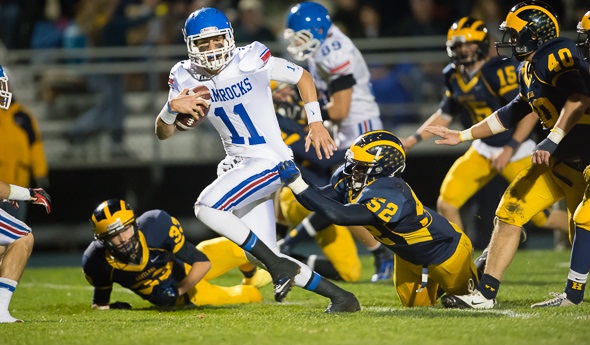
PHOTO: Detroit Catholic Central senior quarterback Garrett Moores (11) tries to break the grasp of Hartland senior lineman Markus Inman (52) during Friday's Division 1 District victory. (Click to see more at Terry McNamara Photography.)