

Constantine Comeback Gets Running Start
By
Wes Morgan
Special for MHSAA.com
September 6, 2018
Shawn Griffith is fully aware of the fact he’s now coached fathers and sons, uncles and nephews during his tenure at Constantine High School.
 That doesn’t make him old, he says; it just means he’s “seasoned.”
It also means he’s now been around long enough to experience both the highs and lows of coaching. Traditionally one of the state’s small-school powerhouses, Constantine lost its way in 2017 with a 3-6 record — Griffith’s first losing season since taking over the program in 2007 and the school’s first sub-.500 season in 26 years.
With a pair of Division 6 championship game appearances (2011 and 2012) and a 114-36 overall record to his credit, last autumn’s fall from grace, though somewhat expected, he said, was a reminder that high school sports still have a cyclical nature.
Attrition, inexperience, lower participation numbers, defensive struggles and fractured team chemistry all attributed to the disappointing season. Still, the Falcons were four points away from five wins, which likely would have been enough to qualify for the playoffs. With a 5-4 regular-season record back in 2013, Constantine went on to advance to the Regional Finals, underscoring Griffith’s mantra of improving each week and what can be accomplished by doing so.
“We knew last year we were going to go through some growing pains,” Griffith said. “I think the 3-6 thing really helped these guys focus in the offseason, and they have done a great job coming together.”
Now the Falcons, 2-0 this year after blowout victories against Gobles (56-0) and Quincy (42-7), are out to reclaim their seat at the table, with expectations just as high as they’ve always been. A few players only need to look at their family trees to be reminded of what’s possible.
Senior fullback Brendon Schragg in particular has a bloodline that traces back to the most memorable year in Constantine football history, as his uncles literally carried the Falcons to their only MHSAA football championship.
 With Griffith then serving as offensive coordinator in 2004 — just the second season after he transitioned the offense from an I-Formation to the Wing-T — senior twins Jim and Mike Schragg lined up in the backfield for the Falcons and combined for nearly 3,800 rushing yards, fueling the team’s title run and 13-1 record.
Mike Schragg, a tailback, rushed for more than 100 yards in the championship game against Suttons Bay, a 34-13 Constantine victory. But it was fullback Jim Schragg’s legendary effort that put him atop the MHSAA record book list for yards in a Final after he went for 307, including an 89-yard run.
“We were loaded with backs,” Jim Schragg said. “It’s a fun offense to run. Some parents get ticked off that we don’t throw it enough, but you have three bad things that can happen with a pass and not too many bad things can happen with a run.
“It’s cool to have your name there with the record and all that. But the state championship is more important to me than the record and running for over 300 yards. The state finals was the whole goal for our senior class. It was state championship or bust. That was what every single kid played for on that team.”
Some things haven’t changed. Though going from a three-win season to a state title is extremely unlikely, Brendon Schragg and his teammates believe they can put together a pretty special year.
“They were superstars to me,” Schragg, who rushed for 575 yards and five touchdowns as a junior, said of his uncles. “I always had the dream that if you go to state, I want to go to state. That’s been a goal since I was 4 years old.
“In my opinion, come Week 5 when we start our (Southwestern Athletic Conference) games, I think we are going to come out and compete. There isn’t a doubt in my mind we can’t win a league title. I ask myself a question every day, ‘Why not us?’”
Brendon Schragg is a three-year starter and one of three returning backs this season. The Falcons haven’t needed complete games out of the trio in the victories so far this year, but Schragg has 145 yards and two TDs on 14 carries. He and teammates Hunter Lindbert and Josh Lawson will probably split the load the rest of the season. Lindbert has compiled 188 yards and 4 TDs on 14 carries, and Lawson has 235 yards and two TDs on 18 carries.
Of course, none of it would be possible without the big guys up front.
“We’re just more physical in the trenches this year,” Schragg said of linemen such as Trenton Stears, Marquise Wykle, Matt Hutton and Austin Loose. “Hutton, our center, both his uncles played on the state championship team, believe it or not.”
Part of Griffith’s job is to both encourage his players to shoot for the moon and to make sure they also have their feet firmly planted on the ground. He certainly understands there are challenges ahead with teams like Kalamazoo United, Watervliet and Schoolcraft.
“We look a lot better,” he said. “But we’re certainly not naïve; we see some pretty darn good football teams on our schedule here coming up. I think our guys have done a real good job of not blowing this out of proportion. It is what it is; it’s a good start. They have done a good job of concentrating and preparing week to week.”
 Wes Morgan has reported for the Kalamazoo Gazette, ESPN and ESPNChicago.com, 247Sports and Blue & Gold Illustrated over the last 12 years and is the publisher of JoeInsider.com. He can be reached at [email protected] with story ideas for Berrien, Cass, St. Joseph and Branch counties.
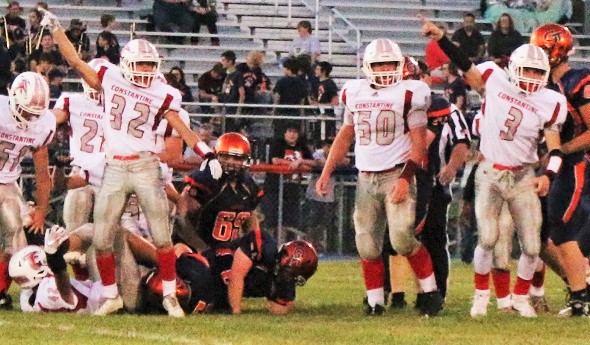
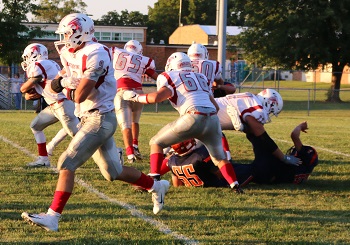
PHOTOS: (Top) Constantine defensive players motion for a turnover during their win over Gobles in Week 1. (Middle) Brendon Schragg, far left, breaks through the Gobles defense. (Photos courtesy of JoeInsider.com.)
DCC, Rice Begin Following New Leaders
By
Tom Markowski
Special for Second Half
August 16, 2017
The Detroit Catholic League football coaching carousel took a few more turns during the offseason, with a pair of programs once led by two of the winningest coaches in state history welcoming new leaders for this fall.
 Two former understudies to those longtime mentors now find themselves with the top jobs directing programs that have combined to earn 18 MHSAA Finals championships.
Adam Korzeniewski, 43, is the new coach at Birmingham Brother Rice, replacing Dave Sofran, who replaced legendary coach Al Fracassa after the Warriors won their third consecutive Division 2 title in 2013.
Dan Anderson, 48, is the new coach at Detroit Catholic Central, taking over for recently-retired Tom Mach, who directed the Shamrocks to a Division 1 runner-up finish nine months ago.
“It is daunting,” Anderson said. “You question yourself. Would Tom have done that? You want to keep the tradition alive. I’m not Tom Mach. I can learn from him and put my stamp on it.”
He and Korzeniewski will seek to do so while navigating what continues to be one of the most competitive leagues in the state. Detroit Catholic Central (10), Brother Rice (8) and Orchard Lake St. Mary’s (7) have combined to amass 25 MHSAA football titles, while Warren DeLaSalle has added two more.
But when Mach announced his retirement from DCC in February, it continued a recent run of Catholic League Central programs passing the baton. Following the 2015 season Paul Verska – who led DeLaSalle to the 2014 Division 2 title – stepped down from the Pilots, and Mike Giannone left Macomb Dakota to fill Verska’s spot. Fracassa retired after the 2013 season with a record of 430-117-7 since starting at Royal Oak Shrine in 1960 and moving to Brother Rice in 1969; he holds Michigan’s record for most high school football coaching wins, while Mach is third with a record of 370-94 from 1976-2016.
St. Mary’s longtime leader George Porritt (256-71 since 1989) will enter this season as the league’s only coach with more than a year heading up the program at his school.
“I’m not a tight T (formation) guy. But I will run it right at you,” Anderson said in explaining a philosophical similarity to Mach. “And I do run some tight T plays. You can’t get rid of the wham. Tom’s philosophy was defense wins championships. That won’t change while I’m here.”
The wham is a basic run play into the middle of the line, a trademark of Mach’s offense. It’s simple but often effective. Anderson said he will install a multiple offense incorporating formations and plays from a variety of schemes as the Shamrocks look to add to last season's 13-1 run.
Anderson has been well-schooled, at Catholic Central and a number of high schools in Ohio where he grew up, played football and coached. He came to Catholic Central in 1999 as a freshmen coach. The next five seasons he was the head junior varsity coach. In 2005, he became a varsity assistant – and in 2007 he became the defensive coordinator.
Anderson played defensive end and offensive tackle at Archbishop Alter in Kettering, Ohio, located near Dayton. He earned a scholarship to University of Pittsburgh where he played guard and was a starter his junior and senior seasons.
Long before then, he knew he wanted to become a teacher and a coach. A junior high history teacher, who was also a coach, played a major role in Anderson becoming the person he is today.
“He coached me in CYO (Catholic Youth Organization),” Anderson said. “He made a big impression upon me. I was 12 or 13 years old, and I knew then I wanted to teach history and coach.
 “I love the game (of football). As soon as I got out of college (1992), I started coaching as a volunteer assistant at Penn Hills (Pa.).”
And he hasn’t stopped coaching since. After leaving Penn Hills, Anderson went to Pomfret, Maryland, located just outside of Washington, D.C., and coached three sports (baseball, basketball and football) at McDonough High. After two years, he went back to his alma mater and spent five years there, the last three as the head football coach. His wife at the time was transferred to General Motors in the Detroit area and, again, Anderson sent out applications and was hired by Catholic Central as a history teacher and football coach.
Anderson said he feels fortunate to be in this position. Learning and having mentors within a parochial school system prepared him for this opportunity and challenge.
“Mach, to me, was a heck of a mentor,” he said. “My high school coach, Ed Domstiz, was one of my mentors, too. And he’s still coaching.
“Tom was laid back. He didn’t take things too seriously. With all of the extracurricular things that go on now, he wanted football to remain a game. That bothered him, the kids jumping from one school to another. To me, high school was a great time, all of the friends that you made. When you move around you miss that.
“For Tom, it was more of his relationships with people. He had the Xs and Os, but it was about building men. That was always an emphasis. You had to develop them into great people. What you saw with Tom is what you got. It was refreshing.”
Though Korzeniewski isn’t directly replacing a legend, Fracassa’s shadow still looms over Brother Rice football; history doesn’t leave us that quickly. Expectations remain high for a program that won three straight Division 2 titles from 2011-13. The Warriors finished 7-4 last fall.
There’s an added unknown for Korzeniewski. He’s never been a head coach before. He’s coached for 17 seasons, including six as Fracassa’s defensive coordinator. The last two seasons Korzeniewski was the defensive coordinator at Birmingham Seaholm, working under his good friend Jim DeWald. The two were teammates at Western Michigan during the mid-1990s.
Korzeniewski’s approach is to keep things simple. He doesn’t see his job as having more pressure than most head coaching positions. As a coach, you teach. For the players, they learn.
“To me, it’s my job,” he said. “I go about it as I would anything else. To other people it would be different. I do my job every day.
“I didn’t come here thinking other people did this or that. It’s the kids. It goes back to why I got into coaching. You see the progress. It’s important to them that they get better. Football is important to them.”
Just as Anderson learned from his predecessor, Korzeniewski has borrowed much from Fracassa.
“I learned the importance of a team,” Korzeniewski said. “Nothing is more important than the team. And there’s something else. He made every player feel a part of the team. He had a way to make kids compete. I wish I could do that.
“What’s important to me is that things get taught and understood. You have to be demanding and supportive. (It’s) the action and reaction.”
Rest assured, both coaches will be watched as if through a microscopic lens. They understand that. They also understand they are heading into once-in-a-lifetime opportunities, and they’re going to make the most of them.
“I’m excited,” Anderson said. “We have a great group of kids. We have a great group of coaches and we’re going to enjoy each other’s company.”
 Tom Markowski is a columnist and directs website coverage for the State Champs! Sports Network. He previously covered primarily high school sports for the The Detroit News from 1984-2014, focusing on the Detroit area and contributing to statewide coverage of football and basketball. Contact him at [email protected] with story ideas for Oakland, Macomb and Wayne counties.
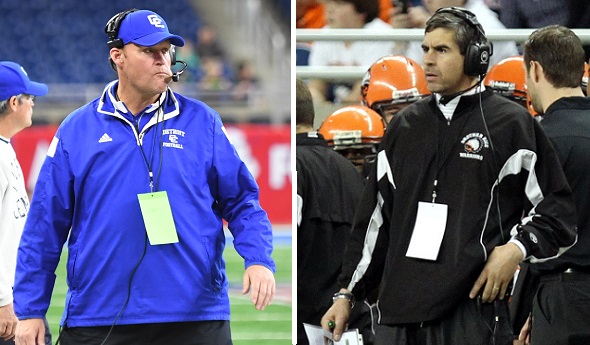
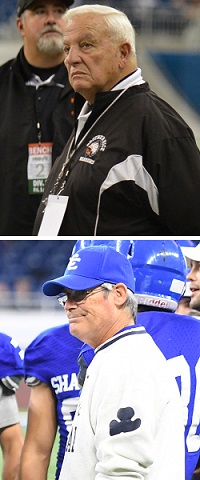
PHOTOS: (Top) Detroit Catholic Central's Dan Anderson (left), here coaching the defense during the 2016 Division 1 Final, and Brother Rice's Adam Korzeniewski, the Warriors' defensive coordinator during their 2012 Division 2 title run, are taking over top Detroit Catholic League programs this fall. (Middle) Former Brother Rice coach Al Fracassa (top) retired after the 2013 season, while DCC's Tom Mach stepped down in February.