

Constantine Comeback Gets Running Start
By
Wes Morgan
Special for MHSAA.com
September 6, 2018
Shawn Griffith is fully aware of the fact he’s now coached fathers and sons, uncles and nephews during his tenure at Constantine High School.
 That doesn’t make him old, he says; it just means he’s “seasoned.”
It also means he’s now been around long enough to experience both the highs and lows of coaching. Traditionally one of the state’s small-school powerhouses, Constantine lost its way in 2017 with a 3-6 record — Griffith’s first losing season since taking over the program in 2007 and the school’s first sub-.500 season in 26 years.
With a pair of Division 6 championship game appearances (2011 and 2012) and a 114-36 overall record to his credit, last autumn’s fall from grace, though somewhat expected, he said, was a reminder that high school sports still have a cyclical nature.
Attrition, inexperience, lower participation numbers, defensive struggles and fractured team chemistry all attributed to the disappointing season. Still, the Falcons were four points away from five wins, which likely would have been enough to qualify for the playoffs. With a 5-4 regular-season record back in 2013, Constantine went on to advance to the Regional Finals, underscoring Griffith’s mantra of improving each week and what can be accomplished by doing so.
“We knew last year we were going to go through some growing pains,” Griffith said. “I think the 3-6 thing really helped these guys focus in the offseason, and they have done a great job coming together.”
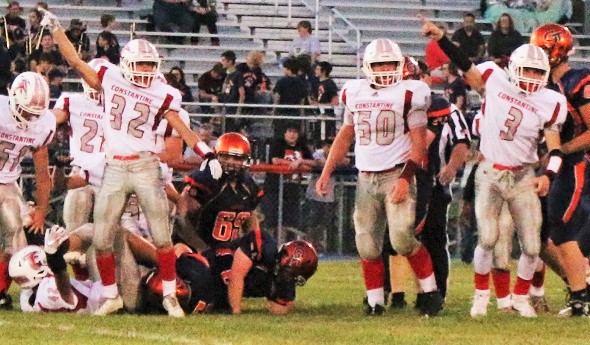
Now the Falcons, 2-0 this year after blowout victories against Gobles (56-0) and Quincy (42-7), are out to reclaim their seat at the table, with expectations just as high as they’ve always been. A few players only need to look at their family trees to be reminded of what’s possible.
Senior fullback Brendon Schragg in particular has a bloodline that traces back to the most memorable year in Constantine football history, as his uncles literally carried the Falcons to their only MHSAA football championship.
 With Griffith then serving as offensive coordinator in 2004 — just the second season after he transitioned the offense from an I-Formation to the Wing-T — senior twins Jim and Mike Schragg lined up in the backfield for the Falcons and combined for nearly 3,800 rushing yards, fueling the team’s title run and 13-1 record.
Mike Schragg, a tailback, rushed for more than 100 yards in the championship game against Suttons Bay, a 34-13 Constantine victory. But it was fullback Jim Schragg’s legendary effort that put him atop the MHSAA record book list for yards in a Final after he went for 307, including an 89-yard run.
“We were loaded with backs,” Jim Schragg said. “It’s a fun offense to run. Some parents get ticked off that we don’t throw it enough, but you have three bad things that can happen with a pass and not too many bad things can happen with a run.
“It’s cool to have your name there with the record and all that. But the state championship is more important to me than the record and running for over 300 yards. The state finals was the whole goal for our senior class. It was state championship or bust. That was what every single kid played for on that team.”
Some things haven’t changed. Though going from a three-win season to a state title is extremely unlikely, Brendon Schragg and his teammates believe they can put together a pretty special year.
“They were superstars to me,” Schragg, who rushed for 575 yards and five touchdowns as a junior, said of his uncles. “I always had the dream that if you go to state, I want to go to state. That’s been a goal since I was 4 years old.
“In my opinion, come Week 5 when we start our (Southwestern Athletic Conference) games, I think we are going to come out and compete. There isn’t a doubt in my mind we can’t win a league title. I ask myself a question every day, ‘Why not us?’”
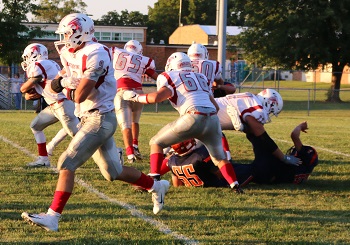
Brendon Schragg is a three-year starter and one of three returning backs this season. The Falcons haven’t needed complete games out of the trio in the victories so far this year, but Schragg has 145 yards and two TDs on 14 carries. He and teammates Hunter Lindbert and Josh Lawson will probably split the load the rest of the season. Lindbert has compiled 188 yards and 4 TDs on 14 carries, and Lawson has 235 yards and two TDs on 18 carries.
Of course, none of it would be possible without the big guys up front.
“We’re just more physical in the trenches this year,” Schragg said of linemen such as Trenton Stears, Marquise Wykle, Matt Hutton and Austin Loose. “Hutton, our center, both his uncles played on the state championship team, believe it or not.”
Part of Griffith’s job is to both encourage his players to shoot for the moon and to make sure they also have their feet firmly planted on the ground. He certainly understands there are challenges ahead with teams like Kalamazoo United, Watervliet and Schoolcraft.
“We look a lot better,” he said. “But we’re certainly not naïve; we see some pretty darn good football teams on our schedule here coming up. I think our guys have done a real good job of not blowing this out of proportion. It is what it is; it’s a good start. They have done a good job of concentrating and preparing week to week.”
 Wes Morgan has reported for the Kalamazoo Gazette, ESPN and ESPNChicago.com, 247Sports and Blue & Gold Illustrated over the last 12 years and is the publisher of JoeInsider.com. He can be reached at [email protected] with story ideas for Berrien, Cass, St. Joseph and Branch counties.
PHOTOS: (Top) Constantine defensive players motion for a turnover during their win over Gobles in Week 1. (Middle) Brendon Schragg, far left, breaks through the Gobles defense. (Photos courtesy of JoeInsider.com.)
History-Making Huskies Reverse Course
October 12, 2016
By Geoff Kimmerly
Second Half editor
Breckenridge football coach Kris Robinson is doing his best to remain guarded despite his team’s history-making run to begin this season.
 But the signs something special is playing out in his community are impossible to miss.
Like the multiple TV crews that came to practice Tuesday, one from WJRT, a local channel that still is based more than 60 miles away in Flint. The second crew, from Fox Sports Detroit, was putting together a feature for its statewide audience.
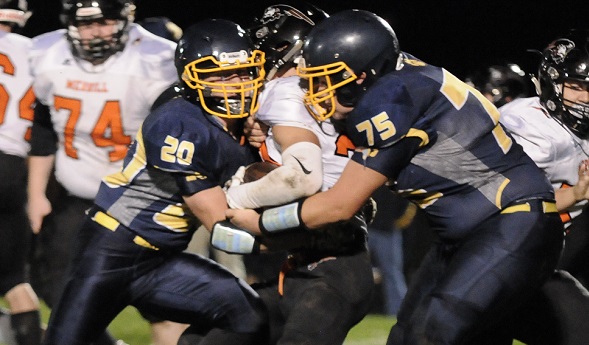
And they are just the latest to take note of the undefeated Huskies, who are 7-0 and clinched their first league championship Friday since 1946 after finishing 0-9 last season.
“The atmosphere here Friday night against Merrill was ridiculous. Our student section, the outpouring has been pretty awesome,” Robinson said. “I was always told – our AD Ryan Sklener played basketball here in the (19)80s and he said when our team was good, they would line up four deep around the basketball court. He said that would happen (for football). I was waiting for it. It didn’t happen when we went 5-4, so I’ve been anxious to see it happen. And it sure has.”
The Breckenridge football team is the first Applebee’s statewide Team of the Month for the 2016-17 school year.
The Huskies have the opportunity to become the first Michigan team in the playoff era (beginning in 1975) to follow an 0-9 finish with a 9-0 regular season – not counting Bellaire, which went 0-9 in 11-player in 2010 but then 9-0 in 8-player the following fall. Even if Breckenridge falls short on that goal, it has guaranteed it will become just the eighth team since 1975 to come back from a winless season to make the playoffs the following year.
A “perfect storm” is how Robinson describes how his team has gone undefeated heading into this week’s matchup with Vestaburg. But truly, a number of pieces have fallen into place to help the Huskies make history – with more opportunities to do so on the way.
Robinson is in his fourth year as coach, having taken over a program in 2013 that went 1-8 the year before and hadn’t made the playoffs since 1993 before qualifying this season with a 38-0 win over Carson City-Crystal on Sept. 30.
His first team finished 2-7, and the Huskies improved to 5-4 in 2014. But they felt all the way back to square one last fall with only three seniors on the team and freshmen at quarterback and running back. Breckenridge scored 68 points over nine games and lost all of them by at least 21.
But things were about to change – and quickly.
“They were ticked off, especially that (current) sophomore group,” said Robinson, who previously coached wrestling at the school and as a football assistant at Farwell and Roscommon. “They’ve won at every level, and for them to come out last year and not win a game, there were some moments last year that were really tough on them.”
 First, Breckenridge – a Class C school with 235 students – is enjoying a roster of 28 players after finishing last fall with only 12. With that jump in numbers has come the opportunity to fit players at their best-possible positions, and at least half on both sides of the ball are playing only one way. Although this team will graduate 14 seniors, another solid group is waiting that is 4-1 at the junior varsity level with only a two-point loss to Fowler. Of 110 boys in the school, 50 are playing football.
Many also put in the time during the offseason. Robinson credits commitment to the weight room for a lot of this team’s turnaround as well, pointing to players like sophomore Lukas Ebright, who was a good JV player last season but added 25 pounds and increased his vertical jump to 32 inches during the offseason to line up this fall as a 5-foot-5, 155-pound cornerback.
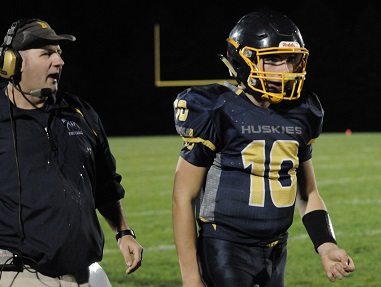
It's also helped greatly that those freshmen playmakers from a year ago have become leading sophomores. Quarterback Carter Staley had run for 773 yards and 10 touchdowns and completed 62 percent of his passes for 711 yards and 12 scores heading into last week’s Merrill game. Including that 12-0 win over the Vandals, Hunter Collins has run for 762 yards and seven touchdowns, averaging more than nine yards per carry. (Click to watch the replay of Breckenridge vs. Merrill on MHSAA.tv.)
In front of them is an offensive line that averages 240 pounds, sizable for sure relative to the size of their school. It’s also been brought up that Breckenridge moved to a league this fall – the Mid-State Activities Conference – that is a better fit, as the Huskies have the third highest enrollment among eight schools in the league compared to when they were the third-smallest of eight schools in the Tri-Valley Conference West in 2015. But that doesn't mean the MSAC is some easy run; Breckenridge included, five of eight teams are 4-3 or better, and four teams are tied for second place in the league at 4-2 in conference games.
The Huskies can clinch the title outright Friday, which would represent another accomplishment – Breckenridge hasn’t won an outright conference championship since 1941.
Trophies celebrating those long-ago league championship seasons are among five total owned by the school – with two others a cup from 1917 and a 1931 trophy with a player kicking a football, except all that’s left is the foot. But that will change shortly, as well.
“We broke the season scoring record in Week 6, and they knew we broke the season scoring record and actually asked me that night if we’ve broken the record for breaking the most records yet,” Robinson said. “So they get it.
“But I don’t think they understand the gravity of the situation. This is older than their grandparents.”
PHOTOS: (Top) A pair of Breckenridge defenders wrap up a Merrill ball carrier during Friday’s 12-0 league title-clinching win. (Middle) Huskies coach Kris Robinson (left) speaks with quarterback Carter Staley. (Click to see more from HighSchoolSportsScene.com.)