

Crampton Hanging Up Official's Whistle After 46 Years of Giving Back
By
Doug Donnelly
Special for MHSAA.com
October 26, 2022
After most high school football games end, the referees typically head for the exits, get to the locker rooms and head home. Rarely do fans, players and coaches notice how they disappear.
 Things were a little different Friday night in Ottawa Lake.
After Ottawa Lake Whiteford beat Pioneer (Ohio) North Central 30-0, the fans stayed in their seats, the players stayed in the handshake line and coaches gathered around as retiring referee Tom Crampton received his place in the spotlight. After nearly 50 years as a high school football referee, Crampton had blown his whistle a final time.
“I feel like I’m at that point,” Crampton said. “I wanted to go as long as I could. I’ve been fortunate to get to this stage.”
Crampton turned 76 in September. The Jackson native got his start as an official during the 1977-78 school year after hurting his knee in a flag football game.
“I was just running across the field and heard something pop,” he said. “I realized my playing days were over. I had a friend who was an official. He got me into it.”
For years Crampton was a football referee in the fall, basketball official in the winter and umpire in the spring. He gave up the other sports about a decade ago but never wanted to give up football, the game he learned as a 10-year-old growing up in Jackson under the tutelage of Howdy Woods.
“He brought sports into my life,” Crampton said. “He worked with the juveniles of Jackson County and was an official himself, I believe. All of us kids knew Howdy. He got me started in sports.”
Sports became a lifelong passion for the retired director of pharmacy for Henry Ford Allegiance. When he and his wife Colleen had children, he thought about stepping back from his referee duties, but his family wasn’t having it.
“My wife and children all encouraged me to keep doing sports,” he said. “When the kids were younger, I said, ‘I really need to taper this back,’ and they didn’t want me to. They followed me. My wife was my biggest fan. After I retired from work, I thought maybe it was time, but she would not let me quit.”
For years Crampton was a back judge. He transitioned to umpire a few years ago because he felt he was better equipped for that role than running up and down the field.
 Chris Dauterman has been an official for 27 years and was a back judge for years before becoming a crew chief only few years ago. Crampton joined his crew when the group of officials he had been working with for decades disbanded due to retirements.
“It’s hard to imagine being dedicated to a hobby that long,” Dauterman said. “That’s really what it is, a hobby. Nobody who does this is doing it for the money. They are doing it for the love of the kids and game. I give him all the respect in the world for putting up with the things he does for so long.
“His knowledge of the rule book and mechanics of an officiating crew is unbelievable,” Dauterman added. “I’ve worked with a lot of officials over the years. In the three years I’ve worked with Tom, he’s helped me transition from back judge to the crew chief. The knowledge he has is tremendous. It’s nice to have him as a sounding board. As another official, it means the world.”
Crampton lives in Lake Columbia, not far from Michigan International Speedway in Brooklyn. He primarily has done games in the Jackson area, including the Cascades Conference and Southeastern Conference the last few years. Friday he was doing a nonleague game between Whiteford and a school from northwest Ohio.
The game ended prematurely when North Central pulled its players off the field at halftime due to injuries and lack of available players to continue.
Before anyone left, however, Crampton was presented with a golden whistle and received a standing ovation for his years of service. After the handshakes, players from both sides greeted Crampton at midfield.
Crampton said most kids haven’t changed in the last 45-plus years he’s been on the field with them. Except for just a few players, most are respectful of him and the sport.
“When I played in the 60s, sports were an extension of the classroom,” he said. “It was learning things of life and that things don’t always work right. There are failures sometimes, but you go on and you pick yourself up and you respect those around you and the competition.
“I think that has waned a little over the years, but most of the kids haven’t changed. Being a referee has been a great experience. I love being out with the kids. Most of the kids out there are great kids, great people. You just have to give them a chance.”
Crampton said he realized his time as an official was nearing the end about a year ago when he said he couldn’t quite get into the position that he wanted during a game. He hopes new officials sign up for the gig and continue the tradition of helping high school athletics.
“We’ve tried recruiting some new officials,” he said. “They were moving up fast now from lower levels to varsity. We’ve lost so many officials over the last few years. I couldn’t have done this without the support of the MHSAA. I’ve enjoyed being everywhere and meeting all the people.”
Crampton worked two MHSAA Finals games during his officiating career and has memories of great athletes, great coaches, and great games to last a lifetime.
“I’ve been fortunate my whole life,” he said. “I’ll miss it, there’s no doubt about it. This is my 66th year of football. How lucky can a person be?”
 Doug Donnelly has served as a sports and news reporter and city editor over 25 years, writing for the Daily Chief-Union in Upper Sandusky, Ohio from 1992-1995, the Monroe Evening News from 1995-2012 and the Adrian Daily Telegram since 2013. He's also written a book on high school basketball in Monroe County and compiles record books for various schools in southeast Michigan. E-mail him at [email protected] with story ideas for Jackson, Washtenaw, Hillsdale, Lenawee and Monroe counties.
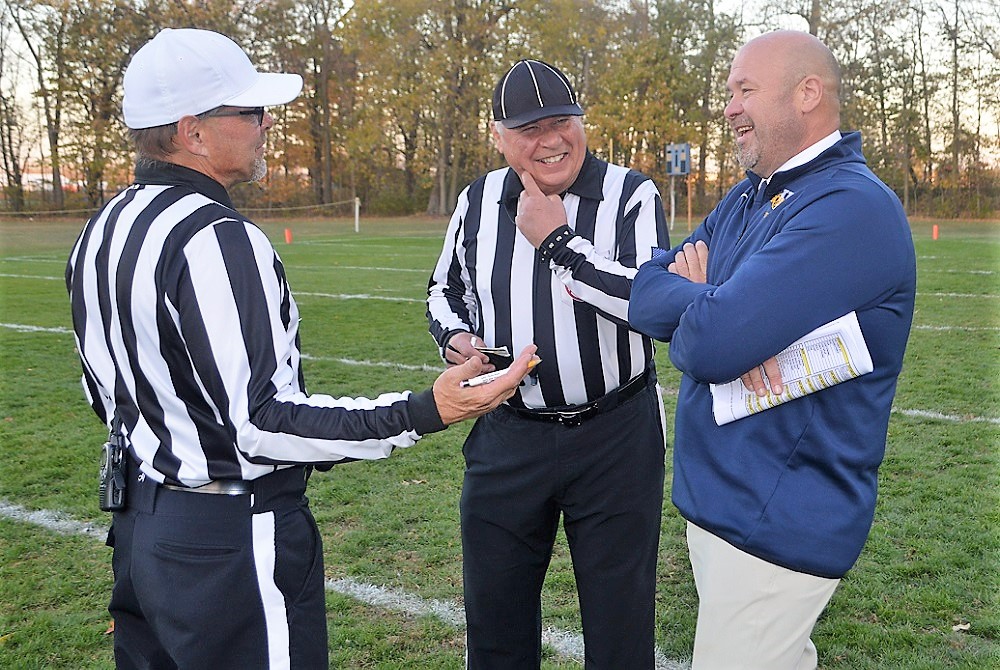
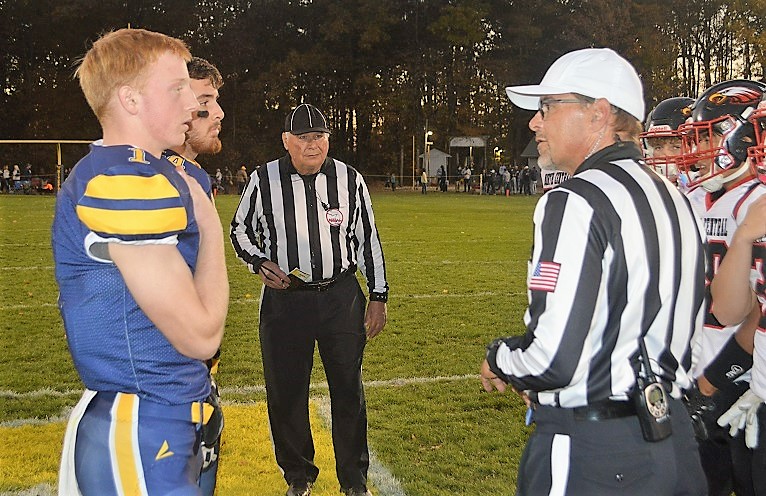
PHOTOS (Top) Retiring official Tom Crampton, middle, shares a laugh with referee colleague Chris Dauterman and Whiteford varsity football coach Todd Thieken before Crampton’s final game Friday. (Middle) Crampton and Dauterman bring Whiteford and Pioneer North Central players together at midfield prior to Friday’s game. (Photos by Doug Donnelly.)
Be the Referee: Basketball Replay
By
Paige Winne
MHSAA Director of Brand Management
March 11, 2026
Be The Referee is a series of short messages designed to help educate people on the rules of different sports, to help them better understand the art of officiating, and to recruit officials.
Below is this week's segment – Basketball Replay - Listen
When watching a college or NBA game, the last two minutes of the game can seem like they take forever, especially in recent years where more and more judgment calls made by officials are subject to instant replay.
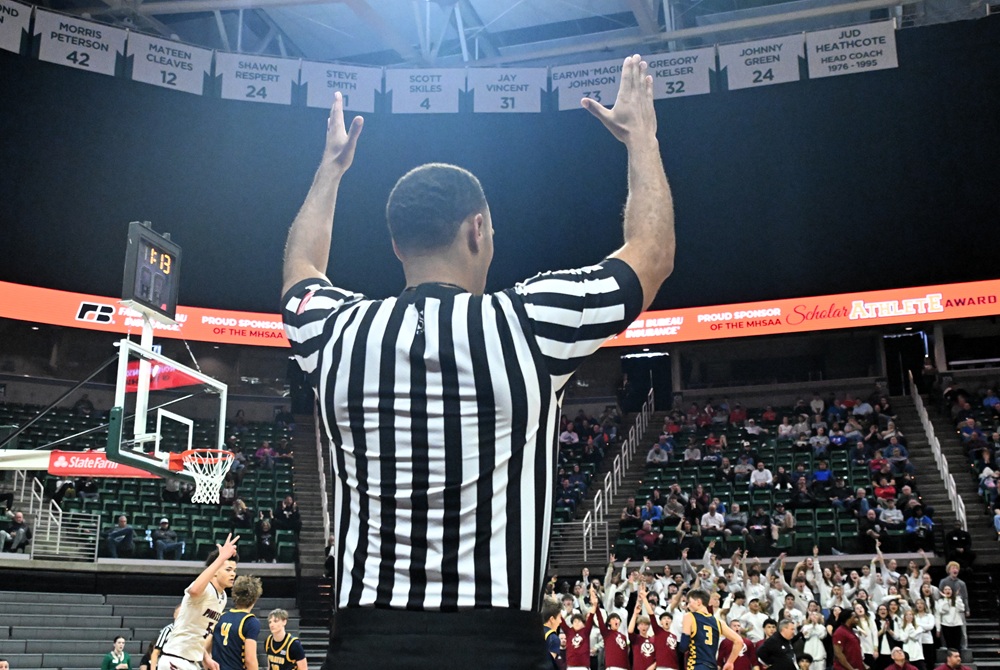
At the high school level, video is not used to make a ruling or confirm or overturn a call made during the course of the contest. The only time video review is used in basketball at the high school level is at the MHSAA Semifinal and Final games.
In these games, video review can be used only to determine if a shot was released in time at the end of the fourth quarter or overtime or if that shot was a 2-point or 3-point field goal attempt.
The MHSAA believes that this very limited use of replay in these games at the very end of the tournament series in boys and girls basketball is the right call.
Previous 2025-26 editions
March 3: Over the Back - Listen
Feb. 24: Wrestling Out-of-Bounds - Listen
Feb. 17: Backwards Skiing - Listen
Feb. 10: Faking Being Fouled - Listen
Feb. 3: Bowling Pins - Listen
Jan. 27: Ski Gates - Listen
Jan. 20: Cheer Judges - Listen
Jan. 13: Basketball Over the Back - Listen
Jan. 6: Bowling Ball Bounces Out of Gutter - Listen
Dec. 9: Puck on Goal Netting - Listen
Dec. 2: Goaltending vs. Basket Interference - Listen
Nov. 25: Football Finals Instant Replay - Listen
Nov. 18: Volleyball Libero Uniforms - Listen
Nov. 11: Illegal Substitution/Participation - Listen
Nov. 4: Losing a Shoe - Listen
Oct. 28: Unusual Soccer Goals - Listen
Oct. 21: Field Hockey Penalty Stroke - Listen
Oct. 14: Tennis Double Hit - Listen
Oct. 7: Safety in Football - Listen
Sept. 30: Field Hockey Substitution - Listen
Sept 23: Multiple Contacts in Volleyball - Listen
Sept. 16: Soccer Penalty Kick - Listen
Sept. 9: Forward Fumble - Listen
Sept. 2: Field Hockey Basics - Listen
Aug. 26: Golf Ball Bounces Out - Listen