

Cvengros Leaves Lasting Impact
By
Geoff Kimmerly
MHSAA.com senior editor
April 1, 2014
Retired Associate Director Jerry Cvengros, who served at the Michigan High School Athletic Association for more than 13 years after three decades at Escanaba High School, died Monday evening in Lansing. He was 80.
As lead assistant to Executive Director John E. “Jack” Roberts from August 1988 until retiring in January 2002, Cvengros served as director of football and briefly hockey in addition to coordinating the Program of Athletic Coaches Education (PACE), presenting annual in-service training for administrators and serving as MHSAA liaison to statewide principals, athletic directors and coaches associations.
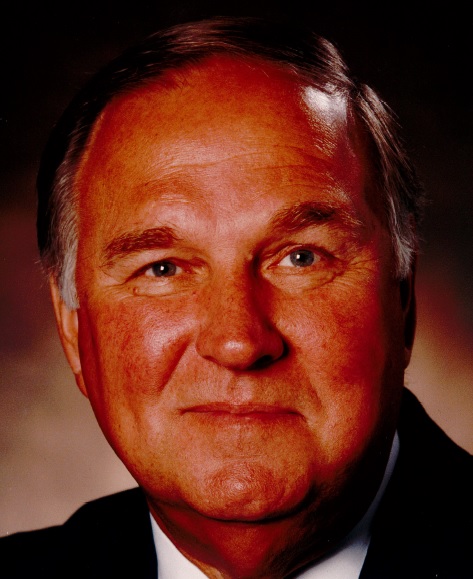 He came to the MHSAA after 30 years at Escanaba, where he taught, coached, served as athletic director and later principal during a tenure stretching from August 1958 through July 1988. While at Escanaba, Cvengros also represented Upper Peninsula Class A and B schools on the MHSAA Representative Council from 1983-88 and served as the Council’s president from 1986-88.
Cvengros received the MHSAA’s Charles E. Forsythe Award in 2000 in recognition of his many and significant contributions to interscholastic athletics.
“During his lifetime, Jerry Cvengros impacted every area of interscholastic athletics as a coach, athletic director, principal and then associate director of the MHSAA," Roberts said. “He was the perfect combination of fairness, toughness and diplomacy, able to draw on a vast knowledge of MHSAA rules and an understanding of educational athletics fostered by his various experiences.
“Jerry was known and respected statewide for his dedication, and his contributions have had a lasting impact.”
Cvengros built an elite football program at Escanaba as varsity head coach from 1962-84, leading the Eskymos to a 161-42-3 record, a Class A runner-up finish in 1979 and the MHSAA championship in 1981. That team remains the only Class A/Division 1 team from the Upper Peninsula to win an MHSAA football title. Cvengros was inducted into the Michigan High School Football Coaches Association Hall of Fame and served on its original Board of Directors.
His 1979 team fell to Detroit Catholic Central 32-7, but he brought the Eskymos back to the Finals for a 16-6 win over Fraser two seasons later. Cvengros' championship lineup included quarterback Kevin Tapani, who would go on to pitch for the Minnesota Twins among five major league clubs, and tailback Dean Altobelli, who later played at Michigan State University. The title run included a 15-14 Semifinal win over Dearborn Fordson that included a savvy two-point conversion call by Cvengros, who wanted to avoid overtime after a late score drew Escanaba to within a point of tying the score.
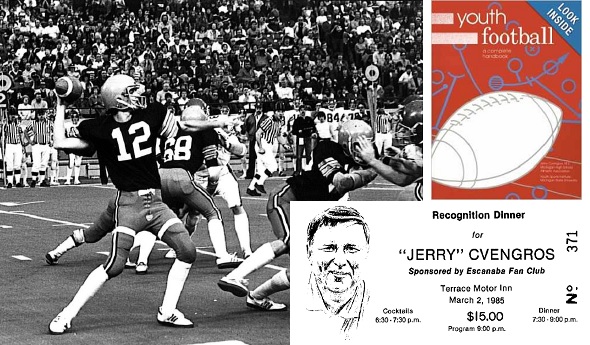
As the MHSAA’s director of football, Cvengros was instrumental in creating the current playoff format that expanded the field from 128 to 256 teams beginning with the 1999 season. He also co-authored “Youth Football: A Complete Handbook,” a guide to coaching at that level.
Among many additional honors, Cvengros was inducted into the Upper Peninsula Sports Hall of Fame and Michigan High School Coaches Association Hall of Fame and received the Distinguished Service Award from the Michigan Interscholastic Athletic Administrators Association. The National Federation of State High School Associations twice awarded Cvengros with a Citation – the NFHS’ highest honor – for his service as a coach and then as a member of the MHSAA staff.
Since his retirement, Cvengros and his wife Shelley have continued to reside in Okemos. A visitation will take place beginning at 10 a.m. Monday, April 7, at St. Martha Parish in Okemos, with a funeral Mass to follow at 11 a.m.
Cvengros was a 1951 graduate of Ironwood High School and went on to study and play football at the University of Wisconsin in Madison. He earned his bachelor’s degree in secondary education and teaching from the University of Wisconsin-Superior and a master’s from Northern Michigan University.
He taught English, history and physical education at Escanaba High School and also coached basketball and track and field. He became the school’s athletic director in 1970, added the duties of activities director in 1975 and became principal in 1983.
Cvengros is survived by his wife and children Michael, Steven and David, and seven grandchildren. He was preceded in death by his daughter Lee Ann (Cvengros) Swasey in May 2013.
PHOTOS: (Clockwise from left) Escanaba quarterback Mike Beveridge fires a pass during the 1979 Class A Final; Cvengros co-authored a book on coaching youth football; Cvengros was celebrated once more in Escanaba following his final season as football coach.
1st & Goal: 2022 Week 3 Preview
By
Geoff Kimmerly
MHSAA.com senior editor
September 9, 2022
With Labor Day behind us, all Michigan high schools are back in session – and just in time for league competition to begin for several conferences across the state.
 League matchups make up most of our “games to watch” as we prep for Week 3, with the most intriguing from every region highlighted below.
Games are Friday unless noted. Click for the full schedule from MHSAA.com and check out the broadcast schedule from MHSAA.tv.
Bay & Thumb
Armada (2-0) at Croswell-Lexington (2-0)
The way this season has begun – and the way last season ended – makes this matchup look like a potential title-decider in the Blue Water Area Conference. Croswell-Lexington was last year champion, thanks in part to holding off co-runner-up Armada 30-14 in the final game on the league schedule. The Pioneers have outscored their first two opponents this fall by a combined 95-14, while Armada made a loud statement immediately with a 28-27 season-opening win over Marine City, last season’s Division 5 runner-up.
Keep an eye on these FRIDAY Marlette (2-0) at Ubly (2-0), Grand Blanc (1-1) at Saginaw Heritage (2-0), Traverse City Central (1-1) at Davison (1-1), Hemlock (1-1) at Millington (2-0).
Greater Detroit
Livonia Churchill (1-1) at Belleville (2-0)
Belleville is off to another strong start this fall coming off last season’s Division 1 championship. But tonight’s matchup could help the Tigers do one better this fall in their repeat attempt. Churchill last season won the Week 3 meeting 28-21, handing Belleville its first regular-season loss since 2016 and only loss of 2021. But the Chargers must bounce back quickly to make this game another classic after seeing a seven-game winning streak against Westland John Glenn end with a 21-20 loss last week.
Keep an eye on these FRIDAY Clarkston (1-1) at Rochester Adams (2-0), Utica Eisenhower (2-0) at Clinton Township Chippewa Valley (2-0), DeWitt (2-0) at Detroit Catholic Central (1-1), Warren Michigan Collegiate (2-0) at Detroit Country Day (2-0).
Mid-Michigan
Fowler (2-0) at Bath (2-0)
The Bees are off to their best start since 2017, already avenging one loss from when the team finished 2-7 a year ago. But this matchup could tell a lot more about where Bath is headed in 2022. The Bees fell to Fowler 47-14 last season and will be seeking to break a five-game losing streak to the Eagles. Fowler has opened with wins over 2021 playoff qualifiers Carson City-Crystal and Petersburg Summerfield, both by 20-plus points.
Keep an eye on these FRIDAY Saginaw Nouvel (2-0) at Ithaca (1-1), Fowlerville (1-1) at Mason (2-0), Pewamo-Westphalia (1-1) at Dansville (2-0), Durand (2-0) at Ovid-Elsie (1-1).
Northern Lower Peninsula
St. Ignace (2-0) at Frankfort (2-0)
The Saints own one of the best rebound stories of the early going after finishing 2-7 a year ago and winning one game in 2020. They’ve outscored their first opponents by a combined 74-6. Granted, both opponents are winless so far this season and were winless last year as well, but Frankfort will give St. Ignace a better idea how it measures up in what should be a super-competitive Northern Michigan Football League Legacy division. The Panthers have followed their best finish (6-4) since 2017 with a pair of big victories including last week over 2021 playoff qualifier Mancelona.
Keep an eye on these FRIDAY Mount Pleasant (2-0) at Cadillac (1-1), Boyne City (2-0) at Grayling (1-1), Charlevoix (2-0) at Mancelona (1-1), Bay City Western (1-1) at Traverse City West (1-1).
Southeast & Border
Napoleon (2-0) at Manchester (2-0), Saturday
This Saturday showdown presents some interesting possibilities as both look to rise in the Cascades Conference. Napoleon was a contender into October last season before losing the final two games on the league schedule, but was in play in part thanks to a 20-18 win over Manchester in Week 3. The Flying Dutchmen have factored into the race a couple of times since their league title season of 2015, and edged reigning Cascades champion Addison 29-26 last week to re-enter the mix.
Keep an eye on these FRIDAY Grosse Ile (2-0) at Milan (1-1), Hanover-Horton (1-1) at Addison (1-1), Hastings (1-1) at Jackson Lumen Christi (0-2), Centreville (1-1) at Sand Creek (1-1).
Southwest Corridor
Lawton (2-0) at Constantine (1-1)
Lawton is off to another solid start coming off last season’s run to the Division 7 championship game, and additionally the Blue Devils have won 12 straight regular-season games and 25 of their last 26. All but two of those 25 wins were by double digits – with the lone loss to Schoolcraft in 2020 – but Lawton also hasn’t played Constantine since 2017. The Falcons saw their 15-game regular-season winning streak end with a 22-20 loss to reigning Division 8 champion Hudson last week. Before that, no regular-season opponent had come within single digits of catching Constantine since the second game of 2020.
Keep an eye on these FRIDAY Schoolcraft (2-0) at Kalamazoo United (2-0), Battle Creek Lakeview (1-0) at Portage Central (0-2), Plainwell (2-0) at Sturgis (1-1), Allegan (2-0) at Berrien Springs (2-0).
Upper Peninsula
Gladstone (2-0) at Menominee (1-1)
The Maroons regained the Great Northern Conference title last season, sharing it with Kingsford, but earned that claim also because they were able to survive a 35-34 challenge from Gladstone. Menominee has won three straight in this series, but is coming off a rough outing last week against an opponent from Illinois. Gladstone, meanwhile, is off to its third 2-0 start in four seasons but looking to get to 3-0 for the first time since 2017. There’s a little more reason for excitement this time though – both of those first two wins came against 2021 league champions.
Keep an eye on these FRIDAY Houghton (2-0) at Iron Mountain (1-1), Cheboygan (1-1) at Sault Ste. Marie (2-0), Ishpeming Westwood (0-2) at Calumet (0-2). SATURDAY Gaylord (2-0) at Marquette (0-2).
West Michigan
Zeeland East (0-2) at Zeeland West (2-0)
On first glance, this might not seem like much more than the next chapter in a rivalry. But there is some near-uniqueness to this rivalry – it’s one of the few in Michigan where the schools are next door to each other. West has won the last four meetings, including a matchup during the 2019 playoffs, and has rocketed to wins over Stevensville Lakeshore and Cedar Springs – two playoff teams from last season. East’s losses, however, also have come to 2021 playoff qualifiers – Williamston and Spring Lake – and the Chix lost to the Lakers by just seven points.
Keep an eye on these FRIDAY Grand Rapids Forest Hills Central (2-0) at Byron Center (1-1), East Kentwood (1-1) at Grand Haven (1-1), Grand Rapids West Catholic (2-0) at Spring Lake (1-1), Ludington (2-0) at Fremont (2-0).
8-Player
Lake Linden-Hubbell (2-0) at Norway (2-0)
Two-time reigning Division 2 champion Powers North Central has set the pace lately in the Great Lakes Conference West. But the league is full of contenders. The Jets are ranked No. 1 this week, but Crystal Falls Forest Park is No. 3, Lake Linden-Hubbell is No. 5 and Norway could make its way into the Division 1 top 10 with a win over the Lakes. The Knights won last season’s meeting 30-8 and have opened this fall outscoring its first two opponents by a combined 102-12. Lake Linde-Hubbell’s margin is a similar 119-30.
Keep an eye on these FRIDAY Adrian Lenawee Christian (2-0) at Pittsford (2-0), Bridgman (2-0) at Mendon (1-1), Merrill (2-0) at Fulton (1-1). SATURDAY Marion (2-0) at Mesick (2-0).
Second Half’s weekly “1st & Goal” previews and reviews are powered by MI Student Aid, a part of the Office of Postsecondary Financial Planning located within the Michigan Department of Treasury. MI Student Aid encourages students to pursue postsecondary education by providing access to student financial resources and information. MI Student Aid administers the state’s 529 college savings programs (MET/MESP), as well as scholarship and grant programs that help make college Accessible, Affordable and Attainable for you. Connect with MI Student Aid at www.michigan.gov/mistudentaid and find more information on Facebook and Twitter @mistudentaid.
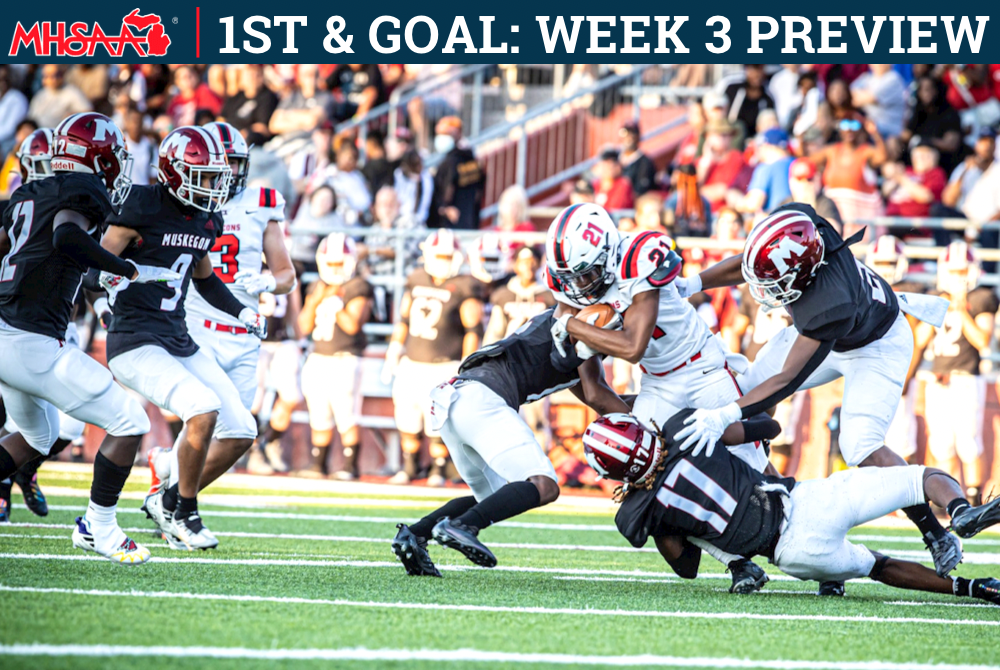
PHOTO: A trio of Muskegon defenders bring down an East Kentwood ball carrier during the Big Reds’ 20-14 season-opening win. (Photo by Tim Reilly.)