

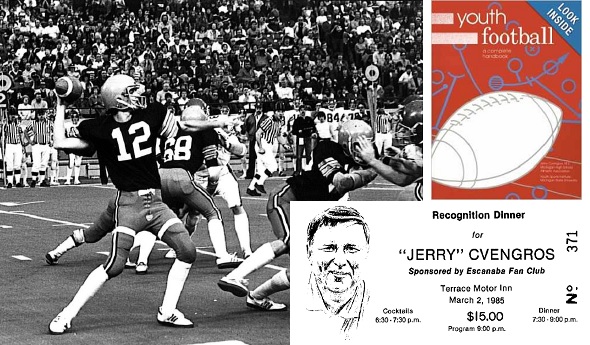
Cvengros Leaves Lasting Impact
By
Geoff Kimmerly
MHSAA.com senior editor
April 1, 2014
Retired Associate Director Jerry Cvengros, who served at the Michigan High School Athletic Association for more than 13 years after three decades at Escanaba High School, died Monday evening in Lansing. He was 80.
As lead assistant to Executive Director John E. “Jack” Roberts from August 1988 until retiring in January 2002, Cvengros served as director of football and briefly hockey in addition to coordinating the Program of Athletic Coaches Education (PACE), presenting annual in-service training for administrators and serving as MHSAA liaison to statewide principals, athletic directors and coaches associations.
 He came to the MHSAA after 30 years at Escanaba, where he taught, coached, served as athletic director and later principal during a tenure stretching from August 1958 through July 1988. While at Escanaba, Cvengros also represented Upper Peninsula Class A and B schools on the MHSAA Representative Council from 1983-88 and served as the Council’s president from 1986-88.
Cvengros received the MHSAA’s Charles E. Forsythe Award in 2000 in recognition of his many and significant contributions to interscholastic athletics.
“During his lifetime, Jerry Cvengros impacted every area of interscholastic athletics as a coach, athletic director, principal and then associate director of the MHSAA," Roberts said. “He was the perfect combination of fairness, toughness and diplomacy, able to draw on a vast knowledge of MHSAA rules and an understanding of educational athletics fostered by his various experiences.
“Jerry was known and respected statewide for his dedication, and his contributions have had a lasting impact.”
Cvengros built an elite football program at Escanaba as varsity head coach from 1962-84, leading the Eskymos to a 161-42-3 record, a Class A runner-up finish in 1979 and the MHSAA championship in 1981. That team remains the only Class A/Division 1 team from the Upper Peninsula to win an MHSAA football title. Cvengros was inducted into the Michigan High School Football Coaches Association Hall of Fame and served on its original Board of Directors.
His 1979 team fell to Detroit Catholic Central 32-7, but he brought the Eskymos back to the Finals for a 16-6 win over Fraser two seasons later. Cvengros' championship lineup included quarterback Kevin Tapani, who would go on to pitch for the Minnesota Twins among five major league clubs, and tailback Dean Altobelli, who later played at Michigan State University. The title run included a 15-14 Semifinal win over Dearborn Fordson that included a savvy two-point conversion call by Cvengros, who wanted to avoid overtime after a late score drew Escanaba to within a point of tying the score.
As the MHSAA’s director of football, Cvengros was instrumental in creating the current playoff format that expanded the field from 128 to 256 teams beginning with the 1999 season. He also co-authored “Youth Football: A Complete Handbook,” a guide to coaching at that level.
Among many additional honors, Cvengros was inducted into the Upper Peninsula Sports Hall of Fame and Michigan High School Coaches Association Hall of Fame and received the Distinguished Service Award from the Michigan Interscholastic Athletic Administrators Association. The National Federation of State High School Associations twice awarded Cvengros with a Citation – the NFHS’ highest honor – for his service as a coach and then as a member of the MHSAA staff.
Since his retirement, Cvengros and his wife Shelley have continued to reside in Okemos. A visitation will take place beginning at 10 a.m. Monday, April 7, at St. Martha Parish in Okemos, with a funeral Mass to follow at 11 a.m.
Cvengros was a 1951 graduate of Ironwood High School and went on to study and play football at the University of Wisconsin in Madison. He earned his bachelor’s degree in secondary education and teaching from the University of Wisconsin-Superior and a master’s from Northern Michigan University.
He taught English, history and physical education at Escanaba High School and also coached basketball and track and field. He became the school’s athletic director in 1970, added the duties of activities director in 1975 and became principal in 1983.
Cvengros is survived by his wife and children Michael, Steven and David, and seven grandchildren. He was preceded in death by his daughter Lee Ann (Cvengros) Swasey in May 2013.
PHOTOS: (Clockwise from left) Escanaba quarterback Mike Beveridge fires a pass during the 1979 Class A Final; Cvengros co-authored a book on coaching youth football; Cvengros was celebrated once more in Escanaba following his final season as football coach.

Bad Axe Sharp Again in Building on 2020 Success with 5-0 Start
By
Paul Costanzo
Special for MHSAA.com
September 30, 2021
When it comes to dishing out praise for the newfound success of the Bad Axe football program, those involved are doing plenty of finger pointing.
 The good kind.
“I think it’s all the responsibility of our head coach, coach (Kal) Pokley,” Bad Axe senior offensive and defensive lineman Sam Hass said. “He was essential to our team – just his coaching skills and bringing us all together and getting us focused for our games.”
Pokley pointed right back.
“It really comes down to the kids and the parents,” he said. “The kids have really bought into the program. They’ve bought into our offense and our defense. They trust it, and they know it works. Because of that, we’ve been able to be more successful. They’re very hard workers, and they’ve been willing to put in the work in the offseason.”
They’re both right, and now the Hatchets are reaping the benefits. After a 2020 season that saw it win a share of the Greater Thumb Conference West title and earn its first playoff victory since 1978, Bad Axe is now off to a 5-0 start, its best since 2001.
“It’s a blast to see all of our hard work pay off – all the hard work we put in through the offseason,” junior quarterback and defensive back Keaton Braun said. “I think last year, winning our first league title in who knows how long, and our first playoff win and everything, it kind of puts in perspective how hard work can lead you in the right direction.”
 Pokley took over the Bad Axe program as head coach prior to the 2020 season, after serving as a junior high and junior varsity coach the previous four seasons. He inherited a program that had a single playoff appearance (2014) since 2001, and just nine winning seasons during the playoff era (since 1975). The 1978 team lost in the Class C Final, but the three playoff wins that season represented the only three in program history prior to 2020.
But Pokley had coached the JV team to a perfect record in 2019, and saw the potential in the players within the program. While they opened the 2020 season with a 36-6 loss to Sandusky, Pokley’s optimism for the program didn’t waver, and his players backed that up, showing up early for a Sunday film session following that game. The Hatchets would win their next four, not allowing a “here we go again” attitude to creep in.
“As a coaching staff, that wasn’t going to be an option, so it wasn’t talked about,” Pokley said. “We had done some preseason polls, some meetings with the kids, and a bunch of the seniors from last year, they were very vocal early on that they weren’t OK with that, and they weren’t going to let that happen.”
The Hatchets finished the regular season 4-2, their other loss coming against Division 8 finalist Ubly, and defeated rival Elkton-Pigeon-Bay Port Laker in the opening round of the playoffs before losing 20-17 to Hemlock in the second round.
“It felt pretty good knowing that we had changed the culture,” Hass said. “For years, Bad Axe had kind of been on the (back) end of the league. Being part of a team that kind of flipped that around felt pretty good.”
That has continued into this season, as Bad Axe is perfect heading into Week 6 when it will take on another undefeated GTC West team, Reese. To get to this point, the Hatchets have ridden a balanced offensive attack and a dominant defense. After winning 42-33 in Week 1 against perennial Greater Thumb Conference contender Harbor Beach, the Hatchets have allowed just 14 points total over their past four games.
That defensive effort has been led by junior linebacker Jake MacPhee, who has 41 tackles on the season.
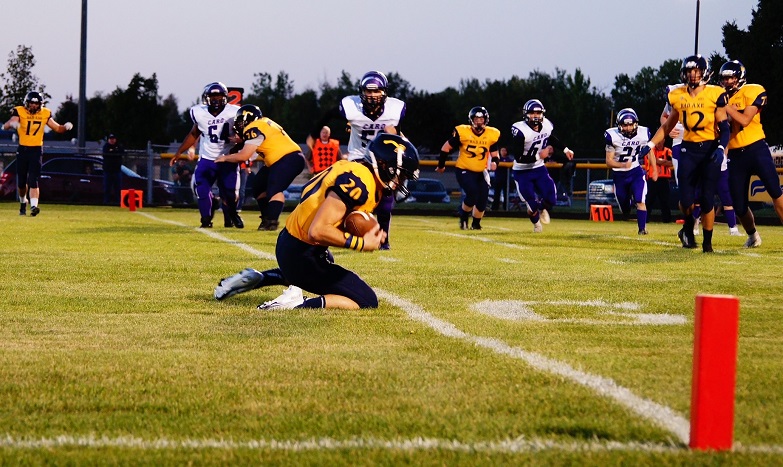
 Offensively, the Hatchets have had multiple players stand out on different nights. Braun was the star against Harbor Beach, running for 165 yards and throwing for 146 more, along with two touchdowns. Griffin Meinhold (135 yards, two touchdowns) and Devyn Howard (116 yards, one touchdown) led the attack against Cass City, and Blake Talaski (82 yards, two touchdowns) handled things against Caro.
Braun is averaging an impressive 8.7 yards per carry through five weeks, and he’s well behind Meinhold (16.8) and Howard (17.2), who are spitting out big plays nearly every time they touch the ball.
“They’re focused, and they know they’re capable as long as they’re continuing to put in the hard work,” Pokley said. “Up to this point, they’ve really been focused on doing the right things – staying after practice, watching film, staying healthy and getting good grades. It’s really a blessing – I can’t say enough about this group of kids.”
The players said they’ve noticed a different energy around town and in their school, which has turned into big, excited crowds on Friday nights.
“There are a lot more people showing up to our games,” senior offensive and defensive lineman Austin Volmering said. “There’s a lot more cheering, and that helps us get more momentum.”
The Hatchets are hoping that momentum turns into another GTC West title, and then a longer playoff run. They aren’t shying away from the biggest of goals, either, as they feel they can play with anyone lined up in front of them. After seeing some of their league mates make deep runs, there’s a bit of a “why not us?” vibe in a program where that once seemed unthinkable.
“It motivates us a lot to see (Ubly, Harbor Beach and other GTC teams) getting to that stage in the playoffs, and know that a small-town team can play football with the bigger towns and bigger teams,” Meinhold said. “It means a lot knowing that they can do that, and we believe that we can, too.”
 Paul Costanzo served as a sportswriter at The Port Huron Times Herald from 2006-15, including three years as lead sportswriter, and prior to that as sports editor at the Hillsdale Daily News from 2005-06. He can be reached at [email protected] with story ideas for Genesee, Lapeer, St. Clair, Sanilac, Huron, Tuscola, Saginaw, Bay, Arenac, Midland and Gladwin counties.
PHOTOS (Top) The Bad Axe offense, including Noah Braun (53) and Draiden Romas (24), lines up against Caro during their Week 5 matchup. (Middle) Blake Talaski (20) pulls in a touchdown grab against the Tigers. (Below) The Hatchets are off to their best season start since 2001. (Photos courtesy of the Bad Axe football program.)