

Cvengros Leaves Lasting Impact
By
Geoff Kimmerly
MHSAA.com senior editor
April 1, 2014
Retired Associate Director Jerry Cvengros, who served at the Michigan High School Athletic Association for more than 13 years after three decades at Escanaba High School, died Monday evening in Lansing. He was 80.
As lead assistant to Executive Director John E. “Jack” Roberts from August 1988 until retiring in January 2002, Cvengros served as director of football and briefly hockey in addition to coordinating the Program of Athletic Coaches Education (PACE), presenting annual in-service training for administrators and serving as MHSAA liaison to statewide principals, athletic directors and coaches associations.
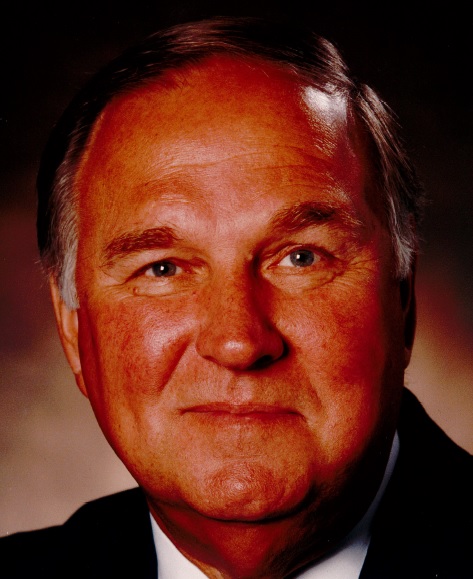
He came to the MHSAA after 30 years at Escanaba, where he taught, coached, served as athletic director and later principal during a tenure stretching from August 1958 through July 1988. While at Escanaba, Cvengros also represented Upper Peninsula Class A and B schools on the MHSAA Representative Council from 1983-88 and served as the Council’s president from 1986-88.
Cvengros received the MHSAA’s Charles E. Forsythe Award in 2000 in recognition of his many and significant contributions to interscholastic athletics.
“During his lifetime, Jerry Cvengros impacted every area of interscholastic athletics as a coach, athletic director, principal and then associate director of the MHSAA," Roberts said. “He was the perfect combination of fairness, toughness and diplomacy, able to draw on a vast knowledge of MHSAA rules and an understanding of educational athletics fostered by his various experiences.
“Jerry was known and respected statewide for his dedication, and his contributions have had a lasting impact.”
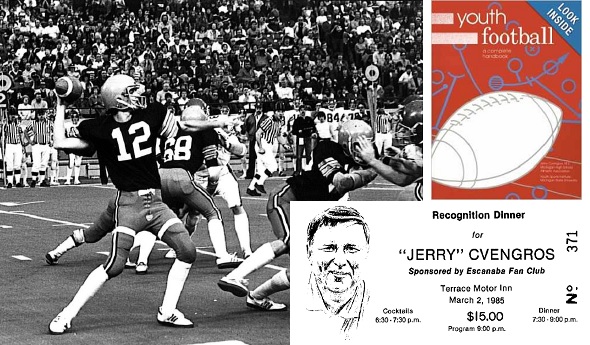
Cvengros built an elite football program at Escanaba as varsity head coach from 1962-84, leading the Eskymos to a 161-42-3 record, a Class A runner-up finish in 1979 and the MHSAA championship in 1981. That team remains the only Class A/Division 1 team from the Upper Peninsula to win an MHSAA football title. Cvengros was inducted into the Michigan High School Football Coaches Association Hall of Fame and served on its original Board of Directors.
His 1979 team fell to Detroit Catholic Central 32-7, but he brought the Eskymos back to the Finals for a 16-6 win over Fraser two seasons later. Cvengros' championship lineup included quarterback Kevin Tapani, who would go on to pitch for the Minnesota Twins among five major league clubs, and tailback Dean Altobelli, who later played at Michigan State University. The title run included a 15-14 Semifinal win over Dearborn Fordson that included a savvy two-point conversion call by Cvengros, who wanted to avoid overtime after a late score drew Escanaba to within a point of tying the score.
As the MHSAA’s director of football, Cvengros was instrumental in creating the current playoff format that expanded the field from 128 to 256 teams beginning with the 1999 season. He also co-authored “Youth Football: A Complete Handbook,” a guide to coaching at that level.
Among many additional honors, Cvengros was inducted into the Upper Peninsula Sports Hall of Fame and Michigan High School Coaches Association Hall of Fame and received the Distinguished Service Award from the Michigan Interscholastic Athletic Administrators Association. The National Federation of State High School Associations twice awarded Cvengros with a Citation – the NFHS’ highest honor – for his service as a coach and then as a member of the MHSAA staff.
Since his retirement, Cvengros and his wife Shelley have continued to reside in Okemos. A visitation will take place beginning at 10 a.m. Monday, April 7, at St. Martha Parish in Okemos, with a funeral Mass to follow at 11 a.m.
Cvengros was a 1951 graduate of Ironwood High School and went on to study and play football at the University of Wisconsin in Madison. He earned his bachelor’s degree in secondary education and teaching from the University of Wisconsin-Superior and a master’s from Northern Michigan University.
He taught English, history and physical education at Escanaba High School and also coached basketball and track and field. He became the school’s athletic director in 1970, added the duties of activities director in 1975 and became principal in 1983.
Cvengros is survived by his wife and children Michael, Steven and David, and seven grandchildren. He was preceded in death by his daughter Lee Ann (Cvengros) Swasey in May 2013.
PHOTOS: (Clockwise from left) Escanaba quarterback Mike Beveridge fires a pass during the 1979 Class A Final; Cvengros co-authored a book on coaching youth football; Cvengros was celebrated once more in Escanaba following his final season as football coach.
Rep Council Wrap-Up: Spring 2021
By
Geoff Kimmerly
MHSAA.com senior editor
May 6, 2021
The addition of a girls division to the Individual Wrestling Tournament series and approval of a common start date for all Fall sports highlighted actions taken by the Representative Council of the Michigan High School Athletic Association during its annual Spring Meeting on May 3.
The Spring Meeting of the 19-member legislative body of the Association’s more than 1,500 member schools is generally the busiest of its sessions each year. The Council considered 19 committee proposals and dealt with a variety of eligibility rule, postseason tournament and operational issues.
Beginning with the 2021-22 school year, a championship division for female competitors who participate on MHSAA member school teams will be added to the Individual Wrestling Tournament series. There will be 14 champions awarded, based on weight classes established by the National Federation of State High School Associations. Qualifiers will be determined via a sectional format, and girls will continue to compete on boys teams during regular-season and team tournament competition; girls also may choose to compete in the boys individual tournament instead of the girls bracket. A total of 401 girls competed in wrestling for MHSAA member schools during the 2019-20 school year, up from 250 in 2017-18 and then 327 in 2018-19. The girls division proposal had been put forth by the MHSAA Wrestling Committee.
The Council also voted to move the start of all Fall sports practices to the same day. Those sports now may begin on the 16th Monday before Thanksgiving. Previously, football started on a Monday and all other sports began Wednesday. For the upcoming school year, the Fall sports start date is Aug. 9, 2021.
As it has during most meetings over the 2020-21 school year, the Council continued to discuss possible adjustments because of the COVID-19 pandemic and disruption it has caused to Michigan high school athletics. Notably, the Council approved an extension of the waiver of the previous academic record regulation for sports played in Fall 2021. This is the third extension of the waiver. The previous academic record regulation requires participants to have received credit for at least 66 percent of a full credit load during the previous semester. As COVID-19 has resulted in various academic scheduling adjustments, schools will continue to determine if athletes have met the credit level necessary to be eligible for athletics this fall.
The Council also made permanent the allowance for cooperative programs in nine sports among schools of the same public school district regardless of the 3,500-student enrollment maximum. Those co-op programs were first allowed as part of a two-year experiment beginning with the 2016-17 school year to increase possibilities for participation in those sports – baseball, bowling, girls competitive cheer, cross country, golf, soccer, softball, tennis and wrestling. Schools taking part in these co-op programs must continue to show a demonstrated history of inadequate numbers of participants and apply for renewal every two years.
Here is a summary of other notable actions taken by the Representative Council at the Spring Meeting, which will take effect during the 2021-22 school year:
Athletic Equity
• The Council approved an Athletic Equity Committee recommendation to publish the following statement to suggest to local schools that they review nicknames and school logos that are considered offensive or hurtful to minority groups or demonstrate an insensitive bias:
“The MHSAA recognizes the importance of equity in high school sports. Schools and mascots are rich in tradition and unique to each community. Although we understand the tradition of those individual communities, we also wish to support and foster an environment of inclusion. It is in this spirit that the MHSAA encourages member schools and communities to evaluate and reconsider names and mascots that may be offensive to groups of individuals.”
Officials
• The Council approved an Officials Review Committee recommendation to adjust the officials rating system with the hope of encouraging more ratings and providing a more specific understanding of an official’s overall body of work. Instead of the current overall 1-5 rating system, officials will receive specific feedback in four categories: judgment, presence and demeanor, attitude and effort, and administration and communication.
Sport Matters
• In bowling, the Council approved a Bowling Committee recommendation to adopt the Phantom oil pattern for the 2021-22 season.
• In competitive cheer, the Council approved a Girls Competitive Cheer Committee recommendation to study a new choreography chart that will award points based on a variety of skills while also awarding a range of points to benefit both small and large teams which have various skill levels.
• Also in cheer, the Council approved a pair of Committee technical recommendations; the first allows for a connected tumbling skill to be considered a new variety point for Round 3, and the second allows four difficulty points for a one-leg flair at the elevator level for middle school competition.
• In golf, the Council approved the Golf Committee recommendation to require the use of the iWanamaker scoring program and app during the regular season, beginning in Fall 2021. The program and app became required during Regional and Finals play during the Fall 2020 season.
• In softball, the Council approved a Girls Softball Committee recommendation to add a suspended game policy to MHSAA playing rule adoptions in the MHSAA Handbook. This policy – which mirrors that approved for baseball in 2020 – provides a game will be suspended any time it is called before it reaches regulation, or if called any time when the score is tied.
• In tennis, the Council approved a Tennis Committee recommendation regarding instances when a seeded player withdraws from Regional or Finals competition before the first match is played. In those instances, the players seeded lower in that flight than the player who withdrew will move up one seed and be placed on the previously-determined lines for those seeds within the flight bracket. However, non-seeded players already drawn into the bracket will not be moved.
• Also in wrestling, the Council approved a late-arrival skin check on days – especially during weekends – when teams may be competing in multiple regular-season duals. An athlete who misses the scheduled morning skin check may, with coach’s notification to the official beforehand, receive a skin check upon later arrival to the event but prior to the start of the dual in which the wrestler may compete. This will allow an individual the opportunity to participate if that wrestler missed the scheduled morning inspection due to educational reasons or unforeseen circumstances.
The Council also discussed possible topics for presentation during this fall’s Update Meeting statewide tour, and took action to clarify Handbook language regarding a variety of topics. The Association’s $11.5 million budget for the 2021-22 school year also was approved.
The Representative Council is the 19-member legislative body of the MHSAA. All but five are elected by member schools. Four members are appointed by the Council to facilitate representation of females and minorities, and the 19th position is occupied by the Superintendent of Public Instruction or designee.
The MHSAA is a private, not-for-profit corporation of voluntary membership by more than 1,500 public and private senior high schools and junior high/middle schools which exists to develop common rules for athletic eligibility and competition. No government funds or tax dollars support the MHSAA, which was the first such association nationally to not accept membership dues or tournament entry fees from schools. Member schools which enforce these rules are permitted to participate in MHSAA tournaments, which attract more than 1.4 million spectators each year.