

Cvengros Leaves Lasting Impact
By
Geoff Kimmerly
MHSAA.com senior editor
April 1, 2014
Retired Associate Director Jerry Cvengros, who served at the Michigan High School Athletic Association for more than 13 years after three decades at Escanaba High School, died Monday evening in Lansing. He was 80.
As lead assistant to Executive Director John E. “Jack” Roberts from August 1988 until retiring in January 2002, Cvengros served as director of football and briefly hockey in addition to coordinating the Program of Athletic Coaches Education (PACE), presenting annual in-service training for administrators and serving as MHSAA liaison to statewide principals, athletic directors and coaches associations.
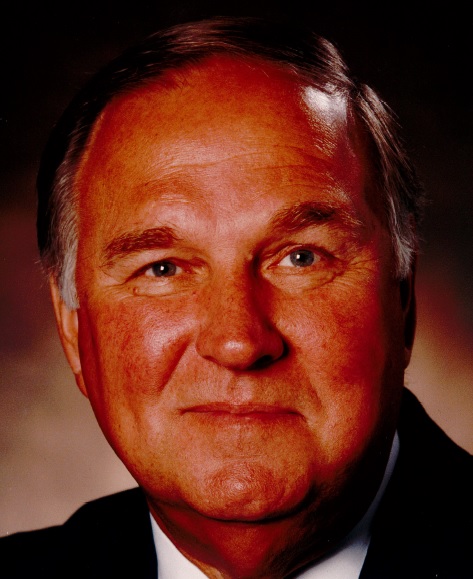 He came to the MHSAA after 30 years at Escanaba, where he taught, coached, served as athletic director and later principal during a tenure stretching from August 1958 through July 1988. While at Escanaba, Cvengros also represented Upper Peninsula Class A and B schools on the MHSAA Representative Council from 1983-88 and served as the Council’s president from 1986-88.
Cvengros received the MHSAA’s Charles E. Forsythe Award in 2000 in recognition of his many and significant contributions to interscholastic athletics.
“During his lifetime, Jerry Cvengros impacted every area of interscholastic athletics as a coach, athletic director, principal and then associate director of the MHSAA," Roberts said. “He was the perfect combination of fairness, toughness and diplomacy, able to draw on a vast knowledge of MHSAA rules and an understanding of educational athletics fostered by his various experiences.
“Jerry was known and respected statewide for his dedication, and his contributions have had a lasting impact.”
Cvengros built an elite football program at Escanaba as varsity head coach from 1962-84, leading the Eskymos to a 161-42-3 record, a Class A runner-up finish in 1979 and the MHSAA championship in 1981. That team remains the only Class A/Division 1 team from the Upper Peninsula to win an MHSAA football title. Cvengros was inducted into the Michigan High School Football Coaches Association Hall of Fame and served on its original Board of Directors.
His 1979 team fell to Detroit Catholic Central 32-7, but he brought the Eskymos back to the Finals for a 16-6 win over Fraser two seasons later. Cvengros' championship lineup included quarterback Kevin Tapani, who would go on to pitch for the Minnesota Twins among five major league clubs, and tailback Dean Altobelli, who later played at Michigan State University. The title run included a 15-14 Semifinal win over Dearborn Fordson that included a savvy two-point conversion call by Cvengros, who wanted to avoid overtime after a late score drew Escanaba to within a point of tying the score.
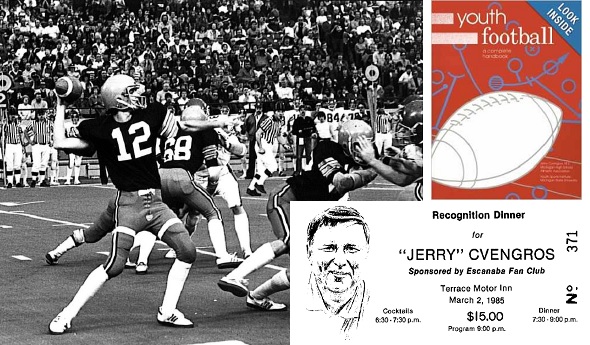
As the MHSAA’s director of football, Cvengros was instrumental in creating the current playoff format that expanded the field from 128 to 256 teams beginning with the 1999 season. He also co-authored “Youth Football: A Complete Handbook,” a guide to coaching at that level.
Among many additional honors, Cvengros was inducted into the Upper Peninsula Sports Hall of Fame and Michigan High School Coaches Association Hall of Fame and received the Distinguished Service Award from the Michigan Interscholastic Athletic Administrators Association. The National Federation of State High School Associations twice awarded Cvengros with a Citation – the NFHS’ highest honor – for his service as a coach and then as a member of the MHSAA staff.
Since his retirement, Cvengros and his wife Shelley have continued to reside in Okemos. A visitation will take place beginning at 10 a.m. Monday, April 7, at St. Martha Parish in Okemos, with a funeral Mass to follow at 11 a.m.
Cvengros was a 1951 graduate of Ironwood High School and went on to study and play football at the University of Wisconsin in Madison. He earned his bachelor’s degree in secondary education and teaching from the University of Wisconsin-Superior and a master’s from Northern Michigan University.
He taught English, history and physical education at Escanaba High School and also coached basketball and track and field. He became the school’s athletic director in 1970, added the duties of activities director in 1975 and became principal in 1983.
Cvengros is survived by his wife and children Michael, Steven and David, and seven grandchildren. He was preceded in death by his daughter Lee Ann (Cvengros) Swasey in May 2013.
PHOTOS: (Clockwise from left) Escanaba quarterback Mike Beveridge fires a pass during the 1979 Class A Final; Cvengros co-authored a book on coaching youth football; Cvengros was celebrated once more in Escanaba following his final season as football coach.
1st & Goal: Finals in Review
January 28, 2021
By Geoff Kimmerly
Second Half editor
With absolute certainty, we can say this recently-concluded football season was like no other during the nearly 100-year history of the MHSAA.
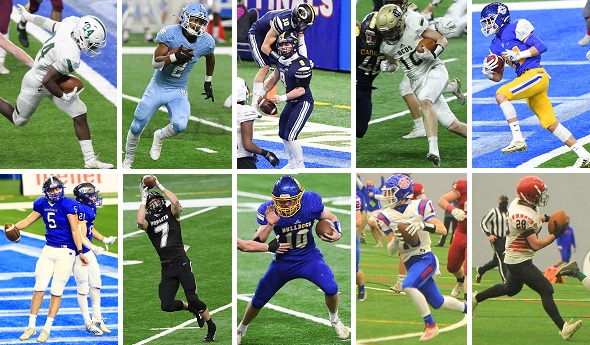
But after just more than five months, and amid COVID-19, it was played to completion – with 8-Player Finals on Jan. 16 at Brighton’s Legacy Center and 11-Player Finals Jan. 22-23 at Ford Field in Detroit.
Second Half again covered all 10 championship games, with quick recaps and links (click on the game scores) to those stories below followed by notations of performances entered into the MHSAA Finals record book and a report on some of the biggest and best stories to emerge from the championship weekends. See also below highlights from State Champs Sports Network.
Finals in Review
11-Player Division 1: West Bloomfield 41, Davison 0
Led by Donovan Edwards’ 257 yards and three touchdowns rushing, West Bloomfield won its first Finals championship with a shutout of the 2019 champion Cardinals. Much more on Edwards below, but the Lakers’ effort on the other side of the ball can’t be overlooked – the shutout was the team’s sixth of the season.
11-Player Division 2: Muskegon Mona Shores 25, Warren De La Salle Collegiate 19
After winning its first championship in 2019, Mona Shores earned another in its encore led again by quarterback Brady Rose. Rose had started last season’s Final in place of an injured all-stater, but he was hardly unknown this time – and still ran for 154 yards and two touchdowns, including a 65-yard sprint during the fourth quarter that helped wrap things up for the Sailors.
11-Player Division 3: DeWitt 40, River Rouge 30
DeWitt finished off the longest football season in MHSAA history with its first championship, earning it against a River Rouge team looking to repeat after winning its first title in 2019. Quarterback play was on display in this finale as well, with DeWitt’s Tyler Holtz and Rouge’s Mareyohn Hrabowski putting up big numbers.
11-Player Division 4: Detroit Country Day 13, Cadillac 0
With youngest son Danny a major contributor, Country Day coach Dan MacLean led the Yellowjackets to their first Finals championship since 1999. Country Day kept first-time finalist Cadillac to just 166 total yards, and the shutout was the Yellowjackets’ third straight.
11-Player Division 5: Grand Rapids Catholic Central 48, Frankenmuth 21
The Cougars added their fourth championship in five seasons, this one their first in Division 5 after winning previously in Division 4. GRCC quarterback Joey Silveri accounted for six touchdowns in a Final for the second-straight season as his team built a big early lead against the first-time finalist Eagles.
 11-Player Division 6: Montague 40, Clinton 14
Strong quarterback play and a father-son connection both came into play in Division 6 as well as senior Drew Collins led dad Pat’s team to its first Finals championship since 2009. What Drew said after told the story of the entire season restart: “Everybody on this football team, coaches, players, trainers – everybody on this football team loves high school football. I love high school football. I love these coaches. I love my friends on the team. I love everybody on the team. I love the community. It’s bittersweet when you win a state championship when you’re a senior because it’s all over.”
11-Player Division 7: New Lothrop 42, Traverse City St. Francis 35
The Hornets’ Julius Garza put up one of the most impressive individual performances of the weekend, scoring three ways for a total of four touchdowns. New Lothrop got up early and then held off a St. Francis comeback to claim its second championship in three seasons.
11-Player Division 8: Centreville 22, Ubly 0
Centreville’s shutdown defense put together one more awe-inspiring performance to help the Bulldogs’ to their first championship. Centreville ran its state-best points-allowed-per-game average to 2.9 with its seventh shutout in 10 games played.
8-Player Division 1: Adrian Lenawee Christian 47, Suttons Bay 0
The Cougars put an exclamation point on a dominating first season of 8-player football with their first Finals championship in the sport, either format. Lenawee Christian not only performed well offensively but held Suttons Bay to 52 yards total. The Norsemen finished Division 1 runners-up for the second-straight season.
8-Player Division 2: Powers North Central 70, Portland St. Patrick 48
The Jets claimed their third championship in what was the highest-scoring 8-player championship game in the decade-long MHSAA Finals history of this format. More on that below, and also on North Central quarterback Luke Gorzinski and St. Patrick quarterback Connor Cross, who were among those to put up giant numbers. The Jets also feature a father/son combo, with Luke the son of head coach Leo Gorzinski.
Records Report
As one might imagine, the highest-scoring game in 8-Player Finals history was filled with record book accomplishments. North Central’s 70 points were the 8-Player Finals record for one team, and the combined 118 points were 19 more than the previous record set in Peck’s 67-32 win over Rapid River in 2013. The teams’ 933 combined total yards ranks third on that 8-Player Finals list, while North Central’s 22 first downs was tied for second and St. Patrick’s 21 first downs ranked fourth. Neither team punted, making for another first in 8-player championship games. The game was not only the highest-scoring 8-Player Final, but the third-highest scoring 8-player game in MHSAA history (including regular season), missing tying that record by only six points.
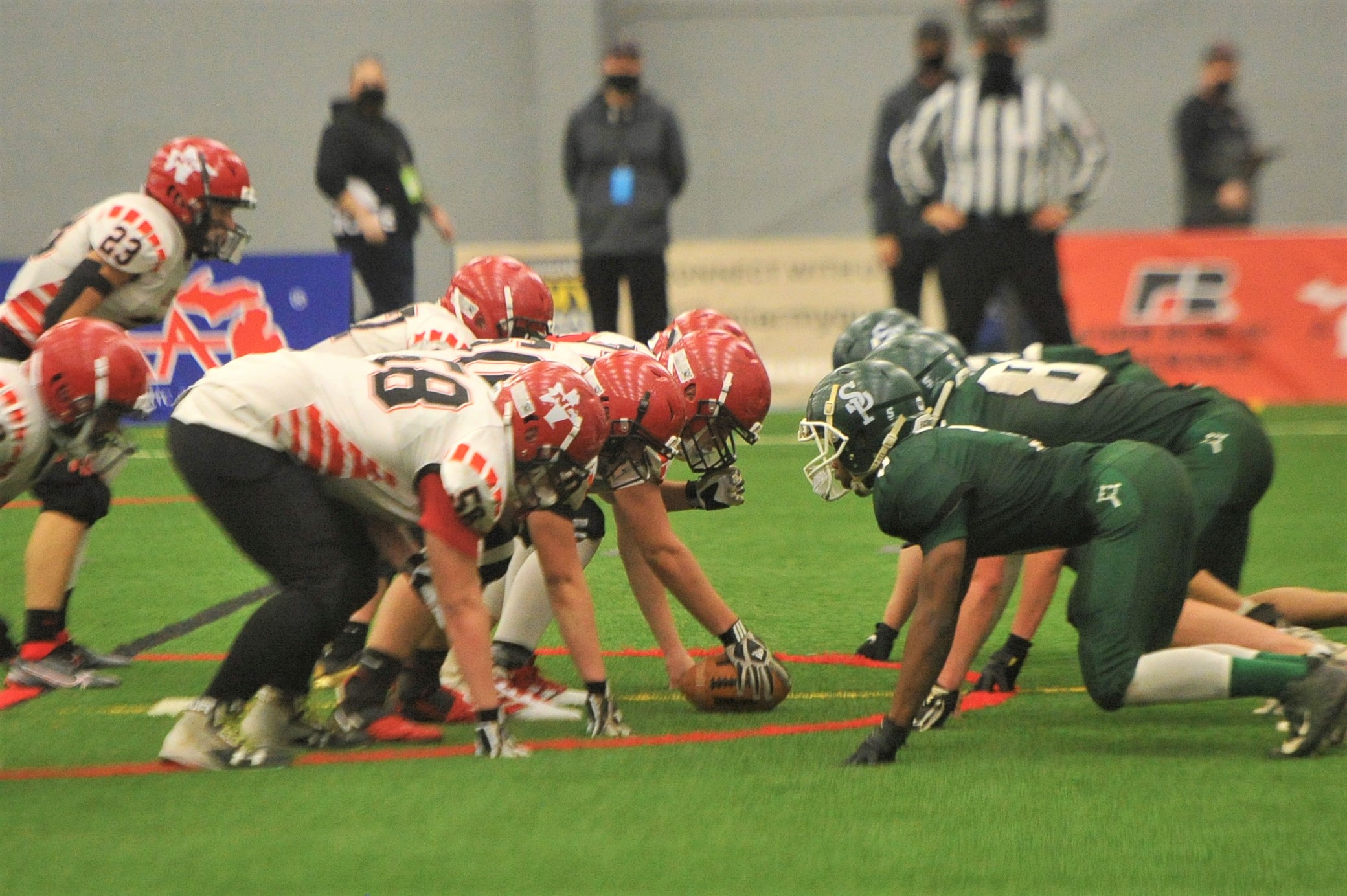 Also as noted above, all-state quarterback play was on display for both 8-player Division 2 finalists. North Central QB Luke Gorzinski totaled the second-most rushing yards, 299, in an 8-Player Final, and with 156 yards passing set the total offense record at 455. St. Patrick QB Connor Cross, with 397 total yards, is fourth on that list. Cross’s 374 passing yards were second-most in an 8-Player Final, as were his six passing touchdowns, and he earned the first listings with 25 completions and 38 pass attempts. Shamrocks receiver Shane Cook, meanwhile, set the record with 13 receptions for the second-most receiving yardage, 179. North Central as a team finished with the third-most rushing yards, 373 on 37 attempts, and third-most rushing touchdowns with six. St. Patrick as a team was second for team passing yards and touchdowns.
Gorzinski wasn’t the only offensive star for the Jets; teammate Wyatt Raab finished with the third-most points scored in an 8-Player Final, 32, on four touchdowns, three two-point conversions and a safety. Gorzinski did finish with the fourth-most points, 28, on four touchdowns and two two-point conversions. Both made the total touchdowns list with four apiece.
The 8-Player Division 1 Final made the record book as well, in two categories. Lenawee Christian as a team defense posted the lowest number of yards allowed, just 52. And Cougars quarterback Landon Gallant also made the total offense list with 326 yards – 59 rushing and 267 passing.
New Lothrop’s Julius Garza was among individual standouts from the 11-Player Finals, tying for fourth with 26 points scored – on four touchdowns and a two-point conversion – and also tying for fourth for touchdowns in a game, in Division 7.
West Bloomfield’s Jake Ward made all three kicking lists for 11-player, tying for third with two field goals in a game, ranking fourth for longest with a 45-yarder, and making the extra points list with five in the Division 1 Final. Grand Rapids Catholic Central’s Jack Barlow tied for fourth on that extra points list with six in the Division 5 game.
The Lakers’ Donovan Edwards was another of the stars of the weekend, with his 257 yards rushing ranking eighth all-time for an 11-Player Final – and while coming on just 14 attempts in Division 1.
Montague’s Drew Collins made the 11-player passing yards list with 244, coming on 15 completions in the Division 6 game. Three of those went for touchdowns to teammate Samuel Smith, who tied the record held by nine others for touchdown catches in an 11-Player Final.
DeWitt quarterback Tyler Holtz tied for fifth on the passing touchdowns list with four in Division 3. Opposing quarterback Mareyohn Hrabowski from River Rouge made the total yardage list with 321 – 94 rushing and 227 passing. New Lothrop’s Cam Orr also made the total yardage list with 344 – 122 rushing and 222 passing.
While quarterbacks starred in many cases, the run game was hardly left behind. In addition to Edwards’ performance for West Bloomfield, Clinton had the fifth-most rushing attempts in 11-player championship game history with 65, for 358 yards. Clinton also tied the record with just one pass attempt, with West Bloomfield tying for fifth on that list with two throws. Those two and Cadillac all tied the 11-Player Finals record by recording zero completions – they brought that all-time list to 21 teams that didn’t complete a pass in an 11-player title game.
Grand Rapids Catholic Central in Division 5 also became the 28th 11-player finalist to go an entire game without punting.
 The Division 6 Clinton/Montague matchup also finished as one of the least-penalized in MHSAA 11-Player Finals history. The two teams combined for just 10 penalty yards, coming on one Clinton penalty. Montague was not penalized in the game.
Stories Behind the Scores
The Longest Season: Due to COVID-19, this season started on time, stopped, restarted, stopped again in mid-November, and restarted one more time with rapid testing the final week of December with playoffs ending over two weekends in mid-January. There are many reasons to want to forget the last year, and many much sadder circumstances. But the perseverance of all Fall athletes and families, coaches, administrators and support staff; along with the testing program provided by the Michigan Department of Health and Human Services, made for a memorable story that surely will be recalled for years to come.
First finishing 1st: West Bloomfield in 11-Player Division 1, DeWitt in Division 3 and Centreville in Division 8, and Adrian Lenawee Christian in 8-Player Division 1 all won their first MHSAA Finals in this sport. Cadillac in Division 4 and Frankenmuth in Division 5 made their first championship game appearances.
Edwards’ excellent ending: Edwards was slated to join University of Michigan’s football program as an early enrollee in January. But first, he wanted to finish his high school season, and career, with the Lakers. He led them to their first championship, with one of the top rushing performances in Finals history, and as arguably the biggest headliner from the weekend at Ford Field – likely gaining a few more fans along the way as well.
Many ways to win: As noted above, defense still works – four of 10 Finals were shutouts, and Centreville’s season-long performance was incredible. Also noted above, champions won both running and passing. But a final fun note on offense – seven of 10 champions this season scored 40 or more points in their championship games. That’s compared to two in 2019, five in 2018 and five in 2017.
(Click for more photos from Hockey Weekly Action Photos.)