

Cvengros Leaves Lasting Impact
By
Geoff Kimmerly
MHSAA.com senior editor
April 1, 2014
Retired Associate Director Jerry Cvengros, who served at the Michigan High School Athletic Association for more than 13 years after three decades at Escanaba High School, died Monday evening in Lansing. He was 80.
As lead assistant to Executive Director John E. “Jack” Roberts from August 1988 until retiring in January 2002, Cvengros served as director of football and briefly hockey in addition to coordinating the Program of Athletic Coaches Education (PACE), presenting annual in-service training for administrators and serving as MHSAA liaison to statewide principals, athletic directors and coaches associations.
 He came to the MHSAA after 30 years at Escanaba, where he taught, coached, served as athletic director and later principal during a tenure stretching from August 1958 through July 1988. While at Escanaba, Cvengros also represented Upper Peninsula Class A and B schools on the MHSAA Representative Council from 1983-88 and served as the Council’s president from 1986-88.
Cvengros received the MHSAA’s Charles E. Forsythe Award in 2000 in recognition of his many and significant contributions to interscholastic athletics.
“During his lifetime, Jerry Cvengros impacted every area of interscholastic athletics as a coach, athletic director, principal and then associate director of the MHSAA," Roberts said. “He was the perfect combination of fairness, toughness and diplomacy, able to draw on a vast knowledge of MHSAA rules and an understanding of educational athletics fostered by his various experiences.
“Jerry was known and respected statewide for his dedication, and his contributions have had a lasting impact.”
Cvengros built an elite football program at Escanaba as varsity head coach from 1962-84, leading the Eskymos to a 161-42-3 record, a Class A runner-up finish in 1979 and the MHSAA championship in 1981. That team remains the only Class A/Division 1 team from the Upper Peninsula to win an MHSAA football title. Cvengros was inducted into the Michigan High School Football Coaches Association Hall of Fame and served on its original Board of Directors.
His 1979 team fell to Detroit Catholic Central 32-7, but he brought the Eskymos back to the Finals for a 16-6 win over Fraser two seasons later. Cvengros' championship lineup included quarterback Kevin Tapani, who would go on to pitch for the Minnesota Twins among five major league clubs, and tailback Dean Altobelli, who later played at Michigan State University. The title run included a 15-14 Semifinal win over Dearborn Fordson that included a savvy two-point conversion call by Cvengros, who wanted to avoid overtime after a late score drew Escanaba to within a point of tying the score.
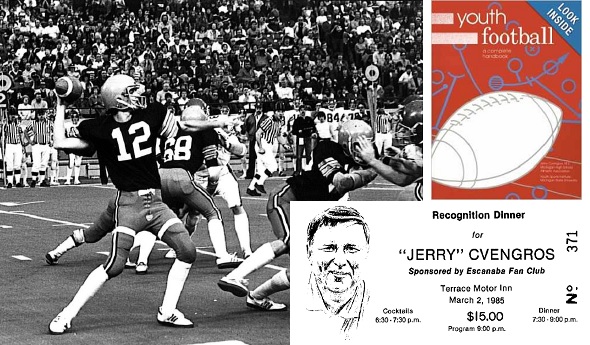
As the MHSAA’s director of football, Cvengros was instrumental in creating the current playoff format that expanded the field from 128 to 256 teams beginning with the 1999 season. He also co-authored “Youth Football: A Complete Handbook,” a guide to coaching at that level.
Among many additional honors, Cvengros was inducted into the Upper Peninsula Sports Hall of Fame and Michigan High School Coaches Association Hall of Fame and received the Distinguished Service Award from the Michigan Interscholastic Athletic Administrators Association. The National Federation of State High School Associations twice awarded Cvengros with a Citation – the NFHS’ highest honor – for his service as a coach and then as a member of the MHSAA staff.
Since his retirement, Cvengros and his wife Shelley have continued to reside in Okemos. A visitation will take place beginning at 10 a.m. Monday, April 7, at St. Martha Parish in Okemos, with a funeral Mass to follow at 11 a.m.
Cvengros was a 1951 graduate of Ironwood High School and went on to study and play football at the University of Wisconsin in Madison. He earned his bachelor’s degree in secondary education and teaching from the University of Wisconsin-Superior and a master’s from Northern Michigan University.
He taught English, history and physical education at Escanaba High School and also coached basketball and track and field. He became the school’s athletic director in 1970, added the duties of activities director in 1975 and became principal in 1983.
Cvengros is survived by his wife and children Michael, Steven and David, and seven grandchildren. He was preceded in death by his daughter Lee Ann (Cvengros) Swasey in May 2013.
PHOTOS: (Clockwise from left) Escanaba quarterback Mike Beveridge fires a pass during the 1979 Class A Final; Cvengros co-authored a book on coaching youth football; Cvengros was celebrated once more in Escanaba following his final season as football coach.
1st & Goal: Week 5 Preview
September 24, 2020
By Geoff Kimmerly
Second Half editor
Most years, we’d talk this weekend about Michigan high school football teams being in midseason form.
They’re getting there quickly – and with another series of big-time matchups these next few days helping all of us get back up to speed.
Major rivalries will play out again in Muskegon, Flint and Metro Detroit among various communities all over the state. Some of the most noteworthy games are briefly previewed below. Check out the MHSAA Score Center beforehand for kickoff times and locations of all games, and come back Friday and Saturday for scores as they’re reported.
This week we’ll also have 53 varsity football games broadcast on MHSAA.tv; click the link for listings.
Bay & Thumb
Flint Hamady (1-0) at Flint Beecher (1-0)
Anthony Branch’s coaching tenure after Courtney Hawkins left for Michigan State began with a 27-19 win over Ann Arbor Father Gabriel Richard last week. The Bucs’ biggest game of the regular season is up next, and Branch has plenty of experience in Hamady matchups after serving previously as an assistant coach and having played in the Beecher program. The Hawks have won all three regular-season matchups with the Bucs since the teams rejoined the same league in 2017.
Keep an eye on these: FRIDAY Davison (1-0) at Grand Blanc (1-0), Frankenmuth (1-0) at Saginaw Swan Valley (1-0), Sandusky (1-0) at Harbor Beach (1-0), Saginaw Nouvel (0-1) at Saginaw Michigan Lutheran Seminary (1-0).
Greater Detroit
Sterling Heights Stevenson (1-0) at Macomb Dakota (1-0)
These two finished fifth and fourth, respectively, in the Macomb Area Conference Red in 2019. But together last week they defeated reigning champion Clinton Township Chippewa Valley (Dakota 29-20) and runner-up Utica Eisenhower (Stevenson 7-3). Dakota owns a five-game regular-season winning streak against the Titans, including last year by a 40-14 score. But Stevenson may be continuing a surge that took it to last year’s Division 1 Semifinals – a run which included a 38-35 win over Dakota in the District Final.
Keep an eye on these: FRIDAY Dearborn Fordson (0-1) at Belleville (1-0), Detroit Mumford (1-0) at Detroit Cass Tech (1-0). SATURDAY Detroit Catholic Central (1-0) at Bloomfield Hills Brother Rice (1-0).
Mid-Michigan
Midland Bullock Creek (1-0) at Ithaca (1-0)
These two are in different divisions of the Tri-Valley Conference West this fall. But a year ago they were in the same division and shared the championship, breaking Ithaca’s streak of nine straight outright league titles. The Yellowjackets won last year’s matchup 35-21, but Bullock Creek was able to grab a championship share after Ithaca fell to Hemlock 30-6 in the league finale. Both opened last week with wins over 2019 playoff teams, Ithaca over Saginaw Nouvel and Bullock Creek over Carrollton.
Keep an eye on these: FRIDAY DeWitt (1-0) at Grand Ledge (1-0), LeRoy Pine River (1-0) at Beal City (1-0), Leslie (0-1) at Stockbridge (1-0), St. Johns (0-1) at Williamston (1-0).
Northern Lower Peninsula
Ogemaw Heights (1-0) at Kingsley (1-0)
Ogemaw Heights is coming off its first winning season since 2013 after going 8-3 a year ago. Kingsley, meanwhile, posted its best finish since 2005 at 12-1 and with a run to the Division 5 Semifinals. A 36-19 Week 2 win over Ogemaw Heights was among seven victories total the Stags posted against teams that finished with winning records. And this matchup should mean more in the future as Ogemaw Heights has joined Kingsley in the Northern Michigan Football Conference Legends division.
Keep an eye on these: FRIDAY East Jordan (1-0) at Harbor Springs (1-0), Traverse City St. Francis (0-1) at Grayling (1-0), Petoskey (1-0) at Traverse City Central (1-0), Oscoda (1-0) at Rogers City (1-0).
Southeast & Border
Breckenridge (1-0) at Reading (1-0)
Added just this week, this might be one of the top small-school matchups in the state this season. Reading has won the last two Division 8 championships and defeated Breckenridge 39-20 in the 2018 title game. This could be a preview of another playoff matchup to come. Together they defeated their season-opening opponents last week by a combined score of 95-6.
Keep an eye on these: FRIDAY Blissfield (1-0) at Hillsdale (1-0), Brooklyn Columbia Central (1-0) at Clinton (1-0), Riverview (1-0) at Milan (1-0), Battle Creek Pennfield (1-0) at Parma Western (1-0).
Southwest Corridor
Saugatuck (1-0) at Schoolcraft (1-0)
This might have gotten a little more attention a year ago, as these two frequently are the best or near the top of their divisions of the Southwestern Athletic Conference. Schoolcraft was a co-champion in the Lakeshore last season, but Saugatuck finished sub-.500 overall for the first time since 2006. Saugatuck got off to a winning start last week, however, as did Schoolcraft – and this fall both are in the SAC Valley.
Keep an eye on these: FRIDAY Marshall (0-1) at Coldwater (1-0), Portage Northern (1-0) at Mattawan (1-0), Decatur (0-1) at Cassopolis (1-0), Coloma (1-0) at Kalamazoo United (1-0).
Upper Peninsula
Sault Ste. Marie (1-0) at Marquette (1-0)
Granted, it’s just one week to go on. But based on early returns, these might be the best in the Upper Peninsula this fall. Sault Ste. Marie opened with a seven-point win over Traverse City St. Francis, while Marquette downed Menominee by 23. Marquette has beaten the Blue Devils in four straight including 31-0 a year ago, but despite last year’s defeat Sault Ste. Marie went on to its winningest season since 2013. A win tonight could end up the Sault’s highlight of this shortened season.
Keep an eye on these: FRIDAY West Iron County (1-0) at L'Anse (1-0), Hancock (1-0) at Bessemer Gogebic (0-1), Menominee (0-1) at Marinette, Wis. (0-0), Norway (0-1) at Houghton (1-0).
West Michigan
Muskegon Mona Shores (1-0) at Muskegon (1-0)
This easily is the headliner of the week, matchup up a pair of teams that reached Ford Field a year ago. A 53-0 Muskegon win over Shores in Week 8 was among dominating victories that pushed the Big Reds to a Division 3 runner-up finish. The Sailors, meanwhile, didn’t lose again after that night, stringing together a series of mostly close wins on the way to the Division 2 title. Muskegon has a five-game winning streak in this rivalry matchup, but a much closer finish than last year’s has to be the expectation this time.
Keep an eye on these: FRIDAY Montague (1-0) at Muskegon Oakridge (1-0), Rockford (1-0) at Caledonia (1-0), Byron Center (1-0) at Grand Rapids Christian (0-1), Hudsonville Unity Christian (1-0) at Grand Rapids West Catholic (1-0).
8-Player
Colon (1-0) at Adrian Lenawee Christian (1-0), Saturday
Colon’s move to 8-player in 2018 proved beneficial and then some as the Magi went a combined 23-2 over the last two seasons and won the 8-player Division 1 title a year ago. Lenawee Christian’s move this fall could usher in similar dominance for the Cougars, who finished 10-2 and just missed defeating eventual Division 8 champion Reading in the Regional Final last year. Lenawee opened its 8-player era with a 62-0 win over another first-year 8-player team Athens last week, while Colon downed frequent playoff qualifier Bellevue 45-6.
Keep an eye on these: FRIDAY Portland St. Patrick (1-0) at Vestaburg (1-0), Merrill (1-0) at Atlanta (1-0), Pickford (1-0) at Cedarville (1-0). SATURDAY Newberry (0-1) at Munising (1-0).
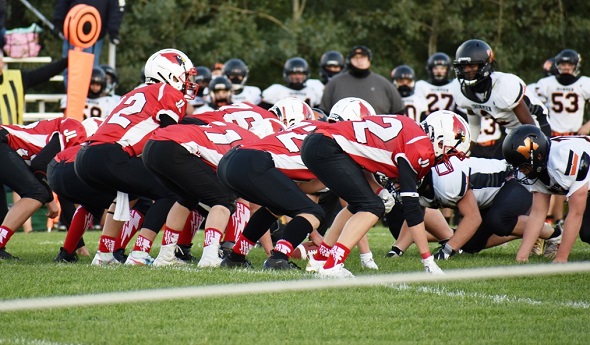
PHOTO: Johannesburg-Lewiston opened last week with a 47-14 win over Mancelona. (Photo by Robert Batzloff.)