

'D' Propels Centreville to 1st Finals Win
By
Paul Costanzo
Special for MHSAA.com
January 22, 2021
DETROIT – It didn’t take long Friday for the Centreville defense to prove its season statistics were no fluke.
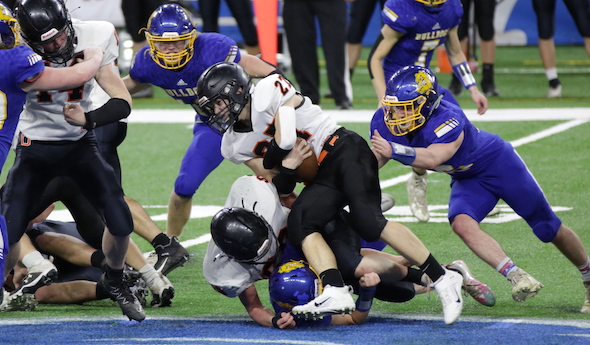
The Bulldogs stuffed Ubly on a 4th-and-short at midfield on the first possession of the MHSAA Division 8 Football Final, setting the tone for a dominant performance in their 22-0 victory at Ford Field.
“The defense played hard today,” Centreville senior defensive end and fullback Jared Spencer said. “I think we went all out – our seniors went all out just because it was our last game. Our first time making it to state, so I just think our defense, we were ready for the game.”
The title is the first for the Bulldogs (11-0), who had never won a District title in the sport prior to this season. While it didn’t look like it to those observing, coach Jerry Schultz said the nerves were certainly there pregame.
“If they’re going to say (they weren’t nervous), then they’re lying,” said Schultz, who is in his first year leading the program. “I could see it on their faces that they were nervous, especially this morning. That’s why we got on the field so early … we went and ran routes, I wanted them to just throw the ball around. As we told them, it’s 100 yards. Even I walked out here – I've never been here before, I’m actually a Packer fan – but just walking out here, it’s awesome.”
The 11 wins are a school record, despite the regular season being shortened by three games. The program was in the postseason for the third straight year, but just the seventh in school history.
“All the offseason work in the weight room and all the conditioning – everything that we had done since we were freshmen, it’s the best feeling to have to come in as a senior (and win) with this group of guys,” senior quarterback and safety Sam Todd said. “So, coming out on top as a senior, it doesn’t get better than that.”
Centreville was dominant throughout the year, with only two of the 10 games it played – its Semifinal was won by forfeit over Clarkston Everest Collegiate – being decided by single digits. That effort was led by a defense that had seven shutouts and allowed 29 points on the season.
“Just buying into the defense,” Spencer said when asked to explain the success. “It’s been the same defense since (defensive coordinator Trevor Haas) has been here. We’ve had the same players since freshman year, so I think we just had that bond to keep it tight.”
The Bulldogs held Ubly (9-3) to 142 yards of total offense, but 103 of those came on second half possessions when they had already built a 22-0 lead. Ubly was held to 24 yards in the first half, and didn’t record a first down until there was 3:54 to play in the third quarter.
 Jacob Spencer led the Bulldogs defense with 10 tackles, while Ethan Brownridge had seven. Tristan McElroy had an interception in the end zone, which ended Ubly’s best drive of the day.
“One thing that they do is they have that angle front,” Ubly coach Eric Sweeney said. “Four years ago, (former Centreville coach) Tyler Langs coached at (Unionville-Sebewaing) and they’re still running his defense. So, it’s not something we haven’t seen, but we knew it was going to be tough because when you’re trying to run a trap and they’re angling those guys up front, you have to do some different things. They flew to the ball. Their linebackers came downfield. It was nothing we didn’t expect, but I kind of thought we’d block it better, but we didn’t. I thought they played incredible defense.”
When the Centreville defense wasn’t on the field stifling the Bearcats, the offense was giving it plenty of rest. The Bulldogs’ ball-control attack chewed up clock, with nearly 30 minutes of possession to Ubly’s 18. They ran the ball 42 times for 156 yards, and made big plays in the passing game when needed, as Todd was 6-for-7 for 130 yards and a pair of touchdowns, both to junior receiver Tyler Swanwick.
Todd also led the Centreville rushing attack with 70 yards and a touchdown on 19 carries.
“I think our biggest problem like I was saying before, we like to play ball-control offense, and that’s what they did,” Sweeney said. “When they needed a big play, they got it. When we only run 10 plays in the first half, that’s not ball-control offense. Personally, I thought our defense played very well, but our defense never got rest, because we played bad offense. We knew (Todd) was an excellent football player. There were no surprises there.”
Todd’s first score came on a 1-yard run midway through the second quarter. The fourth-down play was nearly blown up in the backfield, but Jared Spencer had a big block to help his quarterback get the edge.
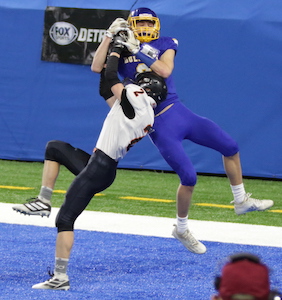
Swanwick made a pair of big plays on the second scoring drive, catching a deflected pass for a 31-yard gain, setting his team up at the 20-yard line with nine seconds to play in the half. On the next play, Todd found his top target with a well-thrown jump ball in the end zone, and the Bulldogs took a 16-0 lead into the half.
The Bulldogs all but put the game away with their first drive of the third quarter, eating up 7:46 on the clock, and finishing the drive off with a 12-yard pass from Todd to Swanwick.
Carson Heleski led the Bearcats in his final game, recording 16 tackles, including 1.5 for loss. He also had a team-high 67 rushing yards.
PHOTOS: (Top) Centreville defenders swarm around Ubly running back Mark Hellig during Friday’s Division 8 Final. (Middle) Centreville’s Tyler Swanwick pulls in one of his two touchdown catches. (Click for more from Hockey Weekly Action Photos.)
Fresh from Cancer Fight, Disbrow Returns to Coaching Ready to Continue 'Winning the Day'
By
Doug Donnelly
Special for MHSAA.com
September 16, 2026
Nikki Disbrow grabbed her keys and started to get into the family vehicle to pick up her son from a summer 7-on-7 practice. Her husband, Sand Creek football coach Sid Disbrow, told her he wanted to come, too.
 “What are you doing?” she asked. “You can barely walk.”
Sid, who had just returned home from surgery to have a tumor removed while battling colorectal cancer for the second time in three years, wasn’t having it. He got in the vehicle.
When Nikki arrived at the field, Sid opened the door.
“Where are you going?” she asked.
Sid, unrelenting, got out of the car and began making his way to the field.
“She was kind of my walker,” he said. “I couldn’t walk on my own, but I needed to address the kids. I needed to be out there. I needed to show them that it’s about winning the day, because you never know what might happen.”
Disbrow, 49, has been coach for just about 30 years. It’s part of who he is in the Sand Creek school district and community. He’s been an assistant football coach, youth baseball and softball coach, varsity boys and middle school basketball coach. He’s detailed, organized, loves the competition and thrives on being around kids.
Last year around the eighth or ninth week of the football season, he began noticing the symptoms of the cancer he had chemotherapy and radiation to treat a couple years prior. He finished the season, knowing middle school basketball was getting ready to start.
Within a week of finding out the cancer had indeed returned, he was able to get everything scheduled and begin chemotherapy. He was getting treated at Flower Hospital in Sylvania, Ohio, about 45 minutes from Sand Creek.
 “They would give me the last appointment of the day so I could get there after school,” he said. “They were great to work with.”
It wasn’t easy trying to maintain a rigorous coaching schedule while fighting cancer.
“There are no rules in cancer. You don’t get to do as you wish. Chemotherapy is real,” Disbrow said.
He wasn’t deterred. He coached the entire middle school basketball season – which ended around Christmas. Some days, he was exhausted. Still, quitting wasn’t an option.
“I wanted to be out there for my son and all of the other kids that I’ve been coaching all the way through,” he said. “That was important to me. That was my driving force.”
Not long after basketball season ended, he began eight weeks of radiation. It ended just in time for him to coach his son’s baseball team.
After that season ended, something still wasn’t right. Doctors found a tumor, although they weren’t sure if it was shrinking or growing. They gave him an option – surgery to remove it or wait a few months, get tested again. At that point, if it returned, it meant starting chemotherapy and radiation all over again. He checked the calendar.
“I thought about football season,” he said. “My son is on JV this year. That’s not something I want to miss.”
He went in for surgery and had the tumor successfully removed. Doctors found out later it was indeed cancerous and growing.
“I made the right decision,” he said.
He was recovering from that round of surgery when he made it onto the football field to talk to the Aggies players. The football field is more than a place for Disbrow to forget all about cancer and focus on the lives of the young men on the field. It’s a place him and Nikki, a former varsity volleyball coach at Sand Creek herself, got married.
“It’s probably the first time there was a wedding on the football field, and probably the last time,” he said.
On Aug. 3 – one week before two-a-days started for Sand Creek – he found out the cancer was in remission. He was back with the team when practice began.
“I brought my lawn chair with me,” he said. “There were some days where I just didn’t have the strength.”
Through it all, he’s endured, never wavering.
“The credit goes to God,” he said. “I don’t see how people go through something like this without their faith. I owe it all to Him. He’s given me this chance to continue to teach and coach. I don’t take that lightly.”
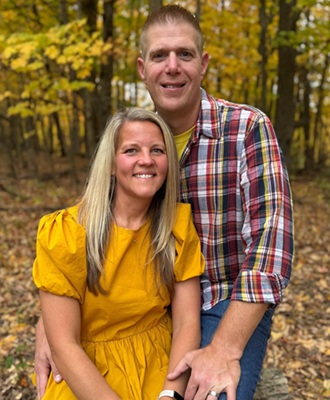 Sand Creek varsity football coach Derek Hewitt said seeing Disbrow come back to practice after all he went through was inspiring. Disbrow coaches special teams, the quarterbacks and helps Hewitt with the offense. On most Fridays he’s in the coach’s box.
“It’s great to have him back out there,” Hewitt said. “He’s not the scout team quarterback anymore, but he’s there, every day. It’s great for me to have him by my side.”
One thing Disbrow is not planning to do is stop coaching. In fact, he’s going to be even busier. He was recently named the school’s junior varsity boys basketball head coach.
“Coaching really kept me going through all of this,” he said. “The kids have been great through it all.”
The father of four is from Morenci, the neighboring town to the south and heated rival of Sand Creek, which he admits caused some angst when he moved from coaching football at his alma mater to Sand Creek.
He was part of the 1995 Morenci football team that played for a Class C championship in the Pontiac Silverdome, graduating in 1996. He was a sophomore at Adrian College when a Morenci coach asked him to join that coaching staff. A couple years later he began coaching at Sand Creek.
Now, he, his wife and four kids are engrained in the Aggies community.
“I wasn’t one of those people who got into teaching because I wanted to coach,” he said. “I wanted to be a teacher, to be around young people and help them. Coaching was something I loved once I started doing it. It’s who we are now as a family. It’s part of our lives.”
 Doug Donnelly has served as a news and sports reporter at the Adrian Daily Telegram and the Monroe News for 30 years, including 10 years as city editor in Monroe. He's written a book on high school basketball in Monroe County and compiles record books for various schools in southeast Michigan. He is now publisher and editor of The Blissfield Advance, a weekly newspaper. E-mail him at [email protected] with story ideas for Jackson, Washtenaw, Hillsdale, Lenawee and Monroe counties.
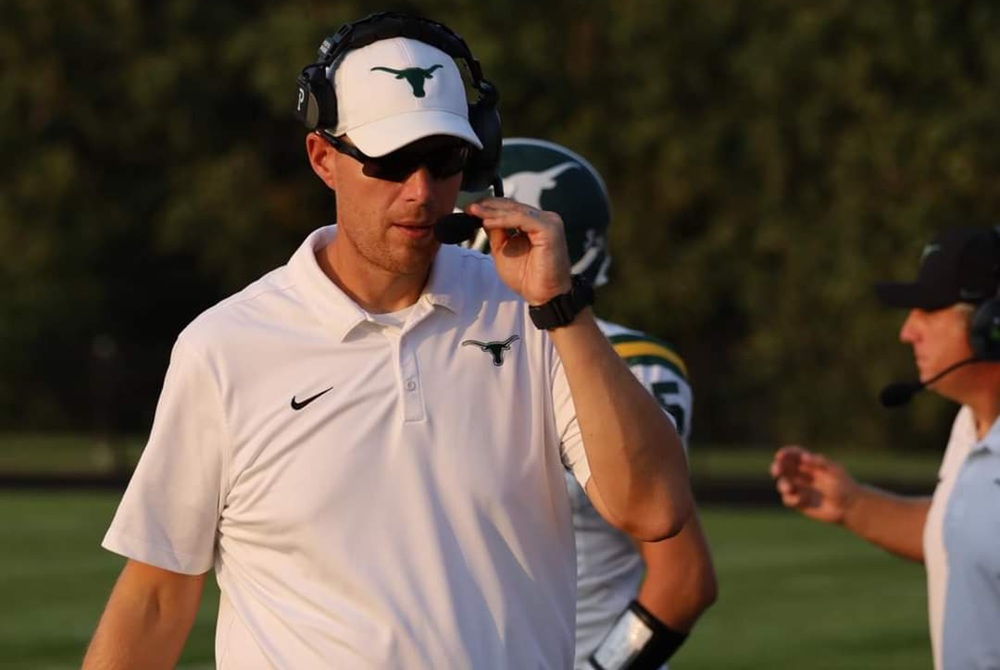
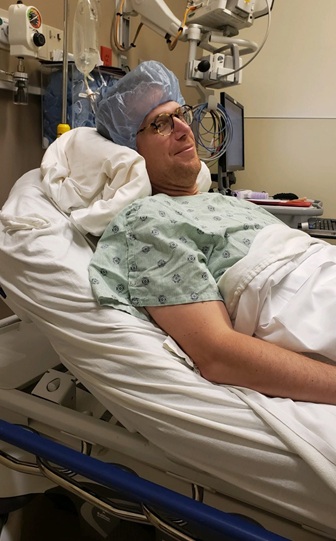
PHOTOS (Top) Sand Creek assistant football coach Sid Disbrow mans the headset while on the sideline during a game. (Middle) Disbrow lays in a hospital bed while receiving care in 2023. (Below) Disbrow stands for a photo with wife Nikki last fall. (Top photo by Becky Serin. Hospital and family photos courtesy of the Disbrow family.)