

DCC, Rice Begin Following New Leaders
By
Tom Markowski
Special for Second Half
August 16, 2017
The Detroit Catholic League football coaching carousel took a few more turns during the offseason, with a pair of programs once led by two of the winningest coaches in state history welcoming new leaders for this fall.
 Two former understudies to those longtime mentors now find themselves with the top jobs directing programs that have combined to earn 18 MHSAA Finals championships.
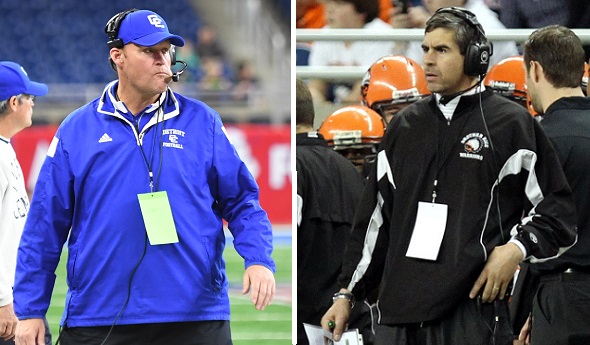
Adam Korzeniewski, 43, is the new coach at Birmingham Brother Rice, replacing Dave Sofran, who replaced legendary coach Al Fracassa after the Warriors won their third consecutive Division 2 title in 2013.
Dan Anderson, 48, is the new coach at Detroit Catholic Central, taking over for recently-retired Tom Mach, who directed the Shamrocks to a Division 1 runner-up finish nine months ago.
“It is daunting,” Anderson said. “You question yourself. Would Tom have done that? You want to keep the tradition alive. I’m not Tom Mach. I can learn from him and put my stamp on it.”
He and Korzeniewski will seek to do so while navigating what continues to be one of the most competitive leagues in the state. Detroit Catholic Central (10), Brother Rice (8) and Orchard Lake St. Mary’s (7) have combined to amass 25 MHSAA football titles, while Warren DeLaSalle has added two more.
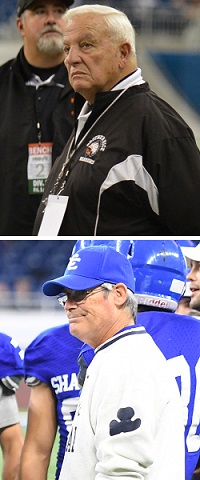
But when Mach announced his retirement from DCC in February, it continued a recent run of Catholic League Central programs passing the baton. Following the 2015 season Paul Verska – who led DeLaSalle to the 2014 Division 2 title – stepped down from the Pilots, and Mike Giannone left Macomb Dakota to fill Verska’s spot. Fracassa retired after the 2013 season with a record of 430-117-7 since starting at Royal Oak Shrine in 1960 and moving to Brother Rice in 1969; he holds Michigan’s record for most high school football coaching wins, while Mach is third with a record of 370-94 from 1976-2016.
St. Mary’s longtime leader George Porritt (256-71 since 1989) will enter this season as the league’s only coach with more than a year heading up the program at his school.
“I’m not a tight T (formation) guy. But I will run it right at you,” Anderson said in explaining a philosophical similarity to Mach. “And I do run some tight T plays. You can’t get rid of the wham. Tom’s philosophy was defense wins championships. That won’t change while I’m here.”
The wham is a basic run play into the middle of the line, a trademark of Mach’s offense. It’s simple but often effective. Anderson said he will install a multiple offense incorporating formations and plays from a variety of schemes as the Shamrocks look to add to last season's 13-1 run.
Anderson has been well-schooled, at Catholic Central and a number of high schools in Ohio where he grew up, played football and coached. He came to Catholic Central in 1999 as a freshmen coach. The next five seasons he was the head junior varsity coach. In 2005, he became a varsity assistant – and in 2007 he became the defensive coordinator.
Anderson played defensive end and offensive tackle at Archbishop Alter in Kettering, Ohio, located near Dayton. He earned a scholarship to University of Pittsburgh where he played guard and was a starter his junior and senior seasons.
Long before then, he knew he wanted to become a teacher and a coach. A junior high history teacher, who was also a coach, played a major role in Anderson becoming the person he is today.
“He coached me in CYO (Catholic Youth Organization),” Anderson said. “He made a big impression upon me. I was 12 or 13 years old, and I knew then I wanted to teach history and coach.
 “I love the game (of football). As soon as I got out of college (1992), I started coaching as a volunteer assistant at Penn Hills (Pa.).”
And he hasn’t stopped coaching since. After leaving Penn Hills, Anderson went to Pomfret, Maryland, located just outside of Washington, D.C., and coached three sports (baseball, basketball and football) at McDonough High. After two years, he went back to his alma mater and spent five years there, the last three as the head football coach. His wife at the time was transferred to General Motors in the Detroit area and, again, Anderson sent out applications and was hired by Catholic Central as a history teacher and football coach.
Anderson said he feels fortunate to be in this position. Learning and having mentors within a parochial school system prepared him for this opportunity and challenge.
“Mach, to me, was a heck of a mentor,” he said. “My high school coach, Ed Domstiz, was one of my mentors, too. And he’s still coaching.
“Tom was laid back. He didn’t take things too seriously. With all of the extracurricular things that go on now, he wanted football to remain a game. That bothered him, the kids jumping from one school to another. To me, high school was a great time, all of the friends that you made. When you move around you miss that.
“For Tom, it was more of his relationships with people. He had the Xs and Os, but it was about building men. That was always an emphasis. You had to develop them into great people. What you saw with Tom is what you got. It was refreshing.”
Though Korzeniewski isn’t directly replacing a legend, Fracassa’s shadow still looms over Brother Rice football; history doesn’t leave us that quickly. Expectations remain high for a program that won three straight Division 2 titles from 2011-13. The Warriors finished 7-4 last fall.
There’s an added unknown for Korzeniewski. He’s never been a head coach before. He’s coached for 17 seasons, including six as Fracassa’s defensive coordinator. The last two seasons Korzeniewski was the defensive coordinator at Birmingham Seaholm, working under his good friend Jim DeWald. The two were teammates at Western Michigan during the mid-1990s.
Korzeniewski’s approach is to keep things simple. He doesn’t see his job as having more pressure than most head coaching positions. As a coach, you teach. For the players, they learn.
“To me, it’s my job,” he said. “I go about it as I would anything else. To other people it would be different. I do my job every day.
“I didn’t come here thinking other people did this or that. It’s the kids. It goes back to why I got into coaching. You see the progress. It’s important to them that they get better. Football is important to them.”
Just as Anderson learned from his predecessor, Korzeniewski has borrowed much from Fracassa.
“I learned the importance of a team,” Korzeniewski said. “Nothing is more important than the team. And there’s something else. He made every player feel a part of the team. He had a way to make kids compete. I wish I could do that.
“What’s important to me is that things get taught and understood. You have to be demanding and supportive. (It’s) the action and reaction.”
Rest assured, both coaches will be watched as if through a microscopic lens. They understand that. They also understand they are heading into once-in-a-lifetime opportunities, and they’re going to make the most of them.
“I’m excited,” Anderson said. “We have a great group of kids. We have a great group of coaches and we’re going to enjoy each other’s company.”
 Tom Markowski is a columnist and directs website coverage for the State Champs! Sports Network. He previously covered primarily high school sports for the The Detroit News from 1984-2014, focusing on the Detroit area and contributing to statewide coverage of football and basketball. Contact him at [email protected] with story ideas for Oakland, Macomb and Wayne counties.
PHOTOS: (Top) Detroit Catholic Central's Dan Anderson (left), here coaching the defense during the 2016 Division 1 Final, and Brother Rice's Adam Korzeniewski, the Warriors' defensive coordinator during their 2012 Division 2 title run, are taking over top Detroit Catholic League programs this fall. (Middle) Former Brother Rice coach Al Fracassa (top) retired after the 2013 season, while DCC's Tom Mach stepped down in February.
Offseason Work Begins as Gobles Continues Building on Successful Reboot
By
Pam Shebest
Special for MHSAA.com
November 14, 2023
GOBLES — Football season may be over for players at Gobles High School, but the Tigers do not have much time to relax.
 For coach Greg Eichler, the season never really ends.
The Tigers made it to the MHSAA 8-player Division 1 Regional Finals before losing to reigning champion Martin two weeks ago.
While some of his athletes are preparing for their various winter sports, Eichler has been sitting down with players and coaches to “identify what went well, what didn’t go well this season and what are we going to do to address those things.
“For our kids, it’s setting goals athletically and academically. What are they looking to do the rest of the school year in their other sports and classroom and as individuals, as human beings? Our goal is to make sure that they grow in that aspect more than anything.”
Eichler also will talk with his coaches to “figure out what our shortcomings were and how we can improve on that in the offseason and make 2024 even better.”
That’s just the beginning for the third-year coach.
“In November and December, it’s equipment and helmet reconditioning, our banquet, sending out thank yous to our sponsors,” Eichler said.
“I’m going to communicate with our alumni. I always send out a state of the program, a whole write-up of what we’ve done and where we’re going.”
With his coaches, Eichler will evaluate game film and break it down, finalize stats and plan offseason workouts with the Tigers’ two strength and conditioning coaches.
“In January and February, there’s a whole bunch of other stuff,” he said. “That’s clinic season, that’s going to listen to other coaches, visit other staff, learn new things we can bring back to Gobles among a million other things.”
Starting from scratch
When Eichler – who is also the district’s K-12 assistant principal – took over the 8-player football program in 2021, he had just 10 varsity players.
The team folded after seven weeks.
 “We had to start from scratch as far as building a winning mentality,” he said. “It started with getting in the weight room and lifting, getting bigger, getting stronger, getting faster. Building that winning mentality so that when we step on the field, we expect to win.
“Our kids had to learn how to raise the bar against those better opponents.”
This year’s team, with 24 players, made strides toward the ultimate goal – a state championship to go with the program’s 11-player Class D title won in 1984.
The Tigers finishing 8-3, defeated Mendon for the first time since 2005 and advanced a round further in the playoffs after losing in a Regional Semifinal a year ago.
“Progress is being made,” Eichler said. “It didn’t end the way any of us really wanted, but it’s going to make us stronger, make us better. It’s going to motivate us going into 2024.”
Building on experiences, setting examples
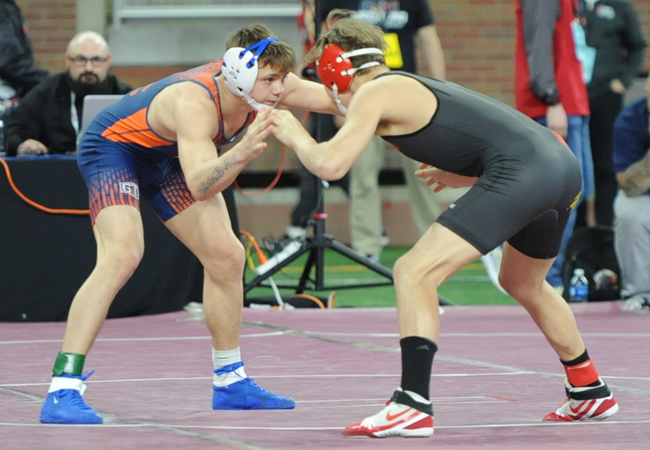
One player who brings MHSAA Finals experience to the team is junior Mason Mansfield. He placed eighth at the Division 4 Individual Wrestling Finals last season at Ford Field.
“Wrestling actually prepares you for football,” said Mansfield, whose winter season starts this week. “You’ve got to be tough in wrestling – six minutes tough. You’ve got to be tough to wrestle, especially to place and finish in the top of the top at Ford Field.”
While he wrestled at 150 pounds last year, he has moved up to 165 for this season. Eichler said Mansfield is one of the top athletes at the school.
“He is energetic and brings that into our locker room and our team,” he said. “Other kids feed off that.
“He’s very positive and brings an attitude of ‘we can overcome any challenge.’ He enjoys facing really good competition, and I think that wears off on the rest of the team and helps us elevate our play.”
 Another junior, Jackson Geiger, will begin practice on the varsity basketball team next week.
“I feel like right now I’d rather be playing football because I have two weeks to spare until basketball starts,” said Geiger, who expects improvements from this season’s basketball team coming off of a 4-19 finish.
“Last year (basketball) was more of a bonding experience,” he said. “We played really well in practice, but at game time didn’t really show up.”
As for football, Eichler said Geiger embodies the "Tiger Way."
“Jack is an extremely hard worker,” he said. “He really dedicated himself to the weight room, so I thought he brought that work ethic.
“He leads by example. He’s great in the classroom. Not only on the field, but off the field, he’s a great role model.”
After playing varsity football this season, sophomore Nathan Ray will play junior varsity basketball. He started the 2022 football season on the junior varsity before being called up to varsity for the last two games of the season.
“The players (on varsity) are a lot stronger and faster,” he said. “It’s a different level of athleticism, but the game is still the same.”
Eichler said Ray is very coachable.
“Nathan puts his head down and works,” the coach said. “He’s great on and off the field and great in the classroom. He’s dedicated himself to the weight room and has committed to making himself better every day.”
Looking back on the football season, Eichler said: “I’m really proud of how far our program has come.
“If you look back two years ago, we barely could field a team. And now we’re a Regional finalist.”
 Pam Shebest served as a sportswriter at the Kalamazoo Gazette from 1985-2009 after 11 years part-time with the Gazette while teaching French and English at White Pigeon High School. She can be reached at [email protected] with story ideas for Calhoun, Kalamazoo and Van Buren counties.
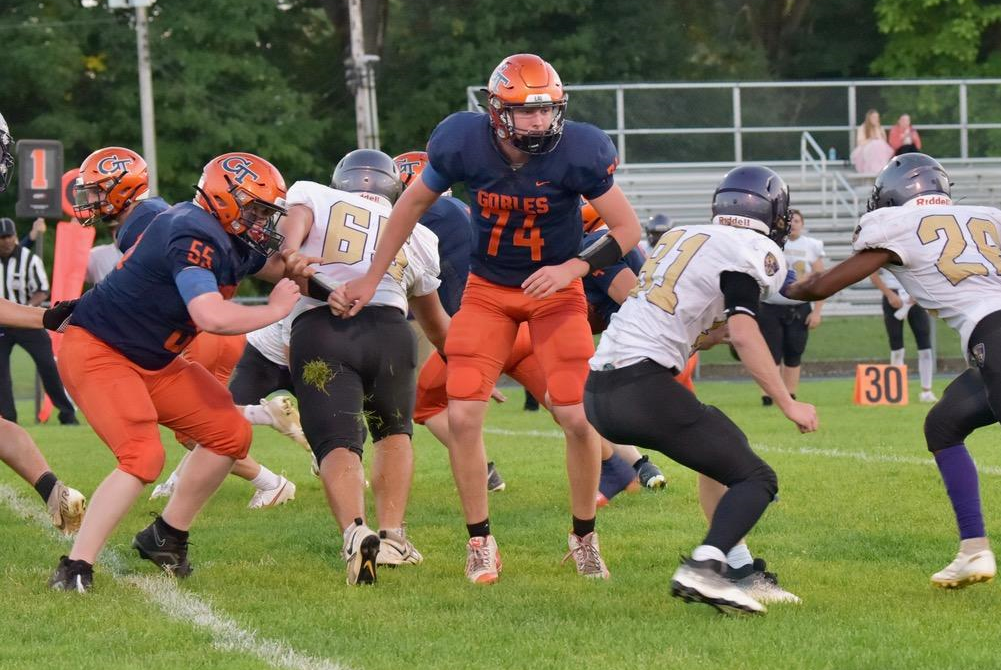
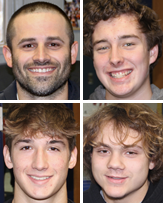
PHOTOS (Top) Gobles junior Jackson Geiger (74) squares up to make a block during his team’s game against Concord this season. (Middle) Clockwise from top left: Gobles coach Greg Eichler, Geiger, Mason Mansfield and Nathan Ray. (Below) Mansfield, left, wrestles during the first round of last season’s Individual Finals at Ford Field. (Top photo by Kathie Brown/Creative Photography. Head shots by Pam Shebest. Wrestling photo by High School Sports Scene.)