

DCC, Rice Begin Following New Leaders
By
Tom Markowski
Special for Second Half
August 16, 2017
The Detroit Catholic League football coaching carousel took a few more turns during the offseason, with a pair of programs once led by two of the winningest coaches in state history welcoming new leaders for this fall.
 Two former understudies to those longtime mentors now find themselves with the top jobs directing programs that have combined to earn 18 MHSAA Finals championships.
Adam Korzeniewski, 43, is the new coach at Birmingham Brother Rice, replacing Dave Sofran, who replaced legendary coach Al Fracassa after the Warriors won their third consecutive Division 2 title in 2013.
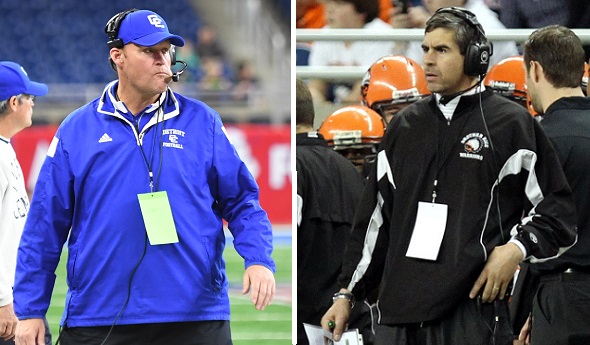
Dan Anderson, 48, is the new coach at Detroit Catholic Central, taking over for recently-retired Tom Mach, who directed the Shamrocks to a Division 1 runner-up finish nine months ago.
“It is daunting,” Anderson said. “You question yourself. Would Tom have done that? You want to keep the tradition alive. I’m not Tom Mach. I can learn from him and put my stamp on it.”
He and Korzeniewski will seek to do so while navigating what continues to be one of the most competitive leagues in the state. Detroit Catholic Central (10), Brother Rice (8) and Orchard Lake St. Mary’s (7) have combined to amass 25 MHSAA football titles, while Warren DeLaSalle has added two more.
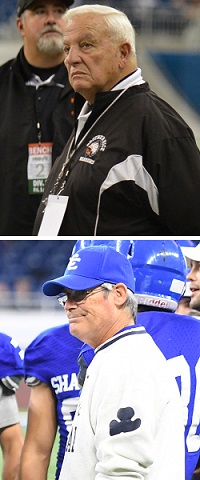
But when Mach announced his retirement from DCC in February, it continued a recent run of Catholic League Central programs passing the baton. Following the 2015 season Paul Verska – who led DeLaSalle to the 2014 Division 2 title – stepped down from the Pilots, and Mike Giannone left Macomb Dakota to fill Verska’s spot. Fracassa retired after the 2013 season with a record of 430-117-7 since starting at Royal Oak Shrine in 1960 and moving to Brother Rice in 1969; he holds Michigan’s record for most high school football coaching wins, while Mach is third with a record of 370-94 from 1976-2016.
St. Mary’s longtime leader George Porritt (256-71 since 1989) will enter this season as the league’s only coach with more than a year heading up the program at his school.
“I’m not a tight T (formation) guy. But I will run it right at you,” Anderson said in explaining a philosophical similarity to Mach. “And I do run some tight T plays. You can’t get rid of the wham. Tom’s philosophy was defense wins championships. That won’t change while I’m here.”
The wham is a basic run play into the middle of the line, a trademark of Mach’s offense. It’s simple but often effective. Anderson said he will install a multiple offense incorporating formations and plays from a variety of schemes as the Shamrocks look to add to last season's 13-1 run.
Anderson has been well-schooled, at Catholic Central and a number of high schools in Ohio where he grew up, played football and coached. He came to Catholic Central in 1999 as a freshmen coach. The next five seasons he was the head junior varsity coach. In 2005, he became a varsity assistant – and in 2007 he became the defensive coordinator.
Anderson played defensive end and offensive tackle at Archbishop Alter in Kettering, Ohio, located near Dayton. He earned a scholarship to University of Pittsburgh where he played guard and was a starter his junior and senior seasons.
Long before then, he knew he wanted to become a teacher and a coach. A junior high history teacher, who was also a coach, played a major role in Anderson becoming the person he is today.
“He coached me in CYO (Catholic Youth Organization),” Anderson said. “He made a big impression upon me. I was 12 or 13 years old, and I knew then I wanted to teach history and coach.
 “I love the game (of football). As soon as I got out of college (1992), I started coaching as a volunteer assistant at Penn Hills (Pa.).”
And he hasn’t stopped coaching since. After leaving Penn Hills, Anderson went to Pomfret, Maryland, located just outside of Washington, D.C., and coached three sports (baseball, basketball and football) at McDonough High. After two years, he went back to his alma mater and spent five years there, the last three as the head football coach. His wife at the time was transferred to General Motors in the Detroit area and, again, Anderson sent out applications and was hired by Catholic Central as a history teacher and football coach.
Anderson said he feels fortunate to be in this position. Learning and having mentors within a parochial school system prepared him for this opportunity and challenge.
“Mach, to me, was a heck of a mentor,” he said. “My high school coach, Ed Domstiz, was one of my mentors, too. And he’s still coaching.
“Tom was laid back. He didn’t take things too seriously. With all of the extracurricular things that go on now, he wanted football to remain a game. That bothered him, the kids jumping from one school to another. To me, high school was a great time, all of the friends that you made. When you move around you miss that.
“For Tom, it was more of his relationships with people. He had the Xs and Os, but it was about building men. That was always an emphasis. You had to develop them into great people. What you saw with Tom is what you got. It was refreshing.”
Though Korzeniewski isn’t directly replacing a legend, Fracassa’s shadow still looms over Brother Rice football; history doesn’t leave us that quickly. Expectations remain high for a program that won three straight Division 2 titles from 2011-13. The Warriors finished 7-4 last fall.
There’s an added unknown for Korzeniewski. He’s never been a head coach before. He’s coached for 17 seasons, including six as Fracassa’s defensive coordinator. The last two seasons Korzeniewski was the defensive coordinator at Birmingham Seaholm, working under his good friend Jim DeWald. The two were teammates at Western Michigan during the mid-1990s.
Korzeniewski’s approach is to keep things simple. He doesn’t see his job as having more pressure than most head coaching positions. As a coach, you teach. For the players, they learn.
“To me, it’s my job,” he said. “I go about it as I would anything else. To other people it would be different. I do my job every day.
“I didn’t come here thinking other people did this or that. It’s the kids. It goes back to why I got into coaching. You see the progress. It’s important to them that they get better. Football is important to them.”
Just as Anderson learned from his predecessor, Korzeniewski has borrowed much from Fracassa.
“I learned the importance of a team,” Korzeniewski said. “Nothing is more important than the team. And there’s something else. He made every player feel a part of the team. He had a way to make kids compete. I wish I could do that.
“What’s important to me is that things get taught and understood. You have to be demanding and supportive. (It’s) the action and reaction.”
Rest assured, both coaches will be watched as if through a microscopic lens. They understand that. They also understand they are heading into once-in-a-lifetime opportunities, and they’re going to make the most of them.
“I’m excited,” Anderson said. “We have a great group of kids. We have a great group of coaches and we’re going to enjoy each other’s company.”
 Tom Markowski is a columnist and directs website coverage for the State Champs! Sports Network. He previously covered primarily high school sports for the The Detroit News from 1984-2014, focusing on the Detroit area and contributing to statewide coverage of football and basketball. Contact him at [email protected] with story ideas for Oakland, Macomb and Wayne counties.
PHOTOS: (Top) Detroit Catholic Central's Dan Anderson (left), here coaching the defense during the 2016 Division 1 Final, and Brother Rice's Adam Korzeniewski, the Warriors' defensive coordinator during their 2012 Division 2 title run, are taking over top Detroit Catholic League programs this fall. (Middle) Former Brother Rice coach Al Fracassa (top) retired after the 2013 season, while DCC's Tom Mach stepped down in February.
Undefeated Cassopolis Continues to Climb
By
Wes Morgan
Special for MHSAA.com
October 5, 2017
By Wes Morgan
Special for Second Half
Getting to the postseason wasn’t the issue for the Cassopolis varsity football program, which is currently ranked No. 6 in the latest Associated Press Division 7 poll and has earned playoff berths 11 times since 2000.
 It was taking that next step.
Now in his fifth year guiding the program, head coach Dan Purlee, a Cassopolis graduate, former athlete and longtime assistant coach, helped push the school past that barrier. And 2016 was the program’s banner year.
The Rangers ripped through all their opponents last season except for a talented Buchanan squad in Week 5. Throughout their 8-1 run during the regular season, the Rangers were on the right side of a 365-130 scoring differential. They went on to outscore their first three playoff foes 141-49.
Cassopolis, which also boasted a 4-0 mark to win the Berrien-Cass-St. Joseph Conference Red championship, finished last year 11-2 with a 54-22 loss to Detroit Loyola in the Division 7 Semifinals.
Just a year earlier, Cassopolis recorded a 9-3 record in 2015, falling to Pewamo-Westphalia in the Regional round. The Rangers’ 48-14 victory against Bridgman that fall earned the program its first District championship.
“We’ve put together a few good years here,” said Purlee, whose team, led by six returning seniors, is 6-0 heading into Friday’s game against Southwest 10 Conference opponent Hartford. “We’re playing pretty good football, but you always feel like there’s room for improvement, and there is. But we like where we’re at this year, and we’re proud of our success and accomplishments over the previous few years.”
Purlee doesn’t easily accept the credit. He promptly shifted the focus to the student-athletes and his astute assistants, including Michigan High School Football Coaches Association Hall of Fame inductee Jim Myers, who has 42 years of coaching under his belt and previously was the head coach at Niles Brandywine. And there’s also Steve Green, who has been coaching alongside Purlee at Cassopolis the last 18 years.
“We’ve done it together,” Purlee said. “Your coaching buddies — it goes beyond coaching. They’re like your brothers.”
Cassopolis athletics director Matt Brawley had high praise for Purlee.
“He’s a professional,” Brawley said. “He’s extremely detailed and has a game plan for every situation. He’s very impressive to watch.”
Brawley also pointed out that, with a current team grade-point average of 3.40, a second consecutive academic all-state award is on the horizon.
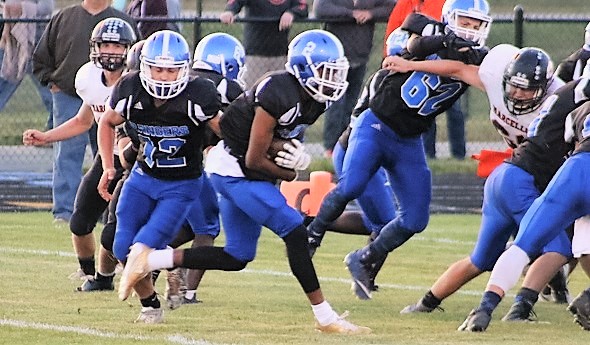
Running the full house T formation offense, no one player has had to carry the load. Statistical information was only available through the Rangers’ first five games, but senior Brandon Anderson and junior Tyrese Hunt-Thompson had combined for nearly 500 rushing yards and 14 touchdowns. Senior quarterback Xander Smith had rushed for more than 250 yards with a couple passing touchdowns as well.
Junior Hunter Parsons had rushed for 266 yards through five contests, and quarterback Dylan Green has been responsible for four passing TDs. Keep in mind, most of the starters have watched the second half from the sideline most of the year with games well in hand.
 “We have the ability to run a little shotgun spread,” Purlee said. “We’re pretty diverse offensively. Teams were really loading up the box on us and we’re not traditionally very big up front, so we realized we were going to need to counter that with spreading the field a little bit.
“We’ve just had a stretch here where we’ve had some kids who are extremely athletic and can catch the ball and quarterbacks that can throw the ball. We can pound it up the middle and also spread you out.”
Defensively, freshman outside linebacker Ahsan Hart boasts 33 tackles and a pair of sacks, senior Kyjuan Lanier, a captain at middle linebacker, has 29 tackles, two sacks and two fumble recoveries; and junior defensive end Skyler McKee has recorded 28 tackles with two sacks.
“We’re all comfortable with each other,” Lanier, a three-year varsity player, said. “It’s trust. I feel like if I don’t make a play, I’ve got Hunter Parsons right next to me coming up to make the tackle. Our secondary likes to come up and make plays. Our lines are disciplined.
“When I was younger, it was more coming downhill, filling holes and blitzing. As I’ve gotten older, it is recognizing where the ball is going, watching linemen, seeing what they’re doing, watching a pulling guard … getting smarter rather than just running to the play.”
The Rangers, who have given up only 28 points all year, pin their ears back and keep the pressure on every snap.
“I think there are several factors,” Purlee said of his program’s building success. “We’ve had some really good players over the past few years, and we have some athletic and tough kids. When you have that, you can put together a pretty good football team. I feel like our coaches have done a great job in helping instill discipline. It’s a team that executes in all phases of the game. We work hard, and we’re well prepared. It’s a collaborative effort between good players, good coaches and the right type of kids.”
Instead of being content, having tasted this kind of success has only intensified the team’s appetite.
“They have been a committed group. They’re extremely focused,” Purlee added. “Obviously, we’re proud of what we’ve done the last two years, but we want to go further. We’re not going to limit our goals. The next step for us is to play in Ford Fieldhouse.
 Wes Morgan has reported for the Kalamazoo Gazette, ESPN and ESPNChicago.com, 247Sports and Blue & Gold Illustrated over the last 12 years and is the publisher of JoeInsider.com. He can be reached at [email protected] with story ideas for Berrien, Cass, St. Joseph and Branch counties.
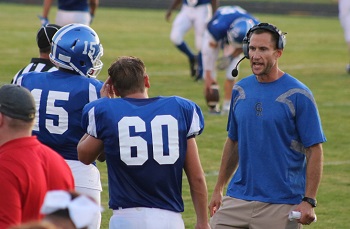
PHOTOS: (Top) Casspolis' Tyrese Hunt-Thompson (2) follows his blockers into the line against Marcellus last week. (Middle) Rangers coach Dan Purlee confers with one of his linemen on the sideline. (Photos by Billie Austin.)