

DCC's Mach Builds Legacy Sure to Live On
By
Tom Markowski
Special for Second Half
March 20, 2017
NOVI – Tom Mach’s impact on the Detroit Catholic Central football program didn’t end with his retirement Feb. 9.
 The aftershocks will be felt for years to come.
Mach and C.C. football have become synonymous over the past 41 seasons. The double tight end, three-back backfield, sometimes lined up in the T-formation, is the offense we’ve been accustomed to watching game after game, year after year, so much so that it’s become a blue thread woven through the fabric that is high school football in this state.
But times change. Coaches move on, and new ones are hired.
Mach, 69, had been contemplating retirement for some time and the reasons to do so gathered momentum after the Shamrocks lost to Detroit Cass Tech, 49-20, in the Division 1 Final in November.
“You’re not as inspired as you used to be,” Mach said. “I’ve gone back a couple of times on my decision. It wasn’t an easy decision. It was real hard. I prayed real hard that God would tell me what to do. It’s stressful. People count on you. I finally said to myself that you have the confidence that the next guy would carry on with what we did here.
“My first meeting with the players (at C.C.) was in 1976. I remember writing the speech. I thought of that. The 41 years and all of the things that came in between.”
When Mach wrote his last speech he incorporated what C.C. football meant to him and to the players he coached. He tried to reassure the players that the program, and what it is today, will remain so the next day and the day after that.
“The actual doing it was hard,” he said. “It was the hardest speech I’ve ever done.”
Mach was hired in 1976 after gaining experience as an assistant coach at Southgate Aquinas. He never thought administrators at C.C. would hire him. In his mind, why would they? He had no experience as a head coach, and he thought the experience of going through the hiring process would benefit him when he applied somewhere else. To Mach’s surprise, he was hired.
C.C. went 8-1 in Mach’s first season. He said that success was crucial for him and his staff to win over the players and administration. Had C.C. finished below .500, the future might have been different for him. As it was, the players warmed up to his way of coaching, and three years later the Shamrocks won the Class A title, the first of 10 under Mach.
“The first thing I thought of when I got hired was, how am I going to fair against guys like (Birmingham Brother Rice coach) Al Fracassa? If I make it five years, I’ll be happy,” Mach recalled. “What was good for me, the team I inherited was talented. I had written a book on football and my philosophy but there are always questions. I was thankful for that (initial success). Once that happened, the next group would buy into it. I did the same thing. I have a good group of guys coming back. I wanted to leave a good legacy for the next guy. Having that good start made people believe in my philosophy.
“We did it. We never changed anything. We proved it in the way we handled things, and the kids bought into it. We did it the right way.”
Last weeks, DCC did hire that “next guy” – Shamrocks defensive coordinator Dan Anderson, who was promoted to take over the program after working 20 years under the longtime mentor.
But the initial shock of not being the person in charge will take time to sink in for Mach. What he will lean on to make this transition as smooth as possible are his family and friends.
Mach fought with this decision, but what made him make it at this time was his family, notably his wife, Lynn. His wife had knee replacement on Jan. 10, and on April 4 she is scheduled to have the other knee replaced. Whether it’s hip replacement, knee replacement or any similar type of surgery, the process is painstaking, and the person going through it must have someone close to assist in the process.
Being that person, Mach knew this would take time away from coaching his team in the offseason had he chosen to stay. Lynn had physical therapy sessions three days a week, and the other four Mach would assist with the therapy at home.
In the end, it would have been too difficult to do both.
“I have to be her coach,” he said. “After (the knee replacement) I was with her two weeks, every day. I don’t think I’ve ever done that before. Fourteen days. But we did it.”
Mach said Lynn is recovering well and is anxious to have the other one done.
The Machs will spend much of their free time at the summer home just south of Gaylord. Though not a fisherman or hunter, Mach does enjoy the outdoors. Snowshoeing is one hobby he enjoys as well as taking walks, often long walks.
To add to his activities, Mach has a brother who lives in Williamsburg, just outside of Traverse City, and his sister lives near Gaylord.
They will enjoy the peacefulness that place provides, but they’ll remain residents in southeast Michigan. Their two sons, Mike and Joe, both assistant coaches in the football program, live in the Detroit area. The Machs have one granddaughter with another grandchild on the way.
“(Lynn) won’t move anywhere,” Mach said. “We have friends here. This is our home.
“It’s always great when I’m up there, and it’s always tough to leave. Now we’ll have more time to go there and won’t be in such a hurry to leave.”
Mach said he’ll remain in contact with Catholic Central and the people who have been so much a part of his life over the years. He’ll go to games and root for the Shamrocks from his seat in the stands.
To give back to the sport, Mach said he will consider speaking at clinics or schools if asked. He mentioned that Ferris State University and Royal Oak Shrine have made contact with him on such matters.
Mach’s resume is as impressive as any coach. His teams won 10 MHSAA Finals titles and seven other times reached championship games. Those numbers are staggering. In 41 seasons when a Tom Mach-coached team began practice in August, more than 41 percent of the time it would reach the last game of the season.
He also ends third on the list of career coaching victories. His record is 370-94. Only Fracassa (Brother Rice, Shrine) with 430 and John Herrington at Farmington Hills Harrison (425) have more.
But Mach was never keen on talking about his accomplishments. For him, success was measured by the development of his players – physically, mentally and spiritually – and the respect they showed for the game.
“Throughout my life, I’ve been lucky,” he said. “It was a hard decision when you work with people so long. The school is great. The people are great. They all inspired me. It’s the people I’ll miss. You become a coach because you love it.
“I love C.C. I want them to do well. I want them to make sure the kids here have every opportunity to win.”
 Tom Markowski is a columnist and directs website coverage for the State Champs! Sports Network. He previously covered primarily high school sports for the The Detroit News from 1984-2014, focusing on the Detroit area and contributing to statewide coverage of football and basketball. Contact him at [email protected] with story ideas for Oakland, Macomb and Wayne counties.
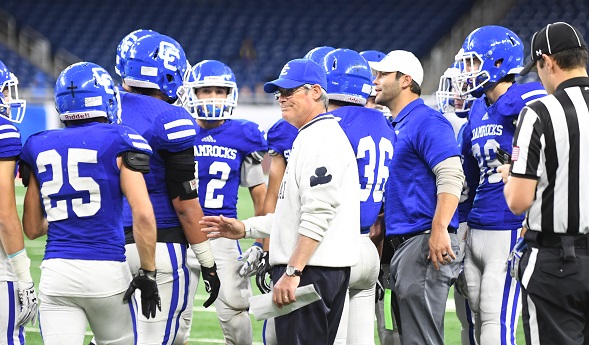
PHOTO: Detroit Catholic Central retiring football coach Tom Mach led his team to one last MHSAA Division 1 Final in the fall, against Detroit Cass Tech at Ford Field.
Howell Names Field for Longtime Leader
August 30, 2018
By Tim Robinson
Special for Second Half
If you got the impression that John Dukes has been around Howell football forever, you wouldn’t be far off.
 His association with the program began before high school.
“When I was a kid, I used to live near Page Field (Howell’s former athletic complex), and I would go out and watch football practice,” Dukes said. “I was at practice all the time, and the coach said, ‘If you’re going to be here all the time, you may as well get some water for the boys while they’re practicing.’”
That was in 1963, when the Highlanders went 9-0.
A little more than 55 years later, Dukes will be honored tonight when the field at Howell’s Memorial Stadium will be named John Dukes Field.
Howell football coach Aaron Metz began the drive to name the field after Dukes when it was determined the old turf, installed in 2004, needed to be replaced.
“We have a commitment award named for John,” he said. “If you play football for four years, you get the John Dukes Commitment Award. We put a committee together with people who have been around Howell for a long time, and when you ask anybody, they say there’s not a person more deserving than John Dukes.
“So I ran it up the ladder to the athletic director and superintendent, and, to be honest, it was a pretty easy process because no one could find anything bad about John,” Metz added. “We’re excited to have the opportunity to do it.”
Dukes was a three-year varsity player at Howell and then played at Alma College, where his teams won three league championships.
With the exception of six years at Hartland coaching under his son, Marcus, John Dukes has been affiliated with Howell football for 46 years, including 25 as the head coach.
After graduating from Alma in 1972, Dukes got a teaching job at Howell and was an assistant freshman coach for a season and a varsity assistant for two before taking over as head coach at age 25.
“My philosophy at the time was I wanted to help the kids enjoy playing football and help them to be successful at it,” he recalled. “The previous three years our record wasn’t very good. That was one of my objectives, was to make it fun.”
He then talked about his first season with a little self-deprecation, a common thread in most conversations with Dukes.
“I remember my first game,” he said. “Because I played defense in college (Dukes was a linebacker), I thought we were going to be a really good defensive team. We played Fenton in my first game, and we lost 32-19, so my defensive prowess wasn’t good at the time.”
The Highlanders lost six of their first seven games that season, but won the last two and went 8-1 three seasons later.
In all, Howell had winning records in 15 of his 25 seasons, but one group of players stood out for an entirely different reason.
“We had a period of time (1989 and 1990) where we weren’t very good, and we lost 17 games in a row,” he said. “But those kids were wonderful kids to coach. They came to practice with energy all the time, and from a coaching standpoint, it was wonderful to coach them during the week. Now, Fridays were a different story, because we didn’t play very well on Fridays, ever.
 “But the real thing that stands out with that group was the very last game of their senior year we beat (Waterford Kettering), and you’d have thought we’d won the Super Bowl,” Dukes continued. “Those kids who were seniors, that was their first football victory in high school. It was an amazing time. We had several teams with good players, and I really enjoyed coaching them, too, and I don’t want to leave them out. But that really stood out in my mind, in that they came out to work every day.
“Over a period of time of losing that many games, sometimes, it’s not fun and it’s not fun for them or the coaches. But we had a very enjoyable time over that two-year period, regardless of the fact we didn’t win any games.”
His perspective is consistent with the principles by which he ran his program.
“These weren’t original to me,” he says, “but the three things I always told our kids was your faith should be your number one priority, your family should be your number two priority. Football, when school hadn’t started, should be number three. And when school started, school became three and football became number four. We tried to base everything we did on these priorities in our lives. Sometimes those things cross over and mix and match. When they do, then you have to step back and say what is really important here?”
Dukes resigned after the 1999 season.
“There were a lot of things and I don’t know if anything in particular,” he said of his decision. “I had been doing it for 25 years, and we had a string of years where we were 6-3. So we were OK, but I felt it was time to be done with it.”
His self-imposed exile lasted one season. He had a couple of stints as an assistant coach when he finally decided to retire for good in 2006.
“No sooner had I done that, my son (Marcus) called me up and said he just got the Hartland job,” Dukes recalled. “He said, ‘Dad, you have to come here and help.’ So I went there for six years. Then he resigned, and I thought I was going to be done again.”
After another stint as a Howell assistant, John Dukes took the last two years off before agreeing to rejoin the program as a junior varsity assistant this season, as the offensive coordinator.
As it turns out, one grandson, Jackson Dukes, plays on the Howell JV, and John Dukes also is helping coach another grandson, Colin Lassey, on his junior football team.
“When Jackson gets home, I ask him, ‘Did you get yelled at by Grandpa today?” Josh Dukes says. “And when he says yes, I say, ‘Good. You should be getting yelled at.’ So nothing has changed in the 30 years since high school.”
Josh Dukes, the oldest of John Dukes’ three children, joined Marcus in playing football for their father.
“There was never an expectation that we had to be this or that,” Josh Dukes said of himself, his brother and sister, Carrie. “Now maybe he was a little harder on me, but that’s something we were thankful for. I’d rather him be harder on me than any kid on the field, because then the other kids left me alone. They knew it was the same for everyone across the board. He wasn’t going to take it easy on me, my brother or my sister.”
John Dukes coached his daughter, Carrie, when she played middle school basketball.
“The first time he coached me, he came home to my mom and said, ‘I don’t know how people do this,’” she recalled. “‘They’re all crying, half of them don’t think I like them. I don’t know how to do this with girls. It’s a totally different ballgame.’ But he was a great coach. I know some people don’t like their parents coaching them, but I loved having him coach.”
Like her brothers, Carrie Lassey stayed involved with sports. She is now the athletic director at St. Joseph Catholic School in Howell.
“He coached my freshman team a couple of years ago,” she said. “It was third and fourth-grade girls. It’s amazing. He can coach pretty much anybody.”
Indeed, Dukes also coached baseball and wrestling at the varsity level at Howell, and, for a couple of weeks, filled in as a competitive cheer coach when the Highlanders had a temporary vacancy.
“I was more a supervisor,” he said, but serving that role illustrated his commitment to the athletic program as a whole. He was needed, and he stepped in.
 Having stopped and started his career so many times, Dukes, now 68, laughs when asked about what he will do when he retires in the distant future.
“I’m sure he’ll be coaching when he’s in his 90s. Maybe triple digits,” jokes Bill Murray, the former Brighton coach who matched up with Dukes’ teams during the second half of Dukes’ Howell tenure. “The guy loves the game, he’s out there and he has a lot to offer. His teams were always well-prepared, they played great defense, were fundamentally sound and when you went nose-to-nose, they were consistent as to what they were going to do. It was a matter of whether you could stop them or not.”
Dukes still keeps up with the Howell varsity, still offers advice when asked, and still enjoys the competition.
“For me, as a head coach, it’s great having a coach (on staff) who has been there and done it to talk to and mentor, even me,” Metz said. “What makes a successful coach, I don’t think, changes, whether it’s been 50 or 100 years ago to the current day. He steered the ship to have an outstanding record (130-95) and also have a huge impact on kids in our community.”
“When people talk to me about my dad, they say he was a dad to them, or like a second dad,” Josh Dukes added. “Or, ‘I wanted to be a teacher because of him.’ These are the things that for us,” referring to his siblings, “is the most impressive part. The kids of players he’s coached, or the grandkids.”
Dukes has the unusual distinction of having coached more congressmen (Mike Rogers and Mark Schauer, who started on the offensive line for Dukes in the late 1970s) than pro football players (Jon Mack, who played for the Michigan Panthers of the USFL in 1984).
John Dukes will give a short speech before tonight’s ceremony, which will take place before Howell’s home opener against Plymouth.
“They’ve given me five minutes, but it will probably be shorter because they want to get the game started on time,” he joked.
“It’s an incredible honor,” Josh Dukes said. “Everyone in our family feels the same way. I don’t think he ever went into this with any intentions of being singled out. It’s a great lesson for our community and our athletes, to see what hard work and effort and care for your community can do, you know?”
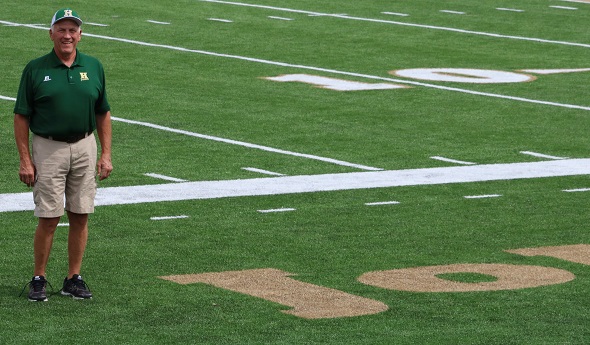
During the ceremony, the letters “John Dukes Field,” which were sewn into the artificial turf in Howell’s Vegas Gold, will be unveiled.
“Aaron showed it to me last week when they were putting it in,” John Dukes said, then joked, “I thought (the lettering) was going to be a little trademark sign (sized), and my goodness, it’s bigger than the numbers. It’s a little bit ostentatious for me, I think; wow, that’s quite a tribute. I’m very humbled by it and honored by it and very appreciative of what people have done to make this happen.”
A few days later, Dukes posed for a picture next to his name on the field and chatted with a reporter as they left the stadium.
Then, he turned a corner to the JV football office and kept walking.
Before he became a living legend, John Dukes was a football coach, and there’s a game coming up and his team to prepare.
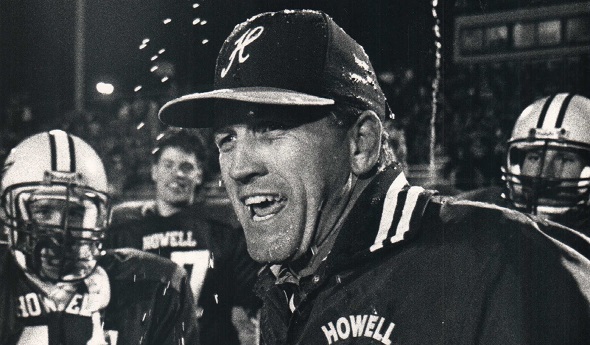
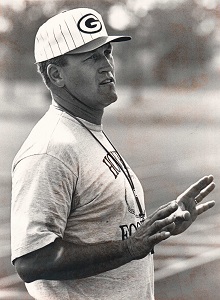
PHOTOS: (Top) Howell coach John Dukes celebrates his team’s 38-0 playoff victory over Wayne Memorial in 1992. (Middle) Dukes, during the 1991 season. (Below) Dukes stands next to the lettering that will be unveiled Thursday when the school’s field is named in his honor. (Photos taken or collected by Tim Robinson.)