

Dedication Continues to Make Difference as Pittman Elevates Game, Shores' Offense
By
Tom Kendra
Special for MHSAA.com
September 11, 2024
Jonathan Pittman lives by the acronym “PGF.”
 “My mom gave me that life motto; it stands for 'Put God First,'” explained Pittman, the senior quarterback for Muskegon Mona Shores, which is off to a 2-0 start.
“That is the core of who I am.”
Those aren’t just words for Pittman, who starts every day – Monday through Friday, from 6 a.m. to 7, when much of the world and most 17-year-olds are still sleeping – by going to church to study his Mormon faith at the Spring Lake Ward of the Church of Jesus Christ of Latter-day Saints.
He heads directly from there to school, where he either practices throwing the football or shooting the basketball (Pittman is also a standout on the Sailors’ hoops team). Then it’s off to the classroom – where, by the way, he is a straight-A student in honors classes.
Only when all of that is completed does he switch his focus solely to football. The 6-foot-2, 205-pound senior is a three-year starter with a rocket arm and the power to run over linebackers like a fullback.
“Pitt is the hardest-working kid I have ever coached,” said 14th-year Mona Shores coach Matt Koziak, who has led the Sailors to four Division 2 championship games and won two, in 2019 and 2020.
“He is very critical of his own game. He identifies where he needs to get better, and he just keeps working at it.”
Koziak can track how much film his players are watching. One day, he checked and noticed that senior linebacker and film study devotee Solomon Robertson had logged two hours on that day. The only player with more was Pittman – with six hours.
Pittman’s work ethic appears to be paying dividends, as he’s led the Sailors to impressive road wins over Grand Blanc (28-26) and River Rouge (21-6) to open the season and heading into yet another road game this week at undefeated Flint Hamady.
He did it with his feet against Grand Blanc, running 25 times for 192 yards and throwing for only 43. Against River Rouge, it was just the opposite – he completed 9-of-13 passes for 127 yards, while rushing for just 30.
Pittman comes from good pedigree. His father, also Jonathan Pittman, is a California native and former standout receiver at Brigham Young University who went on to play three years in the NFL for Buffalo, Tampa Bay and the New York Jets. His mother, Quintina, was a three-sport high school star whose college sports dreams were cut short by a knee injury.
 The Pittmans moved to Muskegon in 2014 when his father was hired as the general manager at The Lakes Mall, a position he held for five years. (The younger Pittman, who is the second oldest of four children, said his family is not related to any of the many Pittmans in the Muskegon area.)
Pittman has always had a big arm, which allowed him to earn the varsity starting role as a sophomore. Last fall, he completed 87-of-134 passes for 1,391 yards and 15 TDs. His main targets this fall are wideouts Jaeger Johnson and Micah Carafelle and tight end George Duggins.
Pittman is equally well-known for his power running, forming a tough-to-tackle 1-2 duo with junior running back Tomarion “Ike” Steward (5-11, 205).
The biggest improvement for Pittman so far this season has been his increased speed and agility, as he has slimmed down from 218 pounds to 205.
“I wasn’t as fast as I needed to be and couldn’t execute some of the things we like to run,” said Pittman. “I needed to work on that. Our offense is much more diverse this year. We have a ton of weapons, and we can hit teams from all angles.”
Koziak hopes his quicker quarterback will give his team the extra edge it needs in huge Ottawa-Kent Conference Green games at home against Byron Center (Sept. 20) and at Muskegon (Sept. 27) – both against likely Division 2 playoff opponents.
Shores made it to the Division 2 Final four times in eight years, losing to Warren De La Salle Collegiate in 2014 and 2018, then defeating Detroit Martin Luther King in 2019 and De La Salle in 2020. The Sailors have not advanced out of their District the past three years.
Right now, Shores is just waiting to play a game in West Michigan, and will have traveled 1,030 miles round-trip for their first three this season.
The most puzzling aspect of Pittman’s football career thus far is his surprisingly small number of college scholarship offers. Wayne State, Lawrence Tech and Siena Heights have made offers, while Eastern Michigan and Northern Illinois have made the trip to Muskegon to watch him throw.
Pittman, who plans to major in accounting, is not doing any lobbying – preferring to let his play on Friday nights speak for itself.
One thing is for certain: He has made a believer out of Koziak, who has been coaching football for more than 20 years, with prior stops as offensive coordinator at Muskegon Heights and head coach at Muskegon High in 2009.
“I will say this: Wherever he goes, by his junior year, he will be a team captain,” said Koziak. “You combine his athletic ability and his work ethic, and it’s magic. He’s a special kid; a generational kid.”
 Tom Kendra worked 23 years at The Muskegon Chronicle, including five as assistant sports editor and the final six as sports editor through 2011. E-mail him at [email protected] with story ideas for Muskegon, Oceana, Mason, Lake, Oceola, Mecosta and Newaygo counties.
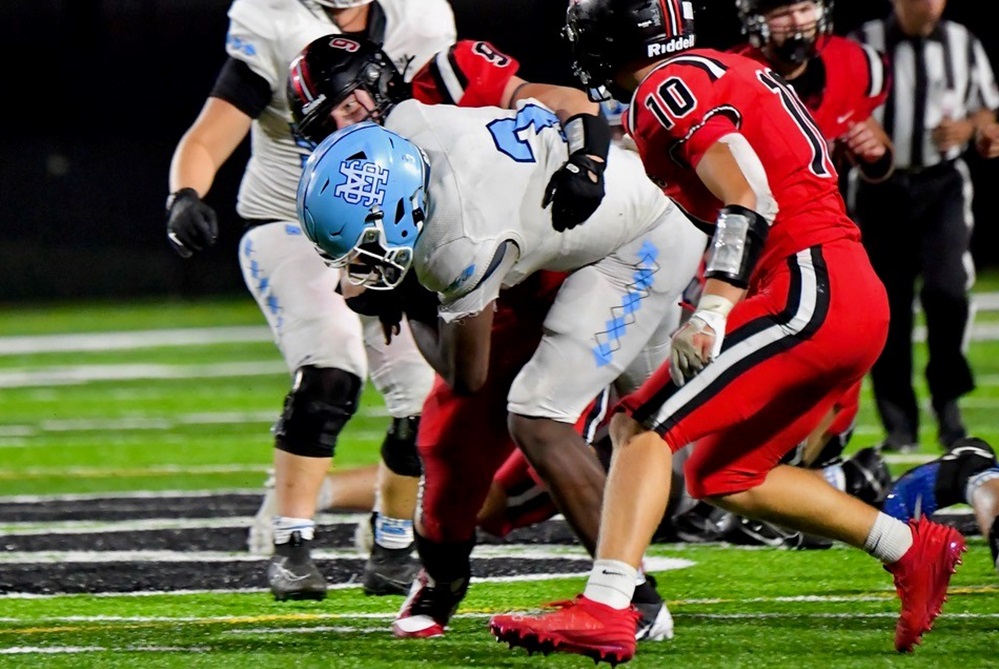
PHOTOS (Top) Muskegon Mona Shores' Jonathan Pittman powers into the Grand Blanc defense during his team's season-opening win. (Middle) Pittman watches as a teammate carries the ball upfield. (Photos by Terry Lyons.)
Many-Sport Standout Gash Closing High School Career with Repeat Title Pursuit
By
Keith Dunlap
Special for MHSAA.com
September 3, 2026
Gideon Gash said this fall is marking the end of an era for him athletically.
 Throughout his life, it didn’t seem to matter what the sport was, because Gash was playing it.
Whether it was soccer, basketball, lacrosse, football, or track & field, Gash sampled them all, and it didn’t stop when his high school career began.
Last year as a junior at Detroit Catholic Central, Gash continued to play several sports after being named all-state for football in the fall.
During the winter, he played on Catholic Central’s basketball team. In the spring, he decided to go out for track and thrived, finishing second in the 100-meter dash and winning the long jump at the Catholic High School League meet, and then taking third in the long jump at the Lower Peninsula Division 1 Finals.
Following that championship meet, Gash returned to the lacrosse team and suited up for the Shamrocks during the final week of the season, which culminated in a DCC Division 1 title. Gash had played lacrosse the previous spring as a sophomore, but decided to focus more on track as a junior.
“I worked out different muscles and different skills and just having that versatility helped me a lot throughout life,” Gash said. “Being able to do different things and learn faster and having to keep up with everyone in terms of basketball, lacrosse, in terms of just raw skills. That helped me a lot in terms of just being able to add to my bag and be the best I can.”
But now, Gash said his multi-sport playing days are all but over.
One of the premier college football recruits in the nation, the 6-foot-4, 210-pound Gash has committed to play at Texas Tech for now, although he recently said his recruitment is “not closed down,” according to an article on Rivals.com.
 Regardless of where he ends up, Gash said he plans on enrolling early and starting college in January, adding he made sure to accumulate enough class credits to be able to do so.
That means it’s football from here on out, and odds are he’s going to have a monster senior year for reigning Division 1 champion Catholic Central.
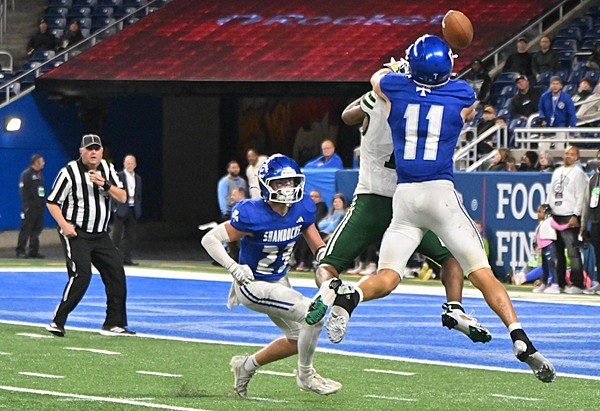
Last year, Gash was all-state in Division 1-2 as a lockdown defensive back, collecting 74 tackles and nine pass breakups. He also was a big-play threat as a wideout, catching three long touchdown passes for Catholic Central in a championship game win over Detroit Cass Tech at Ford Field.
There are times this season where Gash may never leave the field, given he will see lots of time as a dangerous punt returner. In a season-opening win over Clinton Township Chippewa Valley, Gash returned a punt 48 yards for a touchdown.
Playing so many sports throughout his life has shaped him into an all-around force on the football field and helped turn him into a dominating physical specimen.
Gash gained 10 pounds of muscle since last fall and going into his senior year is more chiseled and faster than he has ever been.
“He just loves competing,” Catholic Central football head coach Justin Cessante said. “When we compete and he works the way he does when nobody is watching, and he’s got his agility, his strength and his size, he’s a 10 times better player and athlete than he was last year. I think that attributes to doing all those different things.”
This is the first year Gash is not playing alongside his older brother, Samson, the 2025 Finals champion in the 100-meter dash and all-state wide receiver last fall who is a freshman at Michigan State.
Gideon Gash will certainly be counted on for veteran leadership since Catholic Central entered this season with only two returning starters, although there are several talented underclassmen already with Division I college scholarship offers who are expected to soon make names for themselves on the high school level.
While the next wave of great players is already coming for Catholic Central, it certainly will be hard to replace Gash and how he was able to excel at more than just football.
“I’m going to miss it,” Gash said. “I’ve been playing three sports my whole life, so I’m going to miss it a lot.”
 Keith Dunlap has served in Detroit-area sports media for more than two decades, including as a sportswriter at the Oakland Press from 2001-16 primarily covering high school sports but also college and professional teams. His bylines also have appeared in USA Today, the Washington Post, the Detroit Free Press, the Houston Chronicle and the Boston Globe. He served as the administrator for the Oakland Activities Association’s website from 2017-2020. Contact him at [email protected] with story ideas for Oakland, Macomb and Wayne counties.
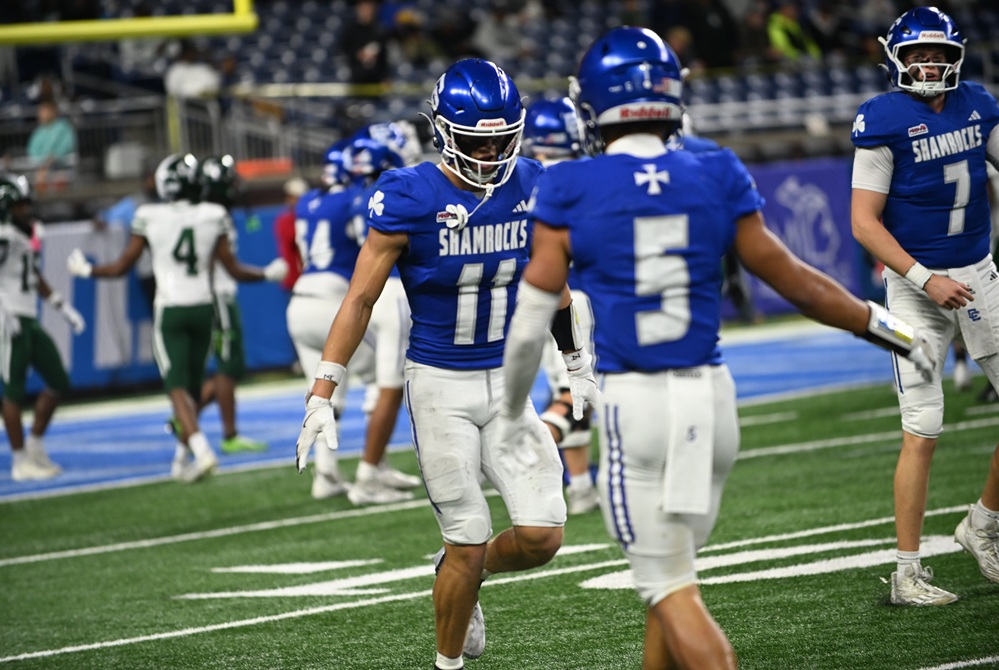
PHOTOS (Top) Detroit Catholic Central’s Gideon Gash (11) is congratulated by brother Samson Gash after scoring during last season’s Division 1 Final. (Middle) Gash breaks up a pass during the win over Detroit Cass Tech.