

Detroit Embarks on Historical Weekend
By
Tom Markowski
Special for Second Half
November 27, 2015
DETROIT – Basketball used to be king in Detroit. Detroit Public School League teams like Detroit Cooley, Detroit Pershing, Detroit Southwestern and others won MHSAA championships and sent numerous players on to college to play at major universities like Michigan, Michigan State and others.
 Recently the quality of basketball has taken a step back, and football has taken center stage.
This past March, Detroit Western International was the first PSL team to win the Class A boys basketball title since Pershing in 2009 and just the second since Detroit Central won the Class A title in 1998. This is a far cry from what is considered one of the glory eras in PSL history. From 1987-94, teams from the PSL won eight consecutive Class A titles.
(It should be noted that Detroit Renaissance did win Class B titles in 2004 and 2006, and Detroit Crockett also won the Class B title in 2001.)
In 2007 Detroit King was the first PSL team to win a football state title. For those outside of the city, it might not have meant that much other than a simple statistic. But for the PSL coaches who longed for respect statewide, King’s victory over Midland in the Division 2 Final was vindication.
When Detroit Cass Tech won back-to-back Division 1 titles (2011, 2012) a few years later, football fans across the state began to realize that what King accomplished in 2007 was not a fluke. Teams from Detroit were relevant statewide.
This weekend another first will take place. King will play for the Division 2 title (against Lowell) on Friday and Cass Tech will play for the Division 1 title (against Romeo) on Saturday. It’s the first time two PSL teams will play for MHSAA championships in the same season. Both games kick off at 1 p.m. at Ford Field.
The milestone is not lost on the coaches, Dale Harvel of King and Thomas Wilcher of Cass Tech.
Wilcher pointed to King and then-coach James Reynolds for taking the lead. King was the first PSL team to reach an MHSAA Final (1989 and 1990), and by doing so created instant credibility.
“King established what we could accomplish,” Wilcher said. “By winning the first state title, by winning both the PSL and then the state the same year.
“I don’t prepare my kids the same way. From day one I’m preparing for a state championship, Thanksgiving Day weekend, not for nine weeks. You have to condition a different way. You have to have a long-haul focus. The kids you started with might not be the ones you finish with. King High set that bar.”
Step aside for moment and realize what Wilcher said. Cass Tech and King is the most intense rivalry in the city. Emotions run high, and sometimes they boil over. But here is the coach from one team praising the other. In addition to the rivalry, there is mutual respect.
“It’s great,” Wilcher said of the two city powers playing for a title. “It’s great for the city.”
Regardless of what takes place Friday, Harvel said he, his staff and players will be at Ford Field in support of Cass Tech.
And Harvel said it’s not just about King and Cass Tech. What will take place this weekend will affect all PSL schools: their players, coaches, student body and alumni.
“It’s a factor with our school system,” he said. “It’s a pride factor even if you don’t play for Cass or King. The alumni for all public schools are represented.”
Harvel said even though most point to the 2007 championship season as a turning point, it was the teams that lost in the Class A Final in 1989 and 1990 that started it all. Some forget that back in 1989 there were just four MHSAA Finals champions, not eight, making King’s run all the more noteworthy. The next season the playoffs were expanded from four classifications to eight.
Coincidentally, each team has had two difficult playoff games and two one-sided affairs on their way to Ford Field. King (13-0) trailed Detroit U-D Jesuit, 24-21, in a Pre-District before winning, 35-24, and King led Detroit East English 7-0 after three quarters before pulling away for a 26-12 victory in a Regional Final.
Cass Tech (11-2) blew past its first two opponents by the combined score of 84-20. In the Regional Final it trailed Macomb Dakota 10-0 before coming back for a 16-10 victory. Last week, the Technicians held on to defeat Canton 48-41 on a snow-covered field at Troy Athens. Canton had possession on Cass Tech’s 40 for the last play of the game.
 Tom Markowski is a columnist and directs website coverage for the State Champs! Sports Network. He previously covered primarily high school sports for the The Detroit News from 1984-2014, focusing on the Detroit area and contributing to statewide coverage of football and basketball. Contact him at [email protected] with story ideas for Oakland, Macomb and Wayne counties.
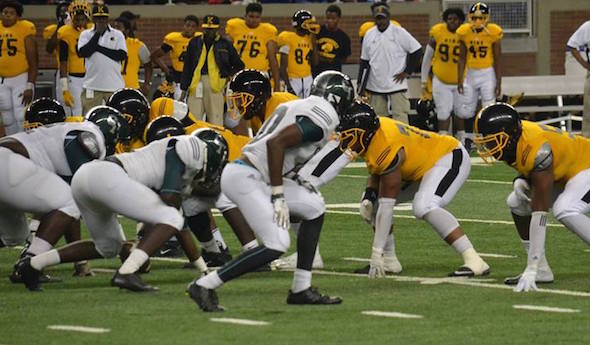
PHOTO: Detroit Cass Tech (green helmets) and Detroit Martin Luther King, here in the Detroit PSL Final, give the league two MHSAA finalists for the first time. (Photo courtesy of the Detroit Public School League.)
Portland Makes Right Moves for March
November 29, 2012
By Geoff Kimmerly
Second Half editor
Dylan Carroll and Adam Goodman knew the request was coming long before coach John Novara asked them to make a big change for their senior seasons on the Portland football team.
The writing was on the scale, so to say. At 6-foot-5 and 230 pounds, Carroll was among the three most sizable players on the Raiders’ roster this fall. And Goodman, at a solid 6-0, 200, wasn't far behind.
Still, it’s fair to assume not a lot of players want to trade in the opportunity to carry the ball for a jersey in the 50s. But Novara had no choice but to ask; he needed two new guards, and the best fits were tight end Carroll and the fullback, Goodman.
“At first, it was block, block, block. But after that, you get to pancake guys when you pull. Especially in this offense, guard is one of the best positions that we run,” Goodman said. “At first, it wasn't so exciting. But after that, it’s the best position. I would've played it all four years if I’d had the chance.”
Their one season on the line helped the Raiders produce unprecedented results.
Portland gets a Second Half High 5 this week after finishing a 13-1 season with its first trip to the MHSAA Finals – and first championship, thanks to a 12-9 win over Grand Rapids West Catholic.
The Raiders won in the same way they've made the playoffs every season over the last decade – with a mix of physical play up front, tough running and stout defense. That style often has been made possible by big bodies up front – a standout or two like alum and recently-graduated Eastern Michigan University 300-pounder Bridger Buche have been more the usual than occasional for Portland of late.
Not this season. For the Raiders to win again like they always have, it took the sacrifices of a couple smaller but just as tough seniors to be the catalysts.
“I think that was one of the keys to our success, offensively,” Novara said. “They graciously moved there. Without them moving to guards, I don’t know that we could've done this.”
Portland scored 500 points this season, likely its most ever (Michigan-football.com records date back to 1950). No other Raiders team had scored even 400.
Carroll and Goodman also were two of only three Portland players who pulled double duty, with Carroll also a starting defensive end and Goodman a starting linebacker. They helped key a defense that gave up just 13 points per game.
That defense gave up more than 14 points only once during the regular season – in a 41-32 loss to 2011 Division 5 runner-up Lansing Catholic. It gave up more than 20 twice in the playoffs, but hung on when it counted in a 45-28 win over reigning champion Flint Powers Catholic in the Regional Final and then the next week in a 28-23 nail-biter against Ann Arbor Gabriel Richard.
Portland scored all of its points of the MHSAA Final during the game's first 15 minutes. But the defense came up with three interceptions and two turnovers on downs, plus blocked a field goal attempt. The Raiders ended West Catholic’s final drive with a fourth-down stop on their 12-yard-line.
“The defense had been there all season, and we were just happy to make that one last play to win a state championship,” Goodman said.
And if he and Carroll’s moves to the offensive line hadn't been worth it completely before, they certainly became so that afternoon. As Carroll said after, he and most of his teammates are three-sport athletes who grew up together in their small town midway between Lansing and Grand Rapids. A position change hardly qualified as a sacrifice for an opportunity like this.
“I wasn't going to go out without a state championship this year. Our seniors deserved it,” Carroll said.
“We kept our mouths shut. We did whatever was best for the team, and we still worked as hard as we could this summer. It was well worth it.”
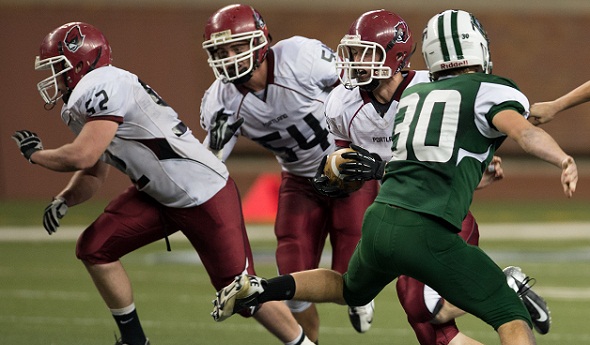
PHOTO: Portland linemen Adam Goodman (52) and Dylan Carroll (54) lead the way for teammate Auston Brandt during Saturday's Division 5 Final at Ford Field. (Click for more from Terry McNamara Photography.)