


Diversionary Tactics Backfire
September 24, 2013
Placing a stone in your left shoe will take your mind off a blister on your right foot; but it does not solve the problem.
Faced with domestic starvation and civil unrest, many dictators have created external enemies in hopes of distracting their countrymen and women and rallying their support. Think of North Korea as just one of dozens of examples, recent to ancient. It has even ocurred in the US, recently and throughout our nation’s history: strawmen vilified to distract us from other more pressing problems.
Closer to home, it is something like this strategy that may be at work in many school districts as they restructure and rename schools, or resort to closings and charters. And something like this is behind the state and federal emphases on standardized testing and schools of choice.
And really close to home, it was something like this at work in football. Faced with thousands of former players with alleged concussion-related illnesses filing suit against the National Football League, and bad publicity mounting, the NFL focused instead on youth football. We told them this strategy would backfire; but a professional league with more money than many nations was not inclined to listen to little guys like us.
The NFL went state by state to advance concussion legislation which was long on symbolism and low on substance, and totally lacking any enforcement capabilities. In state after state, the NFL paraded young people with sad stories in front of state legislators looking for good headlines.
So today, 49 states have new “concussion” laws; and participation rates in youth football are plummeting. Big surprise. But ironically, it’s plummeting at a time when school-sponsored football is the safest it has been since it was introduced to schools 100 years ago. The equipment is the best ever, the rules the most protective ever, the coaches and officials the best trained and most safety conscious ever.
Take a look at this quick video that tells the true story about school-sponsored football.
QB Leads Falcons to Record-Tying Title
November 25, 2017
By Geoff Kimmerly
Second Half editor
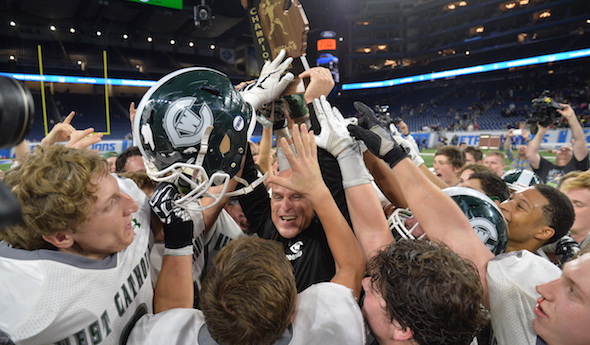
DETROIT – Yes, Grand Rapids West Catholic was well aware of Saturday’s history-making opportunity at Ford Field.
 And yes, becoming only the third program to win five straight MHSAA football championships has been an honor, but also a heavy expectation to uphold.
But this fall it rested on an experienced Falcons group that shined again Saturday at Ford Field, riding the experience of what’s become an annual trip to Detroit.
West Catholic’s 34-7 win over Saginaw Swan Valley gave it five consecutive Division 5 titles, tying the program with Farmington Hills Harrison 1997-2001 and East Grand Rapids 2006-10 for the longest Finals winning streaks in MHSAA football history.
“I think one of the hardest things is coming in and working hard every day throughout the whole offseason, throughout the season itself,” said West Catholic senior Gaetano Vallone, who quarterbacked these last three champions. “Not a lot of programs can do that.
“With our guys, everyone’s there in the morning from freshman to varsity level, so that really helps us. We have a lot of dedication.”
And the Falcons have had Vallone – a major difference maker again Saturday.
He completed 10 of 14 passes for 197 yards and two touchdowns, and ran 17 times for 60 yards and a score. That put his season totals at 2,677 yards and 31 passing TDs and 927 and 15 on the ground.
Over three MHSAA Finals, Vallone averaged 197 yards and two touchdowns passing and 86 yards and a score running the ball as the Falcons previously beat River Rouge 40-34 in 2015 and Menominee 43-7 a year ago with him running the show.
West Catholic coach Joe Hyland called Vallone the best competitor he’s coached. And Swan Valley coach Kevin Gavenda noted how Vallone has played more high school games in three years – including more than a season’s worth in the playoffs – than most to acquire such valuable experience. That’s paid off in playmaking ability but also in perspective, which pays off in potentially stressful situations like the Semifinal where the Falcons trailed Frankenmuth 21-0 before coming back to win 25-21.
“My sophomore year I was just kinda going with the flow, trying to do my best, trying to put the team in a position with my abilities,” Vallone said. “Now as a senior, I’ve gotten a lot better, more knowledgeable of the game. Sometimes I call (Coach) off, because I see something, and he allows me to do that because he trusts me.”
Vallone was not alone, of course, among Falcons who were contributing to a second or third championship Saturday. And that experience seemed to come through in West Catholic’s workmanlike approach.
The Falcons scored on their first three possessions and six of their first seven, putting up all 34 points by the 5-minute mark of the third quarter. Swan Valley’s lone score came on the last play of that period.
West Catholic outgained Swan Valley only 296-265. But the Falcons had only one penalty and intercepted three passes, plus took back the ball on three turnovers on downs (not counting a fourth on the final play of the game).
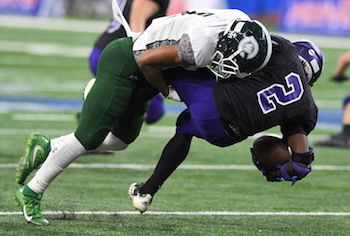
Vallone found seven receivers, with junior Jack Schichtel and senior Zack Lee catching scoring passes. Junior defensive back Mitchell Doyle had 10 tackles and an interception. Senior defensive back Connor Bolthouse had nine tackles, and senior defensive back Zaavon Scott had the other two interceptions and ran one back 28 yards for a touchdown.
 “Experience, as I’ve said quite a bit, has been a huge advantage for us throughout the course of my time here,” said Hyland, who finished his second season as coach and third at the school after previously coaching in South Carolina. “Especially when it comes to playoff time. These guys have been in very difficult situations and fought their way out. They have not in any way panicked despite some unfortunate plays on our part and really good plays by the teams we have competed against.”
West Catholic finished 12-2, its losses by three Week 1 to eventual Division 6 repeat champion Jackson Lumen Christi and by two Week 8 to eventual Division 4 repeat champion Grand Rapids Catholic Central.
Before the Frankenmuth scare, West Catholic also edged Portland 28-26 on the road to earn a Regional title. Frankenmuth, Swan Valley and Portland had the three highest playoff-point averages in Division 5 during the regular season.
The Vikings (12-2) were making their first appearance in an MHSAA football championship game, and Saturday’s loss was their first since Week 1.
“It was a big step for the program, even getting here, going from last year with the disappointing loss to our rivals (Freeland) in the playoffs first round,” Swan Valley senior running back Emmett Boehler said. “To come to Ford Field the next year is a big step.
“I know this program is going in the right direction. And I know Coach is leading us in the right direction, so I know these guys next year Alex (Fries) and Brock (Leinberger), we’ll be back here again.”
Leinberger ran 10 times for 67 yards and the touchdown, and Boehler added 61 yards on the ground to finish with more than 1,600 this season.
Leinberger also had a team-high 12 tackles.
He and Fries, the quarterback, were among a talented group of juniors who could have the Vikings back in the hunt next season as West Catholic also goes for a record-breaking sixth straight title.
“When you have five extra games, that’s big for all of the kids that we brought up,” Gavenda said. “We’re starting six juniors on offense, six juniors on defense, and a lot of these guys are going to be three-year starters next year.
“I don’t think this program is going anywhere any time soon, but you’re never guaranteed anything. We know the grind it took to get here this year, but we’re excited, absolutely.”
The MHSAA Playoffs are sponsored by the Michigan Army National Guard.
PHOTOS: (Top) Grand Rapids West Catholic coach Joe Hyland raises the champion’s trophy with his players Saturday at Ford Field. (Middle) The Falcons’ Zaavon Scott wraps up Swan Valley’s Terryon Liddell.