

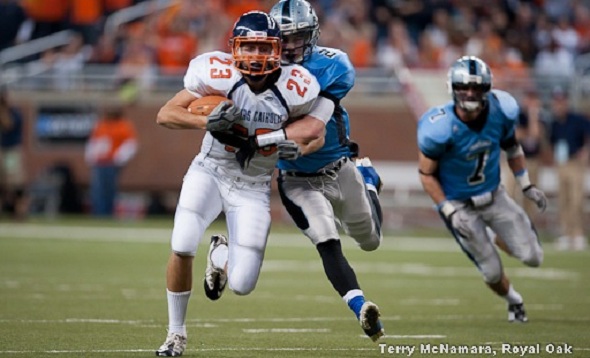
Division 5 Football Final: Powers Up
November 26, 2011
DETROIT – The final night of September was cold, wet and especially disappointing for Flint Powers Catholic.
Chargers coach Bob Buckel sensed that frustration as the bus rolled to to a stop after 6-0 loss and then silent ride home from Davison. Powers already was 2-3 heading into that game and needing to win out to guarantee a playoff spot. Now at 2-4, perfection the rest of the way was absolutely necessary to catch even the slimmest of shots at a postseason berth.
The last eight games became unofficial playoff games for the Chargers. And they won them all.
Unranked and the underdog, Powers downed No. 1 Lansing Catholic in record-setting fashion Saturday, 56-26 to claim the MHSAA Division 5 championship at Ford Field.
“We knew that we had to win out. Nobody shied to that competition,” Powers senior lineman Danny O’Brien said. “We really got after it.”
And especially Saturday. The 56 points tied Saginaw Nouvel’s from the Division 7 Final earlier in the day as the new MHSAA Finals record. They also were the most points Powers has ever scored, beginning with its first season in 1970.
Lansing Catholic senior quarterback Cooper Rush was named Division 5-6 Player of the Year earlier this week by The Associated Press, and his name can be found all over the MHSAA record book. He added 291 yards and three touchdowns passing, and another score rushing to his impressive three-year varsity career totals.
But Saturday it was Powers junior quarterback Garrett Pougnet who played his name into history.
Rewind 12 weeks ago. Lansing Catholic (13-1) beat Powers 37-17. Pougnet struggled, completing just 6 of 20 passes and running for 67 yards and a score.
His performance in the Final was one of the many differences in the rematch. This time, Pougnet was 12 of 15 passing for 258 yards and four touchdowns, and also ran 14 times for 159 yards and two scores. His 413 yards of total offense were second in MHSAA Finals history and just 13 off the record.
Buckel listed the other differences this time around: Heading into the teams’ Sept. 2 meeting, Powers (10-4) was coming off a big loss to Saginaw Nouvel and two players were out with concussions. Two more defensive backs were still playing on the junior varsity. And, of course, he used a few different formations in the rematch.
“I just said, when we get the ball, we’re going to be very aggressive,” Buckel said. “We had a play we put in this week called Ford Field. It didn’t work either time. But we just wanted to be aggressive because we really thought we might need to score 50 points to beat them, because nobody has slowed them down.”
Rush finished this season with 4,005 passing yards, good for second in the MHSAA record book for one season, and 48 passing touchdowns, which tops that list. This time, senior Connor Bartlett was the main recipient with 11 catches for 189 yards and two scores. Senior Matt Macksood also caught a touchdown pass, and finished this season with 95 catches (second for one season) for 1,590 yards (fifth) and 22 touchdowns (tied for second).
“We moved the ball pretty good when we had it on offense. We just didn’t have it. I think they scored just about every time they had the ball,” Lansing Catholic coach Jim Ahern said. “The big difference in the games where we came back – we came back from 21 down against Portland, which was a very good football team – was we got some defensive stops. We just didn’t get them tonight.”
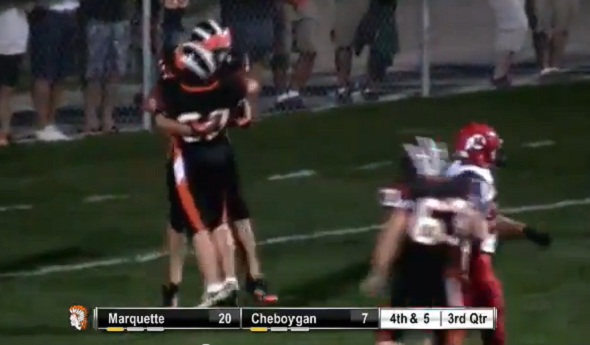
Highlight: Cheboygan's Dawson Granger
September 13, 2012
Cheboygan junior Dawson Granger showed some great focus and hops as well in pulling down this touchdown pass during his team's Week 2 game against Marquette.
See that clip here -- and help us show everyone your favorite highlights from any sport.
Have one or two we all should see? Point us to a video clip already posted on YouTube, and we'll give it a home here as well. Or email the mp4 file to Geoff Kimmerly at [email protected] along with a brief explanation of who is on the clip, when and where it took place, and the final score of the contest, and we'll produce them and post them on our Second Half "Videos" page.
Below, Cheboygan quarterback Damon Proctor finds the 6-foot-3 Granger in the back of the end zone. The Chiefs fell to Marquette 34-21, but are 2-1 this season.