


Division 6 Football Final: Play it Again, Yellowjackets
November 25, 2011
DETROIT – So began the legacy of Ithaca quarterback Travis Smith.
And so continues an incredible run by one of Michigan’s newest football powerhouses.
The Yellowjackets pushed their winning streak to 28 and claimed their second straight MHSAA championship by downing Constantine 42-14 in Friday's Division 6 Final.
They did so led by a number of last season’s top players, but minus their 2010 Final star. That’s where the sophomore Smith came in, joining the starting lineup in the season’s second week and bringing Ithaca back to Ford Field for another title.
“It’s more special just because this is the last time to suit up for most of us. We’re not going to be able to play another game next year, and we get to end on the biggest stage high school football has to offer in Michigan,” Ithaca senior linebacker/running back Garrett Miniard said.
“I think it was almost a little jealousy of the seniors last year of being able do that, being able to go out on top. I think that kept us going throughout the season, throughout the offseason. Being able to have that luxury of going out on top just like they did.
Ithaca (14-0) hasn’t lost since its 2009 Semifinal against Montague. With two more wins to start next fall, the Yellowjackets can become the 14th team on the MHSAA record book list with at least 30 straight victories.
And Smith should be there to lead the way. He connected on 18 of 25 passes for 299 yards and a touchdown Friday, and ran for 43 yards and a score. Miniard rushed for 43 yards and two touchdowns, and had 14 tackles. And senior David Brown caught six passes for 122 yards and also ran for a score.
Smith followed the path this fall of another former sophomore starter at his position – Alex Niznak, who graduated in the spring, plays at Central Michigan now, but didn’t leave before leading the Yellowjackets to both their first Semifinal berth and MHSAA championship over the last two seasons. Niznak’s title game performance last season included 251 yards passing, 138 rushing and an MHSAA Finals-record five touchdowns running the ball.
Brown originally took over at quarterback this fall. But he was injured on opening night – after running for three touchdowns against Williamston – and missed significant time, allowing Smith to take hold of the offense. Smith finished his first varsity season with a not-too-shabby 2,310 passing yards, 969 rushing yards, and a combined 48 touchdowns throwing or running.
“Coach (Terry) Hessbrook told me to just go in there and do what I can do, and just play football,” Smith said. “I’ve got so many good athletes around me. I just need to get my players the ball and let them do what they can do.”
Ithaca twice had catching up to do in the Final, with Constantine (11-3) scoring first and then taking a 14-7 lead midway through the first quarter – before the Yellowjackets rolled to 35 unanswered points.
“These kids had this goal since last year … of getting back here,” Hessbrook said. “We didn’t want Ithaca football to just be one and done, or a one-year wonder. And they’ve worked really hard.”
Constantine junior Ben Mallo did run 17 times for 189 yards and both scores. But the Falcons were without quarterback Tommy Reed, who was injured during last week’s Semifinal win over Ecorse. They played Ithaca to a 14-14 halftime tie before the Yellowjackets’ offense broke the game open.
“We’ve played offenses with that type of talent. Last week, for instance. And I’m sure Coach Hessbrook watched those films and saw some things he could do against us," Constantine coach Shawn Griffith said. "It’s a lot different than what we do, and you saw we caused them a little bit of problems early in the game as well. We do our thing, they do theirs. They do their thing very well. We did ours well. We just weren’t quite there on a couple drives that ended short.”
Click for full stats and play-by-play.
1st & Goal: 2021 Week 6 in Review
By
Geoff Kimmerly
MHSAA.com senior editor
October 4, 2021
As we get deeper into the regular season, we expect to see league championship races draw to a close and the best of the best locally separate from the rest.
 Week 6 saw plenty of contenders begin pulling away and toward conference titles – but also a good share of packs grow as we head into the final three weeks before playoff selection.
We highlight many of both in this week’s review:
Bay & Thumb
HEADLINER Goodrich 48, Ortonville Brandon 21 The Martians (5-1) came way back to get past Brandon and secure a share of the Flint Metro League Stars championship. Goodrich scored 38 unanswered second-half points after Brandon (5-1) scored the first touchdown of the third quarter to take a 21-10 lead. Jace Simerson was among standouts with 187 yards and three touchdowns rushing, with two of those scores during the third quarter 28-7 blast. Click for more from WJRT.
Watch list Bad Axe 37, Reese 7 The Hatchets (6-0) won a matchup of undefeated Greater Thumb Conference West contenders to set up a potential Week 8 league title decider with Elkton-Pigeon-Bay Port Laker, which also is unbeaten in league play. Laker must get by Reese (5-1) this week, however, and Bad Axe faces Vassar with an opportunity to set up a winner-take-all showdown.
Remember this one Flint Kearsley 40, Fenton 38 The Hornets (3-3) would need three results to go their way to claim a share of the Metro League Stripes title this week. But their first win over Fenton in 14 tries as members of the league together also put the Tigers (3-3) in a must-win situation if they hope to clinch a share and run their league title streak to 11.
More shoutouts Flint Hamady 52, Burton Bendle 20 Since scoring seven points total over back-to-back losses to begin the season, Hamady (4-2) has won all four of its Genesee Area Conference games to clinch a share of the league title, scoring 52 or more points in three of those victories. Bay City Western 54, Midland 8 The Warriors (5-1) have guaranteed their best overall finish since 2012 with their first win over Midland since 2008 – and this one also kept Western in the Saginaw Valley League Blue title conversation with leader Mount Pleasant coming up in two weeks.
Greater Detroit
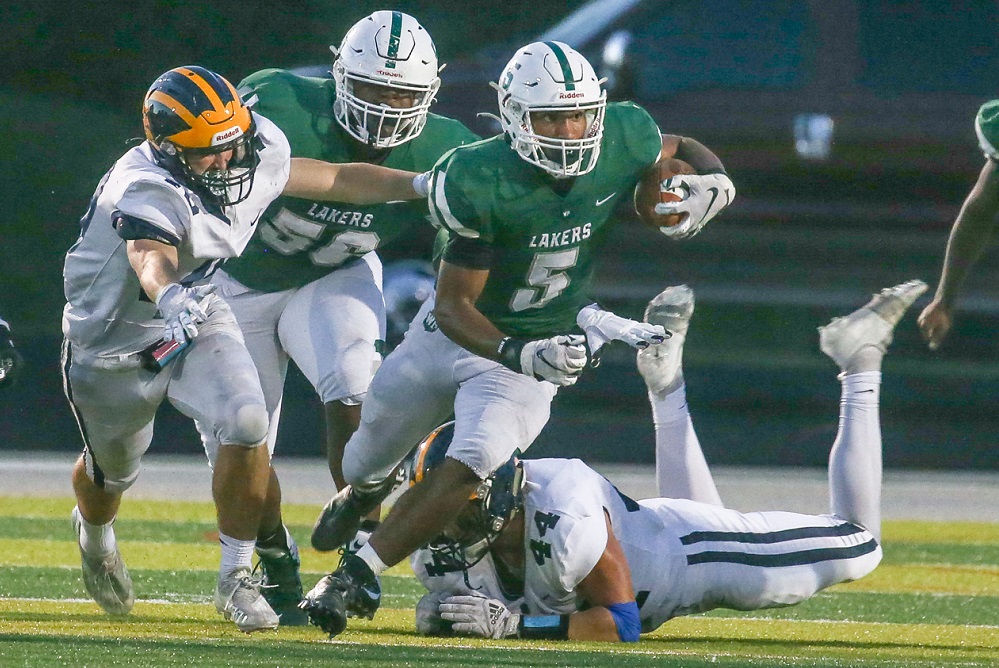
HEADLINER West Bloomfield 34, Clarkston 27 (OT) The Lakers (5-1) emerged with a share of the Oakland Activities Association Red championship, also avenging last season’s 24-21 loss to the Wolves (5-1) that ended up deciding the 2020 league title. West Bloomfield standout Dillon Tatum made multiple plays at the end with all of that on the line, scoring in overtime and intercepting a Clarkston pass in the end zone to end the game on the ensuing possession. Click for more from the Oakland Press.
Here's the full highlights of the West Bloomfield (@WbLakers) vs. Clarkston football game from Friday night. @PrimeTimeDill @coach_grice #StateChamps X @DMC_Rehab pic.twitter.com/ZQxUWfJjyS
— STATE CHAMPS! Michigan (@statechampsmich) October 4, 2021
Watch list Sterling Heights Stevenson 36, Clinton Township Chippewa Valley 32 After sharing the league title last season, Stevenson (5-1) has emerged from a crowded group of state-renowned contenders again, clinching a share of the Macomb Area Conference Red title with this win over the Big Reds (4-2). Stevenson can win the league outright this week against Romeo.
Remember this one Warren De La Salle Collegiate 17, Detroit Catholic Central 7 The Detroit Catholic League Central title belongs to the Pilots (5-0), who avenged last season’s 14-10 loss to the Shamrocks (4-2) and also earned a 5-4 advantage against DCC over the rivalry’s last nine games.
More shoutouts Riverview 42, Milan 29 The Pirates (6-0) need one more Huron League win over the next two games to repeat as champions and all but ended title aspirations for the Big Reds (4-2). Rochester Adams 28, North Farmington 21 (OT) The Highlanders (6-0) put together a string of big plays late to emerge with a share of the OAA White championship. Trailing midway through the fourth quarter, Adams forced a turnover deep in North Farmington territory, scored on the next possession to tie the game, then scored the first points of overtime and stopped the Raiders (3-3) on their possession to finish the job.
Mid-Michigan
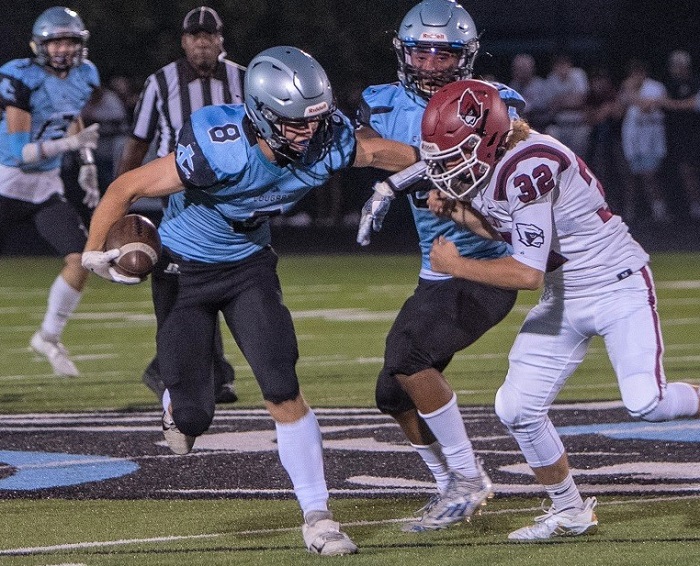
HEADLINER Lansing Catholic 31, Portland 29 The Cougars (6-0) took a two-score lead into the fourth quarter, but needed 33-yard field goal by Jonah Richards on the game’s final play to push past the Raiders (5-1) and clinch a share of the Capital Area Activities Conference White championship. Portland had won 33 straight league games dating to 2014. Click for more from the Lansing State Journal.
Watch list Williamston 21, Haslett 14 Three teams are tied atop the CAAC Red standings with a league game to play after Williamston (4-2) stopped Haslett’s attempt to clinch a share of the championship. Both the Vikings and Mason are also 4-2 overall and 3-1 in league play, and all three play opponents this week with 1-3 conference records.
Remember this one New Lothrop 66, Ovid-Elsie 24 The Mid-Michigan Activities Conference is back to a four-team league title race with these two and Durand all 4-1 and Montrose 3-1 with two MMAC games to play. New Lothrop (4-2) sees Durand this week, while Ovid-Elsie (4-2) finishes the conference slate with two opponents that are a combined 2-7 in league play.
More shoutouts Hartland 29, Howell 7 This finish along with Canton’s win over Brighton also created a three-team tie atop the Kensington Lakes Activities Association West standings between the Eagles (5-1), Highlanders (5-1) and Chiefs. Howell must still see Brighton, and Hartland takes on Canton in Week 8. Pewamo-Westphalia 26, Olivet 14 The Pirates (6-0) appear well on their way to another Central Michigan Athletic Conference championship and got their toughest test of the season from the Eagles (4-2), who will face Lakewood this week for the outright Greater Lansing Activities Conference title.
Northern Lower Peninsula
HEADLINER Traverse City Central 24, Cadillac 0 The Trojans (5-1) put together their second-straight shutout to claim a share of the Big North Conference championship, and they can finish a third-straight outright league title run this week against one-win Alpena. Cadillac (4-2) did hold Central to its season low in points, but the Trojans took a 21-0 lead into halftime in extending their BNC winning streak to 18 with that one league game left before moving into the Saginaw Valley League for football in 2022. Click for more from the Traverse City Record-Eagle.
Watch list Charlevoix 14, East Jordan 6 The Rayders (5-1) will need help to end up with a title share in the Northern Michigan Football Conference Leaders division, but handing a defeat to Legacy co-leader East Jordan (4-2) provided a nice playoff points bonus boost.
Remember this one Traverse City West 22, Petoskey 16 As West (5-1) also prepares to leave for the SVL, Petoskey in 2015 was the only team other than Central to defeat the Titans over the last seven seasons. Three of the last six meetings since were decided by one score.
More shoutouts Grayling 36, Sault Ste. Marie 32 With Legends contenders Kingsley and Traverse City St. Francis behind them, Grayling (4-2) has an opportunity to build some serious momentum heading into a playoff appearance – and defeating Sault Ste. Marie (4-2) was a great start. Boyne City 48, Kalkaska 16 The Ramblers (5-1) face Mancelona this week with a share of the Leaders title on the line, and they enjoyed a nice bounce-back after suffering their lone loss in Week 5.
Southeast & Border
HEADLINER Jonesville 34, Reading 8 The Comets (6-0) clinched a share of a Big 8 Conference repeat championship with another strong defensive performance, making it five games of holding opponents to eight or fewer points while lowering their average to 6.8 points allowed per game. This time they stopped a Reading offense averaging 37 points per game. The Rangers (4-2) fell into a tie for third place, and Jonesville needs to defeat winless Quincy this week to claim the league title outright. Click for more from the Jackson Citizen Patriot.
Watch list Ann Arbor Huron 28, Dexter 21 The River Rats (5-1) have guaranteed their best finish since 2009, and one more win will take that back to tying their best since 2002. Huron surely will be cheering now for Dexter (4-2), which will play Southeastern Conference Red leader Saline in Week 8 with a chance to shake up the standings.
Remember this one Chelsea 49, Ypsilanti Community 13 The Bulldogs (6-0) clinched their third-straight SEC White championship and ran their regular-season winning streak to 21.
More shoutouts Parma Western 13, Coldwater 7 Combined with Jackson Lumen Christi’s loss this weekend (see below), the Interstate 8 Athletic Conference race has a ton of possible conclusions – and Western (4-2) could be in the mix at the end. Napoleon 15, Grass Lake 0 The Pirates (5-1) kept alive a possible winner-take-all Cascades Conference title matchup in Week 8 against Addison, although they still must get past Michigan Center this week. Regardless, this one avenged a 39-0 loss to Grass Lake from last season.
Southwest Corridor
HEADLINER Portage Central 36, St. Joseph 30 (OT) The Mustangs (4-2) also made a series of unforgettable plays late to create a three-team tie atop the Southwestern Michigan Athletic Conference. Aaron Pollack’s 30-yard field goal tied the score at 30-30 with 16 seconds left in regulation, the defense stopped the Bears (5-1) to start overtime and Thomas Layne scored the winning points on the ensuing possession. Click for more from WWMT.
Watch list Battle Creek Harper Creek 33, Jackson Lumen Christi 14 This one looked a little intriguing heading into the weekend. But many more eyes will be turned toward Harper Creek (5-1) and the I8AC over the next two weeks as this turned the title race into at least a three-teamer with Hastings also tied with these two for first.
Remember this one Centreville 28, Cassopolis 0 A third shutout this season gave Centreville a share of its second-straight Southwest 10 Conference championship. The Bulldogs can clinch it outright this week against Comstock, while Cassopolis (4-2) and White Pigeon remain a game back and face each other.
More shoutouts Edwardsburg 57, Paw Paw 14 For the third-straight week Edwardsburg (6-0) defeated another top-four team in the Wolverine Conference, with only the bottom three teams in the league standings left as the Eddies play for a fourth-straight undefeated regular season. Lawton 69, Montrose 40 A late add to the schedule became one for the record books – literally – as they combined to score 109 points. Lawton (6-0) entered as No. 5 in Division 7, and Montrose (4-2) was tied for the No. 13 spot.
Upper Peninsula
HEADLINER Marquette 40, Clare 39 The Pioneers (4-2) scored first and led until Marquette went ahead for good with 7:40 to play. Seven of nine teams on Marquette’s schedule this season are .500 or better after Week 6, and this one provided another playoff points bonus boost. Marquette returns to Great Northern Conference play this week and can clinch the league title outright against Menominee, while Clare will face Gladwin for first in the Jack Pine Conference. Click for more from the Marquette Mining Journal.
Watch list Calumet 21, Iron Mountain 6 Despite beginning the season 0-2, Calumet (4-2) has surged and sits in the middle of the title hunt in a Western Peninsula Athletic Conference Copper that still has all seven teams at .500 or better. The Copper Kings can claim a share by winning out.
Remember this one Menominee 46, Escanaba 20 The Maroons (4-2) set themselves up for that upcoming GNC clash referenced above, as they defeated Escanaba for the first time on the field since 2016.
More shoutouts Ishpeming Westwood 36, Hancock 6 The Patriots (5-1) remain in control of their West-PAC Copper destiny as a Week 9 matchup with Negaunee looks like it could decide at least one team that shares the league title. Negaunee 42, L'Anse 0 The Miners (5-1) held up their end of creating that season-finale showdown with their second-straight shutout and third this season.
West Michigan
HEADLINER Comstock Park 35, Belding 34 (OT) Comstock Park came back from a double-digit deficit and held on through overtime to hold onto a slim lead in the Ottawa-Kent Conference Silver. The Panthers (6-0) remain a game up on Hopkins and Sparta but have defeated both. Click for more from FOX 17.
Watch list Grand Rapids Forest Hills Central 35, Grand Rapids Christian 28 (OT) The Rangers (5-1) are a four-point Week 2 loss to Grand Blanc from a perfect record, and they’re setting themselves up well to face Byron Center in Week 8 to decide the O-K White title after those two shared it last season. This win sent Christian out of a first-place tie and into third.
Remember this one Muskegon Catholic Central 52, Muskegon Heights Academy 20 The Crusaders (5-1) clinched a share of the Lakes 8 Activities Conference championship, their second straight, and will attempt to finish it outright this week against Manistee.
More shoutouts Grand Rapids West Catholic 28, Coopersville 24 Week 6 promised to bring clarity to the O-K Blue race, and West Catholic (6-0) is one of two teams still tied for first after also coming back from a double-digit deficit against the Broncos (5-1). Hudsonville Unity Christian 54, Spring Lake 21 Also in the Blue, Unity Christian (6-0) held onto the other share of first place by handing Spring Lake (5-1) its first loss. Unity and West Catholic face each other this week.
8-Player
HEADLINER Portland St. Patrick 21, Vestaburg 20 The Shamrocks (6-0) took a 13-0 lead into halftime but had to hold off a Vestaburg comeback on the way to earning a share of the Central Michigan 8-Man Football Conference title. Both defenses shined; St. Patrick had averaged 50 points per game entering the weekend, and the Wolverines (5-1) had averaged just more than 60. Click for more from the Greenville Daily News.
Watch list Pellston 34, Gaylord St. Mary 8 The Hornets (6-0) may have made the Ski Valley Conference race a two-team chase by handing St. Mary (4-2) its first league loss. Pellston next faces the other team without a Ski Valley defeat, Indian River Inland Lakes.
Remember this one Mount Pleasant Sacred Heart 44, Peck 36 The Irish (4-2) need help to earn a title share in the North Central Thumb League Stripes, but they gave some assistance to leader Kinde North Huron by sending Peck (5-1) out of a first-place tie.
More shoutouts Adrian Lenawee Christian 28, Climax-Scotts 12 The Cougars (6-0) navigated their closest game in two seasons of 8-player to take over first alone in the Southern Central Athletic Association A. Au Gres-Sims 58, Hale 50 The Wolverines (6-0) have scored 48 or more points every game this season, but survived a big offensive performance from Hale to remain in first alone in the North Star League.
Second Half’s weekly “1st & Goal” previews and reviews are powered by MI Student Aid, a part of the Office of Postsecondary Financial Planning located within the Michigan Department of Treasury. MI Student Aid encourages students to pursue postsecondary education by providing access to student financial resources and information. MI Student Aid administers the state’s 529 college savings programs (MET/MESP), as well as scholarship and grant programs that help make college Accessible, Affordable and Attainable for you. Connect with MI Student Aid at www.michigan.gov/mistudentaid and find more information on Facebook and Twitter @mistudentaid.
PHOTOS (Top) West Bloomfield’s Dillon Tatum (5) sprints past a pair of Clarkston defenders during Friday’s win. (Middle) Lansing Catholic’s Rory Durr (8) works to get upfield against Portland. (Top photo courtesy of C&G Newspapers; middle photo by High School Sports Scene.)