

Dow Charged to Make Deep Playoff Run
November 10, 2015
By Bill Khan
Special for Second Half
MIDLAND — When Midland Dow football players looked at the playoff accomplishments of past Chargers teams, it felt like they were getting a lesson in ancient history.
 There was the 1976 team that won the MHSAA Class A championship back when there were only two rounds in the playoffs. There was the 1997 squad that reached the Class A title game, winning three times in the postseason before losing to Farmington Hills Harrison at the Pontiac Silverdome.
And that's it.
For a program as consistently solid as Dow, it seems strange that only two teams in school history were able to win more than one playoff game.
"Sometimes it's matchups, sometimes it's getting a couple breaks to go your way," Dow coach Jason Watkins said. "When you get to this round of the playoffs, all the teams are going to be good."
So far, none of the teams in their path have been better than the Chargers.
They have made a task that has been difficult for past Dow teams look easy, winning 42-7 over crosstown rival Midland in the first round before beating Fenton, 41-14, in the District championship game.
"It's a big win for the development of the program," Watkins said after eliminating Fenton for the second time in three years. "Since 2010, this is our fourth trip to this round; we came away empty each time. It's nice to be able to finish that and get that District championship. It's a good landmark for us. Let's try to grow the program."
The 10th-ranked Chargers (10-1) will travel to second-ranked Walled Lake Western (11-0) on Saturday to play for the Regional championship.
"It's awesome," Dow junior quarterback Bruce Mann said. "We're gonna be on the board for a long time. People are going to be able to see us and remember us."
It hasn't been a lack of opportunities that has made this season's achievement so rare for Dow. Beginning with the unbeaten 1976 MHSAA championship team, Dow has 30 winning seasons in the last 40. The Chargers have made the playoffs nine times in the last 19 years.
They won their playoff opener each of the past two years and in three of the previous five years, but had their seasons end in the second round.
"It feels great," Dow senior receiver Justin Cook said. "I've been on two losing teams in the District Finals the past two years. The third time's the charm, I guess. It feels really good to finally get the (second-round) win. We're clicking at the right time. We're getting better each week."
Those currently wearing the green and gold of Dow are mindful of those who went before them, laying the foundation for such a strong program.
"It's huge for everyone that is involved, all of the past classes who didn't make it this far or got beat at this step," senior receiver Mike Robb said. "It's a big deal."
 The season didn't begin like one that was shaping up to be special. The Chargers lost their opener to Mount Pleasant, 34-20. Not that there's any shame in that — the Oilers are 9-2 and still alive in Division 3.
In that game, Mann had only 26 yards of offense in the first half, as Dow fell behind 21-0 by halftime. He had 281 yards in the second half — and hasn't slowed up since.
It was Mann's first game in a Dow uniform after playing varsity as a freshman and sophomore for Bay City Western, where his dad, also Bruce Mann, formerly was the coach.
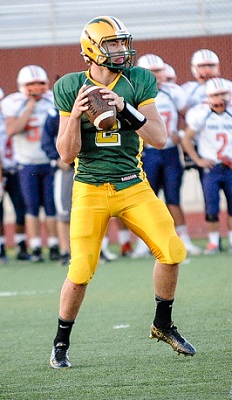
Led by Mann, the Chargers have scored at least 41 points in each of the last five games. Over that span, he is 81 for 109 (74.3 percent) passing for 1,451 yards and 24 touchdowns. For the season, he has 35 touchdown passes and only four interceptions in leading Dow to 10 consecutive victories.
"Coming into Dow, I had a bunch of friends, so it didn't take long to jell," Mann said. "It was just me calming down and realizing I'm not the only player and I have 10 other teammates behind me helping me succeed."
Mann has spread the wealth, throwing 11 touchdown passes to Robb, and nine apiece to Cook and Devontae Stine.
"Bruce has been picking up the offense each week," Cook said. "He's playing out of his mind. Every week, he's getting better. You can tell by the way he plays. He doesn't turn the ball over anymore."
Robb, the team's most dangerous receiving weapon, has become a dual threat in recent weeks.
Watkins moved him to defense for the regular-season finale against Midland. In that game, Robb returned an interception for a touchdown, in addition to catching four touchdown passes. In the playoff rematch a week later, Robb had two interceptions, returning one for a touchdown. Robb's hot streak continued against Fenton, as he caught two touchdown passes, blocked a punt and grabbed his fourth interception in three games.
"Right time, right place," Robb said of his newfound knack for picking off passes. "I love playing football. Wherever coach wants to put me, that's where I'll play."
"He's always been a special teams and offensive player for us," Watkins said. "We only moved him up to defense two weeks ago. It's something we saw in the scheme of things and the teams we were playing against. There was an opportunity to use his athleticism and some of his natural instincts. He's been on a pretty good little run the last couple weeks."
The same could be said for the Chargers as a whole, as they attempt to further enhance their legacy.
Years from now, perhaps 2015 will be spoken of with the same sense of awe as 1976 and 1997.
 Bill Khan served as a sportswriter at The Flint Journal from 1981-2011 and currently contributes to the State Champs! Sports Network. He can be reached at [email protected] with story ideas for Genesee, Lapeer, St. Clair, Sanilac, Huron, Tuscola, Saginaw, Bay, Arenac, Midland and Gladwin counties.
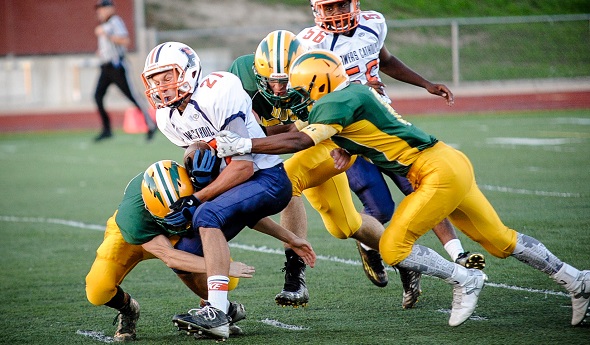
PHOTOS: (Top) A collection of Dow defenders makes a tackle during a win this season against Flint Powers Catholic. (Middle) Chargers quarterback Bruce Mann has thrown 35 touchdown passes this fall. (Click for more from HighSchoolSportsScene.com.)
Glen Lake Plays for Weekends Like This
November 15, 2019
By Chris Dobrowolski
Special for Second Half
There’s nothing that could spoil Jerry Angers’ mood right now.
 When you love coaching football as much as Maple City Glen Lake’s varsity leader, being able to continue preparing your team deep into the playoffs trumps any tough situations that might come along.
That’s why an early-season snowstorm that hammered Leelanau County and shut down a number of schools in the area hardly registered as problematic for Angers, who is guiding his Lakers into a Division 6 Regional championship game against Calumet on Saturday — a clash of 10-1 squads aiming to advance to the Semifinal round.
“It’s totally awesome,” said Angers, in his 11th year in charge of the Lakers. “We’re getting pounded with snow up here, and we’ve got guys plowing our field off. We practiced in the gym today because it was snowing so bad. We were told we had to go home early. I wouldn’t trade that adversity for anything.”
This will be the second time in the last four years Glen Lake has ventured to the Upper Peninsula to face the Copper Kings. In 2016 the two teams met in the same round of the postseason, with the Lakers pulling out a 14-0 win on the way to reaching the Division 6 Final against Jackson Lumen Christi, which won the title with a 26-14 victory. Nearly all of the 16 seniors on Glen Lake’s roster were freshmen on the 2016 team and have the experience of an eight-hour bus trip to the Keweenaw Peninsula under their belts.
“That’s a really cool similarity because those kids have experienced this trip,” said Angers. “They weren’t playing, but they experienced what it took to get there.”
Angers makes the experience more than just playing the game. Getting in a practice on the way to Calumet, the team meals, the hotel stay — each aspect becomes part of the joy of the journey.
“It’s fun getting on the bus and basically spending two days with the kids and experience all the different things,” said Angers. “It’s like college football life on the high school level.”
There’s little doubt this is a business trip for the Lakers, though.
“When we got into film session on Sunday, Coach just told us it’s college football 101,” said senior running back/linebacker Johnathan Wright. “Long bus ride. We’ve got to stay focused.
“(They are) definitely a typical U.P. power team. They want to run downhill and run the clock out and just keep smashing you in the mouth.”
Angers admits to being superstitious enough that he’s trying to mimic as much of the trip this time to the one in 2016 in hopes that it can lead to a similar outcome. Just maybe not an exact mirror, however.
Right as the Lakers were getting ready to head from the hotel to the field in that Regional contest in 2016, they realized they had been locked out of their bus. Without panicking, players had to file into parents’ vehicles to transport them to the game in time. The Lakers managed to overcome that moment of turmoil by winning the game.
“So, if that’s what goes wrong and you still get to play a game? I was laughing about it,” said Angers. “How many other people are playing football right now?”
The seeds for this season were sown during an up-and-down 5-5 campaign a year ago that included a first-round playoff loss to Beaverton. The senior class — which showed its potential when it got significant playing time and performed well in a postseason victory against Roscommon as freshmen — wanted to leave its own legacy with a deep playoff run like the one the Lakers experienced three years ago.
“That was a huge motivation,” said senior lineman Ben Kroll. “We hated how we exited last year. We did not like the way we played. We do a boot camp every summer before the season starts. It was definitely the best boot camp I’ve been to, how close we all were and how we get along. We’ll fight for each other every day.”
Glen Lake has good athletes at the skill positions. Wright is in his second year starting on offense — he’s also been a three-year starter at linebacker — and is the leading rusher. Quarterback Reece Hazelton, at 6-foot-7, has a greater stature than a typical high school quarterback, though his best sport is basketball. He signed his letter of intent Wednesday to play hoops for Ferris State. His favorite target is junior receiver Finn Hogan.
The line, a position group near and dear to Angers’ heart, is the heartbeat of the team, with seniors Garrett Tremble, Dylan Kilinski, River Dallas and Kroll, and junior tackle Sam Keys.
“Without them nothing would happen,” said Wright.
Angers makes sure everyone on the roster knows they have key roles, whether it’s starting on offense, defense or special teams. Guys who make up the scout team are held in high value. Angers can go down the line and name off kids on his team and big plays they’ve been able to make at some point this season.
“There’s 31 kids I can turn to at any time, and I feel very comfortable and confident that they’re going to go in and get the job done,” said Angers. “Next man up. You’re one play away from being a starter. I think these kids also understand that.”
The Lakers have gone through a brutal schedule nearly unscathed. Five of the nine teams on the schedule qualified for the playoffs, and four of those teams won at least one postseason game. The schedule is specifically created that way for Glen Lake to be properly prepared to handle tough teams during the playoffs.
The one slip up came in the seventh week when Kingsley — which remains undefeated and is playing for a Regional crown in Division 5 — handed the Lakers a 53-14 loss. Angers shoulders the blame, saying he didn’t have the Lakers ready for a game of that magnitude and Glen Lake was uncharacteristically sloppy.
“That was a real wake-up call, and I think that was really good for our team because now in these playoff runs we know we can’t take any days off, any moments off,” said Kroll.
The ultimate goal, of course, is to win the Division 6 championship at Ford Field. Two more wins and Glen Lake will be back in the position it was in three years ago, playing in Detroit with a title on the line. Glen Lake’s last football championship came in 1994 when the Lakers won the Class DD crown with a 20-10 victory against Waterford Our Lady of the Lakes.
“There’s nothing like it,” said Wright. “All the lights are on you. You’re at the center of a huge dome, and it feels amazing. I just want to get back to that.”
The memory of being in Detroit for Thanksgiving weekend is still fresh in Angers’ mind — arriving at the stadium and feeling the electricity in the air as an earlier game unfolded.
“One of the coolest experiences was when we were all walking in from the bus into the tunnel and there was a big play made in the game before us,” said Angers. “The crowd just erupted, and it just ran down that tunnel. My kids, they were just starry eyed and they looked at me and I went, ‘You’re in the big time boys.’”
And nothing could be better than that.
 Chris Dobrowolski has covered northern Lower Peninsula sports since 1999 at the Ogemaw County Herald, Alpena News, Traverse City Record-Eagle and currently as sports editor at the Antrim Kalkaska Review since 2016. He can be reached at [email protected] with story ideas for Manistee, Wexford, Missaukee, Roscommon, Ogemaw, Iosco, Alcona, Oscoda, Crawford, Kalkaska, Grand Traverse, Benzie, Leelanau, Antrim, Otsego, Montmorency, Alpena, Presque Isle, Cheboygan, Charlevoix and Emmet counties.
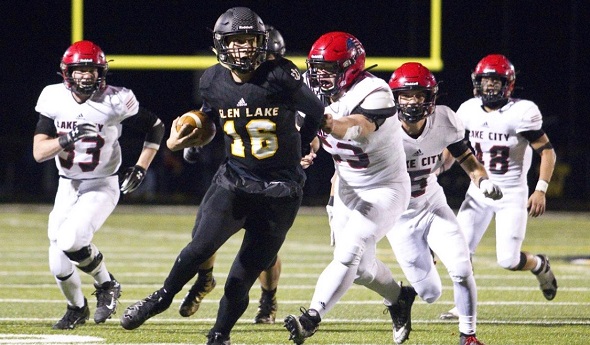
PHOTO: Maple City Glen Lake quarterback Reece Hazelton breaks free from Lake City defenders during a 30-19 Pre-District win. (Photo courtesy of the Traverse City Record-Eagle.)