

Drive Complete: 2019 Finals in Review
December 3, 2019
By Geoff Kimmerly
Second Half editor
Teams that reach the MHSAA Football Finals have been running around in helmets and pads for just short of four months, starting when we’re keeping an eye out for high temperatures and finishing as we watch the snow fall.

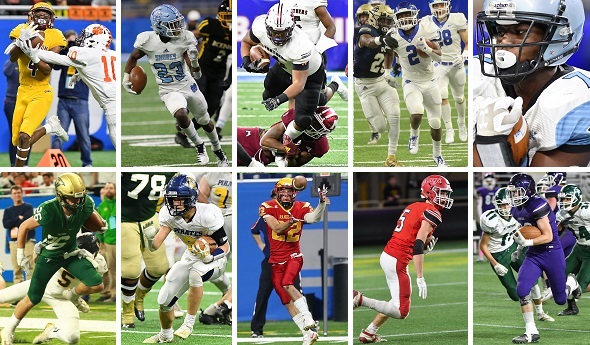
Second Half covered all 10 championship games last weekend at Ford Field and two weekends ago at the Superior Dome, with quick recaps and links (click on the game scores) to those stories below followed by notations of performances entered into the MHSAA Finals record book and a report on some of the biggest and best stories to emerge from the 2019 Finals. See also below highlights from the weekend from State Champs Sports Network, and keep an eye on Second Half for a schedule of replays of the 8 and 11-Player Finals on FOX Sports Detroit.
Finals in Review
11-Player Division 1: Davison 35, Brighton 25
The two first-time Finals qualifiers helped fill most of Ford Field’s lower bowl Saturday, and Davison emerged with its first championship. The game was highlighted by the play of standout quarterbacks Brendan Sullivan of Davison and Colby Newburg of Brighton, who both were added to the MHSAA record book for their performances (see more below).
11-Player Division 2: Muskegon Mona Shores 35, Detroit Martin Luther King 26
The Sailors earned the first of the weekend’s “upsets,” never trailing against the 2018 Division 3 champion Crusaders. For the second-straight week, back-up quarterback Brady Rose led the way with all-stater Caden Broersma injured. After King came within two points early in the fourth quarter, Rose led another scoring drive to put the game away.
11-Player Division 3: River Rouge 30, Muskegon 7
River Rouge suffered only one loss this season and played a solid group of opponents, so calling this an upset is tough – but likely still accurate as Muskegon had been considered the state’s best regardless of division (especially after defeating Mona Shores 53-0 during the regular season) and had received national recognition. Rouge scored the final 30 points after an early deficit.
11-Player Division 4: Grand Rapids Catholic Central 44, Detroit Country Day 0
When these two met in the 2016 Final, they combined to score 17 points. This rematch saw many more, at least for GRCC as it scored 44 of the 111 total points Country Day gave up this season. Cougars quarterback Joey Silveri, just a sophomore, cemented himself as a player to watch over the next two years as well, and receiver Jace Williams tied a Finals record as GRCC won its third title in four seasons.
11-Player Division 5: Lansing Catholic 31, Almont 17
The Cougars came back from a bit of an ugly first half offensively to claim their first championship since 1985. Lansing Catholic scored the final 24 points of the game, also earning coach Jim Ahern his first Finals title of a career that began 50 years ago. This was the third Cougars team he had brought to Ford Field this decade, while Almont was making its first Finals appearance.
11-Player Division 6: Monroe St. Mary Catholic Central 7, Maple City Glen Lake 0
The Falcons scored their first Finals championship since 2014 in one of the lowest-scoring title games in 45 seasons of MHSAA Football Playoffs. SMCC put the game’s only points on the board on quarterback Wyatt Bergmoser’s six-yard TD run with 7:17 to play in the first half. The Falcons otherwise dominated defensively and controlled the clock to secure the win.
11-Player Division 7: Pewamo-Westphalia 14, Jackson Lumen Christi 0
The arguably most power-packed of the weekend’s Finals saw Pewamo-Westphalia win its third championship in four seasons and end a 35-game winning streak for Lumen Christi, which had won three straight Division 6 titles. Both teams had fewer than 120 yards of total offense, but P-W was able to get into the end zone with three seconds left in the first half and again during the game’s final minutes to finish an unbeaten fall.
 11-Player Division 8: Reading 33, Beal City 6
The Rangers opened the weekend with a repeat championship in Division 8, moving to 27-1 over the last two seasons with only a 14-0 Week 1 loss this fall to Pewamo-Westphalia breaking up the perfection. Reading scored the final 19 points and outrushed Beal City 260-42. The Aggies were playing in the Finals for the first time since 2013 and coming off two-straight sub-.500 seasons.
8-Player Division 1: Colon 26, Suttons Bay 14
Colon also won a Division 1 matchup of two teams seeking their first championship, following two-way standout Brandon Crawford to victory at the Superior Dome. The game was tied into the final minute of the third quarter, but the Magi scored the final 12 points to finish off an undefeated season and their closest of 13 wins.
8-Player Division 2: Pickford 48, Portland St. Patrick 15
The Panthers returned to the 8-Player Finals and claimed their first championship after finishing Division 1 runner-up in 2018. Quarterback Jimmy Storey closed his high school career running for three touchdowns and throwing for two more, helping hand the Shamrocks their second runner-up finish in three seasons and only loss of this fall.
Record Report
Star quarterbacks found the spotlight at both the 11 and 8-Player Finals. The Division 1 game saw Brighton’s Colby Newburg (332 yards) and Davison’s Brendan Sullivan (330) both make the all-time 11-Player Finals record list for total offense and passing yards as well with 290 and 249, respectively. Grand Rapids Catholic Central’s Joey Silveri is ranked 10th in Finals total offense after his 375 yards (236 passing, 139 rushing) in Division 4, and Pickford’s Jimmy Storey ranks sixth on the 8-Player Finals list with 298 totals yards after passing for 152 and running for 146.
Silveri also made the 11-player passing touchdowns list with four, and Jace Williams was the main beneficiary. He tied the 11-Player Finals record with three touchdown catches and was the first to catch that many since 2013.
Colon’s Brandon Crawford made the 8-player records twice for rushing – his 205 yards were the third-most in 8-Player Finals history, and his 94-yard touchdown run was the longest rushing play. Colon as a team ranked fifth with 340 yards rushing.
Muskegon Mona Shores kicker Keegan DeKuiper and Davison kicker Trennor Rhodes both were added to the 11-player list for most extra points in a Final, both connecting on all five of their respective attempts.
Brighton, while in defeat, made the 11-Player Finals list with 23 first downs against Davison. Detroit Martin Luther King and Muskegon Mona Shores in Division 2 joined Hartford and Onsted from the 1993 Class CC Final as the only opponents to go an entire championship game without punting.
Monroe St. Mary Catholic Central became one of eight teams to win a championship by scoring seven points or fewer.
Both Grand Rapids Catholic Central and Reading tied for second on the first downs allowed list giving up only four apiece.
Lansing Catholic’s Zack Stone and Zach Gillespie both snagged two interceptions, joining 31 others tied for third for most interceptions in one championship game.
There previously was not a category for most extra-point attempts blocked, but it was impossible to not add one after Detroit Country Day blocked five tries by Grand Rapids Catholic Central.
Stories Behind the Scores
First-time champions: They reigned again, with Davison, Muskegon Mona Shores, River Rouge, Colon and Pickford matching last season’s total of five first-time winners. That makes 10 first-time champions over the last two seasons, compared with a combined three in 2016 and 2017.
 Defense wins championships: After no Finals shutouts in 2018 and just one apiece in 2017 and 2016, this season’s Finals saw Monroe St. Mary Catholic Central, Grand Rapids Catholic Central and Pewamo-Westphalia all hold their opponents scoreless. Total, the 10 runner-up teams scored an average of 11 points. River Rouge saw its season defensive points allowed average fall to 7.6, GRCC’s fell to 8.8, P-W’s to 4.5 and Reading’s to 7.4 points per game. Colon finished the season giving up just 5.5 points per game – perhaps even more notable given the wide-open offensive attack characteristic of 8-player.
Unsung no more: A pair of previously or at least little-known quarterbacks before last week’s 11-Player Finals will certainly be well-known entering next fall. As noted above, Mona Shores junior Brady Rose was forced into action early in his team’s one-point Semifinal win over Walled Lake Western, and he finished an incredible two weeks running for 90 yards and three touchdowns, completing 8-of-11 passes for 122 yards and a score and making a team-high 10 tackles with an interception against King. River Rouge junior Mareyohn Hrabowski burst onto the statewide scene in the weekend’s final game with 175 yards and three touchdowns on the ground and 45 yards passing against Muskegon.
Ahern’s work rewarded: As noted above, Lansing Catholic coach Jim Ahern finished with a Finals championship for the first time, a well-deserved achievement for an architect of multiple programs that have had elite success. Ahern ranks 13th in MHSAA history with a 301-152-6 record at three in-state schools beginning in 1969 (and not counting his seasons coaching in Florida during the end of the last decade). In addition to bringing the Cougars to Ford Field three times over the last nine years, Ahern led Ithaca’s program from 1972-2003. Among his standouts there was current Yellowjackets coach Terry Hessbrook, who is the first to credit Ahern with building the foundation that has led to Ithaca’s five Division 6 titles and two runner-up finishes over the last decade. Ahern pioneered the spread offense in this state, writing a book nearly 20 years ago teaching the scheme that is now used all over the country.
Fun with numbers: Friday’s four-game attendance was just 17,971 fans – the lowest of the decade for one day at Ford Field. But Saturday’s four-game attendance of 30,466 was the highest since 2010 for one day. Together, the 48,437 fans for the weekend fell in line with the five-year average for the 11-Player Finals.
Second Half’s weekly “Drive for Detroit” previews are powered by MI Student Aid, a part of the Office of Postsecondary Financial Planning located within the Michigan Department of Treasury. MI Student Aid encourages students to pursue postsecondary education by providing access to student financial resources and information. MI Student Aid administers the state’s 529 college savings programs (MET/MESP), as well as scholarship and grant programs that help make college Accessible, Affordable and Attainable for you. Connect with MI Student Aid at www.michigan.gov/mistudentaid and find more information on Facebook and Twitter @mistudentaid.
PHOTOS: (Top) Davison and Brighton fans helped fill the lower bowl of Ford Field on Saturday. (Middle) Pickford celebrates its championship at the Superior Dome two weekends ago. (Top photo by Paige Winne; middle photo by Cara Kamps.)
Gorham Rewriting Record Book as Mendon Pursues Superior Dome Return
By
Scott Hassinger
Special for MHSAA.com
November 4, 2025
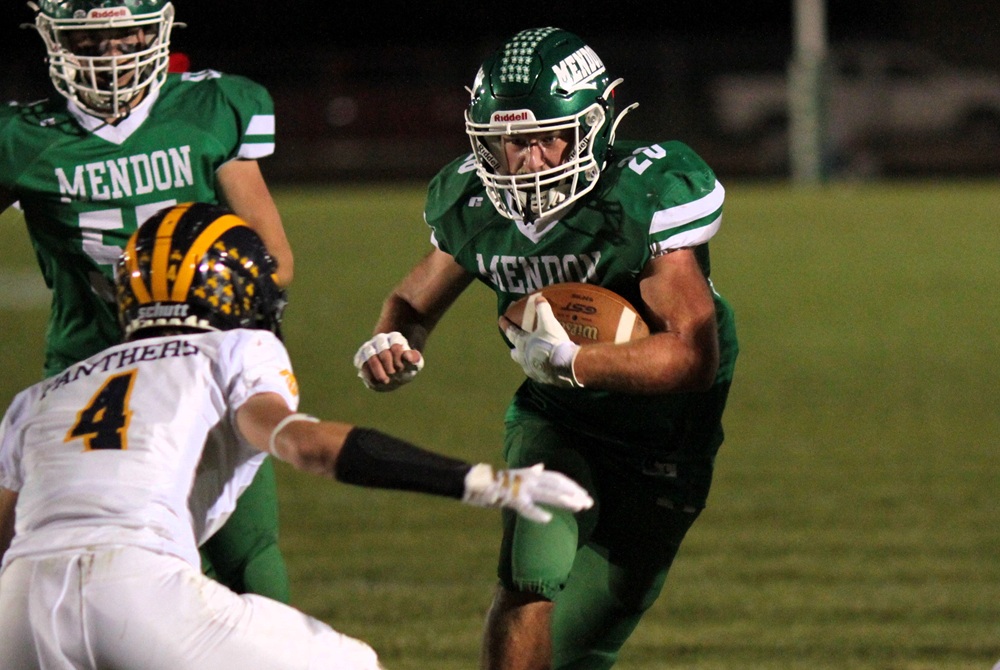
MENDON – Mendon football star Owen Gorham finds enjoyment in being a mentor for younger kids in his community – so much so that he one day aspires to have his own classroom and pursue a career as an elementary teacher.
 If his success on the football field the last four years is any indication, the 5-foot-10, 180-pound senior tailback should be a smashing hit in the education field as well.
Gorham has made a significant impact in 8-Player Division 2 football as top-ranked Mendon (10-0) prepares to travel and face No. 3 Portland St. Patrick this weekend in a Regional championship matchup.
The three-sport athlete already owns MHSAA 8-player career records for scoring with 696 points and touchdowns with 97. Both records were previously held by Bridgman's Reid Haskins (2019-22).
Gorham broke Haskins' career scoring mark in Mendon's 62-0 win over Battle Creek St. Philip in Week 7 before adding the TD record to his resume in a 76-43 victory over Adrian Lenawee Christian to end the regular season.
"I was able to put up pretty good numbers last year as a junior thanks to a good offensive line and a really good team,” said Gorham, who also has lettered in basketball and track & field. “I feel my speed is one of my biggest strengths. Reaching some of these records was among my goals when this season started. I couldn't have done it though without the support of my family, my twin brother Ryder at quarterback, JT Lux my fullback and the guys on my offensive line.”
Owen Gorham has run 471 times for 4,905 career yards and needs just 122 more yards to surpass Haskins as the state's all-time leading rusher. As a senior, Gorham has churned out 1,569 yards – 13.53 per carry – with 27 rushing TDs and two more on receptions.
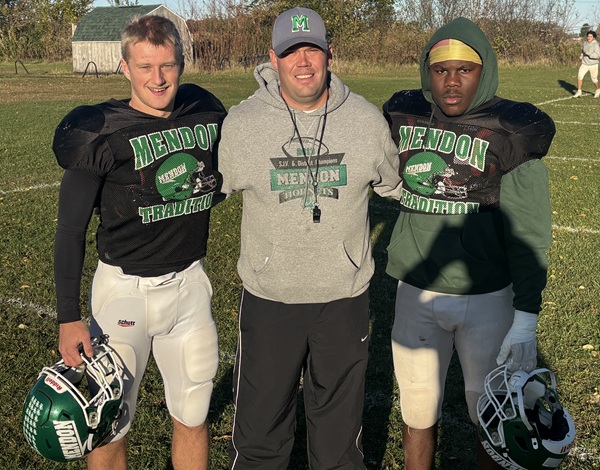
"Owen works his tail off. We never question his work ethic. I always tell him he's his own worst critic. The time that he puts into the game, like watching film and lifting weights, makes him the player he is," said Mendon head coach Bobby Kretschman, an all-state linebacker during his playing days at Mendon and currently the high school’s principal as well.
 "What you see out of Owen on Friday nights is just a small part of what he does. He's got good speed, power, makes good cuts and choices on the field. He's carried the ball close to 500 times for us in his career. That's a testament to his durability to be able to run for that much yardage. Defensively, he has a good nose for the football and his speed allows him to post up on tight ends and cover well out in space. That's huge in 8-man football because of the multiple offenses you see out of opposing teams.”
Mendon has scored 502 points this fall, an average of 55.8 per game. A great deal of that production has come on the ground, where the Hornets have rolled up 3,439 yards – 11.2 yards per carry and 382.1 per contest.
Directing Mendon's offense is Owen's twin brother Ryder, the Hornets' three-year starting quarterback, with Owen at halfback and Lux at fullback. Halfback Xavior Zinsmaster has 32 carries for 512 yards and seven TDs.
"Ryder is my biggest influence. We're twins so we do everything together, and he pushes me in everything I do and I try to do the same for him," Owen Gorham said.
Lux has run for 444 yards on 60 carries, with eight TDs.
"I think Owen and I bring two different types of running styles to the game and complement each other well. You have Owen's speed and my strength. I love blocking for him, and our offense has been very explosive this year," Lux said.
Senior tight end Brayden Crites (6-3, 200) is Mendon's top receiver with 10 catches for 249 yards and seven TDs.
Mendon's standouts on the offensive line, along with Crites, include seniors Adain McCall and Jayden Haigh, big sophomore center Jorden Palmer (5-10, 260) and junior guard Tristan Wood.
"Adain and Brayden do a lot of the dirty work for us. Our offensive line was a big question mark coming in this season. But the kids up there understand their roles well and do a good job staying on blocks for the most part.” Kretschman said. “Ryder runs the offense smoothly and is a good coverage kid, along with Xavior on defense."
Ryder Gorham is Mendon's third-leading rusher with 38 carries for 372 yards and seven TDs, while completing 21-of-43 passes worth 445 yards and eight TDs with just two interceptions. He's also a starter in the Hornets' secondary, where he has 23 tackles and one interception.
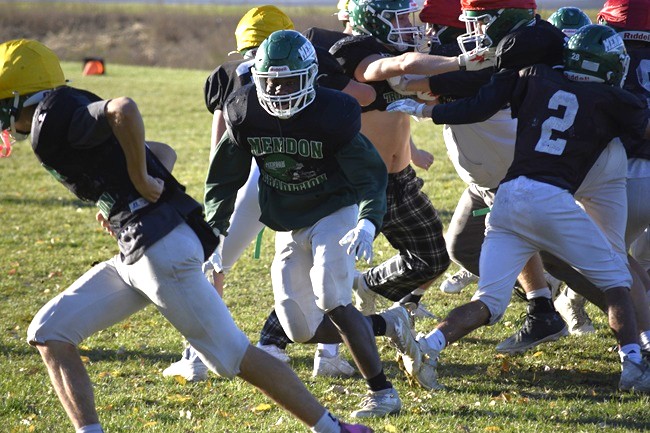
Defensively, Mendon is led in tackles by junior linebacker Zak Iobe (5-10, 165) with 77, followed by Zinsmaster and Wood with 57 stops apiece. Lux (5-10, 195) has 16 tackles, a sack and one fumble recovery at defensive tackle.
 Mendon's seven seniors and their teammates are primed for the biggest game of their careers after receiving a 1-0 forfeit win over No. 7-ranked Grand Rapids Sacred Heart last week.
Mendon won 12 state championships during its era in 11-Player football, including 10 titles under legendary coach John Schwartz.
Mendon lost 66-26 to Powers North Central in the 2022 8-Player Division 1 championship game, which concluded the Hornets’ second season playing the new format. They look to return to the Finals this month at the Superior Dome in Marquette after losing 49-32 to eventual champion Deckerville in a Division 1 Semifinal last season.
Deckerville also is in Division 2 this season and a possible opponent if Mendon wins this week.
"That game didn't go as well as we wanted. Our goal is to get another shot at them and hopefully we do," Owen Gorham said.
He said he and his Mendon teammates spent the offseason working to achieve bigger things this fall.
"We were out here three days a week in the summer lifting weights, running and doing agility drills. During the season we lift on Wednesday and Saturdays and watch film,” Gorham said. “We never stop working hard to keep our season going. We all want it really bad. Losing to Deckerville last year just gave us more fire coming into this season.”
He also feels a great sense of pride whenever he steps onto the field.
Dan Kennedy, Owen's grandfather, was an all-state player at Mendon during the mid-1970s, and cousins Greg Bingaman and Clint Wagner both played on Hornets teams that claimed state titles.
"It's a tremendous honor to put on the Green and White jersey. I've had many family members who have played at Mendon on state title teams. I just feel honored to have a chance to repeat history with what they've done here in the past," Gorham said.
A starter at outside linebacker as well, he also plays a critical role on a Hornets' defensive unit that has allowed just 14.7 points per contest. He has 32 tackles, including four for loss of yardage, to go with 3.5 sacks, one interception and one caused fumble. Rarely does Gorham leave the field as he is also Mendon's punter, averaging 42 yards per attempt.
While Gorham's success has generated interest from college coaches, he has already made a decision to end his football career after Mendon's final game this season.
"I thought about playing college football but decided not to. I want to go to Western Michigan and study elementary education,” Gorham said. “Every Friday I go to our elementary school and help mentor kids. I love volunteering to help little kids get a good future just like where I'm at right now. That has really sparked my interest in having my own classroom some day and helping kids.”
 Scott Hassinger is a contributing sportswriter for Leader Publications and previously served as the sports editor for the Three Rivers Commercial-News from 1994-2022. He can be reached at [email protected] with story ideas for Berrien, Cass, St. Joseph and Branch counties.
PHOTOS (Top) Mendon senior tailback Owen Gorham (20) nears the end zone during a 46-20 win over Climax-Scotts this fall. (Middle) Pictured at practice last week, from left: Gorham, Mendon head coach Bobby Kretschman and JT Lux. (Below) Lux (23) pursues a ballcarrier during a practice drill. (Top photo by Brandon Watson/Sturgis Journal. Practice photos by Scott Hassinger.)