

Drive to Detroit: District Semis in Review
October 29, 2012
By Geoff Kimmerly
Second Half editor
Hopes are high for most of 242 teams heading into the first weekend of the MHSAA football playoffs.
But we see it every October – the unexpected and plain unbelievable take over in the postseason as teams raise their games to meet the urgency of do-or-be-done.
Seven of 34 undefeated teams lost for the first time this weekend and are now eliminated. All eight of last season's 11-player champions are still alive – but 8-player champion Carsonville-Port Sanilac is no longer.
Of course, at this time of year every game takes on critical meaning. So instead of saying the results below were the most signficant, rather, let's say they're the ones that jumped out most from the District Semifinals.
Division 1
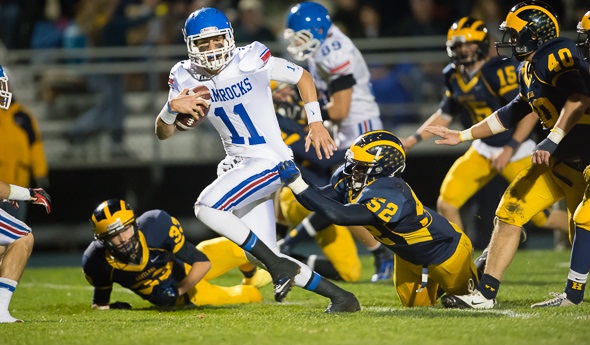
Detroit Catholic Central 21, Hartland 15
The playoffs are when we find out just how strong the Detroit Catholic League Central was compared to the rest of the state each fall, and this provided a start on that comparison for 2012. The Shamrocks (6-4) opened with a close win over of the Kensington Lakes Activities Association West champion Eagles (8-2).
Click to read more from Novi Patch.
Also noted:
Holland West Ottawa 21, Grand Ledge 14 – The Panthers (8-2) avenged a 31-10 loss to the Comets (7-3) on Aug. 31.
Livonia Churchill 49, Livonia Stevenson 35 – These two met for the second week in a row; both times Churchill (10-0) scored 49 points, although Stevenson (6-4) cut the deficit to 14 this game after losing the first by 39.
Walled Lake Northern 41, Howell 27 – On top of playing in its first playoff game ever, Northern (8-2) also earned another by downing the Highlanders (6-4).
Dearborn 24, Dearborn Fordson 14 – The Pioneers (7-3) won a stunner after falling 35-0 to the Tractors (7-3) just five weeks ago.
Division 2
East Lansing 10, Lansing Everett 6
Life was good for the Vikings (9-1) after they completed their first 9-0 regular season ever – a run that included a 6-0 victory against East Lansing. But the Trojans (7-3), who struggled some and had to win in Week 9 just to make the playoffs, earned perhaps the biggest upset of District opener weekend. Click to read more from the Lansing State Journal.
Also noted:
Traverse City Central 48, Bay City Western 47 (2 OT) – Adding to its league title season, Central (9-1) won a playoff game for the first time since 1991. Western finished 8-2.
Lowell 21, Grand Rapids Northview 0 – The playoff-seasoned Red Arrows (8-2) made the first appearance for Northview (7-3) a quick one.
Fenton 22, Farmington Hills Harrison 19 – The Tigers (9-1) have now won a playoff games each of the last three seasons, and delivered Harrison (6-4) its only first-game postseason departure in its last 14 appearances.
Southfield 22, Detroit Martin Luther King 19 – The Bluejays (7-3) were a bit forgotten needing three straight wins just to make the playoffs, but got everyone's attention again by beating the Detroit Public School League champion Crusaders (6-4).
Division 3
Zeeland West 46, Zeeland East 0
That West won this game isn’t the stunning part – their first meeting this season was a 60-52 win by East, and West (6-4) is the reigning Division 4 champion. But consider the score this time, and also that East (9-1) had beaten Division 2 contender Muskegon by a point just a week ago and hadn’t lost this fall. Click to read more from the Holland Sentinel.
Also noted:
Hamilton 42, Edwardsburg 14 – The Hawkeyes (6-4) were among the last to make the playoffs, but got off to a good start against the Eddies (6-4).
Grand Rapids Christian 45, Fruitport 6 – The Eagles (9-1) continued to roll while handing Fruitport (8-2) its second loss of the season and second in a row.
DeWitt 34, Lapeer West 28 (OT) – The Panthers (8-2) extended their streak of winning at least one playoff game to seven seasons, while West finished 6-4 for the second straight fall.
Tecumseh 27, Chelsea 20 – Only three weeks prior, Chelsea (6-4) had beaten Tecumseh (8-2) in a game that decided the Southeastern Conference White championship.
Division 4
Grand Rapids South Christian 48, Paw Paw 0
South Christian’s losses this season came against three playoff teams, including two in Grand Rapids Christian and Grand Rapids Catholic Central that are expected to contend for MHSAA titles. So to figure this game might be close wasn’t too far off. But the Sailors (7-3) did more than that in handing Paw Paw (9-1) its only loss. Click for more from the Kalamazoo Gazette.
Also noted:
Richmond 24, Marine City 21 – Richmond (7-3) hung on again after also handing the Mariners (8-2) a 25-24 loss on opening night of the regular season.
Williamston 29, Marshall 8 – The Hornets (7-3) had to win three straight just to make the playoffs, and are rolling on four in a row with this defeat of the Redhawks (6-4).
Three Rivers 20, Battle Creek Pennfield 14 – This would qualify as an upset win by Three Rivers (7-3), as Pennfield (8-2) had been considered a contender all season.
Detroit Country Day 35, Clinton Township Clintondale 0 – The Yellow Jackets (8-2) handed Clintondale (9-1) its first and only loss of the season.
Division 5
Kingsford 36, Grayling 14
In the first season after the retirement of his legendary coach father Ken Hofer from Menominee, Kingsford coach Chris Hofer led his Kingsford team to one of the best opening wins of the playoffs. The Flivvers (9-1) intercepted four passes in handing Grayling (9-1) its first and only loss. Click to read more from the Iron Mountain Daily News.
Also noted:
Olivet 28, Lansing Catholic 14 – This one was equally stunning, as the Eagles (7-3) knocked out the reigning MHSAA runner-up Cougars (8-2).
Lake Fenton 41, Jackson Lumen Christi 20 – Maybe less of a shocker but still an intriguing result: Lake Fenton (8-2) handed the Titans (8-2) one of their earliest exits of the last two decades.
Grand Rapids West Catholic 19, Hopkins 13 (OT) – The Falcons improved to 7-3 while handing Hopkins (9-1) its lone loss of the season.
Muskegon Oakridge 16, Buchanan 8 – Oakridge moved to 10-0 by winning this clash of league champions; Buchanan finished 7-3.
Division 6
Manchester 37, Clinton 36
The Flying Dutchmen (7-3) fell to Clinton by 18 all the way back on Aug. 24. But they handed Clinton (9-1) its first – and now only – loss this season by scoring with less than a minute remaining in this District opener. Click to read more from The Oakland Press.
Also noted:
Maple City Glen Lake 28, Boyne City 16 – Glen Lake (8-2) rebounded from a Week 9 loss, while Boyne City (8-2) finished with a second straight defeat.
Hemlock 45, Montague 20 – The Huskies (9-1) made it two straight seasons with at least nine wins, while dropping Montague just shy at 8-2.
Montrose 7, Vassar 6 – The Rams (9-1) won by a point for the second straight week while dropping the Vulcans to 7-3.
Detroit Consortium 8, Madison Heights Madison 3 – Consortium (7-3) also won its first-ever playoff game; Madison finished 8-2.
Division 7
Flint Hamady 39, Burton Bendle 33
Hamady (7-3) is better known for its basketball prowess. But after four seasons of one, zero, three and four wins, respectively, Hamady made the playoffs this fall – and earned its first postseason victory ever by avenging a Week 3 loss to Bendle (7-3). Click to read more from the Flint Journal.
Also noted:
Decatur 27, Hartford 15 – It was closer this time, but Decatur (8-2) beat league foe Hartford (7-3) for the second time in a month.
Britton Deerfield 14, Reading 7 – From the maybe-didn’t-see-that-coming file, the Patriots (7-3) knocked out the Big Eight Conference champ Rangers (8-2).
Dansville 21, Ottawa Lake Whiteford 18 – Another testament to the strength of the Central Michigan Athletic Conference, the Aggies (8-2) went on the road and came back with a win over the Bobcats (8-2) – Dansville’s first in the postseason since 1992.
Flint Beecher 35, Rochester Hills Lutheran Northwest 21 – Beecher (6-4) got into the playoffs with two straight wins at the end of the regular season, but pushed the streak to three by downing Lutheran Northwest (5-4).
Division 8
L’Anse 34, Crystal Falls Forest Park 28
The Purple Hornets (8-2) might have fallen just short of a league title, but they did earn their first playoff win since 2007 by downing the perennially-powerful Trojans (7-3). L’Anse scored the go-ahead touchdown with 41 seconds to play. Click to read more from the Iron Mountain Daily News.
Also noted:
Stephenson 14, Pickford 12 – Only three Division 8 games this weekend were decided by eight points or fewer, and this win by Stephenson (8-2) over Pickford (7-3) was the closest.
Climax-Scotts 34, St. Joseph Lake Michigan Catholic 7 – Climax-Scotts (10-0) earned a shot against reigning champion and also 10-0 Mendon by defeating Lake Michigan Catholic (7-2).
Waterford Our Lady 15, Pittsford 7 – This was the third of only three close games in Division 8, with Our Lady (8-2) moving on. Pittsford (7-3) lost in the first round last season by the same score.
Felch North Dickinson 50, Bessemer 20 – North Dickinson (9-0), the smallest school in the 11-player playoffs, needs one more win for its second season in three with at least 10 victories. Bessemer ended its first playoff season since 2006 at 6-3.
8-Player
Owendale-Gagetown 52, Akron-Fairgrove 48
This was a sweet victory for Owendale-Gagetown (8-2) and not just because the Bulldogs live on. These two split during the regular season, but Akron-Fairgrove’s win in the second game of the series counted toward the league standings and earned the Vikings that championship. Click to read more from the Saginaw News.
Also noted:
Deckerville 42, Carsonville-Port Sanilac 39 – The Eagles (9-1) eliminated the reigning MHSAA champion Tigers (4-6) in their third game against them this fall; Deckerville won all three.
Kinde-North Huron 14, Peck 8 (OT) – After falling to Peck (7-3) by 16 three weeks prior, the Warriors (6-4) won the rematch.
PHOTO: Detroit Catholic Central senior quarterback Garrett Moores (11) tries to break the grasp of Hartland senior lineman Markus Inman (52) during Friday's Division 1 District victory. (Click to see more at Terry McNamara Photography.)
Mann Makes Great on High Expectations
By
Tom Markowski
Special for Second Half
April 20, 2017
BEVERLY HILLS – Entering high school, Steve Mann faced high expectations.
 His mother and father both experienced much success as student-athletes at Detroit Country Day, and his sister, Brittany, was one of the top track athletes to compete at and graduate from the school.
But while it's still too early to tell, Steve might end up the best of the Mann bunch.
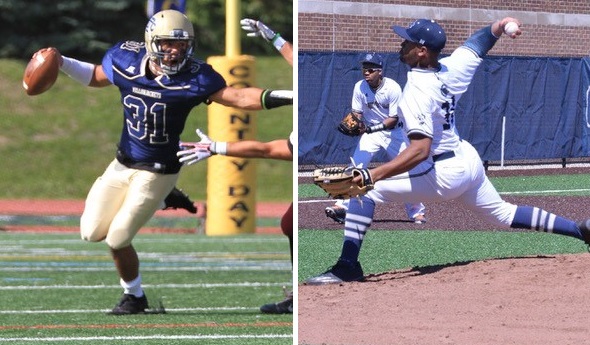
Steve, 18, has played varsity football and baseball for four seasons each at Country Day, earning all-state honors in football this past fall and baseball as a junior. Also an outstanding student, he has signed to continue his academic and baseball careers at Duke University, where he’ll end up unless he’s drafted by a Major League Baseball team this summer and offered a deal he can’t refuse – it’s possible he’ll be taken during the first five rounds.
Country Day varsity baseball coach Steve Lepkowski – a 1993 graduate of the school and former football assistant as well before taking over the baseball program in 2015 – said he’s never coached an athlete like Mann.
“Steve is going to be successful at whatever he does,” Lepkowski said. “He’s a four-year captain here. That’s as unique as you can get. We vote for that. And every year we re-vote, and (each) time we re-voted him in.”
Last season, Mann hit .396 with 25 RBI, 24 stolen bases and 27 walks. Through seven games this season, he’s hitting .536 with three home runs, 18 RBI, nine stolen bases and nine walks. He also is 3-0 pitching with a 1.65 ERA.
In football, Mann played defensive back, quarterback and receiver. He’s 6-foot tall, and his weight has fluctuated depending on what sport he is playing. For football, his playing weight was 195 pounds. For baseball he’s up to 210. Mann is a centerfielder who, out of necessity, also pitches for Country Day. He’s expected to be an outfielder at the next level.
With his Duke signing in November, Mann left a football future behind. But he has known for a while where he wanted to be next. Scholarship offers from a more prestigious baseball conference, the Southeastern Conference, fed Mann’s appetite. But he had his sights set on Duke (which plays in the Atlantic Coast Conference) early on, so when the scholarship offer came, that was the end of his recruiting process.
 “The scouts ask me, why Duke? Why not the SEC?" Lepkowski said. "Well, I said, Steve cares about academics. Duke has been number one with him all along. As a sophomore, I asked him, where do you want to go? It was Duke. So I talked with Duke. I know of the coaches there. And I told them I have a player here that wants to go to your school, and they asked who. I told them Steve Mann. They said, Steve Mann? He wants to come here? That was it. I call him the Shane Battier of baseball.”
If an explanation is needed, Battier helped lead Duke to an NCAA basketball championship after being at the forefront of Country Day’s Class B titles in 1995, 1996 and 1997. Battier was named Mr. Basketball by the Basketball Coaches Association of Michigan as a senior, and Mann is a leading candidate for the Mr. Baseball Award this spring.
Like Battier, Mann also is an outstanding student. He carries a 3.94 grade-point average, taking classes including honors English and advanced placement mathematics and Spanish.
And as for mentors, Mann has to look no further than his living room couch. His father, Steve, also played football, basketball and ran track at Country Day. He caught the winning touchdown pass in the 1986 Class C title game against Muskegon Catholic Central (Final score: 18-14). He went on to play football at University of Wyoming.
His mother, Kira (Lewis), played basketball, lacrosse and volleyball at Country Day before continuing her education at Penn.
Then there’s his sister, Brittany. A 2012 Country Day graduate, Brittany was the Lower Peninsula Division 2 discus and shot put champion as a junior and senior. Country Day won the team title her junior season. Brittany went on to compete at Oregon before graduating last year. She’s enrolled at Southern California and in pursuit of her master’s in communications.
At Oregon, Brittany set the school record in the shot put (57 feet, 4¾ inches) and helped lead her school to its first NCAA team title (2015) in 30 years. She was a four-time All-American.
“I had some big shoes to fill when I came here,” Steve Mann said of Country Day. “Since high school started, even in eighth grade, I knew baseball was going to be it. Before eighth grade I focused on being an athlete. With Brittany coming through Country Day, it was easy to see what I needed to do (to be successful). It was kind of like a competition. I want to be like you, but I want to be better.”
Individually, Mann and his sister are pretty much on par. But there’s that elusive team title he has yet to help win, though he has come close.
County Day lost in the Division 4 Football Final this past November, and last spring the Yellowjackets reached the Division 2 Quarterfinals in baseball before they were eliminated by Dearborn Divine Child, 4-3.
Mann has one more shot.
“I tell myself, I have to win a state championship,” he said. “We’re good enough to win it.”
Mann has always been around sports, even when he was too young to realize it. The year he was born was the year his father became an assistant football coach at Country Day. Whether he was the water boy, ball boy or just tagging along, Steve grew up watching sports.
 “I was always with my dad,” he said. “When I was 5, 6 years old, just being out there was great. My dad has taken me through this journey. It was a step-by-step process.
“Another big factor for me was Brittany going on her recruiting visits.”
When he was in the eighth grade, Steve Mann had the opportunity to meet Olympian Devin Allen through his sister. In 2016, Allen became the first man since 1956 to win the 110-meter hurdles at both the NCAA Outdoor Championships and U.S. Olympic Trials. Allen also played receiver on Oregon’s football team.
“I was star-struck,” Mann said. “He was so humble. How could you not want that for yourself?”
Mann is unassuming. Bragging is not a trait his household condones. Great athletes don’t have to tell you how good they are. Their actions do the talking.
His parents deserve much of the credit for this. A part of Mann’s training was to compete against athletes two and three years older to see, for one, how they train and, two, to see how much Mann needed to improve athletically to become like them.
“There were a lot of expectations,” his father said. “He is very self-driven, to live up to both the Mann name at Country Day and to create his own path. I’ve tried to teach him what it’s like to play at the next level.”
As an example, Steve Mann had his son train in the baseball offseason with Major League players who were home away from the game. This experience was not so much about throwing or hitting a baseball. It was about being around those who made it to see how they trained, what foods they ate and the like.
“I did a similar thing with him when he was in middle school,” Mann said of his son. “I’d have him train with the guys in high school, like a Jonas Gray (currently an NFL free agent) and a Bennie Fowler (Denver Broncos). I do that with my younger son, too.”
The Manns' third child is Brandon, who is 13 years old and about to complete the seventh grade. And, yes, Brandon Mann also plays baseball and football, and, yes, his is quite good at both.
 Tom Markowski is a columnist and directs website coverage for the State Champs! Sports Network. He previously covered primarily high school sports for the The Detroit News from 1984-2014, focusing on the Detroit area and contributing to statewide coverage of football and basketball. Contact him at [email protected] with story ideas for Oakland, Macomb and Wayne counties.
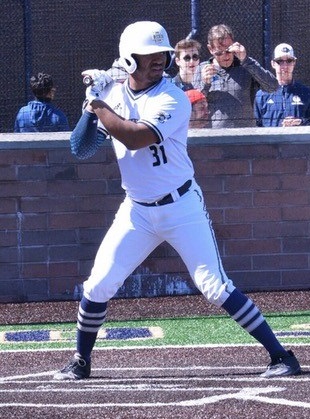
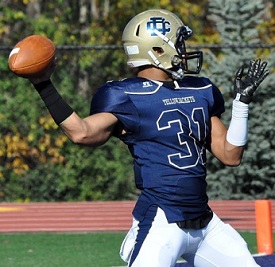
PHOTOS: (Top) Steve Mann starred as a multi-position football player during the fall and also pitches and plays outfield during baseball season. (Middle) Mann, here at the plate, could be drafted during the top five rounds in June. (Below) Mann prepares to unload a pass last fall. (Baseball photos by D’Andrea Parnell. Football photos by Scott Bertschy.)