

Drive for Detroit: Playoff R2 in Review
November 7, 2016
By Geoff Kimmerly
Second Half editor
Revenge is a dish best served during the playoffs.
And a number of MHSAA title hopefuls enjoyed their shares of the buffet this weekend.
Six of nine playoff divisions saw a team win either an 11-player District championship or 8-player Regional title by avenging a loss from earlier this season. Others avenged losses from playoff runs past – or in a few cases, years of just missing against rivals.
All games at this level of the tournament are big, of course, and below are just a sampling of results that stuck out most from the second round.
Division 1
Clarkston 31, Davison 14
Clarkston (9-2) handed Davison its first and only loss this season on the power of a rushing game that tallied 303 yards and nearly 9.5 per carry. Davison (10-1) scored the game’s first touchdown in the first quarter, but didn’t reach the end zone again until quarterback Brenden McRill ran for his second score midway through the fourth. The District Final was the Cardinals’ first since 2008. Click for more from the Oakland Press.
Also noted:
Grandville 20, Rockford 9 – The Bulldogs (10-1) broke a 14-game losing streak to the Rams (7-4), who had beaten Grandville 7-6 in Week 6 and in the playoffs three times over the last 11 seasons.
Saline 37, Canton 31 – The Yellowjackets (11-0) came back from a 10-0 deficit as quarterback Zach Schwartzenberger threw two touchdown passes and ran for a third score to get Saline ahead of the Chiefs (8-3).
Detroit Cass Tech 24, Dearborn 7 – Dearborn (9-2) succeeded in holding Cass Tech (11-0) to its season low in points, but also scored its fewest since Week 5 of 2015.
Division 2
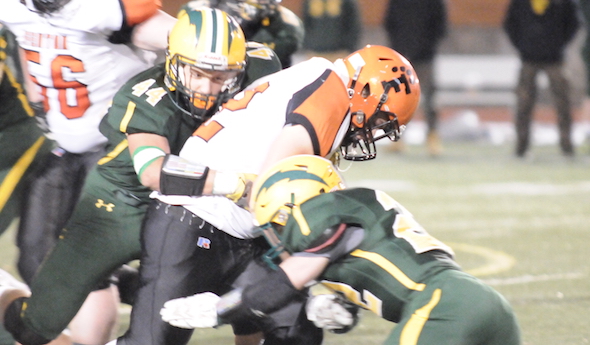
Fenton 49, Midland Dow 42
Fenton scored last, with 2:10 to play, on quarterback Josh Czarnota’s second touchdown pass to go with four touchdown runs as the Tigers (9-2) won their first District title since 2011. Czarnota threw for 264 yards and ran for 166 in a dual with Dow quarterback Bruce Mann, who tossed four touchdown passes with 238 yards and also ran for 127 yards and two scores. The Chargers finished 9-2. Click for more from the Flint Journal.
Also noted:
Grand Rapids Forest Hills Central 27, Portage Central 13 – The Rangers (9-2) added a District title to their best season since 1995, and after finishing 2-7 each of the last two; Portage Central finished 9-2, one win better than a year ago.
Birmingham Groves 24, Birmingham Brother Rice 0 – These neighbors don’t play often; that said, Groves (10-1) earned its first win over the Warriors since 1963 as Rice (7-4) had won their last eight meetings.
Temperance Bedford 39, Livonia Franklin 22 – The Mules (9-2) are another who have shined after a middling go in 2015; they have as many wins this fall as the last two seasons combined and eliminated a Franklin team that made the Semifinals last season and finished this one 7-4.
Division 3
Chelsea 27, Coldwater 20
This rematch of last season’s Division 3 Semifinal was much closer than Chelsea’s 35-7 victory a year ago. The Bulldogs (11-0) won their third straight District title this time by scoring a touchdown with six seconds left to break a 20-20 tie – and with the win earned a Regional matchup with also-undefeated Edwardsburg. Coldwater finished 8-3. Click for more from the Ann Arbor News.
Also noted:
Byron Center 55, Grand Rapids Christian 28 – The Bulldogs (10-1) got to 10 wins for the first time since 2000 with a second District title in four seasons; Grand Rapids Christian finished its best season in four at 9-2.
Muskegon 28, East Grand Rapids 10 – The Big Reds (10-1) won their fifth straight District title by ending a seven-game winning streak for the Pioneers (8-3).
Allen Park 34, Romulus 0 – The Jaguars (11-0) tied their most wins since 2004 in ending the winningest season for Romulus (9-2) since 2000.
Division 4
Hudsonville Unity Christian 35, Benton Harbor 34 (OT)
Unity Christian (9-2) continued the best season of its 14-year history while ending another incredible run by the Tigers. Benton Harbor followed up last season’s first-ever playoff run and 6-5 finish (after a combined 0-18 the previous two years) with a program-best 10-1 record this fall. Both teams scored in overtime, but the Crusaders stopped the Tigers’ conversion run attempt to win a second straight District title. Click for more from WZZM.
Also noted:
Lake Odessa Lakewood 36, Lansing Sexton 28 – These teams combined for more than 750 yards of total offense, but Lakewood (10-1) reached 10 wins for the first time by holding on despite two touchdown passes by Jackson Barnes over the final 10 minutes that kept Sexton (7-4) in the mix.
Detroit Country Day 45, Marysville 7 – Country Day (11-0) got touchdowns from six players, including one on defense after an interception to hand Marysville (10-1) its lone loss.
Adrian 28, Milan 13 – The Maples (7-4) made good on an at-large bid by claiming a District title against the team that beat them on opening night, 27-13; Milan finished 9-2 and has totaled at least nine wins four of the last five seasons.
Division 5
Grand Rapids West Catholic 10, Portland 7
Offense was at a premium during this matchup of teams that previously combined to average 74 points per game this fall. But West Catholic kicker Liam Putz found a score when it mattered most, drilling a 31-yard field goal with four seconds to play to send the reigning champion Falcons (9-2) onward and end the Raiders’ season at 10-1. Click for more from WZZM.
Also noted:
Ithaca 47, Muskegon Oakridge 6 – It’s fair to call this a statement win for the Yellowjackets (11-0), as Oakridge (9-2) arguably was their strongest opponent to date; it’s also accurate to note that Ithaca suddenly has a 25-game winning streak.
Frankenmuth 49, Freeland 14 – Only two weeks ago, Frankenmuth (10-1) fell 7-3 to the Falcons (10-1); last year Freeland beat the Eagles twice in the same scenario.
Reed City 34, Remus Chippewa Hills 28 – The Coyotes (11-0) have had five 10-win seasons over the last six, but 10 was the max – until Reed City broke through with a second victory over Chippewa Hills (9-2) this season by six points or fewer.
Division 6
Jackson Lumen Christi 37, Schoolcraft 34 (OT)
Abe Johnson’s 13-yard field goal in overtime clinched Lumen Christi’s third straight District title, this one over a pre-playoff title favorite in the Eagles (10-1). The Titans (9-2) are hoping to win their first MHSAA championship since 2009, and took a major step after managing to slightly slow a Schoolcraft offense that came in averaging 46 points per game and had scored fewer than 40 only once. Click for more from the Jackson Citizen-Patriot.
Also noted:
Napoleon 42, Grass Lake 21 – The Pirates (9-2) avenged a Week 2 loss to Cascades Conference rival Grass Lake (9-2) to advance to the third round of the playoffs for the first time.
Calumet 6, Negaunee 0 – The Miners (10-1) also were a popular championship favorite heading into the playoffs with their closest game coming from … Calumet (10-1), which fell to Negaunee 14-6 in Week 2.
Detroit Central Collegiate 26, Warren Michigan Collegiate 22 – The Trail Blazers (7-4) won their first District title since 2010, ending the best season for the Charter School Conference champion Cougars (9-2) since 2011.
Division 7
Pewamo-Westphalia 25, Saugatuck 19
Few games in any division could match the star power generated by P-W running back Jared Smith and Saugatuck quarterback Blake Dunn, who combined as juniors to run for just shy of 6,000 yards. Smith ran for 222 yards and two scores Saturday to help the Pirates (11-0) hold on against the previously undefeated Indians (10-1) for their sixth straight District title. Click for more from the Ionia Sentinel-Standard.
Also noted:
Detroit Loyola 46, Grosse Pointe Woods University Liggett 7 – The Bulldogs (9-2) eliminated a league champion for the second straight round, following up last week’s victory over Madison Heights Madison with this one over Michigan Independent Athletic Conference winner Liggett (10-1).
Concord 48, Homer 32 – The Yellowjackets (9-2) could’ve fallen victim to revenge, but stretched out the margin a little after beating Homer (8-3) only 28-26 in Week 2.
Ubly 24, Unionville-Sebewaing 16 – The story was similar for Ubly (11-0), which kept its best season since 2010 going with another win over opening-night opponent USA (9-2).
Division 8
Norway 40, Lake Linden-Hubbell 16
Opportunities for upset get fewer later in the tournament, but this may fall into that category based on past history. Norway (9-2) continued to forget last year’s 2-7 finish and five straight sub-.500 seasons with a first District title since 2006, earning it against a Lakes team that finished the regular season undefeated for the second season in a row and at 10-1 posted its most wins since 2009. Click for more from the Houghton Daily Mining Gazette.
Also noted:
Royal Oak Shrine 49, Clarkston Everest Collegiate 25 – The Knights (9-2) started their four-game winning streak last month against Everest Collegiate and won their first District title since 2008 with a second win over the Mountaineers (8-3).
Climax-Scotts 28, Mendon 14 – For the second straight season, undefeated Climax-Scotts (11-0) downed playoff rival Mendon (8-3), this time for a second straight District title.
Frankfort 38, Lincoln Alcona 34 – The Panthers (11-0) have had only a few scares this season, and needed a touchdown during the final minute to avoid falling to the Tigers (9-2).
8-Player
Powers North Central 60, Crystal Falls Forest Park 50
Forest Park (9-2) made the margin in this growing Upper Peninsula rivalry even closer in this season’s rematch, but the Jets still pulled away. North Central (11-0) had beaten the Trojans by 18 in Week 2, but scored twice during the fourth quarter to keep its perfect record as an 8-player program intact at 24-0. The teams combined for 1,022 yards of total offense, and the stars shone brightly; Jets quarterback Jason Whitens threw for 286 yards and four touchdowns and ran for 114 yards and four more scores, while Forest Park running back Dan Nocerini capped his high school career with 50 carries for 260 yards and five touchdowns on the ground. Click for more from the Escanaba Daily Press.
Other Regional Finals:
Pickford 30, Engadine 28 – The Panthers (10-1) earned a 10th win for the first time since 1991, avenging a 10-point loss to Engadine in Week 3 by handing the Eagles (10-1) their lone defeat.
Wyoming Tri-unity Christian 28, Portland St. Patrick 10 – The Defenders’ first playoff run now includes handing St. Patrick (10-1) its only loss while improving to 11-0.
Deckerville 58, New Haven Merritt 12 – The Eagles (10-0) arguably have been even more dominant than North Central, and only seemed to be getting stronger in handing Merritt (10-1) its first loss.
PHOTO: Fenton (orange helmet) bulled through a tough matchup with Midland Dow to advance in Division 2. (Click to see more from HighSchoolSportsScene.com.)
Bear Lake Looks to Begin New Streak
September 25, 2020
By Tom Spencer
Special for Second Half
When Bear Lake takes steps on the football field at Brethren tonight, the Lakers have a chance they never had last fall.
 It’s a chance to win two games in a row and remain undefeated. Bear Lake is coming off a 26-6 win over Ashley last week, the Lakers’ first win since 2018. The victory sparked a lot of relief and a great celebration in the Bear Lake community.
“It was a long time coming,” said assistant coach and offensive coordinator Samantha Mullet. “Seeing the guys get to experience the results of all their hard work was rewarding.
“But it’s just the beginning,” she continued. “They’ve set the bar now. They know that feeling only comes if you’ve earned it.”
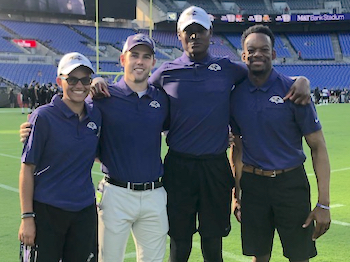
Mullet, who goes by Sam and Coach Sam, has been an assistant coach with head coach John Prokes since 8-player football began at Bear Lake four seasons ago. She was also an intern the summer of 2019 for the Baltimore Ravens and coach John Harbaugh.
The Lakers’ seniors who have played football since their freshman year are thrilled to take the field tonight. Wins have been hard to come by and they were 0-9 in 2019. COVID-19 nearly took away their chance to play football in 2020 and feel the jubilation of victory.
It was long, hard summer of training not knowing the future of all MHSAA sports. The Lakers’ last victory was 28-18 over Big Rapids Crossroads Academy during the 2018 campaign.
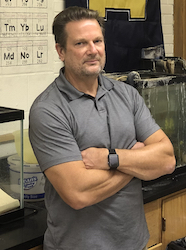
“Participating in sports is one opportunity that provides our young adults with an experience that will only continue to help them with the trials and tribulations throughout their own life,” noted Prokes, who also teaches science in the middle and high school. “We are fortunate to have football at our school and in our community.
“The memories we've established will last well beyond the wins and losses.”
 Mullet and Prokes have been together since Bear Lake exited a football co-op with Onekama to start the exciting 8-player football option. It hasn’t been a smooth road, but both feel the ship is righted now and the future is bright.
Bear Lake athletic director Karen Leinaar couldn’t be happier with the football program. She had never served a school district previously that didn’t offer football.
“The cool thing was the community stepped up and the board made a commitment to football,” she said. “They took a chance and it paid off.
“These two coaches have given hundreds and thousands of hours to these kids,” she continued. “Taking it from nothing to where it is today is great!”
A new culture of football began this summer as training for a possible 2020 season began. Not knowing how COVID-19 would impact MHSAA sports, the Lakers embarked on significant changes.
“With students having been out of school and away from each other since March, we felt it was important to get the kids together and active again, even if it was just for socially-distanced outdoor workouts,” recalled Mullet. “They were really the shift from there – they showed up and worked hard day after day, even when the future of sports was uncertain.
“Their attitude and commitment made us realize this could be the group to really establish our program,” she continued. “We’d been building, but without much of an identity. These guys committed to defining the vague ‘success’ we’ve always talked about and hashed out exactly how things were going to go down – what would be required of everyone and what would not be tolerated of anyone.”
The Lakers took their name and turned it into a “LAKES” acronym for core qualities that all players and coaches must be – Loyal, Accountable, Knowledgeable, Excellent, Resilient, and Selfless.
“We took an Edward Everett Hale quote and used it to establish our creed,” Mullet said. “‘I am only one. But I am one. I cannot do everything, but I can do something. And because I cannot do everything, I will not refuse to do the something that I can do. What I can do, I should do. And what I should do, by the grace of God, I will.’”
 The Lakers’ new creed and culture also came with new helmets featuring improved safety components to start the season. The helmets were made possible by a grant from the Manistee County Community Foundation.
The Lakers were led offensively to victory Saturday afternoon by Bryce Harless and Jake Griffis. Harless connected on 5 of 8 passes for 100 yards and two touchdowns and rushed for 105 yards and a touchdown on 10 carries. Griffis had five receptions for 109 yards and two touchdowns.
Tate Aultman led the Lakers defensively with 10.5 tackles and a sack. Griffis and Quentin Ruize each had nine tackles and combined on a sack. Jack Cook recorded nine tackles.
“We are not the biggest team, by no means,” Prokes said after the Bears snapped their losing streak. “We’ll probably be outsized in every game we play, but we play with a lot of heart.
“Our guys aren’t going to back down from anybody.”
And, when they walk on the field for every practice and tonight’s game, each player must contribute, Mullet believes.
“Every single player has been instrumental in pushing our culture forward,” she said. “As our creed implies, if one person doesn’t do their job, doesn’t give 100 percent effort, doesn’t buy in, the whole team fails.
“You may only have one job, but that one job is critical to the success of the whole team.”
Prokes and Mullet are appreciative of tremendous support they've received from everyone in the Bear Lake community, especially the boosters.
“The town has really embraced the team and has shown nothing but encouragement and patience with our development,” Mullet said. “They've enjoyed the experience that comes with having a football program including the tailgating, Friday Night lights, and even Saturday afternoons.”
And every Laker tonight will be playing with an undefeated helmet.
 Tom Spencer is a longtime MHSAA-registered basketball and soccer official, and former softball and baseball official, and he also has coached in the northern Lower Peninsula area. He previously has written for the Saginaw News, Bay County Sports Page and Midland Daily News. He can be reached at [email protected] with story ideas for Manistee, Wexford, Missaukee, Roscommon, Ogemaw, Iosco, Alcona, Oscoda, Crawford, Kalkaska, Grand Traverse, Benzie, Leelanau, Antrim, Otsego, Montmorency, Alpena, Presque Isle, Cheboygan, Charlevoix and Emmet counties.
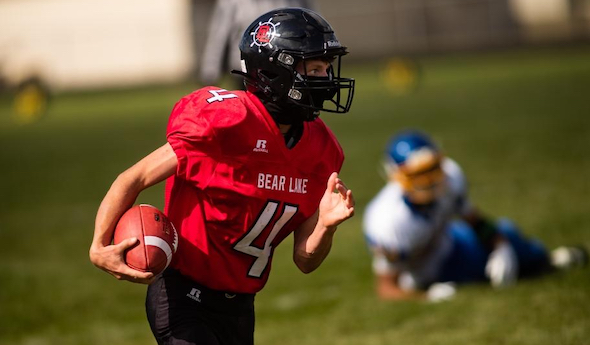
PHOTOS: (Top) Bear Lake’s Jack Cook makes a move upfield during last week’s win over Ashley. (Middle) Bear Lake assistant Samantha Mullet, far left, during her Baltimore Ravens internship, with, following left to right, John Wolfe (co-founder of ShirtFaced), Tim Goins (coach from Japan’s X League) and Jordan Hogan (formerly at Cornell, now a new assistant coach for the Arizona Cardinals). (Below) Bear Lake head coach John Prokes in his science classroom. (Photos courtesy of the Bear Lake football program.)