

Drive for Detroit: Playoff Week 3 Preview
November 14, 2019
By Geoff Kimmerly
Second Half editor
Detroit is only two wins away for Michigan’s remaining 11-player teams.
 But 8-player semifinalists need just one more win to complete a “March to Marquette” – and we’re flipping our usual format by leading off this week’s preview with a look at those four games.
All matchups below are Friday or Saturday, as noted. The 8-player winners will move on to Nov. 23 championship games at The Superior Dome at Northern Michigan University. The 11-player Regional champs this week will play next in neutral-site Semifinals, with those locations and times announced by Sunday morning.
A total of 15 games will be streamed either by Fox Sports Detroit's Prep Zone or MHSAA.tv this weekend; click for links and listings.
"Drive for Detroit" is sponsored by MI Student Aid.
8-Player
Division 1
Kingston (9-2) at Suttons Bay (11-0), Saturday
Only four years ago, when current seniors were freshman, Suttons Bay had to cancel its final seven games for lack of healthy players. The Norsemen have made quite a return along with the move to 8-player, going from seven to nine to 11 wins over the last three seasons, respectively. Luke Mikesell keys a balanced attack with 1,231 yards and 20 touchdowns rushing and eight more scores receiving. Kingston also is celebrating a historic run, making the Semifinals for the first time since 1996. A dominating run game deserves much of the credit, with Caleb Goss (1,470 yards/15 TDs) and Jake DeLong (1,304/20) leading the way and quarterback Aaron Koehler running for 10 touchdowns and throwing for 15 more scores.
Morrice (10-1) at Colon (11-0), Saturday
The reigning Division 1 champion Orioles might be facing their strongest opponent of the last two seasons – including a year ago when it defeated the Magi 40-8 in a Semifinal. Colon is outscoring opponents 53-5 on average, led by dual threat quarterback Phillip Alva (792 yards/16 TDs rushing, 876 yards/17 TDs passing) and top rusher Brandon Crawford (1,404 yards/22 TDs rushing, 11.4 yds./carry). Morrice graduated some significant standouts from last season, but quarterback Jonathan Carpenter has picked things up quickly as the new starter at his spot with 1,413 yards and 21 touchdowns rushing and eight touchdown passes. Morrice’s only loss of the last two years was in Week 8 to Crystal Falls Forest Park, and it handed Deckerville its only loss this season last week.
Division 2
Hillman (10-1) at Pickford (10-1), Friday
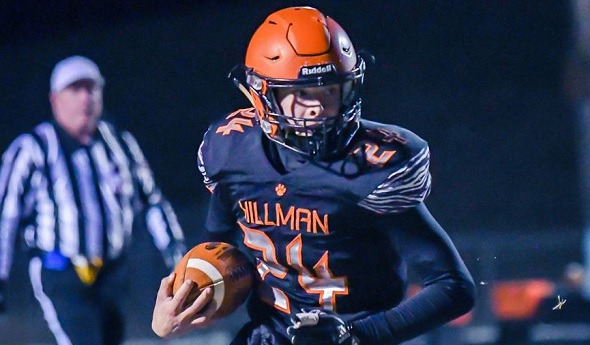
Pickford was last season’s Division 1 runner-up with a junior-filled lineup, and that group has the team on the verge of returning to the Superior Dome. Jimmy Storey was the Associated Press’ 8-player Player of the Year in 2018 and is leading the return charge that last week included avenging the team’s lone loss, to Powers North Central. Hillman is in the midst of its 14th straight playoff trip, with only the last two in 8-player, and playing in its first Semifinal in either format. Lead rusher Gunner Mellingen (949 yards/16 TDs) has taken over even more during the playoffs, last week running for nearly 300 yards and five touchdowns in a 48-44 win over Cedarville.
Climax-Scotts (9-2) at Portland St. Patrick (11-0), Saturday
Portland St. Patrick was among early movers to 8-player and will play in its third-straight Semifinal and fourth since making the format switch in 2012. Somewhat quietly, the Shamrocks rarely have been challenged this fall – their closest win was 42-24 in Week 7 over 2018 Division 2 runner-up Onekama. Climax-Scotts is enjoying a 17th-consecutive playoff run, but this one in 8-player for the first time. The Panthers will enter their first Semifinal since 2007 after defeating Onekama last week and with the experience of rumbling through a tough southwestern region, with its losses to undefeated Division 1 semifinalist Colon and Martin, which suffered its lone loss last week to the Magi in a Regional Final. Conner Gibson (1,342 yards/16 TDs rushing) leads an offense that has run for more than 3,000 yards.
11-Player
Division 1
West Bloomfield (10-1) at Belleville (11-0), Saturday
West Bloomfield has given Belleville one of its few close games during a two-year 23-1 run, coming within 13-10 of the Tigers in last year’s Regional Final. Another defensive showdown might be to the Lakers’ favor, as the difference this time likely will come when Belleville has the ball. The Tigers have broken 500 points and average 46 per game, while West Bloomfield is giving up only 11 and has surrendered a combined 28 points over its last six games.
Other Regional Finals FRIDAY Hudsonville (8-3) at Brighton (9-2), Utica Eisenhower (9-2) at Davison (9-2), Detroit Cass Tech (7-4) at Sterling Heights Stevenson (7-4).
Division 2
Port Huron (8-3) at Birmingham Seaholm (8-3), Friday
Seaholm is looking to add its first Regional title since 1997 to its first District title since 2001 won last week, while Port Huron’s last District title was a little more recent (2011) but the farthest the Big Reds have advanced. Port Huron avenged regular-season losses the last two weeks to Port Huron Northern and St. Clair Shores Lakeview, and Seaholm did the same last week in its rematch with Birmingham Groves. The Maples are enjoying their most potent offense arguably ever (36 ppg) and could set the pace, although the Big Reds have shown they’re capable of keeping up.
Other Regional Finals FRIDAY Muskegon Mona Shores (9-2) at Portage Northern (10-1), Livonia Churchill (7-4) at Walled Lake Western (10-1), Detroit U-D Jesuit (8-3) at Detroit Martin Luther King (9-2).
Division 3
River Rouge (10-1) at Orchard Lake St. Mary’s (10-1), Saturday
After two straight seasons of sub-.500 football, the host Eaglets have rounded back into the form that carried them to seven MHSAA Finals trips in eight seasons from 2009-16. Their only loss was Week 7 to Detroit Catholic Central, and they avenged it two weeks later and have gone on to break 50 points in both playoff wins so far. But River Rouge won’t be fazed as it’s also beaten DCC this fall and is a three-point Week 1 loss to Division 4 contender Grand Rapids Catholic Central from undefeated. The Panthers’ defense has been particularly impressive; after finishing last season with a 7-6 first-round playoff loss to eventual Division 3 champion King, Rouge this fall is giving up only 7.8 points per game.
Other Regional Finals FRIDAY Allen Park (9-2) at Chelsea (11-0). SATURDAY East Grand Rapids (8-3) at Muskegon (11-0), DeWitt (9-2) at Edwardsburg (11-0).
Division 4
Milan (11-0) at Detroit Country Day (11-0), Saturday
Speaking of shutdown defenses, Country Day is giving up 5.5 points per game while facing a schedule that so far has included seven playoff teams as the Yellowjackets have made their longest run since finishing Division 4 runner-up in 2016. Milan is pretty strong on that side of the ball as well, giving up just under 16 ppg as it seeks to reach the Semifinals for the first time. Both also have had to win close this fall – Country Day got past Harper Woods by five last week, and Milan has two one-point victories – and it will be interesting to see if that experience comes into play as these two play one of two games between undefeated teams this week.
Other Regional Finals FRIDAY Hudsonville Unity Christian (8-3) at Paw Paw (10-1), Flint Powers Catholic (9-2) at Pontiac Notre Dame Prep (10-1). SATURDAY Cadillac (7-4) at Grand Rapids Catholic Central (10-1).
Division 5
Kalamazoo United (7-4) at Lansing Catholic (10-1), Friday
Neither of these teams was given enough credit earlier this season as opponents appeared to be standing in their way. But Lansing Catholic finally got past nemesis Portland last week for the first time since 2015, and the Cougars have a defense (giving up 13 ppg) to match their always high-octane scoring attack (41 ppg). United with a new coach and mostly new offensive stars opened this season 0-3 but have won seven of eight since including three straight over league champions. The Titans may not be scoring at last year’s program-record pace, but have given up only 14 points per game during the 7-1 run.
Other Regional Finals FRIDAY Dearborn Heights Robichaud (9-2) at Detroit Denby (9-2). SATURDAY Freeland (9-2) at Kingsley (11-0), Saginaw Swan Valley (8-3) at Almont (11-0).
Division 6
Maple City Glen Lake (10-1) at Calumet (10-1), Saturday
A familiar opponent stands in the way of Calumet potentially reaching the Semifinals for the first time. Just as they did in 2016, the Copper Kings will be hosting Maple City Glen Lake in a Regional Final – and last time, Glen Lake won 14-0 and ended up reaching Ford Field and finishing Division 6 runner-up. The Copper Kings are giving up just a few more points three years later, but scoring a lot more and at the same pace as the Lakers, who have broken 30 points eight of the last nine weeks.
Other Regional Finals FRIDAY Onsted (9-2) at Hillsdale (11-0). SATURDAY Sanford Meridian (8-3) at Montague (9-2), Montrose (10-1) at Monroe St. Mary Catholic Central (9-1).
Division 7
Pewamo-Westphalia (11-0) at New Lothrop (11-0), Friday
With the last three Division 7 championships between these contenders, and both undefeated and barely scored upon this season, this small-school game will be getting some big attention. New Lothrop defeated the Pirates 26-14 in last year’s Regional title game on the way to winning its first Finals championship since 2006. The Hornets have outscored their opponents on average 46-7 against a schedule that included previously-unbeaten Beaverton last week, Division 6 still-contending Montrose in league play and recently-eliminated Division 5 Frankenmuth. P-W has given up 21 points this season, and none over the last three weeks. The Pirates made a statement early with a Week 1 shutout over Division 8 reigning champion Reading and haven’t been challenged since, with a 41-7 win over another Division 8 contender Fowler among highlights. The Pirates score in bunches too, averaging nearly 43 ppg.
Other Regional Finals: FRIDAY Schoolcraft (10-1) at Jackson Lumen Christi (10-0). SATURDAY Traverse City St. Francis (8-3) at Iron Mountain (11-0), Detroit Loyola (6-4) at Cass City (10-1).
Division 8
Ishpeming (9-2) at Beal City (10-1), Saturday
The Aggies’ struggles of the last two seasons should be pushed farther into distant memory as they’ve come all the way back to the verge of what would be a first Semifinal since 2014. A Week 8 loss to McBain aside, Beal City has followed a defense giving up just 11 points per game as it’s rebounded from a combined 6-12 record over the last two years and defeated previously-unbeaten Johannesburg-Lewiston last week for a District title. Ishpeming is playing for its first Semifinal berth since 2015 after narrowly missing in a close Regional loss last year to Breckenridge. The Hematites have won six straight since dropping two in a row against playoff teams Westwood and Negaunee in Weeks 4 and 5, respectively.
Other Regional Finals FRIDAY Adrian Lenawee Christian (10-1) at Reading (10-1). SATURDAY Saginaw Nouvel (7-4) at Ubly (9-2), Fowler (10-1) at Royal Oak Shrine (9-2).
Second Half’s weekly “Drive for Detroit” previews are powered by MI Student Aid, a part of the Office of Postsecondary Financial Planning located within the Michigan Department of Treasury. MI Student Aid encourages students to pursue postsecondary education by providing access to student financial resources and information. MI Student Aid administers the state’s 529 college savings programs (MET/MESP), as well as scholarship and grant programs that help make college Accessible, Affordable and Attainable for you. Connect with MI Student Aid at www.michigan.gov/mistudentaid and find more information on Facebook and Twitter @mistudentaid.
PHOTO: Hillman quarterback Nash Steinke turns upfield during last week's Regional Final win over Cedarville. (Photo by Sports in Motion.)

Fracassa's Remarkable Records Still Rule
By
Tom Markowski
Special for Second Half
June 24, 2020
As a senior at Sterling Heights Stevenson during the 2009 season, Jason Fracassa lit up the high school football world with his aerial display.
 Fracassa shattered the MHSAA career totals for passing yards and touchdowns held by Mill Coleman of Farmington Hills Harrison. Fracassa also etched his name into the national record book in three career passing categories before the remarkable run ended with a 31-21 loss to Detroit Catholic Central in the Division 1 Final at Ford Field.
The numbers he posted at Stevenson indeed were staggering. And just more than a decade later, after securing two undergraduate degrees and a masters in finance from Walsh University in Ohio, Fracassa lives in Auburn Hills and continues to crunch numbers – now for a development company in Birmingham – while also planning for a Sept. 12 wedding to fiancé Kelsey Torzy.
Fracassa has always been a highly-motivated person, and that held true in the classroom and as a three-sport varsity athlete and continues now in the business world. But while driven by success, Fracassa doesn’t dwell on what he accomplished in the sports world – which also included Division II college careers in both football and baseball. What was important then remains so now, and those are the relationships he built through trust, hard work and having a little fun.
“I miss going to practice each day and hanging out with my friends,” he said. “Just walking around school and trying to set an example to the kids, that’s what was important. I’ll go to the golf course now and I’m with all of my friends. That’s what it’s all about. That was the best part. We had the best relationships, no matter if we won or lost. Playing for Coach (Rick) Bye and your friends, that’s the best memories I have.”
A four-year varsity starter for Bye, Fracassa led Stevenson to a combined 23-3 record over his last two seasons, culminated by that fourth trip in program history to an MHSAA Final.
During his junior season, Fracassa threw for 3,353 yards and 34 touchdowns over 12 games. He then took aim at Coleman’s career passing records for touchdowns (77) and yards (7,464), records that had stood for 20 years.
 Fracassa and his teammates put on a show that 2009 season as he threw for 4,433 yards and 44 touchdowns. His career (10,615) and single season (4,433) passing yards remain MHSAA records, the career total by nearly 2,000 yards. Fracassa also continues to own the records for career passing attempts (1,104) and completions (656), accrued over 44 games, and he briefly held the MHSAA record for career TD passes with 97 before it was broken in 2013. The career attempts and yards and senior-season yardage all rank in the National Federation record book as well.
Fracassa credits the coaching staff at Stevenson for the success he and his teammates enjoyed. He couldn’t have imagined playing for anyone but Bye and his staff. Fracassa said he’s spoken with many of Bye’s former players, and they all agree playing for Stevenson and Bye was a phenomenal experience.
Like Fracassa, Bye – who retired after 2009 with a record of 268-94 over 35 seasons – also keeps tabs of his cronies by playing golf once a week with former assistants like Ken Fiott, Jerry Lajeunesse, Larry Zimmerman, Joe Emanuele and D.J. Hill among others. Bye is quick to point out that many of his former players, including Fracassa, keep in touch on a regular basis.
“I saw (Fracassa) at a Stevenson playoff game,” Bye said. “He calls me at least once every two months or so to see how I’m doing. I appreciate that. He was always a highly-respected kid. He’s not a kid anymore.”
Bye recalls hearing about Fracassa when Fracassa was in the eighth grade at St. Lawrence in Utica. Fracassa enrolled at Davis Junior High, Stevenson’s feeder school, for his ninth grade and tried out for the football team not knowing whether he’d make the varsity or not.
“His dad wasn’t pushy one bit,” Bye said. “(Rick Fracassa) asked if Jason was going to be on the JV. A big reason he wanted his son to come (to Stevenson) was Joe Emanuele, who was our baseball coach, and Rick knew Joe had a good program. He wanted Jason to play baseball, too.
“Jason came out and won the (quarterback) job. He proved himself. And he had to win over our seniors.”
Jason Fracassa said that was the hard part – convincing a group of seniors that a freshman could come in, start at quarterback and lead the team can be daunting.
“I knew I could compete at that level,” Fracassa said. “It was more of my getting to associate myself with the older players. That was the most difficult part. The coaches were always there to back me.”
 Stevenson made the playoffs that 2006 season finishing 5-5. The next season was rough as the Titans lost a number of close games and finished 2-7. Stevenson improved substantially to 10-2 in 2008, losing to Lake Orion, 38-36, in a Regional Final.
That all built up to the memorable 2009 season, which included a tense Semifinal game against Clarkston won by Stevenson 37-35 on a Fracassa scoring pass on the final play.
Emotions also ran high the game before when Stevenson took on Detroit Public School League power Detroit Southeastern, led by Michigan State-bound and now-NFL defensive end William Gholston. Fracassa threw for a career-high 494 yards, and Stevenson defeated Southeastern, 38-32.
After a busy and accomplished prep career, Fracassa maintained a hectic athletic schedule in college first at Northwood University – where he started on the baseball team for three seasons and was a member of the football team for two.
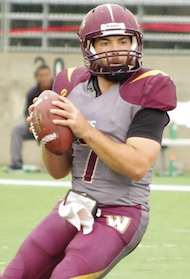
After sitting out a term, Fracassa transferred to Walsh, located in North Canton, Ohio. There he revived his football career starting at quarterback his last two years. Walsh, then a recent addition to the Great Lakes Intercollegiate Athletic Conference, nearly upset conference power and undefeated Ferris State in Fracassa’s final game. Fracassa threw his second touchdown pass of the game to give Walsh a 42-32 lead with 9:38 left before Ferris State came back with two touchdowns, the second with 36 seconds left, to win 46-42.
Fracassa hasn’t completely abandoned football since his last game at Walsh. He and his father coached the Oakland University club team in 2018 and that team reached a championship game. Jason was the offensive coordinator, his father the head coach – branches from the coaching tree rooted with Jason’s grandfather Al Fracassa, the second-winningest high school football coach in MHSAA history and Bloomfield Hills Brother Rice legend.
Jason’s competitive juices continue to flow.
“We had a great run,” Fracassa said, “and any other year could have taken the championship trophy.”
Made in Michigan 2020
June 16: Muskegon Grad Casts "Magic" in HBO Series - Read
 Tom Markowski is a correspondent for the State Champs! Sports Network and previously directed its web coverage. He also covered primarily high school sports for the The Detroit News from 1984-2014, focusing on the Detroit area and contributing to statewide coverage of football and basketball. Contact him at [email protected] with story ideas for Oakland, Macomb and Wayne counties.
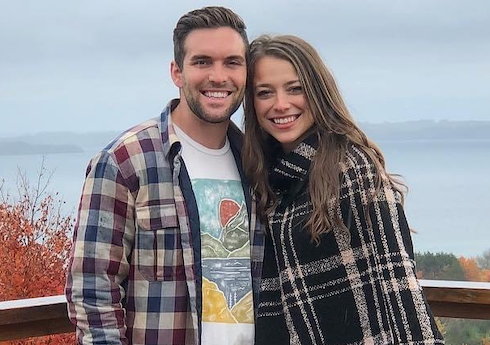
PHOTOS: (Top) Jason Fracassa rolls out during the 2009 Division I championship game at Ford Field. (Middle) Fracassa and fiancé Kelsey Torzy. (Below) Fracassa drops back to pass while playing for Walsh. (Middle and below photos courtesy of Jason Fracassa.)