

Drive for Detroit: Playoffs R2 in Review
November 9, 2015
By Geoff Kimmerly
Second Half editor
The second week of the MHSAA football playoffs again was filled with rematches of some of the regular-season’s most touted games.
And the mix of results – close wins, comebacks and victories by the avenged – surely will impact which teams appear in nine championship games later this month.
Below are results that stuck out most as 136 turned into 68.
Division 1
Saline 27, Ann Arbor Pioneer 23
Pioneer made this rematch of Southeastern Conference Red rivals more like the game it was expected to be Week 6, when Saline (10-0) won 37-21. The Pioneers (7-4) led into the third quarter and early in the fourth, but the reigning Division 1 runner-up earned its second straight District title with a late score and defensive stand. Click for more from AnnArbor.com.
Also noted:
Romeo 34, Lapeer 14 – The Bulldogs (10-1) advanced to a Regional Final for the first time since 1992, with Lapeer receiving its first and only loss in the District Final for the second straight year.
Rockford 21, Hudsonville 13 – The Rams (8-3) downed Hudsonville (7-4) for the second time in three weeks; the first win gave Rockford a share of the Ottawa-Kent Conference Red championship, and this win earned a first District title since 2012.
Grand Ledge 45, Brighton 21 – Grand Ledge (11-0) earned its first District title since 2005 against a Brighton team that at 9-2 won its most games since that same season.
Canton 34, Northville 27 – The Chiefs (9-2) rode a dominating ground game to a second straight District title and handed Northville (10-1) the only loss during a season in which it set a school record for wins.
Division 2
Muskegon 21, Muskegon Mona Shores 10
The second matchup in four weeks between these rivals was just as entertaining. After falling 21-18 in the first meeting, Muskegon (9-2) scored two fourth-quarter touchdowns to take the rematch and end the season for the reigning MHSAA runner-up. Mona Shores (10-1) followed up its best season ever with a second of double-digit victories. Muskegon is trying to get back to Ford Field for the fourth straight season. Click for more from the Muskegon Chronicle.
Also noted:
Walled Lake Western 34, Birmingham Groves 21 – Western (11-0) won this matchup of undefeated teams to get to 11 wins for the first time since 2011, while ending Groves’ winningest season at 10-1.
Livonia Franklin 63, Jackson 35 – After four straight sub-.500 seasons, Franklin (8-3) won its first District title since 2007 and clinched its best record since at least 2005; Jackson (8-3) won its most games since at least 1950 and after five straight finishes below .500.
Berkley 28, Southfield 20 – The first district title for Berkley (9-2) included tying the team record for wins and downing a Southfield team (7-4) that made the Division 2 Semifinals a season ago.
Midland Dow 41, Fenton 14 – The Chargers are 10-1 for the second straight season and headed to a Regional for the first time since 1997 after handing Fenton (9-2) its first loss since opening night.
Division 3
St. Johns 42, DeWitt 28
Count this as a statewide stunner for the Redwings (8-3), even with their tradition of success as they won their eighth game for the third time in four seasons. St. Johns had dropped six straight to the rival Panthers, including 49-21 only four weeks ago, but jumped to a 28-7 first-quarter lead and rode a mix of rushing and passing to put up the most points DeWitt (9-2) had given up since 2012. Click for more from the Lansing State Journal.
Also noted:
Mount Pleasant 16, Petoskey 13 – The Oilers (9-2) won their second District title in three seasons after Connor Fiolek drilled a 42-yard field goal with 24 seconds left to push ahead of Petoskey (8-3).
St. Joseph 40, Edwardsburg 28 – The Bears (10-1) continued to fade out memories of last year’s 4-5, adding a District title to a shared league crown in handing Edwardsburg (10-1) its lone loss.
Coldwater 35, Vicksburg 14 – Coldwater’s first playoff win ever two weeks ago now is now a successful pair as the Cardinals (11-0) ended a five-game winning streak by the Bulldogs (8-3).
Chelsea 29, Trenton 16 – These Bulldogs (10-1) won their second straight District title and went over nine wins for the first time since 2007 by ending the best run since 2005 for Trenton (9-2).
Division 4
Hudsonville Unity Christian 23, Grand Rapids Catholic Central 21
Unity Christian isn’t just a soccer school anymore. The Crusaders improved to 8-3, those wins their most in their 13 seasons of football, and they earned the milestone victory against a program only five seasons removed from its most recent Ford Field trip. GRCC (9-2) improved three wins from a year ago, but was eliminated when Unity Christian’s Connor Hollemans converted a 26-yard field goal with six seconds to play. Click for more from the Grand Rapids Press.
Also noted:
Ada Forest Hills Eastern 21, Comstock Park 13 – The Hawks (10-1) added the first District title of their 12-year history by ending a sixth-straight playoff appearance by the Panthers (8-3).
Richmond 17, Pontiac Notre Dame Prep 15 – The Blue Devils (10-1) won their second straight District title after holding off a comeback attempt that included two fourth-quarter scores by the Irish (8-3), who bounced back from 3-5 a year ago.
Milan 67, Detroit Denby 44 – Milan (9-2) has put up more points by far than even its double-digit win seasons of the last two decades, and needed them this time to hold off a Denby team (6-5) that scored its most in a game since 2013.
Remus Chippewa Hills 35, Big Rapids 12 – The Warriors (9-2) won their first District title by ending the best season for Big Rapids since 2012 after the Cardinals (7-4) won only one game a year ago.
Division 5
Lansing Catholic 21, Portland 14
This too turned out more like what was expected the first time these teams matched up this season. Portland downed Lansing Catholic 28-6 in Week 4, but the Cougars followed their star quarterback Tony Poljan this time with just enough big plays to hand the Raiders (10-1) their first and only loss. He ran for two scores and connected on a key long pass to help Lansing Catholic (10-1) to within two more wins of returning to Ford Field after finishing runner-up a year ago. Click for more from the Lansing State Journal.
Also noted:
Grand Rapids West Catholic 21, Reed City 14 – The Falcons (9-2) won their sixth straight District title with their eighth straight victory, ending the season for Reed City (10-1) for the third time in five years.
Buchanan 35, Berrien Springs 0 – These two played to a two-point win for Buchanan in Week 8, but the Bucks (11-0) must have found what they needed to shut down the Shamrocks (9-2).
River Rouge 42, Detroit University Prep 0 – River Rouge (10-1) has three District titles and three double-digit win totals in four seasons after ending this one for University Prep (7-4).
Ida 39, Dearborn Heights Robichaud 30 – The Bluestreaks’ best season ever continued with their first District title to move to 11-0, while Robichaud (8-3) finished with at least that many wins for the third time in four seasons.
Division 6
Constantine 49, Watervliet 48
The 17th straight playoff berth for Constantine came at-large with a 5-4 regular-season record, but the Falcons have looked like anything but a team that just got into the postseason. First came a three-point win over previously-undefeated rival Schoolcraft. This week’s one-point win ended the season for another league champion in Watervliet (9-2), which beat Constantine by 21 in Week 6. Click for more from the Sturgis Journal.
Also noted:
Ithaca 42, Sanford Meridian 6 – Ithaca (11-0) still hasn’t let an opponent come within 28 points, including now Jack Pine Conference champion Sanford Meridian (10-1), which posted its best record ever this fall.
Jackson Lumen Christi 45, Manchester 28 – Three losses over the final five games of the regular season haven’t slowed down Lumen Christi (8-3) in the playoffs, as the Titans this week posted an impressive win over the Cascades Conference champion Dutchmen (9-2).
Grand Rapids NorthPointe Christian 31, Montague 28 – The Mustangs (11-0) are looking like a contender again for the second straight year after handing rejuvenated Montague (10-1) its only loss.
Clinton 43, Madison Heights Madison 20 – Clinton has owned the road, moving to 11-0 with a sound defeat of host Madison (9-2) after beating the reigning champion Monroe St. Mary Catholic Central in the District opener.
Division 7
Pewamo-Westphalia 38, Saugatuck 28
The Pirates’ fifth straight District championship might have been the toughest to earn against previously-undefeated Saugatuck (10-1). Pewamo-Westphalia (11-0) scored 16 points over the final six minutes to move on. Saugatuck finished with 10 wins for the second time in program history and first since finishing Division 8 runner-up in 2010. Click for more from the Ionia Sentinel-Standard.
Also noted:
McBain 20, Saginaw Nouvel 19 (OT) – The Ramblers (8-3) went for a two-point conversion down one in overtime and extended their best season since 2011 while ending Nouvel’s at 9-2.
Sandusky 7, Cass City 0 – A touchdown on fourth down with less than a minute to play gave Sandusky (11-0) its first District title and continued the Redskins’ best season while ending the best run for Cass City (8-3) since 2005.
Dansville 35, Homer 21 – The Aggies (10-1) have 10 wins and a District title for the first time after defeating Big 8 Conference champion Homer (8-3).
New Lothrop 37, Flint Beecher 7 – The Hornets (11-0) won this unofficial Genesee Area Conference crossover and with it a third straight District title, although Beecher (7-3) did score the first points New Lothrop had given up in four weeks.
Division 8
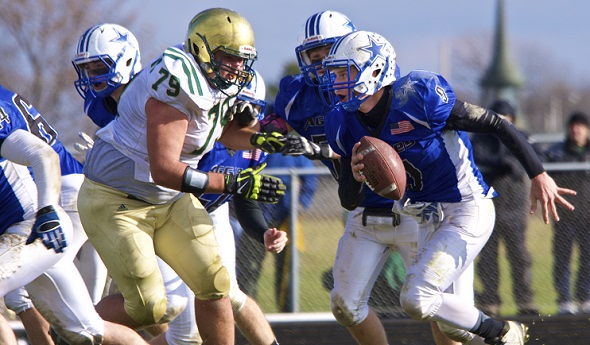
Muskegon Catholic Central 48, Beal City 13
The rematch of the 2013 Division 8 Final again went the Crusaders' way, as MCC rushed for 402 yards and five touchdowns to break open a game still close at halftime. Muskegon Catholic Central has scored at least 48 points the last three games after scoring only six points in a Week 8 loss to Detroit Country Day – the two-time reigning champion put up more points than Beal City had given up in a game since 2011. Click for more from the Muskegon Chronicle.
Also noted:
St. Ignace 16, Johannesburg-Lewiston 8 – Although they finished ahead of Johannesburg-Lewiston (9-2) in the Ski Valley Conference, the Saints (10-1) ended up on the road but came away with a fourth District title in five seasons.
Frankfort 28, Onekama 21 – Frankfort (9-2) earned its first District title since 2009 with a quick turnaround after falling to Onekama (9-2) by 13 points only two weeks ago.
Ottawa Lake Whiteford 26, Morenci 6 – After taking a pair of losses from Tri-County Conference rival Morenci (8-3) in 2014, Whiteford (9-2) returned the favors with its second this fall after also winning the Week 7 matchup.
Crystal Falls Forest Park 26, Bark River-Harris 22 – For the second straight week, Forest Park (7-3) avenged a regular-season loss, this time bouncing back from a one-point opening-night defeat to the Broncos (8-3).
8-Player
Battle Creek St. Philip 58, Lawrence 14
In an odd turn of schedule, St. Philip (11-0) has faced two opponents twice over the last four weeks – Portland St. Patrick in Week 8 and in the Pre-Regional, and then Lawrence in Week 9 and the Regional Final. The first St. Philip-Lawrence meeting came out a three-point St. Philip win, which made this result a little surprising from a score margin point of view. St. Philip had been eliminated the last two seasons by Lawrence (8-3), last year’s eventual champion. Click for more from the Battle Creek Enquirer.
Also noted:
Cedarville 22, Posen 20 (OT) – Two points one way went the other this time, as Cedarville (9-2) avenged a 28-26 Week 6 loss to Posen (10-1) to make a second straight Semifinal.
Powers North Central 64, Rapid River 8 – Believe it or not, North Central (11-0) tied its season low in points in ending a fifth-straight winning season for the Rockets (7-4).
Deckerville 40, Morrice 20 – Deckerville (10-1) also avenged a regular-season loss and its only loss this season, a Week 6 four-point defeat to Morrice (9-2).
PHOTO: Muskegon Catholic Central (gold helmets) defeated Beal City in a playoff game for the second time in three seasons. (Click for more from HighSchoolSportsScene.com.)
Three Rivers Takes Run at District Together
October 31, 2017
By Wes Morgan
Special for Second Half
J.J. Wagner is economical with his words, stoic on the sideline, and not preoccupied with statistical trends. All he really asks of his Three Rivers football players is to play and sacrifice for one another.
 It’s been a pretty good recipe throughout his 13-year tenure as the head varsity coach of the Wildcats, at least in the years when the players truly held up their end of the bargain. With an 82-50 career record since 2005, Wagner has seen what can happen when everyone is pulling in the same direction, like a 13-0 run that ended with a loss in the 2009 Division 4 Final.
He’s also witnessed how complacency can cut a program right back down, as was the case in 2010 when an experienced Three Rivers squad went 4-5 and missed the postseason.
The Wildcats have been noticeably hungrier the last two years, with a 7-3 mark in 2016 and an 8-2 record this year as they prepare for Friday’s Division 4 District championship game against Edwardsburg.
Eleven games into the year, Three Rivers has been unable to break out of a Wolverine Conference bubble. The Wildcats went 7-2 in the league, with losses to Dowagiac (Week 2) and Vicksburg (Week 9). Revenge was sweet last Friday as Three Rivers beat Vicksburg in the Pre-District game (20-10).
Now, the difficult task of beating the league’s most dominant team for the second time in one year is what’s required to move on in the playoffs. If Three Rivers can beat the Eddies (after also doing so 21-18 in Week 7), there’s a chance they’ll face Wolverine Conference member Plainwell in the Regional Round.
“You get through the Wolverine (schedule) and then you’re suddenly in a mini Wolverine tournament,” Wagner joked.
There are no secrets in terms of playoff prep against such familiar foes, so it’s all about the basics.
“Our offense has been moving the sticks, our defense has been playing well, our special teams have played well and we play well when we don’t turn the ball over,” he said.
Having played for perennial power Mendon, where he registered 253 tackles as an outside linebacker during the 1987-89 seasons, Wagners’ emphasis on that side of the ball has been a hallmark of the 2017 campaign. Three Rivers has only allowed 11.7 points and 203 yards per game. The Wildcats have stopped opponents on third down 79.8 percent of the time.
A lot of that has to do with big and athletic senior defensive end Tirrell Hausmanis (6-foot-4, 245 pounds), senior defensive tackle Tyler Moore (5-11, 235) and the linebacker duo of senior Chris Morrill (5-10, 160) and Traven Van Oss (6-1, 165). That group alone has accounted for 34.5 tackles for loss this season. Morrill and Van Oss are tied for a team-best 61 tackles.
“Anytime you’re playing good defense, you can take a few more chances on offense,” Wagner said. “I don’t know how many times we’ve gone for it on fourth down this year, but it’s probably more than most (years). You can take a chance at midfield or the 40 that maybe you wouldn’t normally.”
Perhaps no player has embraced Wagner’s rule of doing what’s best for the team more than Hausmanis, who likely would have garnered a lot more attention from college coaches had he stayed at tight end. Instead, he’s anchored both lines the past two seasons.
“We all just do our jobs,” he said. “This happened and we weren’t big enough (on the offensive line) for me to play tight end. They needed me at tackle. At first I didn’t really like it, but I had to get used to it because it was what was best for the team. It helped us succeed and win, so I had to do it.”
 His defensive stats might not seem that impressive — 30 tackles with two sacks — but it’s what he’s capable of that impacts the game so severely.
“It helps when you know people are going to run away from (Hausmanis), so you can stunt and play games on the other side that can mess with their protections and blocking schemes,” Wagner said.
Wagner admitted he’s not big on stats, but for those who were wondering about how many times the offense has felt comfortable gambling on fourth down because of a belief in the defense, it’s 27. The Wildcats have converted 15 times (55.6 percent).
Other than knowing the defense could likely bail it out if needed, there’s been plenty of confidence in the offense under the leadership of junior quarterback Jalen Heivilin.
With a 22-6 touchdown-to-interception ratio, an average of 214.6 passing yards per game and a completion rate of 61 percent, the first-year starter has settled in nicely. Classmate Gavin Charvat has been Heivilin’s favorite target as the two have connected 42 times for 562 yards and six touchdowns. Bryce Morlan was next in line with 32 receptions for 549 yards and a team-high 11 TDs, but the senior went down in Week 9 with a torn anterior cruciate ligament. Fortunately for the Wildcats they also have reliable receivers in Jett Haifley and Zac Meyer; each has hauled in 23 passes for around 400 yards.
“When we play mistake-free, which is what we harp on, and eliminate pre- and post-snap penalties, you can win a lot of games,” Wagner said. “That’s what we focus on every week. If you can do that, you’re going to keep yourself in a lot of games.”
That was exactly the difference in Three Rivers’ home win against Edwardsburg on Oct. 6, which snapped a 34-game Wolverine Conference winning streak by the Eddies.
“We have to play with that same energy and effort (against Edwardsburg),” Wagner added. “In both of our losses, we came out kind of flat. If I knew why, we wouldn’t do it. We think we can go in there (at Edwardsburg) and play them tough again. It boiled down to mistakes in that (first meeting). We made our extra points, and we held them on all theirs. If we go in there with the same discipline, there’s no reason we can’t beat them again.”
 Wes Morgan has reported for the Kalamazoo Gazette, ESPN and ESPNChicago.com, 247Sports and Blue & Gold Illustrated over the last 12 years and is the publisher of JoeInsider.com. He can be reached at [email protected] with story ideas for Berrien, Cass, St. Joseph and Branch counties.
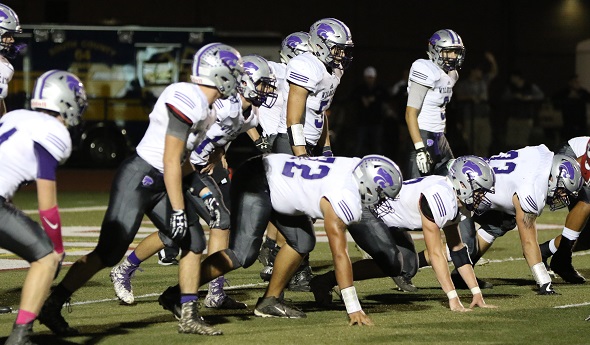
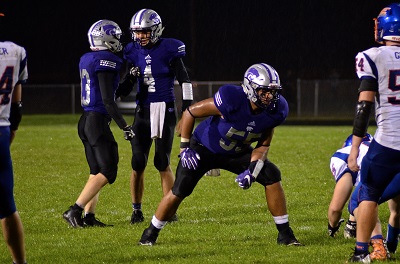
PHOTOS: (Top) Three Rivers’ defense lines up for a play; it’s been stifling this season giving up only 11.7 points per game. (Middle) Receiver Nolan Mark and quarterback Jalen Heivilin (4) talk things over against Edwardsburg. (Photos courtesy of JoeInsider.com.)