

Drive for Detroit: Week 1 in Review
September 3, 2013
By Geoff Kimmerly
Second Half editor
Let’s start our first weekly review of MHSAA football action with some of the results you won’t see among our list of most significant from opening weekend:
Kent City’s first opening night win over Ravenna in 15 tries and Beal City’s incredible 61-0 win over rival Mount Pleasant Sacred Heart. Kalamazoo Central’s 14-13 win over neighbor Loy Norrix and Kinde-North Huron’s 28-14 win over reigning MHSAA 8-player champion Deckerville.
All are big-time results, no doubt. But below I’ve tried to tell you about five more from each region of our state, organized by the winner in each game, that might have bigger impacts as we move immediately forward with most leagues schedules kicking off in three days.
West Michigan
Zeeland West 44, Detroit Country Day 28
Country Day came into this season with plenty of deserved hype returning most of its star power from last season’s run to the MHSAA Division 4 Final. But Zeeland West has plenty of championship experience too, and its tough running proved too much for the Yellowjackets. Click to read more from the Oakland Press.
Also noted:
East Grand Rapids 24, Grand Rapids Catholic Central 7 – The Pioneers began making up for last season’s first playoff miss since 2000 with a solid win over another perennial power.
Grand Rapids Christian 41, Grand Rapids South Christian 13 – New faces abound, but the reigning Division 3 champion won big over last season’s Division 4 title winner.
Muskegon Oakridge 31, Grand Rapids West Catholic 25 – The Eagles are soaring high to start this fall after finishing 2012 with a 13-6 District Final loss to West Catholic.
Rockford 23, Utica Eisenhower 6 – Given these teams’ histories, no one would be stunned if they met again in 13 weeks in the MHSAA Division 1 Final.
Greater Detroit
Oak Park 25, Orchard Lake St. Mary’s 20
Oak Park entered its opener with the opportunity to show last season’s historic run wasn’t over with 2012’s final horn. Four touchdowns during the second half against the reigning MHSAA Division 3 runner-up proved the Knights will be talked about plenty again in 2013. Read more in the Detroit Free Press.
Also noted:
Detroit Cass Tech 18, Southfield 14 – Two-time reigning Division 1 champion Cass Tech and quarterback Jayru Campbell edged an improved Bluejays team to start 1-0.
Clinton Township Chippewa Valley 27, Dearborn 20 (2 OT) – Chippewa Valley also beat Dearborn on opening night last season on the way to its first playoff berth in three seasons; this one could be prove just as important.
Rochester Adams 12, Clarkston 7 – Coming off its first playoff miss since 1996, Adams won for the first time in its last four tries against one of the biggest and best programs in the state.
Lake Orion 35, Oxford 30 – If this was an indication, these two should again be contenders in their respective divisions of the Oakland Activities Association. Lake Orion has held the Double "O" Pigskin Trophy three of four seasons since the series was restarted in 2010; the teams formerly played for the prize from 1962-83.
Southwest and Border
Battle Creek Harper Creek 27, Mattawan 7
Both of these teams should be contenders in their respective divisions of the Southwest Michigan Athletic Conference, and both will run their way to success again this fall. It will be interesting to see in eight weeks just how similar their paths finish after a game that would’ve been much closer if not for some untimely Mattawan turnovers. Click to read more from the Battle Creek Enquirer.
Also noted:
Battle Creek Central 15, Benton Harbor 0 – The Bearcats ended their 18-game winless streak with their first shutout since 2007.
Portage Central 55, Sturgis 0 – Sturgis has a Division 1 college prospect in quarterback Chance Stewart, which made this arguably the most impressive defensive performance statewide.
Watervliet 43, Gobles 14 – Simply put, this was a solid nonleague matchup between teams that each won eight games last season. Watervliet has the head start on repeating that feat.
Edwardsburg 34, Otsego 7 – Different teams, same story as above as both are playoff regulars that should again be in the mix by the end of the season.
Bay and Thumb
Saginaw Swan Valley 27, Saginaw Nouvel 20
Both might end this season at Ford Field after Swan Valley missed by one win a year ago and Nouvel missed by two after winning Division 7 in 2011. But as for the best in Saginaw, it looks like the Vikings at this point after running back Alex Grace ran for more than 200 yards in one of the state’s most intriguing openers. Click to read more from the Saginaw News.
Also noted:
New Lothrop 28, Traverse City St. Francis 7 – The Hornets traveled north for a tough opener and came back with plenty of momentum for the Genesee Area Conference Blue schedule.
Hemlock 19, Frankenmuth 12 – Hemlock, the 2012 Tri-Valley Conference Central champion, held on to beat the 2012 TVC East winner.
Montrose 38, Reese 8 – This looked to be a close game between 10-win teams from a year ago, but Montrose instead avenged last season’s 21-point loss to the Rockets in a bigger way.
Saginaw Arthur Hill 24, Goodrich 14 – Arthur Hill has struggled since it last playoff berth in 2008, but appears on the rebound with this reversal of a 41-6 loss to Goodrich in 2012.
Mid-Michigan
Ithaca 57, Williamston 13
This wasn’t really close, but was significant nonetheless. The win was Ithaca’s 43rd straight, tying the record for longest victory streak in MHSAA history in which all games were won during the playoff era. This week, the Yellowjackets face rival St. Charles with a chance to move up the list again. Click to read more from the Lansing State Journal.
Also noted:
Jackson Northwest 35, Hillsdale 20 – Only a record performance by Ithaca could trump what might be Northwest’s best football win since the mid-2000s. Hillsdale is coming off an 11-win season, and Northwest has won one game in each of the last three years.
Lansing Sexton 21, Chelsea 14 – Beating a team with 14 straight playoff berths will no doubt help the Big Reds return to the postseason after missing last season.
Pewamo-Westphalia 20, Lansing Catholic 7 – This reversed a 24-point loss to the Cougars last season as the Pirates began their quest for a third straight MHSAA Semifinals run.
Eaton Rapids 44, Leslie 0 – New Greyhounds coach Mike Smith, most known from his success at Holt, started his Eaton Rapids rebuilding effort with the team’s biggest win since 1996.
Upper Peninsula
Negaunee 36, Manistique 30
Negaunee had to be on its game for a tough Mid-Peninsula Conference opener against another playoff team from 2012. But the Miners held on through a late Manistique run and scored last to open league play and the season 1-0. Big plays were key, as Negaunee scored on an 80-yard kickoff return and 66-yard run. The Miners continued claim of the Oscar Wassberg Trophy, named for the former coach of both teams. Click to read more from the Marquette Mining Journal.
Also noted:
Cedarville 42, Posen 40 – The Trojans didn’t feel much of a challenge until Week 8 last season, but survived this one to kick off its 8-player season.
Ishpeming 36, Iron Mountain 0 – The reigning MHSAA Division 7 champion kept rolling with a win over another playoff team from last season.
Bessemer 28, Hancock 26 (OT) – The last three games between these two have been decided by a touchdown or less, but all in favor of the Bessemer-led co-op.
Marquette 31, Traverse City Central 23 – Marquette should get a solid boost at playoff selection time from this win as it goes for a fourth straight postseason berth.
Lower Up North
Reed City 39, Big Rapids 26
As stated earlier last week, this game eventually decided last season’s Central State Activities Association title in favor of Reed City. This was the fourth straight opening-night win for the Coyotes over rival Big Rapids. This game is played for the Pioneer Trophy. Click to read more from the Cadillac News.
Also noted:
Alpena 15, Escanaba 7 – Alpena has won only one game in each of the last two seasons and was outscored by Escanaba by a combined 72-0 over 2011 and 2012.
Hillman 55, Gaylord St. Mary 54 – These teams combined for only 41 points when they met to open 2012. This time, they qualified for the MHSAA record book.
Charlevoix 20, St. Ignace 0 – Coming off one win in 2012, and against a team that was 24-2 combined over the last two seasons, Charlevoix pulled off one of the biggest upsets statewide.
Maple City Glen Lake 27, Boyne City 13 – Glen Lake continued rolling off last season’s best finish in more than a decade by beating again the team it defeated to open the 2012 playoffs.
Trophy Games
Each week the MHSAA highlights trophy games played across the state. A few were mentioned above, with these the rest we knew about heading into the weekend.
- Bull Bowl – This is one of our newest trophies, established in 2011 for the opener between Fremont and Sparta. The Spartans gained a 2-1 advantage in the series last week. Final: Sparta 6, Fremont 0.
- Battle of 127 Trophy – Hudson and Addison have met for a number of years for this trophy sponsored by a local insurance company and local automotive group. Final: Hudson 46, Addison 0.
- Battle for The Paddle – Neighbors Sanford Meridian and Bullock Creek have met on opening night for the last dozen seasons. Bullock Creek owns a 7-5 advantage during that time. Final: Meridian 26, Bullock Creek 22.
- State Bank Traveling Trophy – Linden and Fenton have played for this prize dating to 1976, including on opening night the last two seasons. Final: Fenton 39, Linden 27.
- Little Brown Jug – Two games were played for these last week: Napoleon and Brooklyn Columbia Central continuing a series begun in 1967, and Manton and Mesick. Finals: Manton 29, Mesick 0; Columbia Central 26, Napoleon 18.
- Border Battle Cheese Trophy – Hurley (Wis.) made it eight straight opening-night wins over rival Ironwood. Final: Hurley 47, Ironwood 7.
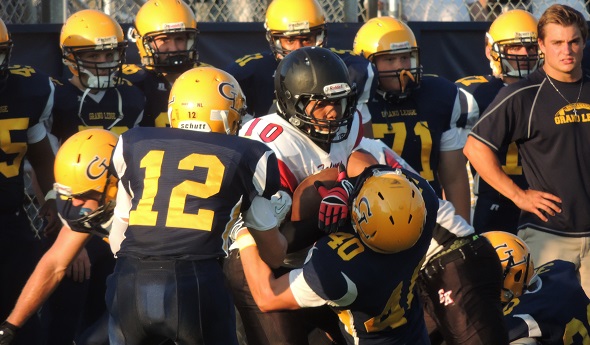
PHOTO: Grand Ledge made this stop, but fell a few short in a 16-14 opening-night loss at home against East Kentwood.
1st & Goal: Week 8 Preview
October 15, 2020
By Geoff Kimmerly
Second Half editor
The midpoint of every other regular season is crunch time during this abbreviated fall of 2020.
Teams across Michigan will play their fifth games this weekend – but a week from Saturday, all of this year’s league championships and playoff profile boosting will be complete.
Every game has meant even more, and below are a number of games this weekend that could end up meaning the most.
Find the schedule and then results this weekend as they’re reported via the MHSAA Score Center. This week’s broadcast schedule includes 53 varsity football games on MHSAA.tv; click the link for listings
Bay & Thumb
Hemlock (4-0) at Millington (4-0)
This will decide the Tri-Valley Conference West I championship, with Hemlock seeking its first league title since 2012 and Millington its first since 2014. To finish first, the Huskies will need to break a recent three-game losing streak against the Cardinals, who won last year’s matchup 15-6. Millington’s defense might be the key this time; it has given up just 34 points over its other three league matchups.
Keep an eye on these: FRIDAY Marine City (4-0) at Marysville (4-0), North Branch (4-0) at Imlay City (3-1), Bad Axe (3-1) at Elkton-Pigeon-Bay Port Laker (3-1), Fenton (4-0) at Swartz Creek (3-1).
Greater Detroit
Detroit Cass Tech (4-0) vs. Detroit Martin Luther King (3-1) at Detroit Collegiate Prep, Saturday
They opened this season with their closest result since 2015, Cass Tech winning 34-26, and now meet again in the Detroit Public School League 1-2 championship game. Both cruised through their league schedules, both giving up only seven points over their other three games this fall.
Keep an eye on these: FRIDAY Detroit U-D Jesuit (2-1) at Detroit Catholic Central (4-0), Garden City (3-1) at Dearborn Heights Crestwood (4-0), Detroit Central (4-0) vs. Detroit Southeastern (4-0) at Detroit Collegiate Prep. SATURDAY Clarkston Everest Collegiate (4-0) at Royal Oak Shrine (4-0).
Mid-Michigan
McBain (4-0) at Beal City (4-0)
The Aggies were well on their way to a perfect run through the Highland Conference last season when third-place McBain stunned with a 27-0 win in the league finale – which sent Beal into a shared championship with Houghton Lake instead. McBain and Beal City are meeting in the league finale again, with the winner taking the championship outright.
Keep an eye on these: FRIDAY Pewamo-Westphalia (4-0) at Fowler (4-0), Harrison (3-1) at Clare (4-0), Durand (4-0) at New Lothrop (4-0), Williamston (4-0) at Olivet (4-0).
Northern Lower Peninsula
Sault Ste. Marie (3-1) at Kingsley (4-0)
The Blue Devils have launched an impressive chase of reigning champion Kingsley in their first season as part of the Northern Michigan Football Conference, as both are the only teams still unbeaten in Legends division play. Both have wins over Traverse City St. Francis, but Sault Ste. Marie’s victory over Marquette in Week 5 may turn out to have been even more important prep for the powerful Stags.
Keep an eye on these FRIDAY East Jordan (3-1) at Johannesburg-Lewiston (4-0), Manistee (3-1) at Ludington (3-1), Cadillac (3-1) at Traverse City West (3-1). SATURDAY Ogemaw Heights (3-1) at Traverse City St. Francis (2-2).
Southeast & Border
Erie Mason (4-0) at Sand Creek (4-0)
The Eagles, first-year members of the Tri-County Conference, are in a league title conversation for the first time since winning the Lenawee County Athletic Association in 2003. They also can tie their winningest finish since 2003 with a victory this week or next, having won a combined eight games over the last seven seasons before this fall. Sand Creek is used to more success, but still is hoping to clinch its first league championship since 2011. Both have scored at least 46 points in every game this fall.
Keep an eye on these: FRIDAY Homer (4-0) at Reading (3-1), Monroe (3-1) at Temperance Bedford (3-1), Ida (2-2) at Blissfield (4-0), Michigan Center (1-1) at Manchester (2-2).
Southwest Corridor
Lawton (4-0) at Schoolcraft (3-1)
In 2019, Lawton won the Southwestern Athletic Conference Valley title, and Schoolcraft the SAC Lakeshore championship. This fall, Schoolcraft moved into the Valley, and Lawton this weekend no doubt is rolling up the welcome mat – recalling as well how the Eagles defeated the Blue Devils 47-10 in last season’s Division 7 District Final.
Keep an eye on these FRIDAY Constantine (3-1) at Kalamazoo United (4-0), Battle Creek Lakeview (4-0) at Stevensville Lakeshore (3-1), Cassopolis (2-2) at Mendon (3-1), Watervliet (2-2) at Coloma (3-1).
Upper Peninsula
Escanaba (0-1) at Marquette (3-1)
Arguably the Upper Peninsula’s most famed rivalry will add one of its more interesting chapters, as Marquette has clinched a share of the Great Northern Conference championship while Escanaba is finally getting an opportunity to play its first game this fall. This could go a few ways. The Eskymos could show some rust against their game-sharpened rivals. They also could unleash a month’s worth of wanting to get back on the field now that they’ve finally gotten the chance.
Keep an eye on these FRIDAY Gladstone (2-1) at Menominee (2-2), West Iron County (4-0) at Gwinn (2-2), Negaunee (3-1) at Houghton (1-1), Calumet (1-2) at Hancock (1-2).
West Michigan
Whitehall (4-0) at Montague (4-0)
Tonight’s winner will clinch a share of the West Michigan Conference title, and Montague is a frequent part of the championship conversation. Whitehall is seeking its first WMC title since 1999, but has had a big role is making this one of the most competitive leagues in the state as well with five playoff appearances over the last six seasons. This matchup could be a test of defensive wills – the Vikings have allowed only three points this season, and Montague has given up a mere 12.
Keep an eye on these: FRIDAY Zeeland West (4-0) at Muskegon (3-1), Allendale (3-1) at Grand Rapids West Catholic (3-1), Hamilton (2-2) at Hudsonville Unity Christian (4-0), Ada Forest Hills Eastern (3-1) at Grand Rapids Catholic Central (4-0).
8-Player
Kinde-North Huron (4-0) at Peck (3-1)
This showdown will decide at least a share of the North Central Thumb League Stripes championship, with North Huron able to clinch outright what would be its second title in four seasons. The Warriors have won six straight times over Peck, including in last season’s playoff opener – although the team’s regular-season meeting was decided by just eight points.
Keep an eye on these: FRIDAY Munising (4-0) at Cedarville (3-1), Deckerville (3-1) at Genesee (3-1), Pickford (4-0) at Rapid River (3-1). SATURDAY Merrill (4-0) at Portland St. Patrick (4-0).
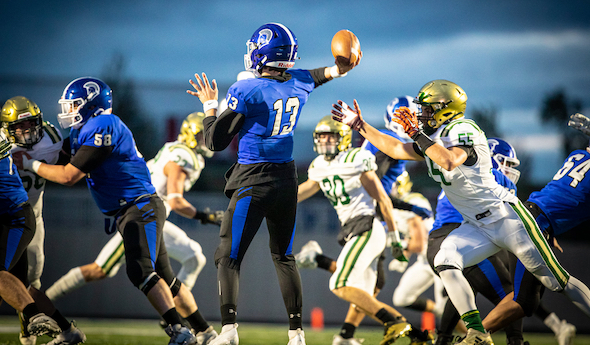
PHOTO: Muskegon Catholic Central is another undefeated team this fall; here the defense surrounds Sparta’s quarterback during the Oct. 2 victory. (Photo by Tim Reilly.)