

Drive for Detroit: Week 10 in Review
November 3, 2014
By Geoff Kimmerly
Second Half editor
A number of MHSAA football teams began practice last week enjoying the unseasonable warmth and glowing sun – and finished their games playing through some combination of strong wind, rain or snow and freezing temperatures.
The results that emerged from the first week of the postseason were more predictable, but far from automatic.
Of 136 games played over nine divisions, 103 (or 76 percent) were won by home teams – those with higher playoff-point averages than their first-round opponents at the end of the regular season. That means home-field advantage was a pretty good thing – but far from a sure one with seasons and careers hanging in the balance.
Take a look below at four games that stuck out from each division as the field was split from its original 272 teams.
DIVISION 1
Rockford 20, Traverse City West 14 (OT)
Only three Division 1 games this week were decided by less than two touchdowns, making this the closest of the bunch. At-large qualifier Traverse City West (5-5) has made the playoffs 11 times during its 18-year history – and faced Rockford eight times, including to open the playoffs the last three seasons. This one was clearly closer than last year’s 19-0 Rams victory, with West coming back from a 14-point halftime deficit. The win earned Rockford a rematch with rival Hudsonville in the District Final. Click for more from the Grand Rapids Press.
Also noted:
Macomb Dakota 21, Utica Eisenhower 14 – This score was identical and no doubt similarly nerve-wracking for Dakota (8-2) as the first time it played Eisenhower (5-5), in Week 5.
Grand Ledge 14, Hartland 0 – In mid-September, the Comets (7-3) were 1-2; now they’re seeking a first District title since 2005 after beating a league champion in Hartland (7-3).
West Bloomfield 34, Livonia Stevenson 6 – The Lakers (9-1) set a school record for wins with their first playoff victory in school history; Stevenson finished 6-4, one win better than 2013.
DIVISION 2
Muskegon Mona Shores 42, Caledonia 14
A year ago Mona Shores made the playoffs for the first time; Friday saw the Sailors (9-1) claim their first playoff victory and look even more like a Division 2 contender despite another tough matchup coming this week against undefeated Midland Dow. Mona Shores had beaten Caledonia 40-7 in Week 4, but that was before the Fighting Scots put together a run that included shutouts of Rockford and Lowell and similarly big wins over East Grand Rapids and Grand Rapids Christian. Caledonia finished 7-3, two wins better than in 2013. Click for more from the Muskegon Chronicle.
Also noted:
Farmington Hills Harrison 42, Fenton 10 – Harrison’s run since falling big to Oak Park in Week 3 keeps getting better and better; the Hawks (8-2) came back from a seven-point defeat to reigning Division 1 champion Clarkston in Week 9 by handing the first and lone loss to Fenton (9-1).
Walled Lake Western 14, South Lyon 13 – The Warriors (9-1) stopped South Lyon and its best season since 2006 with a last stand against the Lions (8-2) during the final minutes.
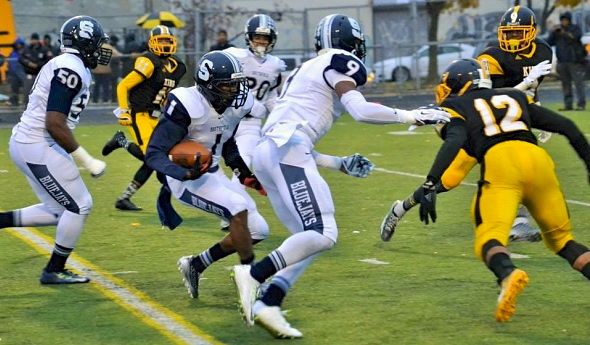
Southfield 40, Detroit Martin Luther King 12 – The Bluejays (7-3) claimed their second playoff win over King (8-2) in three seasons and this time will again face Oak Park in the District Final.
DIVISION 3
Lowell 28, East Grand Rapids 27
A series of classics between these Ottawa-Kent White rivals added another chapter, with East Grand Rapids holding the lead into the final three minutes before Lowell moving ahead for good on a 73-yard touchdown reception by Gabe Steed. The Red Arrows (9-1) have won at least one playoff game every season since last falling in an opener in 1999. East Grand Rapids finished 6-4, still its best finish in three years after missing the playoffs the last two. Click for more from the Grand Rapids Press.
Also noted:
Dearborn Divine Child 9, Allen Park 7 – Divine Child’s first playoff win since 2010 gave it four more victories than how the Falcons (7-3) finished a year ago and also ended the best season for Allen Park (8-2) since 2011.
Trenton 20, Romulus 6 – The Trojans (7-3) are in the playoffs and have their first playoff win both since 2008 after ending Romulus’ first playoff appearance since 2000; the Eagles (6-4) did double their win total from 2013.
Cedar Springs 36, Grand Rapids Forest Hills Northern 0 – These O-K Bronze rivals played to a 14-8 win for Cedar Springs (9-1) in Week 6, but the Red Hawks found something that worked and ended Forest Hills Northern’s season at 7-3 for the second straight year.
DIVISION 4
Comstock Park 19, Cadillac 10
On win total alone, this would be a down season so far for Comstock Park (6-4), winners of at least nine games the last four seasons and 12-1 a year ago. But the Panthers have recovered strongly from a 1-3 start that included losses to teams with a combined 25-5 record. Comstock Park also defeated Cadillac in the playoffs a year ago, in the Regional Final, and in both cases it was Cadillac’s lone loss of the season. Click to read more from the Cadillac News.
Also noted:
Hudsonville Unity Christian 46, Grand Rapids Catholic Central 43 – The Crusaders (6-4) earned their first playoff win in program history, edging regular playoff qualifier Catholic Central (6-4) be re-taking the lead during the final minute.
Vicksburg 14, Three Rivers 13 – The Bulldogs’ best run since 1993 will continue after Vicksburg (8-2) avenged its Week 6 loss to the Wildcats (6-4).
Detroit Old Redford 14, Dearborn Heights Robichaud 6 – The Ravens (7-3) earned their first playoff win with a bit of an upset in edging Western Wayne Athletic Conference Red champion Robichaud (8-2).
DIVISION 5
Calumet 30, Harrison 21
Calumet, the state’s northernmost school, traveled to Harrison in the middle of the Lower Peninsula – and went home with a win as it continued to reverse last season’s 2-7 finish. The Copper Kings opened this fall 1-2 and needed to win out beginning with Week 7 to qualify for the postseason. Harrison also went 2-7 a year ago, finishing 8-2 this time after its first playoff appearance since 1999. Click for more from the Houghton Daily Mining Gazette.
Also noted:
Hopkins 22, Muskegon Oakridge 16 – After falling by six points in its 2012 playoff game and eight points in 2013, Hopkins (9-1) advanced to the District Final against last season semifinalist Oakridge (8-2).
Olivet 33, Stockbridge 32 – This rematch of the deciding game in the Greater Lansing Activities Conference was much closer than when Olivet (8-2) won 69-48 in Week 6; Stockbridge ended its first playoff season since 2010 at 6-4.
Ida 24, Ann Arbor Gabriel Richard 0 – The Bluestreaks (8-2) earned their first playoff win since 1990 with their second straight shutout in October, this one over Gabriel Richard (7-3), which averaged 31 points per game.
DIVISION 6
Flint Beecher 21, Montrose 13
These Genesee Area Conference Red rivals met for the second time in three weeks and again played it close, with Beecher following its 19-14 win in Week 8 with a season sweep. The Buccaneers also set a program record for victories in moving to 10-0 for the first time – they were 8-5 in making the Semifinal round in 2012. Montrose finished 6-4. Click for more from the Flint Journal.
Also noted:
Schoolcraft 42, Constantine 28 – The Falcons (8-2) won the Kalamazoo Valley Association title ahead of Schoolcraft, but the Eagles (7-3) will move on and despite falling to Constantine 31-17 in Week 2.
Negaunee 21, Charlevoix 12 – The Miners quickly made their 5-4 record at the start of the playoffs look a lot better, and the Rayders should celebrate 6-4 as well after going 1-8 in both 2012 and 2013.
Watervliet 22, Niles Brandywine 21 – The Panthers (9-1) made the always-gutsy decision after a touchdown late to go for the two-point conversion and the win instead of a tie, and held on to finish the Bobcats at 8-2 for the second straight season.
DIVISION 7
Cassopolis 29, Decatur 28 (OT)
Cassopolis slugged through a tough league season, going 1-3 in the Berrien-Cass-St. Joseph Red (with two one-point losses) in starting the season 2-3 overall. But the Rangers (7-3) took the final edge in this opener on a partially-blocked extra point that still found its way through the uprights, and beat a Decatur team that finished 8-2 and suffered its two losses by a mere combined 10 points. Click for more from the Cassopolis Vigilant.
Also noted:
Cass City 14, Marlette 8 – The Red Hawks (7-3) returned to the playoffs for the first time since 2006 with their first postseason win since 2005, while Marlette (6-4) finished its third winning season over the last four.
Pewamo-Westphalia 39, Union City 7 – P-W (8-2) actually had a negative yard total passing, but ran for 380 in handing Union City (8-2) its second straight loss to finish the fall.
Bridgman 33, Gobles 8 – The Bees (7-2) celebrated their first playoff win ever after bouncing back from a Week 9 loss to rival Buchanan; Gobles finished 7-3, a two-win improvement from 2013.
DIVISION 8
Bark River-Harris 14, Lake Linden-Hubbell 6
Since a 9-2 finish in 2009, Bark River-Harris won one, zero, one and two games, respectively, before returning to the ranks of the Upper Peninsula small-school elite this fall. Beating solid Lake Linden-Hubbell (7-3) should provide some confidence as well as the Broncos (8-2) prepare for a rematch with Crystal Falls Forest Park, which beat them 48-18 on opening night. Click for more from the Houghton Daily Mining Gazette.
Also noted:
Central Lake 18, Frankfort 6 – The Trojans (6-4) got into the playoffs despite four losses to other eventual playoff teams and made their selection stand up against Frankfort (5-4), in the playoffs for the first time in three seasons.
Johannesburg-Lewiston 35, Hillman 18 – The Cardinals (9-1) set themselves up to take on powerful Beal City for the third time in four seasons by ending the best season for Hillman (8-2) since 2011.
Morenci 25, Petersburg-Summerfield 0 – The Bulldogs (9-1) continued their best run since 2001 with their sixth shutout and second this season of Tri-County Conference foe Summerfield (5-5).
8-PLAYER
Lawrence 57, Portland St. Patrick 6
The Tigers started off this season in dominating fashion while facing only one eventual playoff team over the first five weeks, but haven’t slowed the last five despite taking on some of the best 8-player teams in the state. Lawrence followed up its Week 9 21-point win over Battle Creek St. Philip (9-1) – this week’s Regional Final opponent – with another big win over similarly-strong Portland St. Patrick (8-2). Lawrence has scored fewer than 50 points only once this fall and has yet to give up more than 20.
Also noted:
Rapid River 46, Engadine 26 – The Rockets (10-0) got a much closer game from Engadine (5-5) than the 40-point win in Week 5.
Cedarville 39, Bellaire 0 – These Bridge Football Alliance rivals faced off for the second time in three seasons with the result more of the same for the Trojans (9-1), who ended Bellaire’s season at 7-3.
Kingston 44, Owendale-Gagetown 8 – An 0-2 start made this season look a little like two-win 2013, but Kingston (7-3) has won seven of its last eight and earned a rematch against Owendale-Gagetown (8-2); the Cardinals beat the Bulldogs 48-20 three weeks ago.
PHOTO: Southfield's Kanye Harris follows blockers into Detroit Martin Luther King's defense during the Bluejays' District win over the Crusaders. (Photo courtesy of the Detroit Public School League.)
St Mary's Scores 3-Peat on Late TD
By
Tom Markowski
Special for Second Half
November 26, 2016
DETROIT – Orchard Lake St. Mary’s has been bitten before by teams that made last-second winning plays.
This time St. Mary’s bit back.
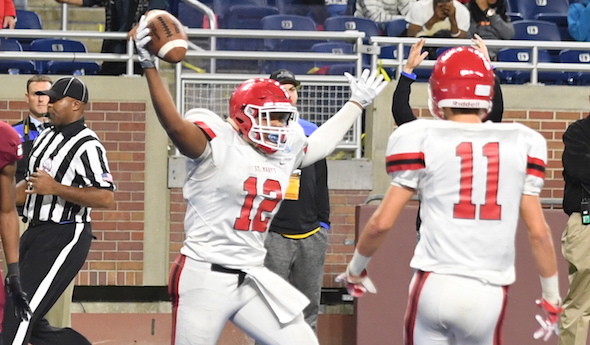
Ky’ren Cunningham’s 18-yard touchdown reception with four seconds left gave the Eaglets a thrilling 29-28 victory over Muskegon in the Division 3 Final on Saturday at Ford Field.
St. Mary’s (10-4) began its last drive on its 20-yard line with 1:55 left. A pass interference penalty by Muskegon and Rashawn Allen’s 22-yard run placed the Eaglets in a good position to go for the winning score.
On 3rd-and-3 from the 22, quarterback Caden Prieskorn scrambled for four yards and a first down. An incomplete pass preceded the winning score.
“It was a pistol right,” Prieskorn said. “All we knew was we were going to have man-on-man coverage.”
Make no mistake. This was desperation, and it was a makeshift play. Cunningham is a starting running back. The last time he lined up as a receiver was in the first game this season against Macomb Dakota. Coach George Porritt ditched that plan afterward. Cunningham would stay in the backfield.
But not this time. St. Mary’s had five wideouts and to confuse matters more, Cunningham went to the slot, then switched spots with Clay Antishin, with Antishin moving inside.
“I play running back,” said Cunningham, a junior. “It was one-on-one and the safety didn’t come over the top. Caden just threw it. He just made the read.
“My body felt so weak (when I caught it). I don’t remember much.”
If Cunningham was stunned, Muskegon was more so.
The only loss the Big Reds (12-2) had this season was to a team from Illinois (Lincolnshire Stevenson). They rolled through the playoffs with their Semifinal game against Edwardsburg (19-8) the only close one.
“I just didn’t do a good enough job of teaching coverage,” Muskegon coach Shane Fairfield said.
“People say we can’t win the big one," he added. "We won a lot of big games to get here. The football game doesn’t define you. It’s what you do and the way you act afterwards that defines you.”
It was Muskegon’s fourth loss in a Final since winning its last title in 2008. Meanwhile, the championship was St. Mary’s third straight and eighth overall.
 Muskegon took a 21-20 lead on its second possession of the second half. It took the Big Reds 1:48 to go 50 yards with senior quarterback/running back Kalil Pimpleton going the final 18 to give Muskegon the lead with 11:21 remaining.
St. Mary’s then went on one of its patented long, time-consuming drives to retake the lead. The Eaglets took 12 plays to go 47 yards, and Ben Fee set an MHSAA Finals record with a 49-yard field goal to give his team a short-lived 23-21 lead with 4:47 left.
Clinton Jefferson, Jr., returned the ensuing kickoff 49 yards to midfield to give the Big Reds great field position, and they made it count. Jefferson carried five times on the drive for 32 yards, including the last three for a touchdown with 1:55 left.
As it turned out, that was too much time to leave for St. Mary’s.
“Cade made some big throws against DeWitt (in a Regional Final),” St. Mary’s coach George Porritt said. “What amazes me is we were 5-4 at one point, and we battled back.”
St. Mary’s is the fifth team to win an MHSAA football title having lost four games.
Muskegon led 14-13 at the end of an entertaining first half.
The Big Reds went 70 yards during the opening drive and took a 7-0 lead on Pimpleton’s 18-yard touchdown run. Pimpleton’s 27-yard pass to Jefferson helped set up the score.
St. Mary’s then went 69 yards, but its drive stalled and Fee kicked a 32-yard field goal.
La’darius Jefferson took over at quarterback for Pimpleton in the second quarter, and Muskegon increased its lead to 14-3 as Jefferson completed an 80-yard drive with a 2-yard touchdown run. He carried five times on the drive for 25 yards. His 54-yard pass to Pimpleton was the key play.
After another Fee field goal, Muskegon had possession late in the half. But on 3rd-and-9 Jefferson handed off to Pimpleton, who threw a halfback pass that was intercepted by Shermond Dabney, who returned it 30 yards to the Muskegon 30. On St. Mary’s 3rd-and-9, Prieskorn threw a 29-yard touchdown pass to Antishin, who made a diving catch in the end zone with 35 seconds left before the break.
Allen was a workhorse in the backfield, and ran with determination. A junior, he rushed for 136 yards on 25 carries, and Cunningham had 15 carries for 46 yards. Prieskorn was 13 of 21 passing for 200 yards and two touchdowns.
For Muskegon, Pimpleton had three receptions for 88 yards, was 3 of 4 passing for 58 and rushed nine times for 56 yards and two touchdowns.
The MHSAA Football Finals are sponsored by the Michigan National Guard.
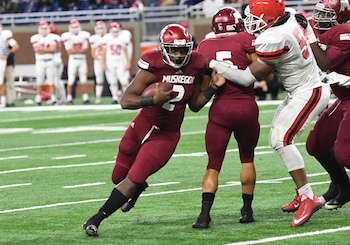
PHOTOS: (Top) St. Mary’s Ky’ren Cunningham (12) celebrates his game-winning touchdown. (Middle) Muskegon’s La’darius Jefferson breaks around his blocker Saturday.