

Drive for Detroit: Week 11 in Review
November 10, 2014
By Geoff Kimmerly
Second Half editor
A total of 16 MHSAA football teams in Divisions 1-5 entered the postseason with playoff-point averages above 100 – an impressive number indicating those teams not only had strong records, but played plenty of tough competition as well.
Three of those 16 teams lost their playoff openers, joined by eight more over the weekend as more of the top achievers during the regular season were overtaken by those raising their games with only a few more to play.
The top playoff-point teams in Division 3 (DeWitt) and Division 5 (Marine City) both suffered their first and only losses this season, and 10 more undefeated teams saw their seasons end with lone defeats of the fall.
Read on to see some of the key results that whittled the playoff field to 68 that will play in 11-player Regional Finals and 8-player Semifinals this week.
DIVISION 1
Clinton Township Chippewa Valley 28, Macomb Dakota 27
This has been anticipated as a top Macomb County matchup for a few years – but instead, Dakota had beaten the Big Reds (8-3) in 16 straight dating back to 2004 and including six times in the playoffs. Dakota (8-3) had beaten Chippewa Valley 42-21 in Week 2 and in the playoffs both of the last two seasons. Junior Stefan Clairborne blocked a late extra-point attempt to highlight a game-changing special teams performance. Click for more from the Detroit News.
Also noted:
Clarkston 23, Lapeer 20 – The reigning champion Wolves (11-0) survived the third three-point game of their 24-game winning streak, handing Lapeer (10-1) the only loss of its inaugural season.
Hudsonville 37, Rockford 15 – The Eagles (7-4) avenged their one-point Week 4 loss to Rockford (8-3), and then some, to claim a second-straight District title.
Detroit Cass Tech 28, Dearborn Fordson 21 – One of these had to fall for the first time this season, and the Technicians (11-0) hung on to claim their fifth straight District championship while ending the best season for Fordson (10-1) since 2008.
DIVISION 2
Muskegon Mona Shores 41, Midland Dow 14
In what seemed like an instant, this one belonged to Mona Shores. The Sailors (10-1) jumped out to a 21-0 lead in handing Dow (10-1) its lone loss this season. Mona Shores quarterback Tyree Jackson was at the center of the offensive effort as usual, but this time on the ground with three rushing touchdowns. Dow hadn’t given up more than 21 points in a game. Click for more from the Muskegon Chronicle.
Also noted:
Farmington Hills Harrison 10, Walled Lake Western 9 (OT) – These former longtime rivals hadn’t played each other since 2001 and battled to 3-3 before Harrison (9-2) prevailed in part by blocking an extra-point attempt by Western (9-2).
Southfield 14, Oak Park 13 – The Bluejays (8-3) won a rematch of these teams' 2012 District Final, which was won by Oak Park (8-3) also close, 19-12.
Wyandotte Roosevelt 28, Brownstown Woodhaven 21 – Roosevelt (9-2) will play this weekend for its fourth straight season of at least 10 wins, but this time ended the best ever for Woodhaven (10-1) by handing the Warriors their only loss.
DIVISION 3
Mason 30, DeWitt 14
Few gave Mason (8-3) much chance against the reigning Division 3 runner-up Panthers (10-1), who entered the postseason with the highest playoff-point average in this division. But the Bulldogs, who entered the season with an experienced group of playmakers, have improved significantly around them after opening 1-3. DeWitt won their first meeting 25-10 in Week 3, but Mason has clamped down particularly on defense in earning this first Regional Final berth since 1995. Click for more from the Lansing State Journal.
Also noted:
Petoskey 20, Mount Pleasant 14 – The Northmen (9-2) earned their first Regional Final berth since 1998 by handing to Oilers (7-4) their second loss this season by six or fewer points.
Zeeland West 30, Stevensville Lakeshore 28 – Most of Friday had to be a little scary for the reigning champion Dux (11-0), who had beaten Lakeshore (8-3) in last season’s Semifinal by a much more comfortable 42-7.
New Boston Huron 44, Trenton 27 – The Chiefs (10-1) set a team record for wins and doubled last season’s total in beating Trenton (7-4) for their first District title.
DIVISION 4
Lansing Sexton 41, Saginaw Swan Valley 20
Swan Valley running back Alex Grace finished one of the most incredible three-year varsity careers in MHSAA football history with 198 more rushing yards and three touchdowns to give him 2,426 and 36 this season and 7,551 yards and 99 rushing touchdowns for his career. His career yards rank third all-time and his TDs are second. But every time Grace made a play Friday – offensively and defensively as well – the Big Reds (11-0) seemed to respond. Sexton senior Ja’Von Wray ran for 235 yards and five touchdowns as his team scored more than the Vikings (10-1) had given up in any two games combined this fall. Click for more from the Lansing State Journal.
Also noted:
Whitehall 41, Comstock Park 36 – Some termed the Vikings’ win “miraculous” as Whitehall (9-2) came back from 23 points down to win their first District title since 2003 and end the Panthers’ run at 6-5.
Edwardsburg 34, Vicksburg 6 – The Eddies (10-1) avenged a 16-14 loss to Vicksburg (8-3) in Week 3 to push into double-figure wins for the first time since 2010 and second time in program history; Vicksburg’s record was its best since 1993.
Eaton Rapids 20, Battle Creek Harper Creek 10 – The Greyhounds (8-3) have gone from never making the playoffs before 2013 to making their second Regional Final in a row, this time over near-annual playoff team Harper Creek (6-5).
DIVISION 5
Almont 35, Marine City 7
The run to the 2011 Semifinals makes it tough to call this the best win in Almont history – but it has to be a close second to that season's Regional Final win over Jackson Lumen Christi. Marine City was the reigning Division 4 champion, in Division 5 for this fall’s playoffs, and 23-1 over the last two seasons with more than 1,000 points scored during that time. Almont held the Mariners (10-1) to their fewest points since the 2011 Division 4 Final and has given up a meager 56 points this season. The Raiders, meanwhile, ran for 294 yards and scored the most points Marine City had given up since last season’s championship game at Ford Field. Click for more from the Port Huron Times Herald.
Also noted:
Reed City 22, Remus Chippewa Hills 21 – For the second straight week, Reed City (9-2) faced a rematch against a league rival, and Chippewa Hills (8-3) made this one much closer than the Coyotes’ 60-32 win in Week 8.
Flint Powers Catholic 19, Frankenmuth 15 – The Chargers (8-3) held on, on the road, in a rematch of the 2012 District Final in which they beat Frankenmuth (9-2) 34-0.
River Rouge 42, Ida 14 – The Panthers (10-1) reached double figure wins for the second time in three seasons and second time ever in ending the longest run for Ida (8-3) since 1990.
DIVISION 6
Madison Heights Madison 32, Flint Beecher 6
Madison eliminated Beecher (10-1) for the second straight season to earn its fourth Regional Final berth in six seasons – and the opportunity to end Ithaca’s 11-player nation-best 67-game winning streak this week. Madison (9-2) scored 20 unanswered points in the second half to pull away while grounding a Beecher offense that hadn’t been held to single digits since 2012. Click for more from the Royal Oak Daily Tribune.
Also noted:
Leroy Pine River 34, Sanford Meridian 27 – Pine River (8-3) won a combined 11 games from 2009-13 and had never won a playoff game before two weeks ago; Meridian (8-3) did finish with its best record since 2009.
Watervliet 28, Schoolcraft 21 – Last season Watervliet won 10 straight before falling to Schoolcraft 28-26 in the District Final; this time Watervliet (10-1) has won 10 straight since falling opening night and avenged that loss to the Eagles (7-4).
Monroe St. Mary Catholic Central 50, Clinton 15 – The Falcons (10-1) won their sixth District title in seven seasons against last year’s Finals runner-up Clinton (10-1), which is 32-3 over the last three seasons.
DIVISION 7
Saginaw Michigan Lutheran Seminary 46, Whittemore-Prescott 0
Offensive firepower has gotten more attention during Seminary’s best season since 1994 – and Seminary scored 40 or more points for the seventh time this season. But Seminary (10-1) also has five shutouts and has given up only 96 points, particularly impressive this time given Whittemore-Prescott hadn’t been shut out since 2010. Whittemore-Prescott (10-1) also had beaten all of its opponents by at least 10 points this fall in earning its best record since 2002. Click for more from the Saginaw News.
Also noted:
Ishpeming 20, Iron River West Iron County 7 – It had been nearly a year since a team had given Ishpeming (10-0) this much of a challenge, a positive for the Wykons (9-2) in falling to the Hematites in the District Final for the second straight season.
Pewamo-Westphalia 34, Hudson 27 – The Pirates (9-2) eliminated a league champion for the second straight week, this time Lenawee County Athletic Association power Hudson (9-2).
Bridgman 17, Cassopolis 14 – The Bees (8-2) set a program record for wins in claiming their first District title and ending Cassopolis at 7-4 for the second straight season.
DIVISION 8
Harbor Beach 39, Waterford Our Lady 21
The Pirates (11-0) are 46-4 over their last 50 games and earned their fourth straight District title against their toughest opponent this fall to date. Harbor Beach had given up only 31 points total entering Saturday’s tilt. But despite allowing a few more, the defense also came through with two touchdown returns off turnovers. Our Lady finished 9-2, one win better than last season. Click for more from the Oakland Press.
Also noted:
Munising 24, St. Ignace 6 – The Mustangs (10-1) have double-digit wins for the first time since 1980 and another highlight after handing St. Ignace (10-1) its lone loss.
Beal City 53, Johannesburg-Lewiston 27 – The Aggies (9-2) have topped 50 points in both of their playoff games and ended the season for Johannesburg-Lewiston (9-2) for the third time in five years.
Morenci 42, Ottawa Lake Whiteford 22 – The Bulldogs (10-1) continued their best run since reaching the 1996 Finals by finishing a sweep of Tri-County Conference rival Whiteford (7-4).
8-PLAYER
Cedarville 28, Rapid River 0
The Trojans (10-1) will play in their first 8-player Semifinal after eliminating rival Rapid River (10-1), last season’s 8-player runner-up and the Bridge Football Alliance champion ahead of Cedarville the last two seasons. Cedarville fell just short against the Rockets, losing 20-19 in Week 6, but came on big in the rematch with a touchdown in each quarter. Click for more from the Escanaba Daily Press.
Also noted:
Deckerville 72, Kingston 22 – Deckerville (9-2) won its second Regional title in three seasons by beating Kingston (7-4) a second time this fall; the Eagles won their first meeting only 14-8 in Week 2.
Peck 56, Morrice 8 – The Pirates (11-0) set up a Semifinal rematch with Lawrence by ending the first 8-player season for Morrice at a solid 6-5 – the Orioles’ best record since 2006.
Lawrence 50, Battle Creek St. Philip 14 – Lawrence (11-0) beat St. Philip (9-2) for the second time in three weeks and by scoring at least 50 points for the 10th time this fall.
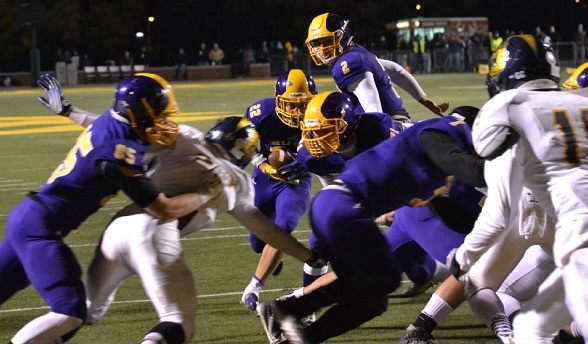
PHOTO: Warren DeLaSalle, on offense, downed Detroit East English 21-14 in their Division 2 District Final. (Photo courtesy of Detroit Public School League.)
Drive for Detroit: 11-Player Finals Preview
November 21, 2017
By Geoff Kimmerly
Second Half editor
This weekend’s MHSAA 11-Player Football Finals are teeming with stories just waiting to be told by all 16 teams as Friday and Saturday’s games play out.
Edwardsburg, Saginaw Swan Valley and West Bloomfield will be making the championship game trip for the first time, and Livonia Franklin will play in its first title game since the first year of the MHSAA playoffs. Ottawa Lake Whiteford is making its second trip ever after finishing runner-up in Division 8 a year ago, while Saugatuck also is seeking its first title and Muskegon is back as well after missing out on winning Division 3 in the closing seconds in 2016.
Speaking of the Big Reds, the state’s winningest program takes on the all-time winningest coach and the program with the most MHSAA football titles in Farmington Hills Harrison. Oakland Activities Association Red rivals West Bloomfield and Clarkston meet in a rematch, but this time with the Division 1 title on the line. Like Clarkston, Warren DeLaSalle and Saginaw Nouvel are seeking to reclaim glory they enjoyed earlier this decade. Grand Rapids Catholic Central, Grand Rapids West Catholic and Pewamo-Westphalia are all aiming to repeat, West Catholic for the fifth straight season. Jackson Lumen Christi is hoping to add a second straight championship as well, but faces powerhouse Ithaca in what might be the game of the weekend.
See below for a look at all of the finalists taking the field, powered by MI Student Aid. Tickets cost $10 and are good for all four games on one day; cash only will be accepted at the door. Click for a full schedule. The MHSAA Playoffs are sponsored by the Michigan Army National Guard.
The first two Friday and Saturday games will be broadcast live on FOX Sports Detroit’s primary and PLUS channels (check cable/satellite box listings for your specific channel) with the third game both days and the fourth game Saturday available live on FOX Sports Detroit PLUS only. Friday night’s Division 4 Final will be broadcast tape delayed at 11:30 p.m. on PLUS but can be viewed live on FOXSportsDetroit.com and on the FOX Sports Go! app. The games will also re-air Sunday on the following schedule: Division 8 – 10 a.m., Division 2 – Noon, Division 6 – 2 p.m., Division 4 – 4 p.m., Division 7 – 6 p.m., Division 1 – 8 p.m., Division 5 – 10 p.m. and Division 3 – Midnight. Audio broadcasts will be available on the MHSAA Network website live both days.
Rankings below were voted on by The Associated Press’ media panel – teams that were ranked in different divisions for the regular season are noted. Statistics are current, also unless noted.
Division 1
 WEST BLOOMFIELD
Record: 11-2, honorable mention
Coach: Ron Bellamy, eighth season (47-34)
League finish: Tied for first in Oakland Activities Association Red.
Championship history: Has never played in an MHSAA Final.
Best wins: 9-7 over No. 3 Detroit Cass Tech in the Semifinal, 28-25 over No. 1 Utica Eisenhower in the Regional Final, 41-7 over No. 6 Waterford Mott in the District Final, 17-16 over No. 8 Rochester Adams, 37-15 over honorable mention Clarkston, 49-26 over Division 2 No. 10 Birmingham Groves.
Players to watch: QB Bryce Veasley, 6-4/225 sr. (3,273 yards/24 TD passing, 467 yards/14 TD rushing); WR Taj Mustapha, 6-0/185, sr. (816 yards/5 TD receiving); RB/DB Collin Heard, 5-10/180 sr. (994 yards/11 TD rushing); WR AJ Abbott, 6-2/190 sr. (1,043 yards/8 TD receiving).
Outlook: West Bloomfield is enjoying its finest season even as it’s had to navigate an OAA Red and playoffs filled with ranked opponents – and now must see a league rival again in the championship game. The Lakers started this season 0-2 and avenged that second defeat, to Bloomfield Hills, in the Pre-District. Veasley is committed to sign with Bowling Green and is surrounded by playmakers, including as well 6-2 junior receiver Tre Mosley (828 yards/10 TDs receiving). But the defense has been arguably the most significant difference maker in the playoffs, holding four opponents to a combined 45 points despite three of them being ranked among the top six teams in Division 1 – including reigning champion Cass Tech. West Bloomfield also can rely on the sharp kicking of senior Nick O’Shea, who has made 55 of 57 extra point tries and 12 of 16 field goal attempts including three for all of the team’s points last week.
CLARKSTON
Record: 11-2, honorable mention
Coach: Kurt Richardson, 31st season (244-86)
League finish: Third in OAA Red.
Championship history: Division 1 champion 2014 and 2013.
Best wins: 29-22 over honorable mention Holland West Ottawa in the Regional Final, 28-0 over No. 7 Davison in the District Final, 27-7 over Detroit Catholic Central in the Semifinal, 23-13 over Farmington Hills Harrison (Division 2 honorable mention for the regular season).
Players to watch: QB Nathan Uballe, 5-10/165 sr. (1,225 yards/10 TD passing); RB/DB Michael Fluegel, 6-1/175 sr. (814/9 TD rushing); RB Joshua Cantu, 5-9/176 sr. (1,478 yards/23 TD rushing); OG Noah Nicklin, 6-4/290 sr. (Uballe's statistics do not include Semifinal totals.)
Outlook: The Wolves are headed back to Ford Field after two years away and can even get a little bit of vengeance after falling to West Bloomfield in league play earlier this season. The Lakers were the only opponent to score more than 22 on Clarkston, and the defense has shined especially during the playoffs in giving up 36 points over four games. Fluegel and Cantu are the latest in a long line of strong Wolves backs – they combined for 200 yards rushing in the Semifinal win over Detroit Catholic Central, last season’s Division 1 runner-up. Aside from West Bloomfield, the only other loss this season came by seven to Rochester Adams, which was ranked No. 8 in Division 1 heading into the postseason.
Division 2
 WARREN DELASALLE
Record: 11-2, No. 6
Coach: Mike Giannone, second season (15-7)
League finish: First in Detroit Catholic League Central.
Championship history: Division 2 champion 2014, two runner-up finishes.
Best wins: 14-13 over No. 1 Detroit Martin Luther King in the Semifinal, 14-7 over No. 8 Oak Park in the Regional Final, 50-0 over honorable mention Port Huron Northern in the District Final, 46-0 over honorable mention Ferndale in the Pre-District, 35-14 and 20-6 over Detroit Catholic Central, 52-14 over Division 3 honorable mention Dearborn Divine Child.
Players to watch: QB Luke Pfromm, 6-6/225 sr. (1,546 yards/13 TD passing, 11 TD rushing); RB Cordell Tannyhill III, 5-9/205 sr. (873 yards/6 TD rushing); WR/DB Jacob Badalamenti, 5-9/150 sr. (546 yards/6 TD receiving); LB Devin Campbell, 6-1/190 jr. (82 tackles).
Outlook: The Pilots made a big wave by eliminating two-time reigning champion King in the Semifinal, but DeLaSalle likely wasn’t receiving enough credit for winning a Catholic League Central that produced three playoff teams. The only losses this fall were opening weekend against Lowell and by 10 to Pennsylvania power Erie Cathedral – and aside from that pair, no other opponent has scored more than 14 points. Including a pair of wins over eventual Division 1 semifinalist DCC, DeLaSalle has given up only 40 points over its last six games. Junior defensive backs Jacob Dobbs and Josh DeBerry are among additional playmakers on that side of the ball; Dobbs has 80 tackles, five sacks and four fumble recoveries and DeBerry has six interceptions. Giannone is 173-58 over 20 seasons coaching overall and led Macomb Dakota to Division 1 titles in 2006 and 2007.
LIVONIA FRANKLIN
Record: 11-2, unranked
Coach: Chris Kelbert, 17th season (87-83)
League finish: Second in Kensington Lakes Activities Association Gold.
Championship history: Class A champion 1975.
Best wins: 20-0 over No. 9 Grand Rapids Forest Hills Central in the Semifinal, 35-28 over No. 5 Walled Lake Western in the Pre-District, 35-21 over Livonia Stevenson, 21-19 over Livonia Churchill in the District Final, 31-29 over Flushing in the Regional Final.
Players to watch: QB Jacob Kelbert, 6-4/190 sr. (1,101 yards/9 TD passing); RB Isaac Moore, 6-0/201 sr. (1,598 yards/14 TD rushing); RB Julius Simmons, 6-0/180 jr. (870 yards/12 TD rushing); LB Jacob Mass, 6-4/215 sr. (111 tackles). (Kelbert/Mass statistics do not include Semifinals).
Outlook: Franklin was the first Class A champion in MHSAA football history and broke through for another title opportunity last week in its second trip to the Semifinals over the last three seasons. This fall also has included losses to neighbors Stevenson and Churchill during a 2-2 start, and then the avenging of both defeats – and the Patriots also have had to gut out a series of close playoff wins to make it this far. Forest Hills Central was averaging nearly 38 points per game before Franklin’s shutout last week, and a strong rushing game helps that defense – Jacob Kelbert threw only six passes in the Semifinal with Moore and Simmons carrying the load.
Division 3
MUSKEGON
 Record: 13-0, No. 1
Coach: Shane Fairfield, eighth season (86-18)
League finish: First in Ottawa-Kent Conference Black.
Championship history: Five MHSAA titles (most recent 2008), four runner-up finishes.
Best wins: 42-0 over No. 4 Battle Creek Harper Creek in the Semifinal, 49-0 over No. 5 DeWitt in the Regional Final, 55-20 over honorable mention Zeeland West in the District Final, 35-24 over Division 2 No. 4 Muskegon Mona Shores.
Players to watch: QB La’darius Jefferson, 6-2/215 sr. (1,850 yards/29 TD rushing, 1,205 yards/21 TD passing); SL/DB Clinton Jefferson, Jr., 6-1/180 sr. (463 yards/10 TD receiving, 786 yards/10 TD rushing); RB/LB Lonnie Clark, Jr., 5-7/165 sr. (877 yards/13 TD rushing); OT A.J. Reed, Jr., 6-6/215/sr. (Clinton Jefferson’s rushing yardage does not include Semifinal.)
Outlook: Muskegon’s season has been memorable, to say the least. After seeing last season’s Division 3 title slip away on an Orchard Lake St. Mary’s score with four seconds left in the Final, the Big Reds are back after rolling through most of the first 13 games. This time they’ve got the fifth highest-scoring offense in MHSAA football history and a defense that hasn’t given up a point in two weeks and only 78 all season. Quarterback La’darius Jefferson may be the toughest player to stop in all of Michigan, and he’s running behind a line that averages 6-foot-3 and 297 pounds led by Penn State recruit Reed. Only Mona Shores in Week 8 stayed within striking distance, and another win would give the Big Reds one of the most impressive seasons in this state in some time.
FARMINGTON HILLS HARRISON
Record: 10-3, honorable mention*
Coach: John Herrington, 48th season (435-106-1)
League finish: Tied for first in OAA White.
Championship history: Thirteen MHSAA titles (most recent 2010), four runner-up finishes.
Best wins: 21-0 over Riverview in the Semifinal, 34-21 over honorable mention Linden in the Regional Final, 17-14 over Division 2 No. 8 Oak Park.
Players to watch: LB/TE Ovie Oghoufo, 6-4/215 sr. (479 yards/5 TD receiving); WB/DB Roderick Heard, 6-0/160 jr. (1,477 yards/23 TD rushing); QB/DB Noah Hendricks, 6-3/195 sr. (1,205 yards/13 TD passing); OL/DL Chris Rexroth, 6-6/275 sr. (Oghoufo and Hendricks’ statistics do not include Semifinals.)
Outlook: Just when it looks like Muskegon might be unbeatable, enter Harrison with the best narrative possible going up against such an opponent. This is the second-to-last season of Hawks football before the school closes, and earlier this fall Herrington become the winningest coach in Michigan high school history. This championship game appearance will give Harrison a record 18 – it’s currently tied with Detroit Catholic Central atop the list – and the Hawks also have the most championships in MHSAA history at 13. But this team has a lot more going for it than a potential storybook ending. Oghoufo will continue his career at Notre Dame and Heard is making a lot of noise carrying the offensive load behind a sizable line. (*Harrison was part of The Associated Press’ Division 2 for the regular season.)
Division 4
 GRAND RAPIDS CATHOLIC CENTRAL
Record: 13-0, No. 1
Coach: Todd Kolster, sixth season (64-11)
League finish: First in O-K Blue.
Championship history: Three MHSAA titles (most recent 2016), two runner-up finishes.
Best wins: 24-0 over No. 10 Escanaba in the Semifinal, 45-34 over No. 2 Wyoming Kelloggsville in the District Final, 32-26 over Hudsonville Unity Christian in the Pre-District, 35-33 over Division 5 No. 2 Grand Rapids West Catholic, 57-50 over Comstock Park.
Players to watch: QB Jack Bowen, 6-1/180 sr. (1,629 yards/20 TD passing); WR/OLB Nathan Trudeau, 6-1/170 sr. (532 yards/6 TD receiving); RB Nolan Fugate, 6-1/210 sr. (2,650 yards/32 TD rushing), OL/DL Jalen Mayfield, 6-6/270 sr.
Outlook: The reigning Division 4 champion has lost only one game in two years – to reigning Division 5 champ West Catholic midway through 2016 – and survived some close calls including two to start these playoffs. But the Cougars keep coming up big with Fugate in particular stacking up yardage – his rushing total stands 17th on the single-season list already – as he continues to run behind a line featuring University of Michigan recruit Mayfield. Bowen also started as GRCC won last season’s championship, and he’s capable of bringing some balance to the offense when needed – although again, Fugate has been one of his top targets with five scoring passes.
EDWARDSBURG
Record: 12-1, No. 6 in Division 3*
Coach: Kevin Bartz, 23rd season (159-73)
League finish: First in Wolverine Conference.
Championship history: Has never played in an MHSAA Final.
Best wins: 32-21 over River Rouge (No. 7 in Division 3 for the regular season) in the Semifinal, 52-30 over Lansing Sexton in the Regional Final, 30-12 over No. 8 Three Rivers in the District Final, 44-20 over honorable mention Plainwell.
Players to watch: RB/DB Nick Bradley, 5-9/160 sr. (1,313 yards/12 TD rushing, 3 TD receiving); RB/LB Chase Sager, 6-0/190 jr. (780 yards/16 TD rushing); RB/DE Kyle Shrider, 6-2/215 sr. (806 yards/11 TD rushing); RB/DB Caden Goggins, 5-8/160 jr. (670 yards/11 TD rushing).
Outlook: In its fourth straight season of double-digit wins and fifth over the last eight years, Edwardsburg finally broke through to make its first MHSAA championship game. The Eddies long have been dominant in the southwestern corner of the Lower Peninsula; in fact, they lost their first league game this season since 2012 but avenged that defeat to Three Rivers a month later. Their charged-up running attack broke 600 points for the first time, regardless that it’s no secret what’s coming – Edwardsburg had attempted only 31 passes heading into last weekend. (*Edwardsburg was part of Division 3 for The Associated Press’ rankings during the regular season.)
Division 5
 SAGINAW SWAN VALLEY
Record: 12-1, No. 4
Coach: Kevin Gavenda, second season (18-6)
League finish: First in Tri-Valley Conference Central.
Championship history: Has never played in an MHSAA Final.
Best wins: 29-14 over T-No. 8 Reed City in the Semifinal, 48-14 over T-No. 8 Muskegon Oakridge in the Regional Final, 36-19 over Division 4 No. 10 Alma.
Players to watch: QB/S Alex Fries, 6-2/180 jr. (1,532 yards/21 TD passing, 486 yards/8 TD rushing); RB/DB Emmett Boehler, 5-8/195 sr. (1,553 yards/16 TD rushing); DL/OL Cameron Toth, 6-1/235 sr. (88 tackles/14 sacks); RB/LB Chase Mendoza, 5-8/195 jr. (521 yards/9 TD rushing).
Outlook: Swan Valley is making its first appearance at the Finals after tying the program’s single-season wins record. The Vikings are finally healthy just in time as well after playing without Boehler and leading receiver/defensive back Terryon Liddell at times during the playoffs. They haven’t lost since opening weekend to Zeeland East, and they haven’t let an opponent within seven points since Week 4. Junior linebacker Matt Pike (135 tackles) anchors the middle of a defense that has given up more than 14 points in a game only once since Week 2.
GRAND RAPIDS WEST CATHOLIC
Record: 11-2, No. 2
Coach: Joe Hyland, second season (23-4)
League finish: Second in O-K Blue.
Championship history: Five MHSAA titles (most recent 2016), two runner-up finishes.
Best wins: 25-21 over No. 1 Frankenmuth in the Semifinal, 28-26 over No. 3 Portland in the Regional Final, 17-6 over Division 3 honorable mention Zeeland West.
Players to watch: QB Gaetano Vallone, 5-10/170 sr. (2,480 yards/29 TD passing, 867 yards/14 TD rushing); WR/DB Nick Dorato, 5-11/165 jr. (816 yards/13 TD receiving); RB/DB Alex Fortier, 5-10/165 sr. (741 yards/3 TD rushing); LB/RB Zack Lee, 6-0/210 sr. (728 yards/13 TD rushing). (Fortier’s stats do not include Semifinal totals.)
Outlook: West Catholic has tested itself against the best as it goes for a fifth straight Division 5 championship. In addition to eliminating two of the other major favorites the last two weeks, West Catholic took a two-point loss from reigning Division 4 champ Grand Rapids Catholic Central and a three-pointer from 2016 Division 6 winner Jackson Lumen Christi. Vallone will be capping his career with a third championship game appearance, while a number of others including senior defensive back Connor Bolthouse have contributed last season or before that as well. Senior Liam Putz also will be kicking in his third Final and has been one of the state’s best.
Division 6
 ITHACA
Record: 13-0, No. 1
Coach: Terry Hessbrook, 14th season (152-19)
League finish: First in Tri-Valley Conference West
Championship history: Five MHSAA titles (most recent 2015), one runner-up finish.
Best wins: 27-0 over Traverse City St. Francis (No. 2 in Division 7 for regular season) in the Semifinal, 33-23 over No. 2 Montague in the Regional Final, 38-14 over Division 5 No. 8 Clare.
Players to watch: QB/FS Joey Bentley, 6-2/185 sr. (1,904 yards/27 TD passing, 1,567 yards/26 TD rushing); WR/DB/K Adam Culp, 6-3/175 sr. (497 yards/10 TD receiving, 96 XP/8 FG); WR/OLB Seth Davis, 5-10/170 sr. (576 yards/5 TD receiving, 79 tackles/6 interceptions). LB/RB Zach Hessbrook, 6-2/215 sr. (154 tackles).
Outlook: What Ithaca has accomplished over the last nine years is astounding. The Yellowjackets haven’t lost a regular season game since 2009, and they are a combined 118-4 over that span. They made six straight Finals before falling in the Regional championship game a year ago, but they’re back trying to win a sixth MHSAA title in eight seasons. They’re doing it with another star quarterback in Bentley, who will play at least Division II college football as he follows a long line of Ithaca signal-callers who have gone on to the next level. The Yellowjackets have outscored four playoff opponents by a combined 159-30, and Montague with 23 points was the only opponent this year to score more than 16.
JACKSON LUMEN CHRISTI
Record: 11-1, No. 3
Coach: Herb Brogan, 38th season (340-79)
League finish: Second in Interstate 8 Athletic Conference.
Championship history: Nine MHSAA titles (most recent 2016), two runner-up finishes.
Best wins: 44-12 over No. 8 Warren Michigan Collegiate in the Semifinal, 44-22 over No. 4 Watervliet in the Regional Final, 27-24 over Division 5 No. 2 Grand Rapids West Catholic.
Players to watch: RB Sebastion Toland, 5-10/170 sr. (1,944 yards/22 TD rushing); QB Troy Kutcha 6-2/200 sr. (1,287 yards/16 TD passing); FB/LB Kyle Minder, 6-1/210 sr. (809 yards/17 TD rushing), DB Bobby Willis, 6-0/175 jr.
Outlook: Lumen Christi is seeking to repeat as champion led by the fifth-winningest coach in MHSAA history and a rushing attack that has gained more than 3,300 yards a year after graduating a 2,600-yard rusher. That Toland and Minder-led ground game will be especially key in keeping Ithaca’s high-powered offense off the field, and as the Titans’ defense plays perhaps the most important role in the repeat attempt. Lumen Christi hasn’t allowed more than 24 points in a game despite facing a few of the state’s most explosive offenses this fall; Watervliet, for example, was averaging 52 per game before scoring only 22 two weeks ago. The only loss was by a point in league play to Battle Creek Harper Creek, which finished 12-1 after falling in Division 3 last week.
Division 7
 PEWAMO-WESTPHALIA
Record: 12-1, No. 3
Coach: Jeremy Miller, fifth season (59-7)
League finish: First in Central Michigan Athletic Conference
Championship history: Division 7 champion 2016, two runner-up finishes.
Best wins: 51-8 over Lake City (No. 9 in Division 6 regular season) in the Semifinal, 34-0 over No. 4 Elkton-Pigeon-Bay Port Laker in the Regional Final, 35-14 over No. 1 New Lothrop in the District Final, 32-11 over Laingsburg.
Players to watch: QB/DE Jimmy Lehman, 6-4/215 sr. (1,569 yards/19 TD passing, 637 yards/15 TD rushing); RB/LB Bryce Thelen, 6-0/180 sr. (517 yards/10 TD rushing, 520 yards/6 TD receiving); RB/LB Hunter Wirth, 5-9/175 soph. (641 yards/8 TD rushing); OL/DL Isaiah Schafer, 6-2/265 sr. (Wirth’s rushing and Thelen’s receiving yards do not including Semifinal totals.)
Outlook: In some ways, P-W looks a lot like last year’s champion – and in some ways it’s a little different and tougher to stop. Any surprise that the Pirates are back at the Finals after graduating Michigan high school’s second all-time leading rusher Jared Smith has worn off. The Pirates are still running hard, led by the dynamic Thelen and Wirth. But they also are relying on one of their finest dual threat quarterbacks in some time in Lehman, who threw for 127 yards and two scores in last year’s championship game on eight attempts. The lone loss this fall – and over the last two seasons – was by seven on opening night to Monroe St. Mary Catholic Central, and P-W eliminated three of the most serious contenders by big scores the last three weeks. No opponent since opening night has scored more than 14 points, with Lehman actually earning all-state on that side of the ball as an end. Junior Alec Thelen (along with Lehman and honorable mentions Bryce Thelen and Schafer) also earned all-state recognition as the second-team kicker.
SAUGATUCK
Record: 10-3, unranked
Coach: Bill Dunn, 15th season (102-51)
League finish: Second in Southwestern Athletic Conference Lakeshore
Championship history: Division 8 runner-up 2010.
Best wins: 14-7 over Madison Heights Madison (No. 6 in Division 6 for regular season) in the Semifinal, 7-6 over No. 7 Cassopolis in the Regional Final, 14-8 over Vermontville Maple Valley in the District Final.
Players to watch: RB/DB Bradley Dunn, 6-0/165 jr. (956 yards/10 TD rushing, 594 yards/9 TD receiving); QB/DB Jackson Shriver, 6-4/180 sr. (1,147 yards/15 TD passing, 251 yards/6 TD rushing); RB/LB Jacob Stewart, 5-7/155 jr. (684 yards/5 TD rushing); LB/OL Reece Schreckengust, 6-1/205 sr. (132 tackles)
Outlook: Similar to P-W, Saugatuck also graduated one of the leading rushers in state history in the spring, Blake Dunn, and has taken the next steps with some new contributors helping carry the load. Bradley Dunn – Blake’s brother – and Schreckengust both made the all-state first team as Saugatuck tied its program record for wins in a season. Character and perseverance have shown through; three victories during the playoffs have been by seven points or fewer, and the Indians bounced back to make this run after seeing their league title hopes fade with a Week 9 loss. The defense has been especially impressive during this Ford Field run, giving up only 42 points over four games. Bradley Dunn is dangerous on special teams as well, with two punt return touchdowns.
Division 8
 SAGINAW NOUVEL
Record: 13-0, No. 4
Coach: Mike Boyd, 18th season (168-42)
League finish: Independent
Championship history: Three MHSAA titles (most recent 2011), two runner-up finishes.
Best wins: 17-14 over No. 9 Iron River West Iron County in the Semifinal, 27-26 over No. 6 Harbor Beach in the District Final, 35-0 over honorable mention Clarkston Everest Collegiate.
Players to watch: QB/CB Tate Hausbeck, 6-3/204 sr. (2,446 yards/26 TD passing, 643 yards/14 TD rushing); WR/OLB Kenneth Kujawa, 5-8/156 sr. (601 yards/7 TD receiving); WR/OLB Peter Snyder, 6-4/198 sr. (692 yards/7 TD receiving); ILB/RB Alex Wrobel, 5-11/211, sr.
Outlook: Nouvel has survived two nail-biters during the playoffs to get back to its first championship game since winning Division 7 under Boyd in 2011. Hausbeck is the leading passer and rusher for an offense that has more than doubled its scoring from a year ago when it reached the District Finals – six players have scored at least six touchdowns. Nouvel outlasted a physical West Iron front last week and 6-2, 274-pound senior Kyle Allen could be especially key again as a starting tackle on both sides of the ball. The Panthers have been strong defensively, giving up more than 14 points only three times. Hausbeck and Wrobel (at linebacker) both made the all-state first team.
OTTAWA LAKE WHITEFORD
Record: 13-0, No. 2
Coach: Jason Mensing, sixth season (60-13)
League finish: First in Tri-County Conference
Championship history: Division 8 runner-up 2016.
Best wins: 50-21 over No. 3 Mendon in the Semifinal, 60-20 over honorable mention Clarkston Everest Collegiate in the Regional Final, 52-21 over Clinton, 51-8 over Morenci.
Players to watch: QB Thomas Eitniear, 5-7/160 sr. (1,260 yards/17 TD passing, 790 yards/13 TD rushing); LB/WB Logan Murphy, 6-0/190 jr. (1,747 yards/24 TD rushing, 4 sacks); LB/WB Zach Bertz, 5-8/170 sr. (706 yards/21 TD rushing, 58 tackles); OT/DT Lucas Tesznar, 6-5/285, sr.
Outlook: Despite graduating its two leading rushers from last season’s first-time MHSAA finalist, Whiteford has stormed back behind an offense that’s put up 695 points – which already ranks fourth all-time in MHSAA history. Eitniear also was the quarterback last fall and has led the two highest-scoring teams in program history. The 50 put up last week tied the most defensively well-reputed Mendon had given up since 1977. And don’t forget Whiteford’s defense; the Bobcats haven’t given up more than 22 points in a game all season, with junior defensive back Ty Eitniear (seven interceptions) among playmakers on that side of the ball. Another to watch is leading receiver Bradyn Clark-Gilmore: the junior has 677 yards and 10 touchdowns through the air and averages 29.4 yards per catch. Tesznar made the all-state first team, while Murphy made the second and Thomas Eitniear earned honorable mention.