

Drive for Detroit: Week 2 in Review
September 5, 2017
By Geoff Kimmerly
Second Half editor
We're only two weeks into this football season, and of course there has been plenty to talk about.
But our 8-player football divisions experienced a season's worth of highlights over this Labor Day weekend.
See below for Week 2's most significant results from every region of the state in 11-player football, but also check out the 8-player highlights – which include the first win ever for one team and the first loss in forever for another.
Bay & Thumb
Bay City Central 22, Midland Dow 21 (OT)
After falling a score short in its opener against Frankenmuth, Bay City Central (1-1) blocked an extra point and then got the game-winner from kicker Austin Welter to beat Dow (1-1) for the first time since 2011 – and after falling to the Chargers both during the regular season and playoffs in 2016. Those two losses last year were by 20 and then 31 points, respectively. Click for more from the Bay City Times.
Also noted:
Algonac 28, Almont 7 – After opening with a big loss to Marine City, the Muskrats (1-1) got a needed bounce-back against another of the Port Huron area’s elite in Almont (1-1).
Freeland 34, Chesaning 25 – The Falcons (2-0) kept their regular-season winning streak intact at 23 straight against an Indians that team opened with a shutout but fell to 1-1.
Flint Powers Catholic 37, Saginaw Heritage 34 (2 OT) – Andrew Simon was another kicking hero as Powers (2-0) won a second straight close game and sent the Hawks to 1-1.
Lake Fenton 21, Montrose 0 – This Genesee Area Conference Red opener was a big one to get out of the way for the reigning champ Blue Devils (1-1), with Montrose (1-1) always in the league title mix as well.
Greater Detroit
Bloomfield Hills 28, West Bloomfield 24
The “new” Bloomfield Hills burst on the scene with its first winning campaign in 2016, starting 9-0 before falling to West Bloomfield 31-14 in a Division 1 playoff opener. To finish off this avenging, however, the Black Hawks needed to drive nearly the entire field over the final two minutes. Bloomfield Hills now sits 2-0 with both wins by four points or fewer, while West Bloomfield fell to 0-2 with two losses by five points or fewer. Click for more from the Oakland Press.
Also noted:
Warren DeLaSalle 31, Grandville 0 – The Pilots (1-1) traveled to face a second straight Ottawa-Kent Conference reigning champion, landing a stunning defeat on last season’s Red co-leading Bulldogs (1-1) after falling to Lowell in Week 1.
Clarkston 17, Southfield Arts & Technology 7 – The Wolves (2-0) have given up 14 points total in two impressive wins, while Southfield A&T might be the best 0-2 team in Michigan after another close loss to a power.
Utica Eisenhower 42, Macomb Dakota 16 – Eisenhower (2-0) ran its streak in this rivalry to three straight after also ending last season for Dakota (1-1) in a District Final.
Gibraltar Carlson 42, Trenton 14 – A week after taking a giant step forward in the Downriver League race with a win over Allen Park, Trenton (1-1) fell for the second straight season to Carlson (2-0), which is coming off a 4-5 finish but won three of its final four games last fall.
Mid-Michigan
DeWitt 14, Grand Ledge 7
The combination of Grand Ledge’s sizable Week 1 win over Hudsonville, DeWitt’s loss to Grand Rapids Christian and the Comets’ victory in the first game of this quickly-building rivalry last fall makes the Panthers victory all the more impressive. DeWitt held Grand Ledge scoreless until late in the fourth quarter – and to its fewest points in a regular-season game since 2013. Click for more from the Lansing State Journal.
Also noted:
St. Johns 56, Cadillac 43 – The Redwings (1-1) especially on offense bounced back after scoring 20 in a one-point loss Week 1 to East Lansing; Cadillac (1-1) also put up its highest tally since midway through 2015.
Ionia 35, Hillsdale 14 – This could eventually come into play as Hillsdale (1-1) tries to get back to the playoffs after seeing its 15-year streak end last fall and Ionia (1-1) tries to get in for the first time since 2013.
Lansing Sexton 20, Portland 14 – This provided an exciting preview of Capital Area Activities Conference White matchups to come, as the Big Reds (2-0) are set to join annual favorite Portland (1-1) in that division next year.
Saranac 27, Fowler 21 – The Redskins are 2-0 for the first time since 2011 with a win over Fowler (1-1) also for the first time since that fall.
Northern Lower Peninsula
Traverse City St. Francis 35, Maple City Glen Lake 9
St. Francis enjoyed the debut of Glen Lake’s new artificial turf field by handing the Lakers their sixth straight loss in this rivalry. The Gladiators (2-0) ran their regular-season winning streak to 24 after also beating Glen Lake 35-9 last fall. But Glen Lake would love to repeat history – in 2016 it rebounded and won 10 of its next 11 to reach the Division 6 championship game. Click for more from the Traverse City Record-Eagle.
Also noted:
Rogers City 14, Indian River Inland Lakes 7 – Inland Lakes (1-1) got to celebrate last week its first win since 2015, but Rogers City (1-1) ended the fun with its first victory since Week 6 a year ago.
Alpena 27, Sault Ste. Marie 26 – The Wildcats (1-1) stopped a two-point conversion to get a win for the second straight season over the Blue Devils (1-1).
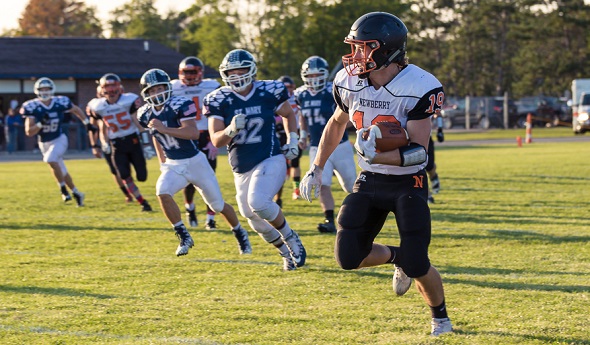
Gaylord St. Mary 28, Newberry 21 (OT) – The Snowbirds are off to a 2-0 start for the second straight season but this time with wins over two teams that made the playoffs the year before; Newberry is 1-1 coming off an 8-3 finish.
Petoskey 14, Escanaba 7 – The Northmen (1-1) got their first win, both equaling last year’s total and avenging last season’s 39-0 defeat to the Eskymos (1-1).
Southeast & Border
Milan 41, Monroe St. Mary Catholic Central 18
The Big Reds (1-1) didn’t enjoy a great start falling by 20 two weeks ago to Chelsea, but made up for it by avenging last season’s only regular-season loss. That 2016 10-point defeat to St. Mary cost Milan an outright Huron League championship, but this win broke a three-year losing streak against the Falcons (1-1). Click for more from the Monroe Evening News.
Also noted:
Parma Western 32, Battle Creek Pennfield 20 – The Panthers are enjoying their third 2-0 start in four seasons but also went 0-2 a year ago; the Panthers, a playoff team in 2016, now must battle back from a winless start.
Homer 52, Concord 12 – These two and Springport shared the Big 8 Conference title last season, but this big win by Homer (2-0) means Concord (0-2) will need to catch up quickly to stay in the mix.
Reading 34, Springport 7 – Staying in the Big 8, Reading made a statement to move to 1-1 after two straight 3-6 finishes, while Springport (1-1) also finds itself now a win back in its title defense.
Chelsea 10, Pinckney 7 – Chelsea (2-0) scored all of its points over the final few minutes to stun Pinckney (1-1) in the latter’s second game in the Southeastern Conference White.
Southwest Corridor
Berrien Springs 27, Schoolcraft 14
Defense has been Berrien Springs’ strength in three straight playoff seasons, and the Shamrocks (2-0) earned one of their most impressive regular-season wins in some time by holding Schoolcraft (1-1) to its fewest points since Week 8 of 2014. The Eagles also hadn’t lost a regular-season game in more than two years. Click for more from the St. Joseph Herald-Palladium.
Also noted:
Climax-Scotts 52, Sand Creek 21 – A week after seeing their 19-game regular-season winning streak end, the Panthers (1-1) started anew by handing a first loss to a Sand Creek team that went 9-2 a year ago.
Delton Kellogg 34, Lawton 21 – Despite starting 1-1, Delton has put up 72 points over two games, with 34 the second-most Lawton (0-2) has given up during the regular season since 2014.
Coldwater 28, Marshall 7 – After losing to Marshall (1-1) by 10 last year and losing out on a share of the Interstate 8 Athletic Conference title because of that defeat, Coldwater (2-0) has jumped the first obstacle a tough league road.
Richland Gull Lake 10, Portage Northern 9 – The Blue Devils (1-1) have won two games in each of the last two seasons, but now own their first of this fall over a 2016 playoff team in the Huskies (0-2).
Upper Peninsula
L'Anse 32, Lake Linden-Hubbell 12
Lake Linden-Hubbell (1-1) hadn’t fallen during the regular season since 2014 and hadn’t lost to L’Anse since a 2013 District opener. But the Purple Hornets – 2-0 coming of a 2-7 run last fall – appear to have turned things around as they look to break a three-season playoff drought. Click for more from the Houghton Daily Mining Gazette.
Also noted:
Gwinn 30, Iron Mountain 24 – The Modeltowners (1-1) bounced back from a rough Week 1 defeat to Gladstone to quickly put Iron Mountain down 0-2 after the latter finished 8-3 a year ago.
Calumet 28, Negaunee 21 – This was a nonleague game but a great confidence builder for Calumet (2-0), which went 10-2 last season despite splitting with the Miners (0-2).
Norway 35, Ishpeming 22 – The Hematites (1-1) came out on a roll with a big Week 1 victory, but Norway (2-0) took that momentum away with a second straight win in the series.
Munising 20, St. Ignace 8 – The Mustangs (1-1) struggled to only two wins last season, but handed 2016 Division 8 semifinalist St. Ignace a rare early second loss.
West Michigan
Lowell 14, Rockford 0
Lowell handed the Rams (1-1) their first shutout since Week 5 of 2014 and scored all the points it needed during the first half to extend its regular-season winning streak to 19. The Red Arrows (2-0) didn’t have a penalty or a turnover in holding an opponent scoreless for the first time since Week 5 of 2015. Click for more from the Grand Rapids Press.
Also noted:
Muskegon Catholic Central 31, Frankfort 6 – The Crusaders (1-0) won this rematch of last season’s Division 8 Regional Final by a nearly identical score and remains the only team to have beaten Frankfort (1-1) since 2015.
East Kentwood 21, Orchard Lake St. Mary's 0 – The Falcons (2-0) put themselves into the thick of O-K Red talk with a surprising shutout of the reigning Division 3 champion Eaglets (0-2).
Muskegon Mona Shores 42, Zeeland West 20 – The Sailors moved to 2-0 by avenging last season’s four-point loss to West (1-1), which hasn’t won its first two games for the first time since 2013.
Muskegon 28, Lincolnshire Stevenson (Ill.) 7 – Muskegon traveled to Illinois to avenge its only regular-season loss of 2016, a three-pointer to Stevenson on the way to finishing Division 3 runner-up.
8-Player
Crystal Falls Forest Park 66, Powers North Central 58 (OT)
The Trojans (1-1) can argue they were the second-best 8-player team in the state last year, losing twice to North Central while giving the Jets their toughest games. Forest Park now also can boast that it handed North Central (1-1) its first 8-player loss, ending the Jets’ winning streak at 27 since making the switch in 2015. Click for more from the Escanaba Daily Press.
Also noted:
Deckerville 52, Lawrence 0 – The Eagles (2-0) have outscored their first two opponents by a combined 94-6, with this especially impressive against a Lawrence program that is 37-8 since moving to 8-player in 2013.
Atlanta 28, Fife Lake Forest Area 18 – Two weeks ago, Atlanta won its first game since 2014; on Thursday it moved to 2-0 for the first time since 1992 against a Forest Area team that is 1-1 but was 7-3 in 2016.
Rapid River 50, Eben Junction Superior Central 42 (2OT) – Combined with Forest Park’s win over North Central, Rapid River (2-0) looks like the team to beat in the Western Eight Conference after surviving Superior Central (0-2) and beating the Trojans in Week 1.
Bear Lake 44, Baldwin 28 – The Lakers (1-1) earned their first win ever in handing Baldwin (1-1) its first loss since moving from 11-player before this season.
PHOTO: A Newberry ball carrier is chased by Gaylord St. Mary defenders during the Snowbirds' overtime win Friday. (Photo by Jeff Rochefort.)

Football Fridays: Welcome to Our House
October 27, 2017
The latest issue of "benchmarks" focused on the nation's most participated in and attended high school sport, football, and efforts to keep Fridays reserved for games at the high school level. Below is an opening editorial by MHSAA Executive Director Jack Roberts, followed by the magazine's cover story published earlier this fall.
By John E. “Jack” Roberts
MHSAA Executive Director
There is no less opportunity to help student-athletes mature into positive people in one sport than another or on one day or night of the week compared to others. That is an unshakable truth of educational athletics.
But that truth has not diminished the efforts of the Michigan High School Athletic Association, time and again for decades, to protest encroachment on Friday night high school football by both professional and college sports. The reasons go far beyond football and Friday nights.
Done right, as it very often is in very many Michigan communities, Friday night is a festival that engages far more than the football team and its fans. It is a forum for showcasing a variety of school activities:
• A volleyball-football doubleheader with a community barbeque in between.
• A cross country run starting and/or ending at the football stadium with the roar of the crowd.
• A showcase for the marching band and a variety of other musical groups to perform, as well as cheerleaders and pompon squads.
• An opportunity for all school groups to provide information booths so students and parents may become aware of these student programs and initiatives.
• An opportunity to announce results of golf, tennis and swimming meets and provide the upcoming schedule of events, both athletic and non-athletic.
Done right, 30 to 70 percent or more of a school’s student body has an active part at most Friday night football games.
It has been said that the interscholastic athletic program provides a window to the entire school – to what it stands for and how it operates. If so, then Friday night football games are the front porch – a place for the entire school body and surrounding community to feel welcomed and to become more engaged.
By Rob Kaminski
MHSAA benchmarks editor
At a time when so many everyday distractions, mediums and changing ideals tear at the fabric of a cohesive society, school sports still offers a huge slice of Americana that continues to bond neighbors and promote community like few others can: high school football on Friday nights.
And now, that, too, is being threatened. Once “the only game in town,” prep football lights shone brightest on local kids playing on nearby fields while generating business for merchants on Main Street and providing inexpensive family entertainment. Friday nights were reserved for high schools.
In recent years, however, the lure of TV dollars led to a wave of universities which could not compete with the perennial powerhouses for exposure on Saturdays, shifting games to all nights of the week. For the most part, they steered clear of Fridays, respecting the hand that feeds their programs.
Not so anymore.
ESPN began to schedule and televise NCAA Friday night games in 2002, and last November things really hit home when the Big Ten announced a slate of games for Friday nights this fall.
Protecting Friday nights is paramount, and as the following illustrates, the MHSAA is not alone in its fight.
It’s difficult to project the effect that such scheduling will have on MHSAA football games, but to borrow an axiom from the go-to book of coaches quotes, it will be prudent to take things one play at a time, one week at a time.
“The Big Ten Conference and other collegiate leagues enjoy high school football within their shadows; but the foray into Friday nights can be problematic,” said MHSAA Executive Director Jack Roberts.
“With lengthier seasons which now reach 12 games – and 13 weeks if there is a bye week – the collegiate seasons extend well into postseason play for the MHSAA and other state associations. Clearly there is a concern when some traditional collegiate rivalries occupy the same dates as high school championships.”
It looked like things would become much worse this year. Originally, Michigan State was scheduled to play at Northwestern on Oct. 27, potentially keeping countless Green and White enthusiasts in front of their televisions during the most pivotal financial weekend of the fall for the MHSAA: the first Friday of the Football Playoffs.
That game was moved to Saturday due to “unintended consequences” had the game remained on Friday. Northwestern also had a Friday tilt against Maryland moved to a Saturday.
So, already things have changed since the first announcement of Friday games by the Big Ten last November.
While there are six Friday games on the Big Ten docket for this Fall, five were in September, including two on Labor Day weekend.
Labor Day Friday games have played out in the MHSAA’s back yard for quite some time, as MSU often hosted such season-opening contests. Those games, however, seldom created conflicts due to most high schools playing on Thursdays leading into the holiday weekend.
This year was no different, with 215 games involving MHSAA schools being played on Thursday, Aug. 31, compared to 58 on Friday, Sept. 1, and five on Saturday, Sept. 2.
Further, it should be noted that neither the University of Michigan nor MSU has a Friday night game this fall, largely because administrators at those schools voiced strong objections to hosting any of the Friday night contests.
Similar sentiments are shared throughout the league.
“I'm very concerned about (Friday night games),” said first-year Indiana University Head Coach Tom Allen at the Big Ten preseason media gathering this summer. “I'm not going to sit here and try and make a big issue in terms of what I think. My history as a high school coach for 15 years is strong. It's who I am, it's how I started, and it's been so many years.
"I think that's a special night. I don't like playing games on Friday night. I think that's high school night. It's not always my decision. But I'm not going to just not tell you what I believe.”
During a May conference involving administrators from Midwest high school associations and the Big Ten, several collegiate stakeholders voiced opinions favoring the high school spotlight on Friday nights.
MSU Athletic Director Mark Hollis made it known that his school would agree to Friday nights only on Labor Day or Thanksgiving weekends. Michigan Head Coach Jim Harbaugh proclaimed to local radio stations that day that, “I'm for traditional Saturdays. Friday is for high school games.”
Decades ago, a million dollar offer by the NCAA to the National Federation of State High School Associations (NFHS) which would have allowed for televised collegiate games on Friday nights was turned down.
Additionally, the NFL is barred by law from televising games on Fridays and Saturdays from mid-September through mid-December to avoid conflict with high school or NCAA games.
The landscape began to change with the formation of the College Football Association, a group formed by many of the American colleges with top-level college football programs in order to negotiate contracts with TV networks to televise football games. It was formed in 1977 by 63 schools from most of the major college football conferences and also select schools whose football programs were independent of any conference.
By 1982, a CFA legal challenge led to a 1984 Federal court decision that dissolved the NCAA’s exclusive control over television rights, allowing athletic conferences, independent schools and others to bargain for contracts.
As games now run rampant across TV screens and weekly calendars like tumbleweeds in the wild, wild west, could there finally be enough backlash to lasso this runaway horse?
The American Football Coaches Association – comprised of coaches from high schools to the pro ranks – unanimously opined in January at its annual convention that the NCAA should refrain from scheduling Friday night contests.
AFCA Executive Director Todd Berry issued a strong statement at the winter meeting, saying, “It was unanimous among all levels of coaches that the AFCA is in support of protecting Friday night for our high schools. We recognize the impact of having college football games on Friday night for our spectators, along with those viewing on television, can be significant. The AFCA feels very strongly that Friday night should be protected, not just for football, because the revenues generated by those high school football game ticket sales impact everything at those high schools such as other sports and organizations.”
That rings true not only from school to school, but also across state associations around the country which, like the MHSAA, depend upon football tournament attendance as one of the main sources of income from which to fund other programs throughout the year.
While the Big Ten’s announcement to increase Friday night television appearances has just recently brought glaring attention to the subject here at home, the unpopular trend has been affecting areas around the country for years.
The year 2001 was a landmark year of sorts for collegiate football telecasts, when the Mountain West Conference, Conference USA and the Mid-American Conference sought to gain exposure by scheduling Friday night contests. While it was long after the deregulation of 1984 and faced opposition from larger conferences such as the SEC, there was no legal ground to stand on for conferences then wishing to ban Friday night telecasts.
Even the larger conferences then – in certain extenuating circumstances – began to utilize Friday nights as an option.
In 2003, the Michigan-Minnesota football game was moved to Friday night to avoid a potential conflict with Major League Baseball as the Minnesota Twins could have hosted a playoff game on that particular Saturday.
At the time, Big Ten Commissioner Jim Delaney said, “The Conference and the Administrators Council regret having to reschedule football games to a Friday night. The Big Ten continues to support the protection of Friday night as a traditional high school football playing date.”
One year later, a high-profile contest between Florida State and Miami was moved to Friday night when several storms hit the area. The problem was no one from the universities or the Atlantic Coast Conference bothered to inform the Florida High School Athletic Association ahead of time.
“In our opinion, (the decision) demonstrates their complete lack of sensitivity to our high school athletic programs, many of which are reeling financially due to the effects of hurricanes Charley and Frances,” said then-FHSAA Commissioner Robert Hughes said. “Most of our schools depend on the revenue from home football games to fund their entire athletic programs throughout the school year. Now, we find out that our schools will have to compete for an audience with the primetime telecast of arguably the biggest college football game that will played this year in this state.”
After watching an increasing number of games fill the prime Saturday slots and spill onto other days of the week, the Big Ten decided to modify its “Fridays are for high schools” stance, embarking on a path that will last until at least 2022.
The news release accompanying the decision stated that the conference “appreciates the significance of high school football within the region and has worked to minimize the impact of this initiative by limiting the number of Friday night games. Overall, these games represent approximately six percent of Big Ten home games annually, and no institution will host more than one game in any given year.”
It’s that top-down communication that doesn’t sit well with those involved in high school sports, the very level that the colleges count on to supply the talent pool. In that regard, the Friday night collegiate games don’t make sense.
“We have so many more teams in the Big Ten, that trying to find those windows that allow you to get that exposure for the whole league is important,” MSU’s Hollis has told reporters.
It’s not just the college football power conferences that have an effect on high school gridirons. Any city or town which includes a college campus shares a similar fan base.
With the MAC playing on any given night of the week for the last couple of decades, high schools in those cities have tried to adjust. After mixed results, however, some schools are simply standing their ground.
“Both (Mt. Pleasant) Sacred Heart and Mt. Pleasant High have avoided the same night as CMU Football over the years,” said Mt. Pleasant Athletic Director Jim Conway. “As of this year, though, both schools have elected to not change schedules based on the CMU schedule. Altering our schedules over the years has had a great effect on the visiting teams and their fan base coming to our sites.”
Further south, Middle Tennessee State University plays rival Western Kentucky on the same Friday as the TSSAA state high school football quarterfinals this fall. Additionally, a home game with Marshall was moved to another Friday night.
“My belief is that college coaches want to keep Fridays for high school only. But they are going to play when TV tells you to,” local high school coach Kevin Creasy, whose team plays that night, said in a story from the Murfreesboro Daily News Journal. “If TV said to us they want us to play on Saturday, we would. College coaches don’t want to play on Friday, but they do want their team to be on TV.”
Yet, it will be difficult for prep players to watch prospective colleges when they are busy playing. It also will minimize the number of live looks afforded college coaches for their recruits.
SBNATION.com writer Alex Kirshner surmised in an article last fall that, “If high school coaches are unified in opposition to something, college football programs have little choice but to listen. Taking a stand against your own state’s high school coaches is a horrible recruiting strategy.
“Friday night games in September and October mean recruits typically can’t visit for college games, because they’re busy playing.”
For those fans who prefer the college game, travel would be more difficult on Fridays, and/or would force many to take time off work to make their destinations by kickoff, versus driving just a few miles to root for the local high school team.
In that regard, logistics favor the high schools when it comes to “butts in the seats.” But, the proliferation of television provides an ample excuse for those more inclined to click remotes rather than drive to games of any level.
“Any diversion from the traditional Friday night football has a direct impact on high school game attendance. High-profile collegiate games clearly will allow people to sit home in comfortable climate and watch football. This is not good for local games,” Conway said.
Losing any number of spectators can be felt throughout athletic departments and booster clubs which count on fall Fridays as a main source of revenue for their overall programs. With most schools having just four or five home football games per year, it’s vital to make the most of them financially.
“When CMU plays on the same night here, it takes away some fundraising opportunities for some of our teams and Booster Clubs,” Conway said. “Obviously it puts our local fan base in a position where they have to decide which game to attend, but also many people who volunteer for our Booster Club and our event staff are paid to work on crews at CMU games. The result is both the high schools and CMU trying to replace game management personnel, as many of us work the high school events and CMU Football.”
Executive Director of the Michigan High School Football Coaches Association Larry Merx believes that in many cases the prep and collegiate followings are different, but agrees with Conway for those locations which share geographic boundaries.
“I think high school football fans will stay with the high school game,” Merx said. “But, especially in and near college towns, many high school fans have work or other support responsibilities related to college games and will have to make some decisions.”
Fridays also provided a special stage for thousands of contest officials across the country. For the vast majority, working a regular schedule of high school varsity football games is the reward for countless hours and preparation.
For the select few fortunate enough to reach higher levels in the avocation, college opportunities and pay will trump Friday nights every time.
There is a vast pool of officials capable of working each week, but the absence of such veteran officials results in missed training opportunities as a new crop of officials is brought forward. In football more than most sports, there are limited chances for live officials training outside the school season.
“I’ve done college games on Saturday and high school games on the same Friday,” said NFL back judge Tony Steratore in a recent Referee magazine story. “Many officials do this, but I have to tell you something, if you’re going to do this you have to bring your ‘A-game’ to Friday night as much as you bring it to Saturday. If you don’t, you’re doing yourself and the game a disservice. When it comes down to it, if you can’t guarantee both games are getting equal attention, then you have to choose one or the other.”
When the games are both on Friday it’s a no brainer for the official faced with the choice.
For spectators, the choice often isn’t as clear-cut. That’s where school sports leaders – from the NFHS to the state high school associations to athletic administrators and coaches – must continue to promote the grand scenes that take place right down the street from their neighbors on Friday nights in the fall.
Portrayed in that light, scholastic sports leaders have an easy product to sell.
“Local high school games bring complete amateurism to the sport of football,” Conway said. “The band plays while moms and dads pop the popcorn and grill the hot dogs. Good high school games last no more than two-and-a-half hours, which is preferred to the length of collegiate games.”
It’s the perfect mix for a Friday night in the fall.
PHOTOS: (Top) Grand Ledge players man the sideline during a home game. (Top middle) The St. Johns' marching band takes the field. (Middle) Walled Lake Western cheerleaders run their flag around the stadium. (Middle below) Watervliet's concession stand feeds the crowd. (Below) Menominee's game provides the true scholastic vibe, complete with school buses parked in the background. (File photos.)