

Drive for Detroit: Week 4 in Review
September 17, 2012
By Geoff Kimmerly
Second Half editor
Most conferences in Michigan have between six and eight teams, and all start each season with hopes of ending up number one.
In a few weeks, showdowns to determine those top teams will take place all over the state. But in the meantime, the leg work must be done to set up those colossal matchups. And a number of those games were played during Week 4, although the most notable result came in a game that instead matched potential MHSAA championship contenders.
West Michigan
Muskegon 36, Lowell 21
The Big Reds have two running backs on pace to rush for 1,000 yards this season if the team makes any kind of run in the playoffs, and at this point it looks like they might run away from the rest of the Division 2 field. Muskegon added another win to its impressive start, in a game that some suggested matched the two best teams in the division this fall. Click to read more from the Muskegon Chronicle.
Also noted:
Zeeland East 27, Grand Rapids Forest Hills Central 23 – The Chix have to be considered one of the hottest teams in all of Michigan so far, with this win perhaps its most impressive of a 4-0 start.
Caledonia 14, Grandville 7 – After two straight seasons at 4-5, Caledonia is 4-0 heading into a series of tough O-K White games.
Comstock Park 13, Allendale 8 – This was one of the best rivalries of the old O-K Silver, and this first matchup between the two since 2004 was a strong way to start off the O-K Blue schedule.
Muskegon Mona Shores 21, Grand Haven 14 – Mona Shores’ 3-1 start is its best since 1997, and comes after the team won a combined three games over the last two seasons.
Greater Detroit
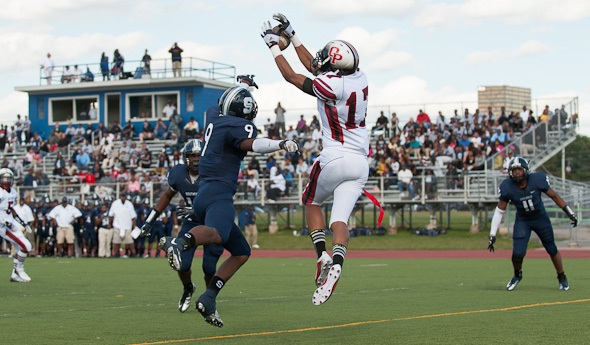
Oak Park 24, Southfield 18 (OT)
This has become Oak Park's most serious conversation about league contention since at least 2003, when it finished second in the Oakland Activities Association III to Farmington – which just happens to be the other team tied for first this fall in the OAA White, and also this week’s opponent. Oak Park needed overtime in this one to get past Southfield, which fell to 2-2 but is much better than that middling record suggests. Click to read more from the Oakland Press.
Also noted:
Farmington 19, Oxford 13 (OT) – This is the other overtime thriller that helped set up this week’s OAA White matchup; the Falcons haven’t given up more than 14 points this fall.
Birmingham Brother Rice 28, Warren DeLaSalle 0 – This is usually a much closer matchup (see explanation last week), but Brother Rice’s defensive performance was stunning and earns the Warriors top billing going forward in the Detroit Catholic League Central.
Waterford Our Lady 24, Royal Oak Shrine 21 – The Catholic League has other divisions too, and with this win Our Lady earned the status as biggest contender to Loyola in the Intersectional.
Milan 21, Grosse Ile 14 – Milan moved to 4-0 after winning just one game last season; the Big Reds look like Huron League favorites heading into this week’s matchup with Monroe St. Mary Catholic.
Southwest and Border
Stevensville Lakeshore 41, Portage Central 40
This nearly ended with the classic comeback, with Portage Central trailing by 20 at halftime. But Lakeshore hung on through a two-point conversion called back because of a penalty. That one-point swing will surely come to mean more as the Southwestern Michigan Athletic Conference West season moves into October. Click to read more from the Kalamazoo Gazette.
Also noted:
Bridgman 27, Niles Brandywine 26 – The Lakeland Conference is down to just three teams after playing with six only three seasons ago, and Bridgman looks like the favorite already after beating Brandywine for the first time since 2006.
Reading 26, Springport 20 – This was a big one as the Rangers move quietly toward another Big Eight Conference decider in Week 8 against Union City.
Portage Northern 7, St. Joseph 0 – This was the other SMAC West game of most note, with these two now among four that are 1-1 in the league and 3-1 overall, but tied for third in the league.
Sturgis 27, Kalamazoo Loy Norrix 12 – The Trojans were in a bit of a rough spot at 1-2 and coming off their first playoff berth in seven seasons; this victory could kick off a run back into the mix.
Lower Up North
Grayling 28, Traverse City St. Francis 20
The Vikings ended a nine-game losing streak against St. Francis, and after falling by three and one point the last two seasons, respectively. Grayling is considered one of the best teams in Division 5 and the Lake Michigan Conference favorite, and beating the Division 7 power Gladiators will no doubt strengthen both expectations. Click to read more from the Traverse City Record-Eagle.
Also noted:
Maple City Glen Lake 56, Benzie Central 12 – The Lakers are 4-0 for the first time since 2001 and appear to have made the Northwest Conference race a two-team battle with Kingsley.
Boyne City 14, Harbor Springs 7 – Boyne City improved to 4-0 to equal last season’s win total heading into this week’s matchup with St. Francis.
Traverse City Central 40, Petoskey 0 – The Trojans announced their Big North Conference contention in a big way over a usual favorite, and next week can equal their 2011 win total by moving to 4-1.
Elk Rapids 48, Charlevoix 22 – Two losses by a combined 11 points have put the Elks at 2-2 and against the playoff wall, but this was a big step with two more tough games coming up.
Upper Peninsula
Escanaba 31, Marquette 22
This was a little unexpected, perhaps more than a little, with Marquette coming in undefeated and the Eskymos having been outscored 99-37 during their 1-2 start. But Escanaba’s defense shut down the Redmen during the second half to win the Great Northern Upper Peninsula Conference opener. Click to read more from the Marquette Mining Journal.
Also noted:
Bessemer 39, Lake Linden-Hubbell 12 – Bessemer not only broke an eight-game losing streak to Lake Linden-Hubbell, but this victory also helped the Speedboys move to 3-1 and equal last season’s three wins.
Negaunee 28, Iron Mountain 6 – The Miners’ broke a two-game losing streak to Iron Mountain and have started 4-0 for the first time since 2006.
Ishpeming 38, Ishpeming Westwood 8 – Ishpeming pushed it to 16 straight over Westwood and hs now won 11 straight regular-season games.
Iron Mountain North Dickinson 55, Stephenson 30 – The Nordics’ point totals this season, in chronological order, have been 41, 42, 48 and 55.
Mid-Michigan
DeWitt 28, Haslett 27
The Panthers have won this rivalry game 10 straight times, which might make it seem like it shouldn’t be a rivalry anymore. Don’t buy it. This game still matters a ton to both communities, and this brought back memories of the classics from the beginning of the 2000s. It also kept DeWitt tied for first in the Capital Area Activities Conference Red and has Haslett needing to win out to guarantee a playoff berth.
Also noted:
Perry 14, Flint Beecher 13 – The Ramblers should celebrate some small victories, like their best start since 2006; two wins already equals their most since that same season.
Lansing Everett 21, Holt 3 – This was the first of four tough CAAC Blue foes the Vikings must survive; Grand Ledge, East Lansing and Lansing Sexton still loom after a 4-0 start.
St. Johns 14, Owosso 13 – The CAAC Red has been tough to read so far, but this combined with the DeWitt win means the Panthers and Redwings likely will play for the title again.
Morrice 44, Burton Atherton 14 – Before opening night, the last time Morrice (4-0) had won was 2009; the last time Morrice won four games in a season was 2006, and the last time the Orioles started 4-0 was 1997.
Thumb and Bay
Flint Powers Catholic 34, Saginaw Nouvel Catholic 12
This game may not have turned out as close as might have been expected. But the reigning Division 5 champion Chargers had plenty to celebrate after falling to Nouvel 55-14 in 2011, when Nouvel finished as Division 7 champion. Click to read more from The Saginaw News.
Also noted:
Saginaw Swan Valley 31, Alma 26 – The Vikings handed Alma its first Tri-Valley Conference Central loss, meaning Swan Valley and Hemlock are the only two still perfect in league play.
Montrose 13, Goodrich 12 – This leaves Montrose and Lake Fenton as the teams to beat in the Genesee Area Conference Red.
Almont 17, Richmond 13 – By way of a series of three and four-point games, including this one, Almont is again among those chasing Croswell-Lexington at the top of the Blue Water Conference standings.
Beaverton 26, Houghton Lake 21 – The Beavers might not contend in the Jack Pine Conference after losing big to Gladwin in Week 3, but this win put them at 3-1 to equal their most wins since 2007 and has them halfway to their first playoff berth since 2000.
Trophy Games
Each week, the MHSAA highlights trophy games around the state. A number were played during Week 4.
- Little Brown Jug: Union City hosted Athens in a Big Eight Conference matchup and kept the trophy for the 12th straight season. Final: Union City 33, Athens 18.
- Little Brown Jug: The Kingsley/Suttons Bay matchup has been much more even, with the teams splitting their last 10 games although Kingsley won for the second straight: Final: Kingsley 62, Suttons Bay 7.
- Little Brown Jug: Concord won its ninth of the last 10 against Homer (including a forfeit in 2006), but this was the closest of the recent renditions. Final: Concord 28, Homer 27.
- The Axe: Newberry kept its strong start going by breaking a seven-game losing streak to rival Munising. Final: Newberry 29, Munising 12.
- Rocket-Rebel Trophy: Wyoming Kelloggsville has won all six since it began playing Wyoming Lee annually again in 2007. Final: Kelloggsville 21, Lee 6.
- Pioneer-Thunderbird Spirit Bowl: Dearborn has won three straight over its Western Wayne Athletic Conference rival Edsel Ford. Final: Dearborn 35, Edsel Ford 14.
PHOTO: Southfield (blue) and Oak Park battled into overtime of a key Oakland Activities Association game that in the end went Oak Park's way, 24-18. (Click to see more at Terry McNamara Photography.)
Drive for Detroit: Week 7 in Review
October 12, 2015
By Geoff Kimmerly
Second Half editor
Every game night provides the opportunity for teams and athletes to make history. From 11-player to 8, Week 7 saw its share of those moments.
In last week's preview, we noted at least 20 leagues with games that had immediate championship implications. As we now review, we touch on a number of those below.
Bay & Thumb
Algonac 21, Almont 7
Algonac continued its history-making run, clinching a share of the Blue Water Area Conference title, its first league championship since 1972. The Muskrats (7-0), also celebrating a first winning season and playoff berth since 2005, grabbed the title share against an Almont team that had won 17 straight league games and hadn’t been held to single-digit scoring since Week 3 of 2012. Almont (6-1) is now tied for second place with Richmond, Algonac’s opponent this week. Click for more from the Port Huron Times-Herald.
Also noted:
Vassar 36, Unionville-Sebewaing 24 – The Vulcans (6-1) clinched a share of the Greater Thumb Conference West title by outlasting second-place USA (5-2) and moved to 8-0 against the Patriots since they’ve been in the same league.
Marysville 48, Sterling Heights 21 – The Vikings (5-2) turned the Macomb Area Conference Gold race into a three-team battle with a league game to play by handing Sterling Heights (5-2) its first league loss; those two are tied with Marine City for first place.
Lapeer 49, Midland 21 – The Lightning (7-0) remains perfect for the regular season over its two-year history and earned a share of the Saginaw Valley League Red title by downing the second-place Chemics (6-1).
Sanford Meridian 30, Harrison 8 – The Mustangs (7-0) can clinch a share of the Jack Pine Conference title this week now that they’ve beaten both second-place teams, Clare and Harrison (5-2).
Greater Detroit
Plymouth 31, Canton 20
Plymouth broke a two-game losing streak to the rival Chiefs (5-2) to close out an outright championship in the Kensington Lakes Activities Association South, and after trailing Canton 20-10 at halftime. This was the eighth straight game between the two decided by 12 points or fewer, and earned Plymouth (6-1) the opportunity to host Northville in this week’s KLAA Kensington title game. Click for more from Observer & Eccentric.
Also noted:
Farmington Hills Harrison 13, Farmington 12 – Harrison (6-1) edged one neighbor, Farmington (4-3), to earn a share of the Oakland Activities Association White title, and can finish the run against another, North Farmington, this week.
Birmingham Groves 47, Berkley 14 – A 6-0 start for Groves last season turned into a 1-4 finish beginning with a three-point loss to Berkley (5-2), but the 2015 meeting was all Groves (7-0) as it earned a share of the OAA Blue title.
Orchard Lake St. Mary’s 14, Detroit Catholic Central 7 – The Shamrocks (5-2) and Warren DeLaSalle meet this week to figure out the rest, but those two and St. Mary’s (6-1) are all in the Prep Bowl mix.
Pontiac Notre Dame Prep 33, River Rouge 30 – Notre Dame Prep’s bounce-back from 3-6 last season to 6-1 this fall has included four wins by seven points or fewer including this one over previously-undefeated River Rouge (6-1).
Mid-Michigan
Brighton 14, Howell 11
These KLAA West rivals both played without key contributors and traded their share of momentum-stopping fumbles and interceptions before Brighton (6-1) closed out the win to earn a share of the division championship. The teams have split their last six games. Brighton also clinched a playoff spot, and Howell (5-2) remains alive for what would be a first playoff berth since 2012. Click for more from the Livingston Daily.
Also noted:
Hartland 30, Grand Blanc 27 (OT) – The Eagles (5-2) earned the other share of the KLAA West title by outlasting last season’s champion, Grand Blanc (4-3), and thanks to a win over Brighton two weeks ago also will play for the Lakes Conference title.
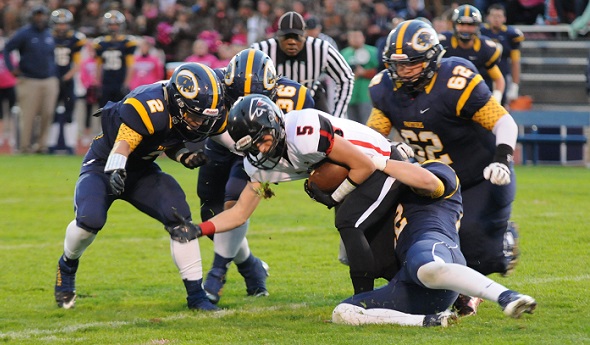
DeWitt 49, St. Johns 21 – It’s time to stop talking about DeWitt (7-0) being inexperienced and under the radar after it clinched an outright Capital Area Activities Conference Red title over three others still alive for playoff berths, including the Redwings (5-2).
East Lansing 14, Lansing Sexton 8 – The Trojans (4-3) are staying alive for the playoffs after going 1-8 only a year ago, although they face undefeated Grand Ledge next; Sexton (1-6) suffered its fifth loss by eight points or fewer.
Mount Pleasant Sacred Heart 48, Vestaburg 7 – The Irish’s win-out campaign to make the playoffs after an 0-3 start now includes claiming a share of the Mid-State Activities Conference title with this win over second-place Vestaburg (5-2) that put Sacred Heart at 4-3 overall.
Northern Lower Peninsula
Frankfort 27, Harbor Springs 7
The Panthers quietly are putting up one of the most impressive defensive stands in the state this fall. Since giving up 10 points on opening night in a four-point loss to Maple City Glen Lake, Frankfort (6-1) hasn’t given up more than one score in a game and 32 more points total. This win allowed the Panthers to equal their total for all of last season and got them within another of clinching the Northern Michigan Football League Legends title, while dropping fourth-place Harbor Springs to 4-3. Click for more from the Benzie County Record Patriot.
Also noted:
McBain 34, Lake City 13 – McBain (5-2) closed out a share of the Highland Conference championship with Beal City by downing third-place Lake City (3-4)
Whittemore-Prescott 30, Rogers City 22 – The Cardinals (4-3) are North Star Big Dipper champions for the second straight season but must beat Little Dipper champ Hillman this week to keep on track for an automatic playoff berth.
Hillman 46, Oscoda 39 – The Tigers (6-1) just survived Oscoda (4-3) to earn a playoff appearance for the 10th straight season.
Johannesburg-Lewiston 48, Lincoln Alcona 22 – Another impressive run continues for Johannesburg-Lewiston, which downed Alcona (5-2) thanks to two touchdown runs and 225 yards (plus 17 tackles) by Logan Huff and four scoring runs by cousin Brandon Huff.
Southeast & Border
Ypsilanti Community 34, Chelsea 24
The third-year Ypsilanti Community program, which emerged from the former Ypsilanti High, has beaten Chelsea all three times the teams have met – although this might be the best win in the young Grizzlies’ history. After opening 0-3 this fall, Community has won four straight and with this victory clinched a shared Southeastern Conference White championship with the Bulldogs (6-1). Click for more from AnnArbor.com.
Also noted:
Monroe St. Mary Catholic Central 41, Milan 14 – The Falcons (7-0) clinched a share of the Huron League by winning this matchup of first-place teams, with Milan (5-2) needing help from Monroe Jefferson this week to also earn a share.
Homer 44, Quincy 18 – This win, combined with Concord’s overtime loss to Springport, gave Homer (6-1) the outright championship in the Big 8 Conference.
Saline 28, Monroe 0 – The Hornets (7-0) closed out an outright title in the Southeastern Conference Red while pushing Monroe (3-4) into the pool of those hoping to make the playoffs with an at-large bid.
Ottawa Lake-Whiteford 34, Morenci 6 – The Bobcats (6-1) nearly reversed last season’s 49-0 loss to Morenci (5-2) to move into second place in the Tri-County Conference with first-place Clinton coming up in Week 9.
Southwest Corridor
Benton Harbor 10, Stevensville Lakeshore 7 (OT)
Benton Harbor (4-3) can’t win the Southwestern Michigan Athletic Conference West title and is tied for third place. But many statewide eyes have turned toward the Tigers, who are in pursuit of their first playoff berth and went 0-18 over the last two seasons – and 4-68 over the last eight. Benton Harbor held Lakeshore (4-3) scoreless to start overtime, then won on a 22-yard field goal. Click for more from the St. Joseph Herald-Palladium.
Also noted:
Mattawan 21, Battle Creek Central 18 – This turned the SMAC East into a three-team battle with one league game left to play; Mattawan, Central and Battle Creek Lakeview all are tied for first and none play each other the rest of the way.
Watervliet 56, Delton Kellogg 35 – The Panthers (6-1) won this matchup of first-place teams in the Southwestern Athletic Conference Lakeshore and earned an outright title; Delton (5-2) now must beat an undefeated team over the next two weeks to earn a first playoff berth since 2001.
Dowagiac 16, Sturgis 7 – The Chieftains (4-3) gave Wolverine B Conference leader Edwardsburg a hand, handing second-place Sturgis (5-2) a second loss that resulted in the Eddies gaining a share of the league title.
Schoolcraft 41, Gobles 12 – The Eagles (7-0) are enjoying their move to the new SAC Central; they earned the title outright with this win and gave up a total of 30 points over five league games. Gobles (4-3) was one of two opponents to put up more than one score.
Upper Peninsula
Ishpeming 22, Negaunee 16
The numbers got more incredible for Ishpeming: 38 wins over its last 39 regular-season games, three straight Mid-Peninsula Conference titles and only 49 points given up in six games this fall. The Hematites (6-0) earned a share of the league title and ended Negaunee’s final drive with an interception to run their latest string of success against the Miners (6-1) to six wins in their last seven meetings.
Also noted:
Kingsford 14, Iron Mountain 12 – The Flivvers (5-2) moved a win closer to returning to the playoffs after missing last season, while Iron Mountain (4-3) must now win out to ensure a second straight bid.
Calumet 34, L’Anse 14 – The Copper Kings (5-2) guaranteed a share of the Western Peninsula Athletic Conference title for the second time in four seasons by downing second-place L’Anse (4-3).
Munising 19, Bark River-Harris 12 – Munising (6-1) must beat Crystal Falls Forest Park this week to guarantee a piece of the Mid-Eastern Conference title, but earned the opportunity by handing Bark River-Harris (5-2) its second straight loss.
Lake Linden-Hubbell 46, Houghton 34 – The Lakes (7-0) continue to cruise, with this win equaling last season’s total and setting the team up to earn its best finish since 2010 with another victory.
West Michigan
Grand Rapids West Catholic 42, Comstock Park 35
This didn’t clinch the Ottawa-Kent Conference Blue for West Catholic (5-2), but it did give the Falcons a one-win lead and victories over both second-place teams, Comstock Park (5-2) and Allendale. West Catholic trailed by two touchdowns during the first half and then withstood a fourth-quarter blitz by the Panthers. Click for more from the Grand Rapids Press.
Also noted:
East Kentwood 30, Rockford 29 – After two straight losses, the Falcons (5-2) bounced back to stay out of must-win territory while forcing Rockford (4-3) to win out to guarantee extending a 20-year playoff streak.
Caledonia 52, Grand Rapids Christian 31 – Considering the Fighting Scots (3-4) have lost to East Grand Rapids, Muskegon Mona Shores, Rockford and Lowell, beating Grand Rapids Christian (4-3) seems like less of an upset.
Grand Rapids NorthPointe Christian 47, Wyoming Godwin Heights 6 – The Mustangs (7-0) earned a share of the O-K Silver title after finishing second each of the last two seasons, while sending Godwin Heights (4-3) into second place after the two entered tied for first.
Hesperia 47, Lakeview 20 – Hesperia’s best season since 2002 now includes a Central State Activities Association Silver championship and first winning record since 2007, and after the team finished just 1-8 a year ago; a win by Lakeview (4-3) would’ve split the title three ways.
8-Player
Stephenson 76, Rapid River 38
Suddenly it’s Stephenson (5-2), not Rapid River (5-2), that stands as Powers North Central’s top competition in the Western Upper Peninsula Conference. Eight-player football appears to be to the Eagles’ liking; they finished 1-8 a year ago in 11-player and appear to be reclaiming the success they enjoyed in the former format during the 1990s and 2000s. Click for more from the Escanaba Daily Press.
Also noted:
Battle Creek St. Philip 55, Waldron 16 – The Tigers (7-0) have won three straight Southern Michigan League Titles and every league game since falling to Waldron (6-1) in 2012.
Cedarville 29, Bellaire 28 – A week after falling by two to Posen, Cedarville (5-2) bounced back to edge rival Bellaire (4-3) in Bridge Alliance play.
PHOTO: DeWitt defenders swarm a St. Johns ball-carrier during Friday's league title-clinching victory. (Click for more from HighSchoolSportsScene.com.)