

Drive for Detroit: Week 5 in Review
September 29, 2014
By Geoff Kimmerly
Second Half editor
No set up is needed to explain the significance of many of the games played across Michigan during Week 5 of the MHSAA football season.
The scores speak for themselves.
Read on for some of the details behind a wide array of results that wowed many over this weekend.
In addition, Ishpeming (5-0) became the first playoff qualifier for 2014, and Battle Creek St. Philip put up one of the most incredible point totals in MHSAA history – 89 points after trailing early in its 8-player win.
Total, seven games this weekend saw teams combine to score more than 100 points – while six games saw both teams score in single digits, including one of the matchups highlighted below.
Bay and Thumb
Goodrich 41, Montrose 39
The game of the season in the Genesee Area Conference Red was shaping up as Montrose vs. Flint Beecher on Oct. 17 – until Goodrich changed things up substantially by ending the Rams’ 22-game league winning streak. That Beecher/Montrose matchup might still decide part of the league title – but Goodrich is back in play as a contender. Click for more from the Flint Journal.
Also noted:
Almont 23, Richmond 6 – The Raiders (5-0) remained perfect while ending a 12-game Blue Water Area Conference winning streak for Richmond (4-1).
Lapeer 63, Mount Pleasant 0 – This is the most impressive win of an early run by the first-year Lightning (5-0), which looks like the Saginaw Valley Association Red favorite after dominating the Oilers (3-2).
Burton Atherton 34, Flint Hamady 22 – Atherton (4-1) still trails in the Genesee Area Conference Blue by a win, but knocked Hamady (4-1) out of a tie for first.
Millington 30, North Branch 29 – Only a week after a huge win over rival Frankenmuth, Millington (5-0) just survived against the Broncos (1-4) to remain atop the Tri-Valley Conference East.
Southwest and Border
Battle Creek Lakeview 27, Stevensville Lakeshore 0
Lakeview has had plenty of success the last few seasons and is 19-3 over its last 22 games, two playoff losses included. But this might be the most impressive win of the run – although Lakeshore plays in the Southwest Michigan Athletic Conference East and Lakeview in the West, the Spartans (3-1) still should celebrate their first win (and in impressive fashion) over the Lancers (4-1) since 2001. Click for more from the Battle Creek Enquirer.
Also noted:
Battle Creek Central 21, St. Joseph 10 – The Bearcats (3-2) already have their most wins since 2008 and now an upset of one of the best teams annually from the southwest in St. Joseph (3-2).
Plainwell 31, Vicksburg 21 – The Wolverine B Conference East title may have been decided Friday, with Plainwell (4-1) bouncing back from a Week 4 loss to slow the upstart Bulldogs (4-1).
Paw Paw 62, Edwardsburg 57 – The favorites in the Wolverine B West also met and combined for more than 100 points for the second straight season as Paw Paw (3-2) took a 2-1 advantage on Edwardsburg (4-1) in their recent series.
South Haven 34, Dowagiac 28 – South Haven (2-3) hadn’t beaten Dowagiac since 2007 – or scored a point on the Chieftains (2-3) since 2011.
Lower Up North
Boyne City 28, Traverse City St. Francis 27 (OT)
This victory will become "legendary" if it ends up deciding the first Northern Michigan Football Conference Legends title. Boyne City (5-0) held on to first place after choosing to go for a 2-point conversion instead of an extra point that would’ve instead sent the game into a second overtime. Both losses for St. Francis (3-2) this season have come in OT. Click for more from the Petoskey News.
Also noted:
Traverse City Central 18, Gaylord 7 – The Big North Conference race is getting whittled down, with Central (4-1) putting much improved Gaylord (4-1) a game back of the leaders.
Suttons Bay 48, Charlevoix 19 – The Norsemen (4-1) with a win over East Jordan this week can clinch a share of the NMFC Legacy title; Charlevoix (2-3) must win out to guarantee a playoff berth.
Manistee 30, McBain 20 – The Chippewas (4-1) broke a four-game losing streak to McBain (2-3) to surpass last season’s win total with four more games to play.
Whittemore-Prescott 34, Lincoln Alcona 0 – The Cardinals (5-0) clinched a share of the North Star League’s Huron Shores title, although Alcona (3-2) can still gain a share with some Week 7 help from Rogers City.
Greater Detroit
Clarkston 42, Oxford 14
Clarkston (5-0) left no doubt which is the top team again in the Oakland Activities Association Red, downing Oxford (4-1) to go with previous wins over Rochester Hills Stoney Creek and surprise contender West Bloomfield. The Wolves, defending MHSAA Division 1 champions, broke open the game at the end of the first half and pulled away during the second. Click for more from the Detroit Free Press.
Also noted:
West Bloomfield 39, Lake Orion 0 – The Lakers (4-1) are off to their best start since 2000 with their only loss to Clarkston; Lake Orion (2-3) finds itself needing to win out to avoid missing the playoffs for the first time since 2000.
Farmington Hills Harrison 34, Southfield 27 (3 OT) – Harrison (4-1) kept its hopes alive for a share of the OAA White title, but now needs help from Southfield (3-2) against league leader Oak Park in Week 8.
Waterford Mott 20, Walled Lake Western 17 – Mott (4-1) equaled its highest win totals of the last six seasons and kept a share of the top spot in the Kensington Lakes Activities Association North by upending reigning champion Western (4-1).
Warren Woods-Tower 16, Madison Heights Madison 14 – Madison (4-1) had won 20 straight regular-season games, although Woods-Tower (5-0) nearly broke the streak in 2013 after becoming the first to fall in 2012.
West Michigan
Caledonia 42, Rockford 0
Caledonia opened this season with two impressive wins and looked like a team to watch until then falling to 2-2 (although those losses were to talented teams as well). Put the Fighting Scots (3-2) back on the watch list; over the last decade, only powerhouse Muskegon has managed to put this kind of loss on Rockford (4-1). Click for more from the Grand Rapids Press.
Also noted:
Grand Rapids Christian 35, Hudsonville 34 – Only the shock of the above result kept this from being the area’s most intriguing game of the weekend; Christian (4-1) scored the go-ahead points during the final minutes, delivering Hudsonville (3-2) its second one-point loss in successive weeks.
Grandville Calvin Christian 29, Wyoming Godwin Heights 28 – The Squires (2-3) trail by a win in the O-K Silver standings but still have hope for the playoffs after giving Godwin Heights (4-1) its first loss.
Grand Rapids South Christian 41, Grand Rapids Catholic Central 14 – Just when it looked like the Sailors (3-2) might struggle after opening with two losses (albeit against strong teams), they’re looking good to win out in the O-K Gold; GRCC (2-3) must do the same to guarantee a seventh straight playoff berth.
Muskegon Oakridge 36, Ravenna 20 – Oakridge (4-1) still owns supremacy in the West Michigan Conference although Ravenna (4-1) is poised to take a share of the league title if the Eagles fall over the next three weeks.
Mid-Michigan
Manchester 18, Hanover-Horton 16
The Flying Dutchmen dissolved a little of the thrill of Hanover-Horton’s turnaround season with a goalline stand that set up this week’s likely Cascades Conference championship game against Grass Lake. Both are undefeated in conference play – Manchester (4-1 overall) has played one more game – while Hanover-Horton sits tied for third but still 4-1 overall and with a strong shot at its first playoff berth since 2008. Click for more from the Jackson Citizen-Patriot.
Also noted:
Charlotte 42, Parma Western 35 – The Orioles (2-3) delivered another heart-breaker to Western (2-3) which has three losses by seven points or fewer.
Fowler 27, Dansville 6 – The Eagles (5-0) are setting up a Week 8 championship game against Pewamo-Westphalia after the two more or less eliminated Dansville (3-2) from Central Michigan Athletic Conference contention over the last two weeks.
Eaton Rapids 9, Portland 7 – This was another sign Eaton Rapids (3-2) has turned a corner as a program; after falling badly to Williamston in Week 4, the Greyhounds hung in a nail-biter against improving Portland (3-2).
Homer 40, Jonesville 16 – The Big 8 Conference looks to be a two-team race after Homer (5-0) dropped Jonesville (3-2) into third behind the Trojans and also-undefeated Union City.
Upper Peninsula
Bark River-Harris 22, Felch North Dickinson 18
Bark River-Harris (4-1) hasn’t won more than two games in a season since 2009 – and its four wins this fall equal the total of the last four seasons combined. The Broncos have won all four after losing on opening night to Crystal Falls Forest Park, but beating North Dickinson was by far the most impressive as the Nordics (3-2) are playoff regulars and went 8-3 a year ago. Click for more from the Escanaba Daily Press.
Also noted:
Iron Mountain 13, Ishpeming Westwood 8 – The Mountaineers (3-2) are shaping up as second-best in the Mid-Peninsula Athletic Conference, with Westwood (3-2) falling after two straight losses.
Marquette 21, Gladstone 13 – The Great Northern U.P. Conference race is again looking like Marquette (4-1) vs. Menominee, with Gladstone (3-2) falling to both in successive weeks.
St. Ignace 28, Johannesburg-Lewiston 0 – The Saints (5-0) are alone atop the Ski Valley Conference with the Cardinals (4-1) now in a tie for second place.
Hurley, Wis., 32, Bessemer 26 – Hurley (5-1) clinched a share of the Great Western Conference title while Bessemer (3-2) fell to third place despite a strong effort.
8-Player
Waldron 66, Webberville 46
When these two have met the last two seasons, it's been busy for the scoreboard operator. Waldron (4-1) scored its most points since Week 6 in 2012, and also scored its season-high points in 2013 in a 56-54 win over the Spartans (3-2). Click for more from the Hillsdale Daily News.
Also noted:
Kingston 26, Dryden 24 – The Cardinals (3-2) surpassed last season’s win total and kept a foot in the North Central Thumb 8-Man League race while handing Dryden (3-2) its second straight loss.
Big Rapids Crossroads Academy 26, Burton Madison 24 – The Cougars (1-4) earned their first win in 8 or 11-player since 2010.
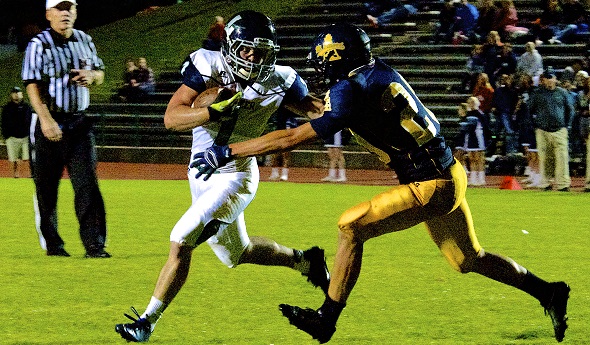
PHOTO: Lapeer, in its first season after former schools West and East combined this summer, is off to a 5-0 start. (Click to see more from HighSchoolSportsScene.com).

Drive for Detroit: Week 2 Preview
August 30, 2017
By Geoff Kimmerly
Second Half editor
The break was short for many teams heading into Week 2 of this football season.
 While last week’s openers were mostly split between Thursday and Friday, nearly all of Michigan’s teams will play this week’s games tonight in advance of the Labor Day holiday and start of school for many next Tuesday.
Below is our weekly look – powered by MI Student Aid – at some of the games to see no matter your neighborhood (relatively and regionally speaking) and includes games that will be played on Thursday, Friday and Saturday.
Remember, check out the MHSAA Score Center for the full schedule plus scores all three nights as they games are completed. A number of games also will be broadcast again this weekend, live, on MHSAA.tv.
Bay & Thumb
Almont (1-0) at Algonac (0-1), Thursday
After a couple of seasons at or near the top of Port Huron-area football, Algonac opened last week with a 42-6 loss to Marine City – its first non-Richmond regular-season defeat since 2014. Up next is Blue Water Area Conference rival Almont, no doubt aching to win big as well after taking four losses (two in the playoffs) from the Muskrats over the last two seasons. The Raiders are coming off a big win over 2016 playoff team Grosse Ile.
Others that caught my eye: THURSDAY Freeland (1-0) at Chesaning (1-0), Saginaw Heritage (1-0) at Flint Powers Catholic (1-0), Beaverton (1-0) at Harbor Beach (1-0), Lake Fenton (0-1) at Montrose (1-0).
Greater Detroit
Southfield Arts & Technology (0-1) at Clarkston (1-0), Friday
Southfield A&T came out on the losing end of arguably the most exciting game of opening weekend. But if its 56-54 triple-overtime defeat to powerful Davison told us anything, it’s that last year’s 8-4 finish could be just a start for the second-year program built from the former Southfield and Southfield-Lathrup. The Warriors beat Clarkston 24-18 a year ago, actually, but the Wolves appear in form already as well coming off a 42-7 win over Lapeer (27-5 over the last three seasons with two of those losses to Clarkston).
Others that caught my eye: THURSDAY Romeo (1-0) at Clinton Township Chippewa Valley (1-0), FRIDAY Toledo Whitmer, Ohio (1-0) at Detroit Catholic Central (1-0), East Kentwood (1-0) at Orchard Lake St. Mary's (0-1), Macomb Dakota (1-0) at Utica Eisenhower (1-0).
Mid-Michigan
Grand Ledge (1-0) at DeWitt (0-1), Thursday
The is the second year in a row the Lansing area’s most successful programs of the last decade have matched up (and the series will continue with DeWitt moving into the Capital Area Activities Conference Blue with Grand Ledge next fall). The Comets won last year’s meeting 28-21. Senior-dominated Grand Ledge impressed last week with a 41-14 win over Hudsonville, but a DeWitt team that put a number of new starters on the field last week also impressed coming back to nearly catch Grand Rapids Christian, on the road, before falling 38-30.
Others that caught my eye: THURSDAY Dearborn Divine Child (1-0) at East Lansing (1-0), Portland (1-0) at Lansing Sexton (1-0), Fulton (1-0) at Laingsburg (0-1), FRIDAY Beal City (1-0) at Clare (0-1).
Northern Lower Peninsula
Muskegon Catholic Central (0-0) at Frankfort (1-0), Friday
The anticipation for this one has been boiling over. Muskegon Catholic Central handed Frankfort its first and only loss last season, 35-0 in a Division 8 Regional Final at MCC on the way to winning a fourth straight MHSAA championship. The Panthers also got within 22-12 of MCC in a 2015 Regional Final, so there’s a nice build-up of history behind this meeting of small-school contenders. The Crusaders couldn’t lock down a Week 1 game this fall, so this is their season opener and the sophomore debut for heavily-followed quarterback Cameron Martinez. Frankfort did have a game in Week 1 and put up 70 points – its most in a game since 2004 – to down Manton by 30.
Others that caught my eye: THURSDAY St. Johns (0-1) at Cadillac (1-0), FRIDAY Newberry (1-0) at Gaylord St. Mary (1-0), Traverse City St. Francis (1-0) at Maple City Glen Lake (1-0), Escanaba (1-0) at Petoskey (0-1).
Southeast & Border
Pinckney (1-0) at Chelsea (1-0), Friday
Chelsea is 32-6 over its last three seasons and won all of its Southeastern Conference White games last season by at least 22 points. The Bulldogs will welcome Pinckney to the league Friday after the Pirates went 8-3 last season (their most wins since 1989) before coming over from the Kensington Lakes Activities Association West. Pinckney also had a coaching change in the offseason with defensive coordinator Rod Beaton getting a promotion, and his expertise will be especially handy this week. Chelsea 27 points last week on a Milan defense that gave up only 16 per game in 2016.
Others that caught my eye: THURSDAY New Haven (1-0) at Ida (1-0), Homer (1-0) at Concord (0-1), Petersburg-Summerfield (1-0) at Pittsford (1-0), FRIDAY Detroit Mumford (1-0) at Saline (0-1).
Southwest Corridor
Schoolcraft (1-0) at Berrien Springs (1-0), Thursday
Berrien Springs has been right on the verge of a big season over the last few, with three straight playoff appearances and a 17-5 record since the start of 2015. The Shamrocks looked ready to make this the year opening with a 53-0 win over Buchanan last week. But giving Schoolcraft its first regular season loss since 2014 would really make a statement. The Eagles are 20-2 going back to the start of 2015 and downed Fennville 41-0 to start this year’s campaign. If Schoolcraft comes through this one on top too, Berrien Springs still will have a few more opportunities to make noise – see Week 4 against Benton Harbor and Week 9 against Muskegon Oakridge.
Others that caught my eye: THURSDAY Coldwater (1-0) at Marshall (1-0), Battle Creek Central (0-1) at Portage Central (1-0), Paw Paw (1-0) at Sturgis (1-0), FRIDAY Grand Rapids South Christian (1-0) at Benton Harbor (0-1).
Upper Peninsula
Ishpeming (1-0) at Norway (1-0), Friday
The Hematites seem to be getting most of the tough ones out of the way early as they work back from last year’s 3-5 finish. Ishpeming started this fall by avenging a 2016 loss to Iron Mountain 34-7, and now comes Norway, which shut out the Hematites 14-0 last year. The slight difference this time is these teams are no longer in the same league, literally; the Knights left the Mid-Peninsula Conference for the Mid-Eastern Conference this season. They opened with a 34-7 nonleague win over Niagara (Wis.) after ending last fall as a District champ.
Others that caught my eye: THURSDAY Iron Mountain (0-1) at Gwinn (0-1), Calumet (1-0) at Negaunee (0-1), FRIDAY Traverse City Central (1-0) at Marquette (0-1), SATURDAY Munising (0-1) at St. Ignace (0-1).
West Michigan
Lowell (1-0) at Rockford (1-0), Friday
One of the best scheduling moves in the state in 2016 was the re-introduction of this matchup between two of the elite programs in all of the Grand Rapids area and statewide. Lowell won that first matchup since the end of a two-year series in 2011-12, 21-10, but it also was Rockford’s opener as it had to miss its Week 1 game last fall with a team-wide sickness. This time both teams have a win out of the way, and impressive ones on both sides. The Rams shut out Saline 14-0 to start, while the Red Arrows downed Warren DeLaSalle 36-6.
Others that caught my eye: THURSDAY Grand Rapids Christian (1-0) at Caledonia (1-0), Detroit Loyola (0-1) at Grand Rapids Catholic Central (1-0), Warren DeLaSalle (0-1) at Grandville (1-0), FRIDAY Muskegon Mona Shores (1-0) at Zeeland West (1-0).
8-Player
Crystal Falls Forest Park (0-1) at Powers North Central (1-0), Friday
At least the faces will look mostly different from those who more or less decided which was the best team in the Upper Peninsula (and arguably statewide) last season. Reigning two-time MHSAA champion North Central graduated the majority of its stars from the last two seasons including quarterback Jason Whitens, and Forest Park’s record-setting back Dan Nocerini is now playing at Michigan Tech. After losing only to North Central (twice) last season, the Trojans opened last week with a 38-36 defeat to Rapid River. But some of the same success could be brewing again for the Jets, who made it 27 straight victories with a 66-0 shutdown of Felch North Dickinson.
Others that caught my eye: THURSDAY Lawrence (1-0) at Deckerville (1-0), Mayville (1-0) at Morrice (1-0), North Adams-Jerome (1-0) at Battle Creek St. Philip (1-0), Wyoming Tri-unity Christian (0-1) at Suttons Bay (1-0).
Second Half’s weekly “Drive for Detroit” previews are powered by MI Student Aid, a part of the Student Financial Services Bureau located within the Michigan Department of Treasury. MI Student Aid encourages students to pursue postsecondary education by providing access to student financial resources and information, including various student financial assistance programs to help make college more affordable for Michigan students. MI Student Aid administers the state’s 529 savings programs (MET/MESP) and eight additional aid programs within its Student Scholarships and Grants division. Click for more information and connect with MI Student Aid on Facebook and Twitter @mistudentaid.
PHOTO: East Kentwood (with red trim) faces Orchard Lake St. Mary's this week after opening with a win against Harrison Township L'Anse Creuse. (Photo by John Johnson).