

Drive for Detroit: Week 5 in Review
September 30, 2019
By Geoff Kimmerly
Second Half editor
In case you missed it: The rain showed up again this weekend, turning the Week 5 football schedule into a two-day trudge for about 200 teams across Michigan.
 But that’s not what we’ll remember most.
The midpoint of this regular season was filled with great rivalry matchups, many decided by only a few points and one that finished with a 3-2 score. We also saw marathons that had nothing to do with thunderstorms – like Livonia Franklin navigating three overtimes to get past rival Churchill and West Bloomfield needing a fourth to edge Lake Orion.
All of it served to set up what’s next to come – a raft of teams clinching league championships over the final month, and a number of teams this week joining our first playoff qualifiers of 2019: Berrien Springs Farmington, Flint Hamady and Jackson Lumen Christi.
"Drive for Detroit" is sponsored by MI Student Aid.
Bay & Thumb
HEADLINER Frankenmuth 23, Saginaw Swan Valley 20 For the second straight week the Eagles (5-0) sent another Tri-Valley Conference East co-leader into second place, this time Swan Valley with a win that took two days to complete. The Eagles now sit alone atop the East standings with Freeland, Swan Valley (3-2) and this week’s opponent Essexville Garber all tied for second with one league loss. Click for more from the Saginaw News and see below for highlights from WJRT.
Frankenmuth leads Swan Valley in the 3rd of postponed game. They'll resume play on Saturday at Noon@FMuthAthletics @SwanValleySport @SwanValleyFball https://t.co/3vKm3EVWAp
— ABC12WJRT (@ABC12WJRT) September 28, 2019
Watch list Harbor Beach 29, Ubly 14 The Pirates (5-0) pulled within a win of claiming a piece of the Greater Thumb Conference East title after sharing it last season and winning it outright in 2017. Harbor Beach is putting up numbers like its MHSAA title contending days of last season and earlier this decade, outscoring opponents by a combined 226-31. Ubly (4-1) hadn’t given up more than 19 in a game until this one and was averaging 40.5 ppg.
Remember this one Goodrich 32, Ortonville Brandon 26 The Martians (4-1) set up a title-deciding matchup with Lake Fenton this week in the Flint Metro League “Lower” division by handing Ortonville Brandon (4-1) its first defeat. Brandon shared last year’s Metro title when the league was still unified for football before adding schools (including Goodrich) and splitting into divisions for this fall.
More shoutouts Fenton 35, Flint Kearsley 13 The Tigers have emerged as the lone first-place team in the Metro League “Upper” after sending Kearsley (4-1) into a tie for second with Linden and Flushing, Fenton’s opponents over the next two weeks, respectively. Saginaw Heritage 50, Midland Dow 15 The Hawks (3-2) just missed last season making the playoffs for the first time since 2007, but breaking a decade-long losing streak to Dow (2-3) might be the difference-maker this time.
Greater Detroit
HEADLINER West Bloomfield 59, Lake Orion 52 (4OT) The Oakland Activities Association Red has three teams at 4-1 midway through the season, and these are two of them after West Bloomfield prevailed in a matchup that tied for ninth highest-scoring overtime game in MHSAA history. The Lakers moved into first place alone in the league standings after coming back from a 10-point halftime deficit and with quarterback CJ Harris throwing for more than 200 yards and running for more than 190. Click for more from the Oakland Press.
Watch list Clinton Township Chippewa Valley 27, Macomb Dakota 21 The Big Reds (5-0) won their fifth straight over rival Dakota (3-2) and hold the top spot alone in the Macomb Area Conference Red as they look to continue their 19-game winning streak.
Remember this one Detroit Catholic Central 7, Bloomfield Hills Brother Rice 3 The Detroit Catholic League Central season is only a week old for DCC and Orchard Lake St. Mary’s, but those teams now have a one-game lead with the Shamrocks (3-2) handing Rice (4-1) its first defeat and the Eaglets edging Warren De La Salle Collegiate 16-14.
More shoutouts Brownstown Woodhaven 21, Allen Park 20 The Warriors (5-0) shared the Downriver League title last season despite losing to eventual third-place Allen Park (3-2), and now sit atop the league alone by avenging that defeat. Grosse Pointe South 35, Port Huron 0 Since falling Week 1 to Birmingham Groves, South (4-1) hasn’t lost – or given up a point – and handed Port Huron (4-1) its first defeat this week.
Mid-Michigan
HEADLINER Portland 21, Lansing Catholic 20 The Raiders (5-0) extended their Capital Area Activities Conference White winning streak to 24 in part by blocking an extra point during the final minutes that would’ve tied this game with the rival Cougars (4-1). The win also ran Portland’s streak in the series to five – something to keep in mind later as these two have met again in the playoffs the last two seasons. Click for more from the Lansing State Journal.
Watch list East Lansing 21, DeWitt 2 The Trojans (4-1) followed up their impressive Week 4 win over Portage Northern with another that could eventually earn them a league title. DeWitt (3-2) was the reigning CAAC Blue champ and downed East Lansing 37-0 last season. But the Trojans now sit alone atop the standings after just two league games, having ended a DeWitt league winning streak that stretched back to 2008 and across the Panthers’ time in the CAAC Blue, Red and Gold.
Remember this one Clare 3, Sanford Meridian 2 It’s a good guess those involved will not soon forget being part of such a low-scoring game that also meant a ton in the Jack Pine Conference standings. Clare (5-0) now sits tied with Beaverton for first place after stopping two drives by Meridian (4-1) deep into Pioneers territory during the final 10 minutes.
More shoutouts Mason 46, St. Johns 7 The Bulldogs are 5-0 for the first time since 2009 and set up a CAAC Red decider this week against Fowlerville by shutting down the Redwings (3-2). Breckenridge 38, Merrill 0 Since falling to Beaverton in Week 1, Breckenridge also is unbeaten and has outscored its last four opponents by a combined 178-8. Merrill (3-2) was averaging 32 ppg entering the weekend.
Northern Lower Peninsula
HEADLINER Charlevoix 37, Frankfort 15 With four wins this season, Charlevoix (4-1) has equaled their totals from the last two years combined. This week’s victory over Frankfort (2-3) was the first since 2014 and kept the Red Rayders tied for first in the Northern Michigan Football League Leaders title race with Week 8 opponent Maple City Glen Lake. Click for more from the Traverse City Record-Eagle.
Watch list Johannesburg-Lewiston 26, Tawas 14 The Cardinals (5-0) earned arguably the best win of a fast start and got some final prep for back-to-back games with Charlevoix and NMFL Legacy leader Harbor Springs. Tawas (3-2), playing eight games, must win two of the next three to guarantee a return to the playoffs.
Remember this one Houghton Lake 34, Lake City 14 The Bobcats (3-2) fell to Highland Conference leader Beat City in their Week 2 league opener, but kept pace in second place by getting past the Trojans (2-3).
More shoutouts Cadillac 26, Lake Odessa Lakewood 6 Like Charlevoix discussed above, Cadillac (3-2) has won as many games this fall as the last two combined and has a chance to make a run at a playoff spot. Mancelona 46, Elk Rapids 6 The Ironmen (3-2) are in position to make a run at their best finish and first playoff appearance since 2014.
Southeast & Border
HEADLINER Jackson Lumen Christi 21, Marshall 14 The Titans (5-0) took a big step toward wrapping up the Interstate 8 Athletic Conference title, bumping the Redhawks (4-1) out of a tie for first and with their final three league opponents a combined 4-11. Marshall kept pace for most of the game, with Lumen scoring the go-ahead touchdown in the third quarter before the teams held each other scoreless during the fourth.
Watch list Chelsea 13, Jackson 0 The Bulldogs (5-0) drew a step closer to clinching the Southeastern Conference White title by shutting out the reigning champion Vikings (3-2), which won the 2018 meeting 29-20. Chelsea’s final three league opponents are a combined 2-13.
Remember this one Hillsdale 10, Hudson 6 The Hornets (5-0) remain tied with Blissfield atop the Lenawee County Athletic Association standings after downing what has to be one of the state’s top 2-3 teams in Hudson, which has lost those games by a combined 32 points to teams a combined 13-2 this fall.
More shoutouts Pinckney 40, Ypsilanti Lincoln 14 The Pirates avenged last season’s loss to Lincoln to move to 4-1, eclipsing last year’s three victories while sending the Railsplitters to 2-3. Adrian Lenawee Christian 49, Grand Rapids NorthPointe Christian 8 Lenawee Christian (4-1) handed NorthPointe (4-1) its first defeat, and aside from a Week 2 loss to Sand Creek has outscored its other four opponents by a combined 201-8.
Southwest Corridor
HEADLINER Battle Creek Lakeview 35, Kalamazoo Central 7 The Spartans (5-0) clinched a share of the Southwestern Michigan Athletic Conference East title, avenging last season’s 21-13 loss to last season’s league champion Kalamazoo Central (2-3). Lakeview can finish an outright title run Week 8 against Kalamazoo Loy Norrix. Click for more from the Battle Creek Enquirer.
Watch list Portage Central 14, Stevensville Lakeshore 13 Both are chasing co-leaders Portage Northern and St. Joseph in the SMAC West and may not catch them. But both also are trying to extend playoff streaks – Central has made the postseason seven straight, and Lakeshore must win out to guarantee running their streak to 22 seasons. The Lancers are tied with Lumen Christi for the third-longest active playoff streak and sixth longest all-time.
Remember this one Schoolcraft 67, Delton Kellogg 14 The Eagles (5-0) are averaging nearly 60 points per game and turned up the offense to start the Southwestern Athletic Conference Valley season against a playoff regular the last few seasons in Delton (3-2).
More shoutouts Benton Harbor 28, Battle Creek Central 21 After three straight playoff seasons and a run of state and national recognition, Benton Harbor fell to 3-5 last fall – but has bounced back and improved to 3-2 with this win. Cassopolis 33, Decatur 11 The Rangers (5-0) gave up their first points of the season, but against a Decatur team that despite falling to 2-3 has a solid chance to earn its seventh playoff berth in nine seasons.
Upper Peninsula
HEADLINER L’Anse 14, Lake Linden-Hubbell 0 The Purple Hornets (4-1) will have to win at least one more game to have a shot at making the playoffs for the first time since 2013, and their final four opponents are a combined 16-4. But L’Anse has set itself up for success just about as well as possible, this shutout its first in two seasons and against a Lakes team that at 3-2 is in a similar boat as it works to get back to the postseason. Click for more from the Houghton Daily Mining Gazette.
Watch list Menominee 35, Boyne City 0 Last season was the rarest of rare for the Maroons, who finished below .500 and didn’t make the playoffs both for the first time since 1995. But Menominee has rebounded substantially, its only loss to a Kaukauna, Wis., team that is 5-1. Boyne City fell to 2-3, but is tied for the lead in the NMFL Legends division.
Remember this one Negaunee 40, Ishpeming 20 After a pair of losses to still-unbeaten Iron Mountain and Calumet to start the fall, Negaunee (3-2) has won three straight with its largest margin yet coming against the Hematites (3-2).
More shoutouts Sault Ste. Marie 24, Ogemaw Heights 12 The Blue Devils (4-1) are a win shy of equaling last year’s 5-4 finish and a candidate to make the playoffs for the first time since 2015, while Ogemaw Heights remains in the hunt for its first postseason berth since 2013. Escanaba 31, Kingsford 8 The Eskymos (4-1) bounced back from a painful loss to Marquette with their second-best defensive performance of the season in locking down the Flivvers (2-3).
West Michigan
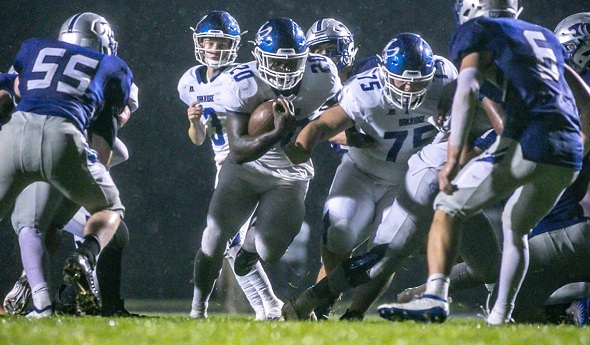
HEADLINER Muskegon Oakridge 15, Montague 13 (OT) One of the best rivalries in Michigan just keeps getting better. This time, Oakridge (5-0) emerged victorious by stopping Montague’s 2-point conversion try to tie in overtime. This close finish follows Montague’s one-point win a year ago and is the fourth meeting over the last five between these two to be decided by seven points or fewer. Oakridge and Ravenna now sit atop the West Michigan Conference standings, with Montague (4-1) one game back. Click for more from the Muskegon Chronicle and see highlights below from State Champs Sports Network.
VIDEO: Check out the highlights of the Muskegon Oakridge (@OakridgeFootba1) at Montague (@Gue_Football) football game from last night.
Brought to you by @LawrenceTechU, @MHSAA & @hungryhowies. pic.twitter.com/zzltqadsPT— STATE CHAMPS! (@statechampsnet) September 28, 2019
Watch list Byron Center 23, Zeeland West 22 We’ve talked up Byron Center (5-0) a bit in the early going this fall, but this win over Ottawa-Kent Conference Green powerhouse Zeeland West (4-1) is another major sign this could be a special season. This was the Bulldogs’ first win over the Dux since 2016, when Byron Center finished 10-2.
Remember this one Grandville 22, East Kentwood 21 The Bulldogs’ star continues to rise, and winning close against reigning O-K Red champion East Kentwood (3-2) could end up one the most important wins of the season as Grandville (5-0) looks to contend.
More shoutouts Zeeland East 42, Holland Christian 39 (OT) The two-time reigning champion Chix (4-1) just got past Holland Christian (2-3) to also remain undefeated in O-K Green play. Sparta 48, Grand Rapids West Catholic 7 The Spartans (4-1) took a serious step toward making the playoffs for the first time since 2013 and also can eye winning more than five games for the first time since 2011. Additionally, they hampered West Catholic’s hopes of extending its 16-year playoff streak. The Falcons (1-4) will have to win out to have the opportunity.
8-Player
HEADLINER Colon 42, Climax-Scotts 0 This was our featured 8-player matchup in Friday’s preview, and as noted then Climax-Scotts (4-1) had beaten Colon in 11-straight 11-player games before Colon switched to 8-player beginning with the 2018 season. The Magi (5-0) showed their superiority in this format, leaping a major hurdle as they run for a second straight Southern Central Athletic Association A championship. Click for more from JoeInsider.com.
Watch list Mio 32, Hillman 14 The Thunderbolts have gone from 17 straight losses in 11-player to a 4-1 start in 8-player and handing Hillman (4-1) its first defeat of this fall. The Tigers had beaten Mio in four straight before they took a year off when Hillman moved to 8-player a year ago.
Remember this one Cedarville 48, Brimley 6 The Trojans (3-2) kept themselves in the mix in what looks like a strong Great Lakes Conference East, bouncing back from a loss to Rapid River by handing Brimley (4-1) its lone defeat.
More shoutouts Bellevue 30, Camden-Frontier 12 The Broncos gave themselves a chance in the SCAA A with a second-straight big win heading into this week’s matchup with Colon. Camden-Frontier (3-2) gets Colon in two weeks. Tekonsha 56, Waldron 54 (OT) Tekonsha (3-2) held on to stay on top in the SCAA B as it looks to repeat, with Week 7 opponent Burr Oak the only other team unbeaten in league play.
Second Half’s weekly “Drive for Detroit” previews are powered by MI Student Aid, a part of the Office of Postsecondary Financial Planning located within the Michigan Department of Treasury. MI Student Aid encourages students to pursue postsecondary education by providing access to student financial resources and information. MI Student Aid administers the state’s 529 college savings programs (MET/MESP), as well as scholarship and grant programs that help make college Accessible, Affordable and Attainable for you. Connect with MI Student Aid at www.michigan.gov/mistudentaid and find more information on Facebook and Twitter @mistudentaid.
PHOTO: Muskegon Oakridge's Leroy Quinn (20) breaks through the line during his team's 15-13 win over rival Montague. (Photo by Tim Reilly.)

Fracassa's Remarkable Records Still Rule
By
Tom Markowski
Special for Second Half
June 24, 2020
As a senior at Sterling Heights Stevenson during the 2009 season, Jason Fracassa lit up the high school football world with his aerial display.
 Fracassa shattered the MHSAA career totals for passing yards and touchdowns held by Mill Coleman of Farmington Hills Harrison. Fracassa also etched his name into the national record book in three career passing categories before the remarkable run ended with a 31-21 loss to Detroit Catholic Central in the Division 1 Final at Ford Field.
The numbers he posted at Stevenson indeed were staggering. And just more than a decade later, after securing two undergraduate degrees and a masters in finance from Walsh University in Ohio, Fracassa lives in Auburn Hills and continues to crunch numbers – now for a development company in Birmingham – while also planning for a Sept. 12 wedding to fiancé Kelsey Torzy.
Fracassa has always been a highly-motivated person, and that held true in the classroom and as a three-sport varsity athlete and continues now in the business world. But while driven by success, Fracassa doesn’t dwell on what he accomplished in the sports world – which also included Division II college careers in both football and baseball. What was important then remains so now, and those are the relationships he built through trust, hard work and having a little fun.
“I miss going to practice each day and hanging out with my friends,” he said. “Just walking around school and trying to set an example to the kids, that’s what was important. I’ll go to the golf course now and I’m with all of my friends. That’s what it’s all about. That was the best part. We had the best relationships, no matter if we won or lost. Playing for Coach (Rick) Bye and your friends, that’s the best memories I have.”
A four-year varsity starter for Bye, Fracassa led Stevenson to a combined 23-3 record over his last two seasons, culminated by that fourth trip in program history to an MHSAA Final.
During his junior season, Fracassa threw for 3,353 yards and 34 touchdowns over 12 games. He then took aim at Coleman’s career passing records for touchdowns (77) and yards (7,464), records that had stood for 20 years.
 Fracassa and his teammates put on a show that 2009 season as he threw for 4,433 yards and 44 touchdowns. His career (10,615) and single season (4,433) passing yards remain MHSAA records, the career total by nearly 2,000 yards. Fracassa also continues to own the records for career passing attempts (1,104) and completions (656), accrued over 44 games, and he briefly held the MHSAA record for career TD passes with 97 before it was broken in 2013. The career attempts and yards and senior-season yardage all rank in the National Federation record book as well.
Fracassa credits the coaching staff at Stevenson for the success he and his teammates enjoyed. He couldn’t have imagined playing for anyone but Bye and his staff. Fracassa said he’s spoken with many of Bye’s former players, and they all agree playing for Stevenson and Bye was a phenomenal experience.
Like Fracassa, Bye – who retired after 2009 with a record of 268-94 over 35 seasons – also keeps tabs of his cronies by playing golf once a week with former assistants like Ken Fiott, Jerry Lajeunesse, Larry Zimmerman, Joe Emanuele and D.J. Hill among others. Bye is quick to point out that many of his former players, including Fracassa, keep in touch on a regular basis.
“I saw (Fracassa) at a Stevenson playoff game,” Bye said. “He calls me at least once every two months or so to see how I’m doing. I appreciate that. He was always a highly-respected kid. He’s not a kid anymore.”
Bye recalls hearing about Fracassa when Fracassa was in the eighth grade at St. Lawrence in Utica. Fracassa enrolled at Davis Junior High, Stevenson’s feeder school, for his ninth grade and tried out for the football team not knowing whether he’d make the varsity or not.
“His dad wasn’t pushy one bit,” Bye said. “(Rick Fracassa) asked if Jason was going to be on the JV. A big reason he wanted his son to come (to Stevenson) was Joe Emanuele, who was our baseball coach, and Rick knew Joe had a good program. He wanted Jason to play baseball, too.
“Jason came out and won the (quarterback) job. He proved himself. And he had to win over our seniors.”
Jason Fracassa said that was the hard part – convincing a group of seniors that a freshman could come in, start at quarterback and lead the team can be daunting.
“I knew I could compete at that level,” Fracassa said. “It was more of my getting to associate myself with the older players. That was the most difficult part. The coaches were always there to back me.”
 Stevenson made the playoffs that 2006 season finishing 5-5. The next season was rough as the Titans lost a number of close games and finished 2-7. Stevenson improved substantially to 10-2 in 2008, losing to Lake Orion, 38-36, in a Regional Final.
That all built up to the memorable 2009 season, which included a tense Semifinal game against Clarkston won by Stevenson 37-35 on a Fracassa scoring pass on the final play.
Emotions also ran high the game before when Stevenson took on Detroit Public School League power Detroit Southeastern, led by Michigan State-bound and now-NFL defensive end William Gholston. Fracassa threw for a career-high 494 yards, and Stevenson defeated Southeastern, 38-32.
After a busy and accomplished prep career, Fracassa maintained a hectic athletic schedule in college first at Northwood University – where he started on the baseball team for three seasons and was a member of the football team for two.
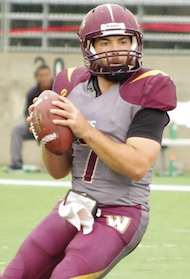
After sitting out a term, Fracassa transferred to Walsh, located in North Canton, Ohio. There he revived his football career starting at quarterback his last two years. Walsh, then a recent addition to the Great Lakes Intercollegiate Athletic Conference, nearly upset conference power and undefeated Ferris State in Fracassa’s final game. Fracassa threw his second touchdown pass of the game to give Walsh a 42-32 lead with 9:38 left before Ferris State came back with two touchdowns, the second with 36 seconds left, to win 46-42.
Fracassa hasn’t completely abandoned football since his last game at Walsh. He and his father coached the Oakland University club team in 2018 and that team reached a championship game. Jason was the offensive coordinator, his father the head coach – branches from the coaching tree rooted with Jason’s grandfather Al Fracassa, the second-winningest high school football coach in MHSAA history and Bloomfield Hills Brother Rice legend.
Jason’s competitive juices continue to flow.
“We had a great run,” Fracassa said, “and any other year could have taken the championship trophy.”
Made in Michigan 2020
June 16: Muskegon Grad Casts "Magic" in HBO Series - Read
 Tom Markowski is a correspondent for the State Champs! Sports Network and previously directed its web coverage. He also covered primarily high school sports for the The Detroit News from 1984-2014, focusing on the Detroit area and contributing to statewide coverage of football and basketball. Contact him at [email protected] with story ideas for Oakland, Macomb and Wayne counties.
PHOTOS: (Top) Jason Fracassa rolls out during the 2009 Division I championship game at Ford Field. (Middle) Fracassa and fiancé Kelsey Torzy. (Below) Fracassa drops back to pass while playing for Walsh. (Middle and below photos courtesy of Jason Fracassa.)