

Drive for Detroit: Week 6 in Review
October 5, 2015
By Geoff Kimmerly
Second Half editor
A dramatic event like an emotion-sapping comeback often will steer a team to greater heights as it moves toward the most important games of the season.
That would be good news for some of this week's most impressive football winners.
Traverse City Central trailed 21-0 before beating Petoskey in overtime; Grand Rapids Christian was down 26-0 before winning in OT as well. Calumet trailed Iron River West Iron County 22-0 at halftime before unloading 40 unanswered points, while Northville came back from 14-0 and Muskegon Catholic Central 13-0 to win their likely league title-deciding games.
Those five and a number of others are discussed below – as are a large handful of the 56 11-player teams that have clinched spots in this season's playoff field.
Bay & Thumb
Flint Beecher 27, Lake Fenton 26 (OT)
While a 20-8 Week 5 loss to upstart Corunna no doubt stunned Beecher a bit, the reigning champ Buccaneers came right back to edge Lake Fenton to remain a half-win ahead of the pack in the Genesee Area Conference Red. Beecher is 4-1 in the league with rival Montrose remaining; Corunna, Goodrich and Lake Fenton all are 3-1 in league play with two more games. Beecher made a two-point conversion in overtime, then stopped Lake Fenton’s conversion attempt. Click for more from the Flint Journal.
Also noted:
Algonac 33, Croswell-Lexington 21 – The Muskrats (6-0) gave up their first points since Week 2, but stayed on pace to face Almont this week to decide the Blue Water Area Conference title while dropping Croswell-Lexington (4-2) to fourth place.
Sandusky 48, Marlette 6 – The Redskins (6-0) remained a game ahead of the pack in the Greater Thumb Conference East while putting Marlette (3-3) in a must-win situation to make the playoffs.
Vassar 56, Cass City 21 – The Vulcans (5-1) will face Unionville-Sebewaing this week for first place in the GTC West, but Cass City (4-2) still looks good to make the playoffs for the second straight season.
Burton Bendle 34, Flint Hamady 26 – The Tigers (5-1) pulled within a win of qualifying for the playoffs after going 3-6 a year ago, handing Hamady (5-1) the only loss during what has been its best season since 2012.
Greater Detroit
Northville 24, Livonia Stevenson 14
Since the formation of the Kensington Lakes Activities Association in 2008, Northville is 32-6 in league games – with half of those losses coming to Stevenson. This avenging of last season’s 46-21 loss to the Spartans gave Northville (6-0) a share of the KLAA Central title, although Stevenson (5-1) can still hope for a claim with the Mustangs needing to beat also second-place Novi this week to finish an outright title run. Click for more from MLive-Detroit.
Also noted:
Bloomfield Hills Cranbrook Kingswood 14, Riverview Gabriel Richard 13 – The Cranes (6-0) have equaled their most wins in a season since 2005 and remain tied with Waterford Our Lady atop the Detroit Catholic League C-D standings after pushing Gabriel Richard (5-1) to third.
Allen Park 23, Trenton 13 – The Downriver League is back to a three-team race, with this result bringing Trenton (5-1) back into a tie with Allen Park (5-1) and Wyandotte Roosevelt for first.
Walled Lake Western 34, Walled Lake Northern 31 – The Warriors (6-0) clinched a share of the KLAA North title but not before the Knights (4-2) provided their toughest test since opening night.
Sterling Heights 25, Marine City 19 – In three seasons as a league opponent, the closest Sterling Heights (5-1) had come to Marine City (3-3) was 24 points before claiming this victory to take a one-game lead over three teams in the Macomb Area Conference Gold.
Mid-Michigan
Hartland 14, Brighton 7
The KLAA West title will come down to this week thanks to the Eagles’ win over Brighton (5-1), which created a three-way tie atop the division standings with Howell. Hartland (4-2) shared the league title a year ago, but fell to Howell in this season’s West opener. Brighton gets Howell this week, while Hartland takes on reigning co-champion Grand Blanc. Click for more from the Livingston Daily.
Also noted:
Fowlerville 31, Williamston 28 – The Gladiators’ upset of the Hornets pushed them to 3-3, guaranteeing their most wins in a season since 2010, while putting Williamston (4-2) in a tougher spot with Portland, Haslett and Lake Fenton to finish.
Holt 14, Lansing Sexton 13 – The Rams’ resurgence continued as they moved to 4-2, but it’s hard to not feel for the Big Reds, who are 1-5 but with two one-point losses and a third by two points.
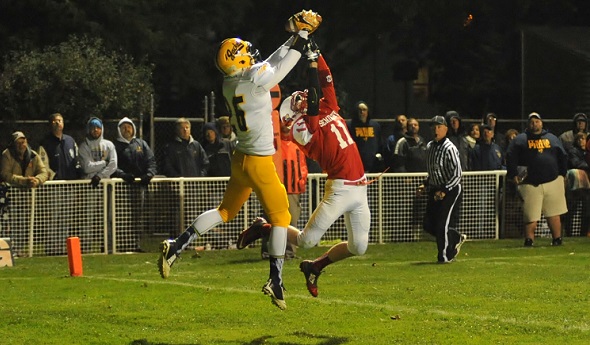
Ithaca 38, Saginaw Michigan Lutheran Seminary 0 – The challenge didn’t come as expected, with Ithaca (6-0) handing MLS (5-1) its first loss and pulling within a win of clinching another Tri-Valley Conference West title.
DeWitt 27, Haslett 10 – The Panthers (6-0) have yet to give up more than 14 points this season, although Haslett (3-3) did hold DeWitt to its season low on offense.
Northern Lower Peninsula
Traverse City Central 28, Petoskey 27 (OT)
The Trojans (6-0) came all the way back from three scores down and stopped a two-point conversion run in overtime to remain atop the Big North Conference, one game ahead of three teams including Petoskey (4-2). Traverse City Central’s last four wins have come by seven points or fewer, and it had lost to the Northmen the last two seasons. Click for more from the Traverse City Record-Eagle.
Also noted:
Beal City 42, McBain 22 – The Aggies (5-1) bounced back from last week’s shocking loss to Evart to stay tied for first with McBain (4-2) in the Highland Conference with one league game left for both.
Traverse City St. Francis 63, Grayling 28 – The Gladiators (6-0) all but locked up the Northern Michigan Football Conference Leaders title with their win over Grayling (4-2) giving them victories over both second-place teams.
Reed City 22, Big Rapids 7 – The Coyotes (6-0) remain tied for first in the Central State Activities Association Gold, while Big Rapids (4-2) moved to third but with a chance to stay in the hunt this week against co-leader Remus Chippewa Hills.
Johannesburg-Lewiston 58, Detroit Consortium 30 – Logan Huff did a lot of everything for the Cardinals (5-1), running eight times for 245 yards and three touchdowns, leading the team with 11 tackles and grabbing an interception against Consortium (2-4).
Southeast & Border
Saline 37, Ann Arbor Pioneer 21
Saline remained in control of the Southeastern Conference Red winning a game that played much closer than the final 16-point margin. Pioneer (5-1) scored the first points the Hornets had given up since Week 3. But Saline (6-0) took advantage of a few key Pioneer errors to clinch a share of the league title with third-place Monroe the last team on the league schedule. Click for more from the Detroit Free Press.
Also noted:
Temperance Bedford 34, Monroe 28 – If the Mules (2-4) get into the playoffs with an at-large bid, edging the Trojans (3-3) might be a big reason why.
Parma Western 28, Battle Creek Harper Creek 25 – Defeating Harper Creek (3-3) could go down as the key victory of a milestone season for the Panthers; Western (4-2) needs two more wins to qualify for the playoffs for the first time, and its Week 8 and 9 opponents are a combined 0-12.
Homer 46, Springport 0 – The Trojans (5-1) pulled to within a win of clinching a share of the Big Eight Conference title, while putting Springport (3-3) into a must-win situation the rest of the way.
Ypsilanti Community 30, Ypsilanti Lincoln 12 – The Grizzlies (3-3) won their third straight and get a shot at first-place Chelsea this week to earn a share of the Southwestern Conference White championship; Lincoln (2-4) must win out to have a slim shot at making the playoffs for the third straight season.
Southwest Corridor
Coldwater 26, Jackson Lumen Christi 7
The Cardinals (6-0) had lost at least 27 straight to Lumen Christi (4-2) and including the game that decided last season’s inaugural Interstate 8 Athletic Conference championship. But this historical win puts Coldwater only one from clinching a share of the league title and in the playoffs for the third straight season; the Cardinals only qualified for the first time in 2013. Click for more from the Coldwater Daily Reporter.
Also noted:
Climax-Scotts 36, Pittsford 0 – Make that 43 straight in the Southern Central Athletic Association for Climax-Scotts (6-0), plus a share of the league title with Pittsford (5-1) one of two teams in second place.
Watervliet 55, Constantine 34 – The Panthers (5-1) kept pace with Delton Kellogg atop the Southwestern Athletic Conference Division 1 while knocking Constantine (3-3) out of the title race.
Plainwell 17, Dowagiac 8 – The Trojans (4-2) have stayed in the upper half of a tough Wolverine B Conference that combined two divisions into one this fall, with Dowagiac (3-3) tied for fifth of 10 teams.
Schoolcraft 47, Lawton 0 – Schoolcraft (6-0) earned a second straight shutout, but this week's much more significant as Lawton (5-1) also entered undefeated and tied for first in the SAC Division 2.
Upper Peninsula
Calumet 40, Iron River West Iron County 22
Reigning Western Peninsula Athletic Conference champion West Iron (1-5) is not the same team this fall. But the Wykons still gave Calumet (4-2) all it could handle as the Copper Kings came back to give themselves a chance to claim the league title this week against co-leader L’Anse. Click for more from the Houghton Daily Mining Gazette.
Also noted:
Sault Ste. Marie 37, Gladstone 27 – The Blue Devils (4-2) continue to line themselves up to return to the playoffs, while Gladstone (2-4) must end a four-game slide to have an at-large shot.
Kingsford 49, Marquette 7 – The Flivvers (4-2) ended a two-game losing streak to Marquette, and may have ended any hope of the Redmen (2-4) returning to the playoffs.
Newberry 50, Gaylord St. Mary 26 – The Indians pulled within a win of tying last season’s total and two from its highest victory count since going 6-3 in 2005.
Hurley, Wis. 52, Bark River-Harris 34 – This didn’t have league implications, but was the first loss of an otherwise stellar season so far for the Broncos (5-1).
West Michigan
Muskegon Catholic Central 29, Fruitport 26
The Lakes 8 Conference championship will belong at least in part to MCC (4-1), which claimed a share against second-place Fruitport (3-3) on a go-ahead touchdown pass with less than a minute to play. The Crusaders have earned at least a share of the league title both seasons in the conference. Click for more from the Muskegon Chronicle.
Also noted:
Grand Rapids Christian 39, East Grand Rapids 33 (OT) – The Eagles (4-2) made the biggest comeback of all teams mentioned above, and with it retained a first-place tie with Lowell while East Grand Rapids (4-2) fell into a tie for third in the Ottawa-Kent Conference White.
Hudsonville 22, East Kentwood 13 – Four teams including both of these still have a shot in the O-K Red, but sharing first with Rockford is a nice spot for Hudsonville (5-1), especially if East Kentwood (4-2) can help with the Rams this week.
Scottville Mason County Central 39, Manistee 6 – The Spartans (4-2) get overlooked a bit in the strong West Michigan Conference, but handing Manistee (5-1) its first loss is headline-worthy.
Cedar Springs 34, Grand Rapids Forest Hills Northern 8 – The reigning O-K Bronze champion Red Hawks (4-2) are again tied with Forest Hills Eastern for first after delivering the first loss this fall to Forest Hills Northern (5-1), which was emerging as the favorite.
8-Player
Posen 28, Cedarville 26
This is more than just the best win of Posen’s six-year 8-player history; it’s arguably the most momentous victory for the Vikings (6-0) in some time. Posen is 6-0, tying its most wins in a season total since going 8-4 in 2004, and joined Rapid River as the only teams to defeat reigning MHSAA runner-up Cedarville (4-2) during the regular season since 2011. Click for more from the Alpena News.
Also noted:
Battle Creek St. Philip 49, Webberville 0 – Webberville (4-2) continues to improve, but St. Philip (6-0) remains among a handful of championship contenders.
Morrice 34, Deckerville 30 – This definitely is the most impressive win in two seasons of 8-player for the Orioles (5-1), as no opponent had come within 20 points of the Eagles (5-1) this fall.
PHOTO: Ithaca, in yellow, won a battle of undefeated teams by downing Saginaw Michigan Lutheran Seminary on Friday. (Click for more from HighSchoolSportsScene.com.)
MCC Extends Streak, Hands Off Legacy
November 25, 2016
By Geoff Kimmerly
Second Half editor
DETROIT – A trio of running backs who played major roles in Muskegon Catholic Central’s last three MHSAA championships closed their high school careers celebrating the school’s fourth straight title Friday.
Along the way, they also handed off the program’s future.
Seniors LaTommy Scott, Logan Helton and Walker Christofferson had become Ford Field fixtures the last few seasons, and each contributed to their combined four touchdowns in this Division 8 Final. But the fifth score of MCC’s 35-6 victory over Ottawa Lake Whiteford was scored by a freshman who will take over from here – and showed the promise that makes the Crusaders look good to continue these annual trips to Detroit.
Splitting time at quarterback with senior Trenton Bordeaux, freshman Cameron Martinez ran for a team-high 154 yards and a touchdown and threw for 61 yards and a score to help MCC pull into a tie for second all-time with its 12th MHSAA football title.
Although a freshman, the scene wasn’t entirely unfamiliar for Martinez; his brother Christian had quarterbacked the team to its 11th title last year as a senior.
“Every time we made it, I was watching from the crowd. I couldn’t wait to put on the gold helmet and bring this team back again,” Cameron Martinez said. “I love this group of seniors. I’m going to miss them, and that’s what I wanted to do – give them their fourth straight title.”
With four straight, the Crusaders (14-0) are now one shy of the MHSAA record of five consecutive titles shared by the Farmington Hills Harrison teams from 1997-2001 and East Grand Rapids’ teams from 2006-10. With 12 championships total, MCC is tied with now-closed Detroit St. Martin dePorres for second most in the sport, one behind Harrison’s record 13 football titles.
Martinez entered the Final third on the team with 614 rushing yards, tallying 12 touchdowns on the ground, and second to Bordeaux with 540 passing yards plus nine scoring passes. Also a starting linebacker, he didn’t play offense in MCC’s 35-0 Semifinal win over St. Ignace last week. But he was impacting the Crusaders’ offense by the end of Friday’s first quarter.
Martinez’ first carry came on the final play of that quarter, for three yards, and he opened the second with a 26-yard run. He also had a 19-yard run and 23-yard pass to set up Helton’s five-yard scoring run that put the first points on the board with 9:05 to go in the first half.
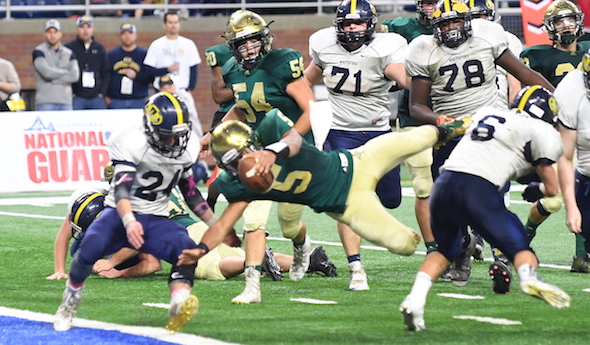
After coming up shy on another drive late in the half and then pushing the score to 14-6 on a 35-yard Helton run to cap its first possession of the second, MCC made it 21-6 with 3:08 to play in the third quarter with a drive that included 55 rush yards on five Martinez carries, including the final one for three yards into the end zone.
“Anytime you have a running quarterback, you have to defend 11 and not 10; it’s just simple math sometimes,” MCC coach Steve Czerwon said. “Having somebody in the backfield as dynamic as Cameron, with the ability to make plays … people are like, ‘He’s a freshman.’ Well, he’s a freshman, fine. But he doesn’t play like a freshman.”
 MCC welcomed its captains from the last three seasons to Thursday’s practice, and after, Czerwon asked Christian Martinez if he was nervous for his brother. Christian’s response to Czerwon: “Nah, he’s made for these big moments.”
“After he said that – and he knows him a heck of a lot better than I do – I felt good about using him today,” Czerwon added. “And I thought he performed very well.”
So did those seniors. Helton ran seven times for 67 yards and those two scores, and Scott ran eight times for 69 yards and scored on the 25-yard touchdown “pass” which was more of a front pitch on a sweep around the left side. Christofferson, who ran for 200 yards and three touchdowns in the Semifinal win, added the day’s final score with 1:04 to play.
Helton, also a linebacker, had 10 tackles and Christofferson, a defensive back, had seven to follow up all-state senior linebacker Andrew Schulte's team-leading 13. The Crusaders never trailed this season, and the defense was a big reason why; including 13 points surrendered over five playoff games, MCC allowed only 77 points this fall (5.5 per game).
But Friday’s score didn’t tell well how close this matchup was for most of it. Whiteford had six turnovers on downs, falling short of first downs by only a yard four times. Twice, MCC sophomore defensive back Dawson Steigman made rally-ending stops. Three of the fourth-down misses came in Crusaders territory.
Whiteford junior quarterback Thomas Eitniear was especially impressive, completing 7 of 10 passes for 96 yards and running nine times for 111 yards including the team’s lone score, an 81-yard sprint around the left end that made it 7-6 with 2:37 to go in the first half.
“Coming into halftime, that was the exact kind of game we were looking to play – to chew clock, and we just didn’t articulate a couple of our possessions into scores,” Whiteford coach Jason Mensing said. “Second half, they found some things offensively against us and took advantage. And on top of that, we didn’t articulate our drives as well.
“Overall, I’m pleased with the effort and passion, and probably the thing I’m most proud of was I didn’t feel like the moment was too big for our kids, which oftentimes you get into this type of stage, the moment can be a little large. I thought our kids handled themselves with great composure, and that’s one of those attributes for life that really matters.”
Whiteford made its first appearance in an MHSAA Final, following up its second straight – and second ever – Semifinal appearance. The Bobcats finished 13-1.
“Me and a bunch of the senior guys, we dreamed about this since freshman year,” said senior running back Jesse Kiefer, who finished as the school’s career record holder in rushing yards, points and total offense. “Coming in and being able to play on this field, it’s just not real to me. Obviously, we wanted it to come out a different way than this, but it’s still an experience I’ll never forget.”
Kiefer had seven tackles at linebacker, following senior safety Herbie Bertz’ 13 and junior tackle Jared Atherton’s eight. Kiefer also broke up three passes.
With it being their last, MCC’s seniors asked to not come out of this game early as they have most of this season with the Crusaders beating all of their opponents by at least two touchdowns.
But as they left Ford Field once more, surrounded by 13 underclassmen, they were confident with who might lead MCC back next time.
“Handing it off the Cameron, our program is in good hands,” Helton said. “I don’t expect anything less than what we’ve been doing.”
The MHSAA Football Finals are sponsored by the Michigan National Guard.
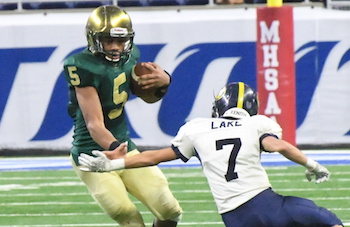
PHOTOS: (Top) Muskegon Catholic Central’s Cameron Martinez stretches toward the goal line for a score late in the third quarter. (Middle) Martinez works to elude Whiteford’s Hunter Lake.