

Drive for Detroit: Week 6 in Review
October 2, 2017
By Geoff Kimmerly
Second Half editor
New powers continued to rise all over Michigan during Week 6 of the football regular season.
 A few did so with spectacular upsets, while others broke streaks that had grown to include multiple seasons – or in one case, stretched nearly two decades.
The Drive for Detroit report powered by MI Student Aid details the most intriguing 11-player results from eight regions across our state plus the best from 8-player every week – and this week’s headliners are the most riveting, as a group, so far in 2017.
Bay & Thumb
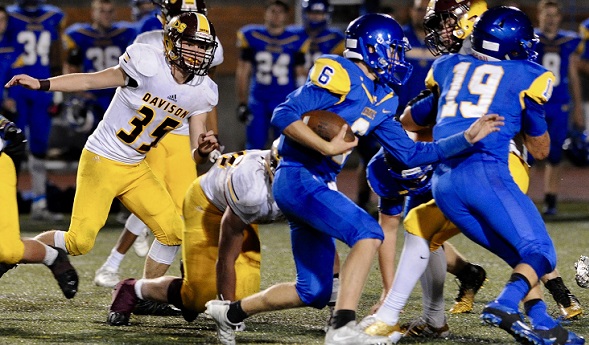
Midland 39, Davison 25
Among the state’s elite in the near past, Midland entered this fall with two 4-5 finishes over the last three seasons (surrounding a 7-3 in 2015). But this win made lots of noise as Davison (5-1) hadn’t lost a regular-season game since 2015 and shut out the Chemics 20-0 last fall. Midland (5-1) and Lapeer now sit atop the Saginaw Valley League Blue standings and meet Week 8. Click for more from the Midland Daily News.
This Methner TD with :12.5 left makes the score 39-25 and seals it for the Chemics. pic.twitter.com/R8NPrEmoql
— Midland Chemics (@midlandchemics) September 30, 2017
Also noted:
Goodrich 41, Corunna 27 – The Martians (5-1) held onto their chance to grab a share of the Genesee Area Conference Red title and will cheer for Corunna (3-3) this week as the Cavaliers take on leader Lake Fenton.
Richmond 17, Almont 7 – The Blue Water Area Conference is down to a two-team race as Richmond (6-0) and Algonac are in first and Almont (4-2) has lost to both; the leaders meet in Week 8.
Flint Carman-Ainsworth 41, Bay City Central 31 – These Cavaliers (4-2) have won three straight to move into first place alone in the SVL Red, with Central (3-3) and Week 8 opponent Midland Dow a win back.
Unionville-Sebewaing 30, Reese 14 – USA (4-2) put itself in position to create a two or even three-way tie for the Greater Thumb Conference West title with leader Elkton-Pigeon-Bay Port Laker up next; Reese (3-3) is fighting for a playoff spot.
Greater Detroit
Belleville 35, Dearborn Fordson 7
Belleville not only clinched a share of the Western Wayne Athletic Conference Red title and earned a playoff berth by downing the co-leading Tractors (5-1), but the Tigers (6-0) make an even louder statement as a contender in Division 1. They are 6-0 for the first time since 2002 after also making the playoffs the last two seasons, and they’ve now given up just 13 points over their last five games. Fordson hadn’t given up more than 14 in a game this season. Click for more from the Detroit News.
ICYMI: Belleville improved to 6-0 on the season with a 35-7 win over Fordson on Friday night! Watch the highlights here! @JermainCrowell pic.twitter.com/FC61NZ7VfY
— STATE CHAMPS! (@statechampsnet) September 30, 2017
Also noted:
Detroit Martin Luther King 27, Detroit Denby 6 – The Crusaders (5-1) earned a share of the Detroit Public School League Black division title while handing Denby (4-1) its first loss in league play and overall.
Rochester Adams 38, Southfield Arts & Technology 14 – The Highlanders (5-1) remain part of a three-team first-place tie in the Oakland Activities Association Red after handing this loss to what has to be one of the best 3-3 teams in the state in the Warriors.
Warren DeLaSalle 52, Dearborn Divine Child 14 – Both could finish first in their respective Detroit Catholic League divisions, and DeLaSalle (5-1) if it wins out would have little argument as the overall best after handing Divine Child (5-1) its only loss so far.
Romulus 31, Redford Thurston 22 – The Eagles (4-2), which finished second in the WWAC Red last year, clinched a share of the WWAC Blue title while sending Thurston (4-2) into a tie for second place
Mid-Michigan
Olivet 34, Lake Odessa Lakewood 6
Lakewood (5-1) had won 15 straight league games and the last two championships after Olivet won the first-ever Greater Lansing Activities Conference title in 2014. The Eagles (6-0) have been on the verge though, with their only league losses the last two seasons to the Vikings. Olivet can clinch the championship outright this week against Stockbridge. Click for more from FOX17.
Also noted:
Alma 21, Freeland 7 – The Panthers (6-0) broke a four-game losing streak to the Falcons (4-2), keeping alive a Tri-Valley Conference Central title showdown possibility against Saginaw Swan Valley in Week 8.
Belding 35, Grand Rapids NorthPointe Christian 21 – The Ottawa-Kent Conference Silver race got whittled down this weekend and Belding (5-1) remains one of two co-leaders, while NorthPointe (5-1) is poised to claim a share if both falter over the final three games.
Breckenridge 27, Carson City-Crystal 26 – The Huskies (5-1) remain perfect in the Mid-State Activities Conference since joining the league last season; a win by Carson City-Crystal (3-3) would’ve created a three-way tie for first.
Pewamo-Westphalia 32, Laingsburg 11 – The Pirates (5-1) got one win away from clinching a third straight Central Michigan Athletic Conference title by upending the second-place Wolfpack (4-2).
Northern Lower Peninsula
Maple City Glen Lake 48, Frankfort 34
A five-point loss to Frankfort cost Glen Lake (3-2) the Northern Michigan Football Conference Leaders title in 2016, even as the Lakers went on to play at Ford Field and finish runner-up in Division 6. But they clinched a share of the 2017 league title with this victory, and with only winless Mancelona standing in the way of an outright championship. Frankfort (4-2) had won 11 straight league games dating to the start of the 2014 NMFC schedule. Click for more from the Traverse City Record-Eagle.
Also noted:
Boyne City 34, Kalkaska 13 – The Ramblers (6-0) held on to a share of first place in the NMFC Legends division by handing Kalkaska (3-3) its third straight defeat.
Traverse City St. Francis 49, Grayling 22 – The Gladiators (6-0) kept pace with Boyne City, handing Grayling (4-2) a second straight loss as the leaders continued to point to a possible league decider in Week 9.
AuGres-Sims 54, Whittemore-Prescott 14 – The Wolverines (6-0) clinched a share of the North Star League title after finishing second a year ago, and may also have dealt the blow to end the Cardinals’ 10-year playoff streak; Whittemore-Prescott is 2-4 and must win out for a chance at an at-large bid.
Traverse City West 30, Benton Harbor 13 – The Titans (6-0) equaled their win total from last season and already their most victories since 2004, while also putting Benton Harbor (2-4) in a position where it must win out to have a hope of a third straight playoff berth.
Southeast & Border
Reading 36, Union City 12
The Rangers, coming off back-to-back 3-6 seasons, are one win from claiming a share of the Big 8 Conference title after downing second-place Union City. Reading (5-1) hasn’t lost this season since opening night, and its final two league opponents are a combined 2-10. Union City also is 5-1 and enjoying a great rebound after going 2-7 last fall and 4-5 in 2015. Click for more from the Hillsdale Daily News.
Also noted:
Ottawa Lake Whiteford 51, Morenci 8 – Whiteford turned away what looked to be its most formidable challenge so far in the Tri-County Conference, sending Morenci to 3-3 overall and second place in the standings.
Clinton 28, Petersburg-Summerfield 24 – Clinton (4-2) is tied for second in the TCC and stayed in line for a Week 8 title-deciding date with Whiteford by jumping above the Bulldogs (4-2), who fell to fourth place.
Pinckney 35, Tecumseh 10 – The Pirates (5-1) held on to a tie for first in the Southeastern Conference White while putting Tecumseh (3-3) in a spot to win out to guarantee a playoff berth for the first time since 2014.
Saline 42, Monroe 14 – The Hornets (5-1) clinched a share of the SEC Red title and face co-second place Ann Arbor Pioneer this week; Monroe (3-3) is aiming to win out to make it back to the playoffs after missing a year ago.
Southwest Corridor
Stevensville Lakeshore 30, Portage Northern 27
In its closest Southwestern Michigan Athletic Conference West game so far this season, Lakeshore clinched a share of the league title and avenged last season’s three-point loss to the Huskies. The Lancers also moved to 6-0 for the first time since 2012 and secured a 20th straight playoff berth. Northern (2-4) continued a heart-breaking string, with three of their losses by a combined nine points. Click for more from the St. Joseph Herald-Palladium.
Also noted:
Climax-Scotts 60, Adrian Lenawee Christian 29 – The Panthers (5-1) remained tied for first in the Southern Central Athletic Association by handing Lenawee Christian (4-2) its second loss in three weeks.
Berrien Springs 59, Parchment 6 – The Shamrocks (5-1) clinched a share of the Berrien-Cass-St. Joseph White title with their third game of 50 or more points; Parchment (4-2) remains two wins from guaranteeing its first playoff berth since 2013.
Schoolcraft 35, Constantine 8 – This rivalry win by the Eagles (5-1), combined with the result below, helped put Schoolcraft into a first-place tie with only Watervliet in the Southwestern Athletic Conference Valley; Constantine (3-3) must win out to guarantee adding to its 18-year playoff streak.
Kalamazoo United 28, Coloma 27 – After falling to Watervliet in Week 5, United (5-1) dealt a disappointing blow to the much-improved Comets (4-2).
Upper Peninsula
Escanaba 42, Menominee 21
The streak is over; the Eskymos (5-1) downed Menominee for the first time since 1998 in the 122nd meeting between the Great Northern Conference rivals. And the win was impressive – the reigning champion Maroons hadn’t given up 42 points in a league game since 2008. Although it was the GNC opener for Menominee, Escanaba had already played two league games and with this win set up a potential league title matchup with Kingsford in Week 9 – although the Flivvers, 2-0 in GNC play, must first face the Maroons in Week 8. Click for more from the Escanaba Daily Press.
Also noted:
Iron River West Iron County 53, Calumet 20 – The Wykons (5-1) remain the only team undefeated in West Peninsula Athletic Conference play, while reigning champ Calumet (3-3) has lost three of four and needs to win out to extend a three-year playoff streak.
Bessemer Gogebic 26, L'Anse 7 – The first half of this season was tough for the Miners (2-4), but they’ve doubled last season’s win total and still have a playoff shot after stunning the Purple Hornets (4-2).
Negaunee 21, Ishpeming 14 – What a turnaround for these Miners; after opening 0-3, Negaunee is 3-3 and put Ishpeming (2-4) in a position of needing to win out for a chance at an at-large playoff bid.
Lake Linden-Hubbell 24, Bark River-Harris 12 – The Lakes also are riding a comeback wave; they opened 0-3, but after having no game Week 4 have won two straight and this time put Bark River-Harris (3-3) into a must-win playoff situation.
West Michigan
East Grand Rapids 28, Grand Rapids Christian 7
Reigning champion East Grand Rapids (6-0) took command of the Ottawa-Kent Conference Gold again by beating the Eagles by an identical score as in last year’s game, which also ended up deciding the league title. EGR lowered its points allowed average to 8.2 per game this fall. Still, this may not be over. Christian (5-1) is one of three teams one win behind in the league standings, and the Pioneers still must play the other two. Click for more from the Grand Rapids Press.
Also noted:
Rockford 27, Grandville 0 – The Rams lined up an O-K Red battle for first place this week against Holland West Ottawa by handing Grandville (4-2) its first league loss; depending on how this week goes, all three could end up sharing the title after Rockford and Grandville did so with Hudsonville in 2016.
Cedar Springs 28, Lowell 14 – It’s odd to call this an upset when Cedar Springs is 4-2, but Lowell (also 4-2) hadn’t lost an O-K White game since 2014 and this season has wins over leaders of two other leagues.
Kent City 28, Morley Stanwood 0 – The Eagles (6-0) not only won a matchup of undefeated teams, but in doing so clinched a share of the Central State Activities Association Silver title against the now second-place Mohawks (5-1); the teams shared the title in 2016.
Wyoming Kelloggsville 21, Wyoming Godwin Heights 20 – This was the other half of the paring down in the O-K Silver; both entered undefeated, but Kelloggsville (6-0) is now tied with Belding atop the standings while Godwin Heights (5-1) fell a game back in a league with four of seven teams at 5-1 or better.
8-Player
Morrice 33, Deckerville 32
Deckerville, last season’s 8-player MHSAA runner-up, has been considered a championship favorite all fall and still may be. But the Orioles (6-0) are in position to claim the North Central Thumb 8-Man League Stars division title after scoring a last-minute touchdown and converting a two-point conversion to hand the Eagles (5-1) their first league loss since 2014. Morrice must beat either Kingston this week or Lawrence in Week 8 to clinch a share NCTL Stars championship. Click for more from the Owosso Argus-Press.
Also noted:
Camden-Frontier 30, Bellevue 26 – The Redskins (6-0) have turned away both second-place teams in the Southern Central 8-Man Football League and can clinch a share of the title this week against Burr Oak; Bellevue (5-1) and Battle Creek St. Philip will be back in the mix with an upset.
Flint International Academy 78, Lawrence 74 – This set the MHSAA record for most points in an 8-player game when both teams score at least 40; Flint International (5-1) is tied for second in the NCTL Stars, but Lawrence (3-3) has scored the most points of any league team this season.
Kinde-North Huron 36, New Haven Merritt Academy 18 – The Warriors (5-1) held on to a first-place tie in the NCTL Stripes with Bay City All Saints; the Mustangs (3-3) have lost to both over the last three weeks.
Rudyard 30, Engadine 20 – The Bulldogs (5-1) still trail leaders Cedarville and Pickford in the Bridge Alliance Conference, but put themselves in position to earn a share of the league title if both falter over the next three weeks; Engadine (4-2) fell to fourth place but gets Cedarville next.
Second Half’s weekly “Drive for Detroit” previews are powered by MI Student Aid, a part of the Student Financial Services Bureau located within the Michigan Department of Treasury. MI Student Aid encourages students to pursue postsecondary education by providing access to student financial resources and information, including various student financial assistance programs to help make college more affordable for Michigan students. MI Student Aid administers the state’s 529 savings programs (MET/MESP) and eight additional aid programs within its Student Scholarships and Grants division. Click for more information and connect with MI Student Aid on Facebook and Twitter @mistudentaid.
PHOTO: Davison defenders chase a Midland ball carrier during Friday's Chemics win. (Photo by Terry Lyons.)
Football Kicks Off Again, 129 Years Later
By
Ron Pesch
MHSAA historian
August 25, 2017
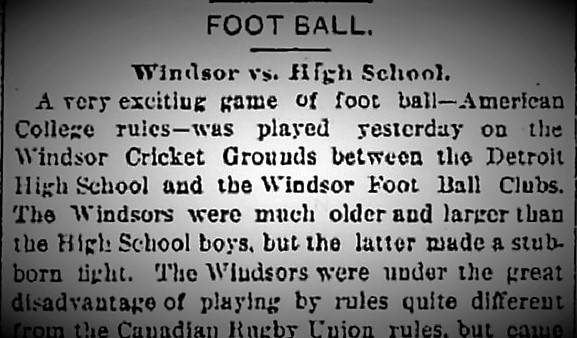
Buried in the text on the fourth page of the Saturday, October 27, 1888, Detroit Free Press is a single, concise sentence bearing a minimum amount of detail.
“The Windsor foot ball team will play the Detroit High School team this afternoon at 3.”
To date, this is the earliest account of a Michigan high school playing the game of “foot ball.”
The following day’s paper provides only a few more details. The game was played on the Windsor Cricket Grounds. Despite the great disadvantage of playing under “American Football rules … quite different from the Canadian Rugby Union rules …” the “older and larger” Windsors won the contest, 12-6. Rosters for each squad were provided.
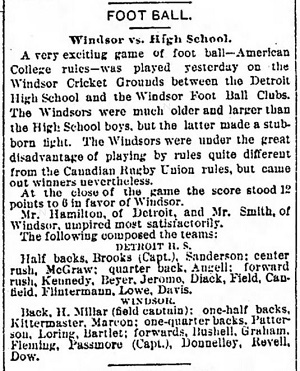 Under American rules of the time, a touchdown was worth four points, with a conversion kick following a touchdown worth two additional points. At the time, a field goal counted for five points and a safety was worth two. The teams, however, may have agreed to a different scoring system before the contest.
Was this the first football game for a Michigan high school? That’s unlikely, but it is certainly among the earliest published accounts involving a prep game in the state.
It’s a fair assumption that foot ball, or some version of the game, was being played in neighborhoods before that time, at least based on the following statement found in the Jackson Citizen Patriot, dated June 18, 1867. Only days before, Dorrance & Goodwin’s, a store on Main Street in Jackson, had placed advertisements in the newspaper’s classifieds noting the pending arrival of this new product.
“Foot Ball – The pastime was inaugurated on our streets yesterday. Three or four balls were kept in motion all day on Main street alone. It affords no little amusement to the little boys, and is certainly a healthy exercise for the larger ones. It’s all right as long as no windows are broken or horses scared. Both calamities were barely escaped scores of times during the day.”
Rutgers and Princeton are credited with playing the first college football game in 1869. A decade later, in 1879, the University of Michigan established a football team.
Detroit High School played a number of games in 1888, besides the Windsor match, including a contest with the Tappen School from the Corktown area of Detroit. Played at the Detroit Athletic Club grounds on the afternoon of Thursday November 15, a final score was not mentioned in the following day’s Free Press.
For those unfamiliar with the sport, an account of the University of Michigan versus Detroit Athletic Club contest that appeared in the November 18 Free Press served as a fine introduction to the game, and the determination behind securing “possession of a leather-covered foot ball.”
“It was very interesting to see one speedy young man, after a desperate struggle in which the spectators fully expected to see him lose an arm or a leg, get away from his captors and start like a deer, with eight or ten of the opposite side in full pursuit. He is overtaken and the leader of the pursuing party springs upon the back of the man with the inflated trophy, bearing him to the ground with a dull thud … It is also an inspiring sight to see a fleet-footed player seize the ball and run at full speed in the direction of the goal of his opponents. Then a wing-footed opponent cuts across to intercept him, makes a flying leap, grasps the fugitive around the neck or waist and both go to grass with a suddenness and velocity that transforms them into human wheels …
 “While one unaccustomed to foot ball will naturally be startled by some of the acrobatic feats, still it is impossible to watch the game for any length of time without a tingling of the blood and holding of the breath. It is most intensely exciting, continuous in action and replete with fine points of play.
“It may be explained that the goals in a foot ball game are set at a distance of 330 feet from each other. The goal is made by placing two pieces of scantling twenty feet long upright in the ground, eighteen and one-half feet apart. Another piece runs midway horizontally between the uprights, and the ball must go over the horizontal piece and between the uprights to count a goal. There are eleven men on each side and the object is, of course, to get the ball through the goal of the other. The time of game is an hour and a half each side playing forty-five minutes from each goal, with an intermission of ten minutes between halves.”
A player who ran over an opponent’s goal line, “with the ball and touched it down” was then entitled to “bring the ball in front of the goal and attempt to kick it through”…
Among those playing for the Athletic Club squad that day was “little Hugh Brooks (captain) of the high school team.” Eligibility rules for players would evolve over time.
On Saturday, November 24, Detroit High School squared off for the first of two contests with Ann Arbor High School, this one at the Detroit Athletic Club grounds. Admission to the 2:45 p.m. contests was 25 cents. A crowd of around 300 watched “an exciting illustration of how Rugby foot ball is played. The exhibition by the Ann Arbor boys was considerably better than that of the Detroiters,” noted the Free Press, “the result of that being that Detroit’s banners have been kicked into the dust.”
Ann Arbor returned home with a 12-0 victory.
A second game with Ann Arbor was quickly scheduled.
In between, on Thursday, November 29, the Detroit High School squad played the Athletic Club before a crowd of about 200.
 “While the Athletics won by 12 to 0, still their playing was very loose, probably the result of over confidence. The Athletics will have to rid themselves of this by Saturday or the Albions will make short work of them.”
A large crowd gathered in the drizzling rain in Ann Arbor on Saturday, December 8, for what appears to be the final contest of the 1888 season for the high school teams of Detroit and Ann Arbor.
“It was a fine game. (Captain) Brooks, McGraw and Wisner, for Detroit, and Jewett, Diggert, Dupont, and Rathbone for Ann Arbor, made fine plays for their respective sides.” The result was an 8 to 2 win, and redemption, for the Detroit squad.
Today, 129 years later, “football” has seen wild expansion, numerous rule changes, and huge advancement in equipment worn when compared to those pioneer days of the sport. In 2017, more than 1 million individuals will suit up for high school teams across the United States. In Michigan alone, more than 36,000 participate in prep football.
And our state’s original programs live on. On Friday, Detroit Central opened its season with a win over Detroit Loyola. Ann Arbor High School, renamed Ann Arbor Pioneer in the late 1960s, fell in its Friday opener to Muskegon.
Welcome to another season of America’s favorite pastime.
 Ron Pesch has taken an active role in researching the history of MHSAA events since 1985 and began writing for MHSAA Finals programs in 1986, adding additional features and "flashbacks" in 1992. He inherited the title of MHSAA historian from the late Dick Kishpaugh following the 1993-94 school year, and resides in Muskegon. Contact him at [email protected] with ideas for historical articles.
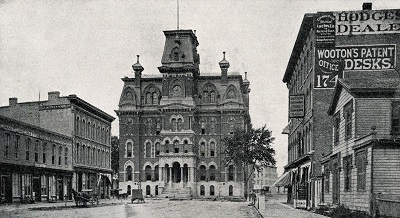
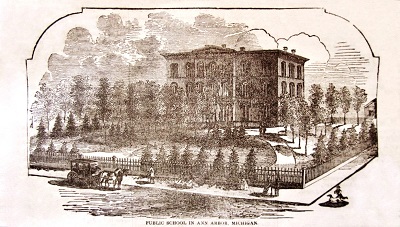
PHOTOS: (Top) The Detroit Free Press included brief coverage of the first "reported" game on Oct. 28, 1888. (Middle) When Michigan’s state government moved from Detroit to Lansing in 1847, the old Capitol building was re-opened as the Detroit’s first city high school in 1863. To better accommodate Detroit’s growing population, the old two-story structure was remodeled into a four-story building, unrecognizable to most. The school served the city well until January 1893, when it burned to the ground. (Below) Erected in 1856 at the cost of $27,000, Ann Arbor High School at State and Huron (now site of the North Quad of the University of Michigan) was destroyed by fire in 1904. (Photos courtesy of Ron Pesch.)