

Drive for Detroit: Week 7 in Review
October 15, 2013
By Geoff Kimmerly
Second Half editor
Numbers are part of most conversations at the end of high school football season. We keep an eye on movements within league standings, monitor daily playoff point averages and watch in awe as some of our biggest stars put up incredible statistical performances.
Consider a few numbers from Week 7 that fascinate:
- Lawrence and Kingston combined for 132 points in their 8-player game, won 88-48 by the Tigers.
- In Detroit Cesar Chavez's 64-41 win over Mayville, receiver Nate Drew caught 17 passes for 459 yards and seven touchdowns. Once confirmed, the 459 yards would be a national single-game record.
- Cesar Chavez quarterback Omar Salih completed 32 of 52 passes for 689 yards and nine touchdowns. The yards and touchdowns would be MHSAA records.
- With all results in, there are 71 teams qualified for the 11-player playoffs, but another 231 that have the opportunity to make the 256-team field by winning the rest of their regular season games.
Those scratched the surface of significant numbers put up as champions continued to be crowned and postseason berths were earned.
Read on for more of those reports from all over the state.
Greater Detroit and Southeast
Canton 34, Plymouth 23
If recent history is an indication, these neighbors will see each other again in a few weeks – they’ve met in the playoffs as well the last five seasons. But Canton has bragging rights for now after moving to 7-0 overall and claiming the Kensington Lakes Activities Association South title outright by edging the second-place Wildcats (5-2). Click to read more from MLive Detroit.
Also noted:
Farmington Hills Harrison 60, Oak Park 52: Although Harrison (6-1) has only a dim chance of catching Southfield in the Oakland Activities Association White, the Hawks did make the playoffs with this win while leaving Oak Park (5-2) needing one more victory to qualify.
Detroit Cass Tech 41, Detroit Mumford 6: The Technicians (7-0) claimed their fourth straight league championship, earning the Detroit Public School League West title by one win thanks to this victory over second-place Mumford (6-1).
Belleville 20, Dearborn Fordson 17: Belleville (5-2) earned a share of the Western Wayne Athletic Conference Blue title, with Fordson (4-3) now needing to beat Edsel Ford this week to also claim a share.
Clinton Township Clintondale 37, Mount Clemens 22: The Dragons (7-0) solidified at least a share of the Macomb Area Conference Bronze title with Mount Clemens (3-4) falling into a second-place tie with Clawson, its opponent this week.
West Michigan
Muskegon Mona Shores 49, Zeeland East 26
One of our favorite watch lists is made up of teams seeking their first appearance in the MHSAA playoffs, which began in 1975. Cross off Mona Shores, which improved to 6-1 and earned its first postseason berth thanks to this victory. The Sailors also remain only one win back of the co-leaders in the O-K Black. Despite falling out of that race, Zeeland East (5-2) still can extend its three-year postseason streak with one more win. Click to read more from the Grand Rapids Press.
Also noted:
Spring Lake 36, Ludington 26: The Lakers (6-1) can do no worse than share the Lakes Eight Conference title and can win it outright this week; Ludington (4-3) must win out to guarantee a playoff bid.
Allendale 38, Sparta 7: The Falcons (6-1) beat Sparta to earn a playoff berth, and would love the Spartans (5-2) to join them in the postseason if it means Sparta beats O-K Blue frontrunner Comstock Park in Week 9 – which could then give Allendale a share of the league title.
East Kentwood 34, Holland West Ottawa 18: The Falcons (5-2) guaranteed their first winning regular season since 2009 and remain atop the O-K Red, tied with Rockford, while West Ottawa (4-3) fell to fourth.
Lowell 53, Caledonia 25: The Red Arrows (7-0) needed to survive a challenge from Caledonia (5-2) to set up this week’s O-K White decider against also first-place Grand Rapids Christian.
Southwest and Border
Paw Paw 15, Plainwell 13
These teams have dominated defensively all fall, and that remained the theme when they met with a share of the Wolverine B East on the line. The win gave the Redskins (7-0) nine in nine games over Plainwell (6-1) since the two became league foes in 2006 – although Paw Paw has to beat co-second place Otsego this week to win the league title outright. Click to read more from the Kalamazoo Gazette.
Also noted:
Battle Creek Pennfield 15, Olivet 14: This turned the Kalamazoo Valley Association race back into a three-team battle with Pennfield, Olivet and Schoolcraft all 6-1 and having played each other; fourth place Constantine plays Olivet and then Pennfield and could have a giant impact on the final order.
Dowagiac 14, Three Rivers 7: The Chieftains (6-1) needed to beat third-place Three Rivers (4-3) to remain undefeated in the league heading into this week’s Wolverine B West deciding game against also first-place Edwardsburg.
Hartford 17, Decatur 14: It’s still possible for four of five teams in the Southwestern Athletic Conference South to earn playoff berths, but Hartford (4-3) needed this win over Decatur (5-2) to keep that hope alive.
Niles Brandywine 24, St. Joseph Lake Michigan Catholic 6: With seven wins, Brandywine (7-0) equaled last season’s total and its most since winning eight 1997, while handing the Lakers (5-1) their first loss of the season.
Lower Up North
Cadillac 26, Traverse City West 21
This Big North Conference showdown literally came down to the final seconds and a few yards, with Cadillac’s defense making a final stand at its 3-yard line to stay ahead as the game ended. By doing so, the Vikings (7-0) claimed a share of the Big North championship while dropping Traverse City West (4-3) one win back with one more league game to play. Click to read more from the Traverse City Record-Eagle.
Also noted:
Grayling 35, Kalkaska 18: Three of seven teams in the Lake Michigan Conference could still have a hand in the league title, but Grayling (6-1) remained tied for first while eliminating Kalkaska (5-2) from contention.
Evart 31, McBain 28: The Wildcats (6-1) earned a second straight playoff berth while leaving McBain (4-3) needing to win out to qualify.
Ogemaw Heights 41, Standish-Sterling 28: Ogemaw Heights (5-2) pulled within one more win of making the playoffs by handing Standish-Sterling (6-1) its first loss.
Maple City Glen Lake 55, Suttons Bay 14: By beating third-place Suttons Bay (3-4), Glen Lake (7-0) finished a second straight undefeated run through the Northwest Conference.
Thumb and Bay
Montrose 34, Flint Beecher 18
The Rams (7-0) ran their Genesee Area Conference Red winning streak to 17 over the last three-plus seasons and set themselves up well to play for a third straight league title, with seventh-place Perry up next before a face-off with also first-place Lake Fenton in Week 9. Beecher (5-2) fell two games back and needs one more win to make the playoffs, with opponents a combined 9-5 left on the schedule. Click to read more from the Flint Journal.
Also noted:
Reese 55, Elkton-Pigeon-Bay Port 13: This decider in the Greater Thumb Conference West didn’t end up close, as Reese (6-1) claimed a share of the title and the Lakers (5-2) fell one game back with one to play.
Saginaw Nouvel 28, Traverse City St. Francis 14: The Panthers (6-1) made it six straight wins since falling on opening night, while putting St. Francis (4-3) in position of having to win out to avoid missing the playoffs for the second straight season.
Gladwin 19, Sanford Meridian 14: The Flying G’s (5-2) are back in the Jack Pine Conference title hunt, tied with Sanford Meridian at one game behind leader Clare, with Clare and Meridian (6-1) set to meet in Week 9.
Grand Blanc 17, Hartland 7: Grand Blanc (6-1) missed out on the KLAA West title last year by falling to eventual champion Hartland (2-5) in the final league game of the schedule; this time the title belongs to the Bobcats thanks in part to a win over the Eagles.
Upper Peninsula
Ishpeming 28, Negaunee 24
This one had been circled since the end of last season, even as Ishpeming claimed the MHSAA Division 7 championship despite losing out on the Mid-Peninsula Athletic Conference title to Negaunee earlier in the fall. Alex Briones, who quarterbacked that MHSAA title run, was the star of this one for the Hematites (7-0), who clinched a share of the league title and need to beat only fourth-place Gwinn in Week 9 to claim it outright. Negaunee (6-1) will be cheering Gwinn on in hopes of still claiming a share. Click to read more from the Marquette Mining Journal.
Also noted:
Iron River West Iron County 30, Eagle River Northland Pines, Wis. 6: The Wykons (7-0) remained undefeated in winning a share of their second West Peninsula Athletic Conference title in three seasons.
Felch North Dickinson 36, Powers North Central 20: The Nordics (6-1) finished a second straight perfect run through the Mid-Eastern Conference schedule by beating the second-place Jets (5-2).
Sault Ste. Marie 34, Cheboygan 14: The Blue Devils (4-3) kept playoff hopes alive by beating a likely qualifier in Cheboygan (5-2).
Houghton 32, Lake Linden-Hubbell 26 (OT): The Gremlins (4-3) needed overtime to keep their playoff hopes alive against another team in Lake Linden-Hubbell (4-3) that also must now win out.
Mid-Michigan
Beal City 42, Lake City 35 (OT)
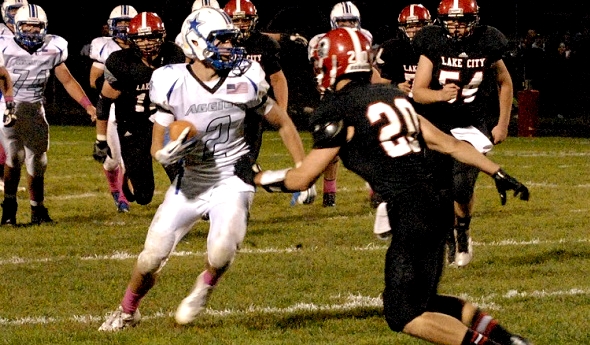
One of the most highly-anticipated small-school games this season lived up to the billing, with Beal City not taking its first lead until earning the advantage for good in overtime. In what was certainly the toughest test this season so far for both teams, the Aggies’ offensive prowess proved superior to Lake City’s stingy defense. Beal City (7-0) claimed a share of the Highland Conference title, while Lake City (6-1) fell to second place. Click to read more from the Mount Pleasant Morning Sun.
Also noted:
Carson City-Crystal 51, Mount Pleasant Sacred Heart 49: The Eagles (7-0) hung on after opening a big early lead to not only beat Sacred Heart (5-2) but claim the Mid-State Activities Conference South title, its first league title since 1961.
Pewamo-Westphalia 25, Fowler 0: The Pirates (7-0) avenged last season’s loss to their biggest rival and in the process won a share of the Central Michigan Athletic Conference title; Fowler (5-2) remains in second place, a game back with one to play.
Hillsdale 31, Ida 14: Four teams are tied atop the Lenawee County Athletic Association standings with two games to play, and that’s thanks to Hillsdale (4-3), which toppled Ida (5-2) from its former spot in first place alone.
Grand Ledge 41, Lansing Everett 19: The Comets (4-3) continue to battle back from an 0-3 start and now are a game behind first-place Lansing Sexton in the Capital Area Activities Conference Blue, with Everett (5-2) facing the Big Reds this week.
Trophy Games
Each week the MHSAA highlights trophy games across the state. Last week’s slate included:
Little Brown Jug: Brighton vs. Howell. These KLAA rivals have faced each other every season but one dating to 1977. Final: Brighton 27, Howell 20.
Baseline Jug: Northville vs. Novi. In the KLAA Central, Northville won this rivalry game to claim the league title outright. Final: Northville 40, Novi 13.
Cedar Log: Menominee vs. Marinette, Wis. These old rivals played for the 107th time, with Menominee tying the series record at 50-50-7. Final: Menominee 56, Marinette 27.
Champions of the North: Traverse City Central vs. Alpena. The Trojans claimed this trophy game for the fourth consecutive season. Final: Traverse City Central 45, Alpena 0.
Ford Cup: Newberry vs. Manistique: This series restarted in 2012 after eight seasons off with a big Manistique win, now followed by a close one by Newberry. Final: Newberry 7, Manistique 6.
Pioneer-Thunderbird Spirit Bowl: Dearborn vs. Dearborn Edsel Ford. The Pioneers own a four-game winning streak in this city rivalry game between teams 2.5 miles apart. Final: Dearborn 41, Edsel Ford 14.
Battle of Bogie Lake Road: White Lake Lakeland vs. Walled Lake Northern. These two both sit, logically, on Bogie Lake Road separated by a 1.6-mile trip around said lake. Final: Walled Lake Northern 45, Lakeland 26.
Skipper's Oar: Waterford Mott vs. Waterford Kettering. The Captains have claimed five of the last six against their rivals located a mere 3.9 miles away. Final: Kettering 27, Mott 0.
PHOTO: Beal City (white jerseys) remained undefeated and claimed a share of the Highland Conference championship by edging Lake City in overtime. (Click to see more from High School Sports Scene.)
1st & Goal: Week 9 Preview
By
Geoff Kimmerly
MHSAA.com senior editor
October 22, 2020
Over the next 72 hours, endings will be followed by new beginnings for just about every high school football team in Michigan.
Today and Saturday, the great majority will kick off for the final time this shortened regular season. On Sunday, for the first time, nearly all will be able to begin preparing for the start of this fall's MHSAA Playoffs.
Pairings in 11 and 8-player will be posted to the MHSAA Website during early afternoon Sunday. In the meantime, more than 270 games will be played to help determine those postseason matchups, with more than 60 available to watch on MHSAA.tv; click the link for listings
Below are some of the games you may want to check out in your corner of the state. Find the full schedule and then results this weekend as they’re reported via the MHSAA Score Center.
Bay & Thumb
Midland Dow (4-1) at Midland (5-0)
Dow’s loss last week to Mount Pleasant rubbed some of the luster off this week’s neighborly meet-up with the Chemics. But this could still significantly impact the Saginaw Valley League Blue championship, as Midland is the only team without a league loss – but a Dow win would leave three one-loss teams (along with the Oilers) at the top of the standings. Dow won this matchup 42-7 last season, breaking a three-game losing streak to its rival.
Keep an eye on these: FRIDAY Ortonville Brandon (5-0) at Fenton (5-0), Saline (5-0) at Grand Blanc (4-1), Davison (5-0) at Lapeer (3-2), Clare (5-0) at Sanford Meridian (4-1).
Greater Detroit
Detroit Loyola (5-0) at Detroit Catholic Central (5-0), Saturday
These teams both have won MHSAA Finals championship over the last 11 seasons, but this Detroit Catholic League Bishop Championship game will pit them against each other for the first time. This is likely a matter of significant difference in enrollment size – the Shamrocks are a Division 1 playoff team, and the Bulldogs will play in Division 7. But they are undefeated champions of the two divisions of largest schools in the league, DCC in the Central and Loyola in the AA, and their past successes no doubt will make this a much-anticipated matchup.
Keep an eye on these: FRIDAY Livonia Churchill (4-1) at Belleville (5-0), Bloomfield Hills Brother Rice (4-1) at Detroit Country Day (3-1), Marine City (5-0) at Pontiac Notre Dame Prep (4-1). SATURDAY Clarkston Everest Collegiate (5-0) vs. Riverview Gabriel Richard (5-0) at Detroit Catholic Central.
Mid-Michigan
Mason (5-0) at Williamston (5-0)
The Bulldogs are attempting to finish a second-straight perfect run through the Capital Area Activities Conference Red. But they’re up against a Williamston team off to its best start since 2014, which is saying something extra given the Hornets’ annual success. This will match strength on strength; Williamston has given up 45 points total (nine per game), while Mason is averaging nearly 38 per contest. The Bulldogs won last year’s meeting 20-9.
Keep an eye on these: FRIDAY Stevensville Lakeshore (4-1) at DeWitt (5-0), Pewamo-Westphalia (5-0) at Lansing Catholic (3-2), Holt (2-2) at Grand Ledge (3-2), Stockbridge (2-3) at Olivet (4-1).
Northern Lower Peninsula
Charlevoix (5-0) at Maple City Glen Lake (4-1)
The Northern Michigan Football Conference Leaders and Legacy championships are up for grabs this weekend, and we’ll focus on the Leaders as the only loss between these two contenders was Glen Lake’s by five to unbeaten Clarkston Everest Collegiate. Glen Lake has won 12 straight league games and three straight championships, and defeated the Red Rayders 42-18 last season when they also met with the title on the line. But a dominant Charlevoix defense could give Glen Lake trouble this time; the Rayders haven’t given up a point over their last two games and only 42 total this fall.
Keep an eye on these: FRIDAY Johannesburg-Lewiston (5-0) at Harbor Springs (3-2), Oscoda (5-0) at Houghton Lake (4-1), East Jordan (3-2) at Frankfort (2-3). SATURDAY Jackson Lumen Christi (2-3) at Traverse City St. Francis (3-2).
Southeast & Border
Addison (5-0) at Grass Lake (4-1)
The Panthers quietly have put themselves in position to clinch a second-straight Cascades Conference championship, outscoring their three league opponents so far by a combined 169-28. Grass Lake trails Addison by a game, thanks to a Week 7 loss to Michigan Center, and also will be looking to avenge last season’s 20-16 defeat that decided the Cascades title.
Keep an eye on these: FRIDAY Chelsea (5-0) at Monroe (4-1), Clinton (4-1) at Hillsdale (4-1), Homer (4-1) and Jonesville (4-1), Brownstown Woodhaven (4-1) at Temperance Bedford (3-2).
Southwest Corridor
Paw Paw (4-1) at Edwardsburg (5-0)
The Wolverine Conference isn’t awarding a championship this season because of the abbreviated schedule, but if it was the title would be coming down to these two again. Paw Paw’s only loss was last week to Detroit Country Day; otherwise the Wolves have again dominated, outscoring their four Wolverine opponents by an average of 48-9. The Eddies, who defeated Paw Paw to claim the league title last year, have yet to be held under 52 points or allow more than 16.
Keep an eye on these: FRIDAY St. Joseph (4-1) at Battle Creek Lakeview (4-1), Schoolcraft (4-1) at Delton Kellogg (3-2), Saugatuck (3-2) at Lawton (4-1), Portage Northern (4-1) a Kalamazoo Central (2-3).
Upper Peninsula
Marquette (4-1) at Calumet (2-2)
At the end of an unpredictable six weeks in the Upper Peninsula, this could be a much more intriguing game than the records might indicate. These teams recently have been among the best above the Bridge, but in substantially different playoff brackets – Marquette will play in Division 3 and Calumet in Division 6 next weekend. The Copper Kings have played only three games on the field, winning two and losing the third to Kingsford by just a point. Marquette defeated Kingsford 10-0 and also has just one close loss, early to Sault Ste. Marie.
Keep an eye on these: FRIDAY Escanaba (0-2) at Gladstone (2-2), Bark River-Harris (2-2) at L'Anse (1-4), Iron Mountain (5-0) at Manistique (1-3), Gwinn (2-3) at Bessemer (0-4).
West Michigan
Grand Rapids Catholic Central (5-0) at Grand Rapids South Christian (5-0)
These two were frequent league or playoff foes until 2016, when GRCC moved for a few seasons into the Ottawa-Kent Conference Blue. This fall the Cougars moved back into the Gold, and they’ll face the Sailors with the championship on the line. Most notably, both have wins over Cedar Springs, and defensively they’ve given up nearly the same number of points – although GRCC is scoring eight more per game, on average.
Keep an eye on these: FRIDAY Grandville (5-0) at Rockford (3-0), Hudsonville Unity Christian (5-0) at Allendale (3-2), Whitehall (4-1) at Muskegon Oakridge (4-1). SATURDAY Detroit Martin Luther King (3-2) at Muskegon Mona Shores (5-0).
8-Player
Portland St. Patrick (5-0) at Burr Oak (5-0)
Shortened schedule or not, Burr Oak has a lot to celebrate. The Bobcats have guaranteed a winning season, their second straight and something of a rarity for many year before that. Burr Oak has won all of its games by at least 32 points. But defeating annual power St. Patrick – and by doing so avenging last year's playoff loss – would be the best victory yet.
Keep an eye on these: FRIDAY Morrice (5-0) at Deckerville (4-1), Mayville (5-0) at Kinde North Huron (5-0), Cedarville (4-1) at Rudyard (3-2). SATURDAY Indian River Inland Lakes (5-0) at Merrill (4-1).
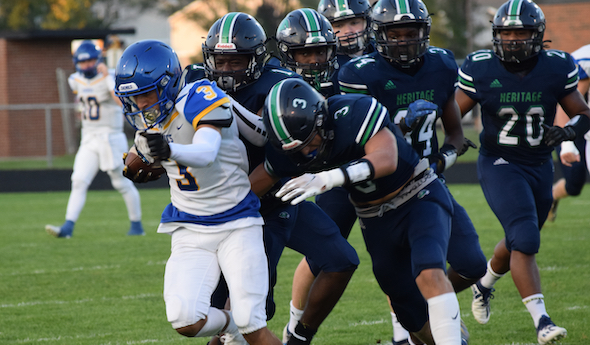
PHOTO: Midland pulled away from Saginaw Heritage for a 42-20 win on Sept. 25. (Click to see more from HighSchoolSportsScene.com.)