

Drive for Detroit: Week 7 in Review
October 13, 2014
By Geoff Kimmerly
Second Half editor
Just as things are finishing up this MHSAA football regular season, plenty is getting started.
The 11-player playoff field is nearly half full with two weeks to play – 126 teams have earned automatic berths, with 66 more one win from joining them.
Two leagues – the Kensington Lakes Activities Association and Detroit Public School League – finished their league schedules over the weekend but will play one and two weeks of playoff games, respectively, to finish the regular season. The Detroit Catholic League will finish its league schedule this week in advance of its Prep Bowl games during Week 9.
And there's plenty more to come. Read on for some of the results that helped further shape the scene all over the state last week.
Mid-Michigan
The deciding game in the Capital Area Activities Conference White didn’t end up much of one after halftime. Cougars junior quarterback Tony Poljan averaged 20 yards a completion in throwing for 404 total with four touchdowns, and he also ran for a score as Lansing Catholic (7-0) broke away with a 22-0 third-quarter run. Williamston is 6-1 and has a slim chance of seeing the Cougars again in the playoffs if both fall into Division 4. Click for more from the Lansing State Journal.
Also noted:
Hartland 29, Grand Blanc 26 – The Eagles (6-1) battled back from a loss in the league opener to take a share of the Kensington Lakes Activities Association West title from co-champ Grand Blanc (5-2) in the final league game of the season.
Okemos 27, Holt 20 – The Chieftains (4-3) reached four wins for the first time since 2011 and should make the playoffs for the first time since that season with their final two opponents owning a combined two wins this fall.
Lansing Everett 38, Grand Ledge 24 – The Vikings (5-2) set themselves up to face Sexton this week with a chance to share the CAAC Blue title, while knocking third-place Grand Ledge (4-3) out of contention.
Charlotte 39, Battle Creek Pennfield 36 – A 39-yard field goal by Sy Barnett with 20 seconds to play kept Charlotte (4-3) in the hunt for a third straight playoff berth.
Greater Detroit
Walled Lake Western 31, Walled Lake Central 14
Western, Central and Waterford Mott all split the KLAA North championship thanks to the Warriors (6-1), who earned a fourth-straight win over their local rivals. Western scored 21 unanswered second-half points to earn the opportunity to play Hartland this week for the Lakes Conference championship. Click for more from the Oakland Press.
Also noted:
Berkley 32, Birmingham Groves 29 – Berkley dealt Groves (6-1) a painful blow heading into Groves' game this week against Oakland Activities Association Blue leader Farmington that could decide the league title; Berkley (6-1) will now root for Groves to win and make all three teams co-champions.
Canton 30, Plymouth 20 – Canton (6-1) outlasted the rival Wildcats (5-2) to claim the KLAA South championship for the second straight season.
Hudson 12, Ida 7 – The Tigers (6-1) avenged last season’s loss to Ida (6-1) that led to a shared Lenawee County Athletic Association title to keep pace with co-leader Hillsdale, Hudson’s Week 9 opponent.
Grosse Pointe Woods University Liggett 26, Lutheran Westland 6 – The Knights (6-1) finished off their fourth Michigan Independent Athletic Conference title in five seasons by defeating second-place Westland (5-2).
Bay and Thumb
Elkton-Pigeon-Bay Port Laker 32, Bad Axe 30
The Lakers (7-0) needed a second-half comeback to keep their best start since 2002 alive, but also came away with a share of the Greater Thumb Conference West championship and can clinch it outright next week against 1-6 Reese. The Lakers, league runners-up to Reese last season, rode more than 300 yards rushing by Dustin Kady to edge Bad Axe (4-3) – which has already guaranteed its best finish since 2001. Click for more from The Saginaw News.
Also noted:
Goodrich 37, Lake Fenton 36 – After claiming a nail-biter over Lake Fenton (1-6), second-place Goodrich (6-1) will be rooting for Montrose this week as the Rams face Genesee Area Conference Red leader Flint Beecher in the final game on the league schedule.
Harrison 57, Beaverton 28 – Harrison (7-0) avoided a potential Jack Pine Conference spoiler in Beaverton (4-3) and now will face reigning champion Clare for the league championship.
Bay City John Glenn 33, Saginaw Nouvel 6 – The Bobcats (5-2) have more wins this fall than in 2012 and 2013 combined and need one more to return to the playoffs for the first time since 2011; Nouvel has a slim postseason hope at 3-4 but will need to win out including a big win over Freeland in Week 9.
St. Clair 25, Warren Woods Tower 21 – St. Clair (6-1) knocked Woods Tower (6-1) out of a tie for first place with Marine City in the Macomb Area Conference Gold, but will root for the Titans to beat the Mariners this week and make all three teams co-champions.
Lower Up North
Cadillac 17, Traverse City West 12
The Big North Conference was the source of most of the north's significant action this weekend, although by Sunday leader Cadillac remained atop the league standings and with a share of the championship – after its second straight win by a less than a touchdown. Cadillac (7-0) got up 17-0 in the third quarter before West (3-4) – playing to remain in the playoff hunt – took advantage of Vikings turnovers to pull within striking distance. Click for more from the Cadillac News.
Also noted:
Traverse City Central 14, Alpena 7 (OT) – Central (5-2) kept its shared Big North Conference title hopes alive by a sliver, edging Alpena (3-4) to remain one win back with Cadillac coming up in Week 9.
Gaylord 49, Petoskey 42 – The Blue Devils (5-2) scored twice during the fourth quarter to ruin Petoskey’s chances at remaining in Big North contention while inching closer to a first playoff berth since 2007; Petoskey (5-2) can earn a return to the postseason for the first time since 2011 against Alpena this week.
Manton 30, Leroy Pine River 27 – The Rangers may be out of the Highland Conference title chase, but they secured their best record since 2005 and need one more win for a first playoff berth since 1994; Pine River (4-3) has its best record since 2007 and by winning out can make the postseason for the first time since 2005.
Elk Rapids 70, Grayling 26 – The Elks (4-3) remain alive for the playoffs although they’ll next face undefeated Boyne City; at 3-4, Grayling will need help to grab an at-large bid.
West Michigan
Cedar Springs 14, Grand Rapids Forest Hills Northern 8
Most of Cedar Springs’ last 15 seasons have ended in the 4 to 6-win range with a hint of league title contention on occasion. But this one is shaking up as special for the Red Hawks (6-1), who sit alone atop the Ottawa-Kent Conference Bronze after sending Forest Hills Northern (6-1) into a second place tie with Grand Rapids Northview. Cedar Springs can clinch a share of the league title next week against Greenville (4-3) or in Week 9 vs. Forest Hills Eastern (3-4). Click for more from the Grand Rapids Press.
Also noted:
East Kentwood 35, Hudsonville 28 – The Falcons (6-1) scored with less than two minutes to play to remain a game behind Rockford in the O-K Red and drop Hudsonville (4-3) out of title contention.
Rockford 27, Grand Haven 21 (OT) – The Rams (6-1) needed overtime against a Grand Haven (3-4) team trying to stay alive for the postseason and now playing for an at-large bid.
Grandville 54, Holland West Ottawa 14 – Grandville (3-4) kept a small playoff hope alive by winning big over former O-K Red co-leader West Ottawa (5-2).
Muskegon Oakridge 50, Whitehall 22 – Oakridge (6-1) regained a share of the West Michigan Conference title and can clinch outright this week; Whitehall (6-1), now tied for second with Ravenna, needs Mason County Central to come through with an upset.
Upper Peninsula
Marquette 35, Constantine 10
Even at 5-1 entering last weekend, Marquette’s chances of extending its playoff streak to five seasons looked a tad shaky – Constantine was 6-0, and together the Redmen’s final three regular-season opponents were 16-3. But Marquette held Constantine to its fewest points this season (by 21) and tied its biggest offensive output to remain undefeated since falling to Traverse City Central on opening night. Click for more from the Marquette Mining Journal.
Also noted:
Ishpeming 28, Negaunee 0 – The Hematites earned a share of their second straight Mid-Peninsula Athletic Conference title and haven’t given up a point since Week 4; Negaunee (4-3) faces two more tough opponents as it works to earn a playoff berth.
Munising 42, Bark River-Harris 0 – The Mustangs (6-1) secured a share of the Mid-Eastern Football Conference title by dominating second-place Bark River-Harris (5-2); Munising also hasn’t given up a point since Week 4.
Kingsford 10, Iron Mountain 0 – Kingsford’s at-large playoff bid hope got stronger as the Flivvers (3-4) shut out the Mountaineers (4-3), who are second in the Mid-Peninsula Athletic Conference.
Powers North Central 48, Felch North Dickinson 44 – North Central’s playoff hopes are slim at 2-4, but beating North Dickinson (3-4) for the first time since 1993 is a nice consolation.
Southwest and Border
Plainwell 34, Three Rivers 28
It seems like most of Plainwell’s games this season have been among the best of the southwest – and the Trojans (6-1) are now one more win from locking up a share of the Wolverine B Conference East title. They ran Three Rivers (4-3) into second place on the legs of Jacob Geter, who rushed for 316 yards on 50 carries. Click for more from the Kalamazoo Gazette.
Also noted:
Saugatuck 26, Fennville 20 – The Indians (5-2) kept pace atop the Southwestern Athletic Conference North with Week 9 opponent Gobles while dropping Fennville (4-3) into third.
Bridgman 62, Centreville 7 – The Bees (5-1) are inaugural champs of the Berrien-Cass-St. Joseph Blue and have scored at least 40 points in all but one victory.
Niles 27, St. Joseph 21 – The Vikings (5-2) locked up their best record since 2003 by beating St. Joseph (4-3) for the first time since 2005.
Union City 41, Reading 34 – The Chargers (7-0) guaranteed themselves a share of the Big 8 Conference title with second-place Homer the only league opponent remaining; Reading (3-4) will hope to win out and earn an at-large playoff bid after losing its second straight game.
8-Player
Kingston 64, Owendale-Gagetown 34
Kingston quarterback – and MHSAA Student Advisory Council senior – Aaron Van Horn carried his team back into the playoff hunt with three touchdown passes and two touchdown runs as the Cardinals handed Owendale-Gagetown (6-1) its first loss. Kingston is 4-3 and faces opponents who are a combined 4-10 to finish the regular season. Click for more from The Saginaw News.
Also noted:
Big Rapids Crossroads 21, Akron-Fairgrove 20 – The Cougars have won three straight since opening 0-4 against four teams still undefeated; they look good to make the playoffs with two winnable games left.
Bellaire 38, Engadine 6 – The Eagles (7-0) may not get mentioned as much as other favorites Cedarville and Rapid River, but are lined up perfectly to make a run at the Bridge Football Alliance title with those two up next over the next two weeks; Engadine (3-4) is hanging on to the 16th spot in the playoff field.
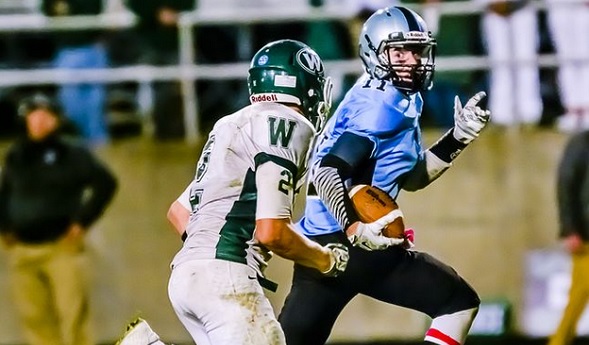
PHOTO: Lansing Catholic's Zac Baker was among recipients of quarterback Tony Poljan's 20 completions Friday as the Cougars defeated Williamston. (Photo courtesy of the Lansing State Journal.)
Fast Start Sends DeLaSalle Soaring
By
Paul Costanzo
Special for MHSAA.com
November 24, 2017
DETROIT – Brendan Madigan kept his promise.
 He was on the field as a freshman in 2014 when Warren DeLaSalle won its first MHSAA Division 2 football championship. And he enjoyed it so much, he told himself he would come back and do it again.
On Friday, the senior captain led the Pilots to title No. 2, as they rolled to a 41-6 victory against Livonia Franklin again in Division 2 at Ford Field.
“I got to see those guys (in 2014), see what it was like and get the feeling of what it is,” Madigan said. “Ever since then, I made a promise to myself to get all of my guys back here and win it again, so it feels great.”
It was a brilliant finish to a season that started with immediate adversity following a 36-6 loss against Lowell during opening weekend. But the Pilots (12-2) responded positively and proved their worth week in and week out, winning the Detroit Catholic League Central title and knocking off two-time reigning Division 2 champion Detroit Martin Luther King on their way to Ford Field.
“Nobody thought we could do it after we lost to Lowell – and we lost by a lot,” said DeLaSalle junior Evan Vaillancourt, who had 160 yards receiving and a touchdown Friday. “But we came back and had the best practice we had, and played really good (in Week 2) against Grandville, then we played good from there on.”
There was no adversity to deal with in the title game, as DeLaSalle found itself ahead 7-0 just 16 seconds in, and without having put its offense on the field.
Madigan recovered a snap that had sailed over the Franklin backfield and ran 13 yards for the touchdown on the first play from scrimmage. It was the first time since 2005 that the first play from scrimmage had resulted in a touchdown in an MHSAA Final.
“I saw the ball go over (the quarterback’s) head, and immediately I knew I had to scoop it up,” Madigan said. “It bounced good, I got to pick it up and run it in. (DeLaSalle junior) Jacob Dobbs even helped me get in, carrying me a little bit. It felt great to start the game out with points even when they started with the ball.”
DeLaSalle scored 21 points off three first-half Franklin turnovers.
 “We knew going in that we couldn’t get them extra opportunities, and that’s kind of what we did there in the first half,” Franklin coach Chris Kelbert said. “Just momentum never got on our side, and that’s one of the things we had to do to win, to beat a team that good, and it just didn’t work out for us.”
DeLaSalle proved it didn’t need good field position to score points, averaging 8.0 yards per play and racking up 313 yards of offense. Senior quarterback Luke Pfromm accounted for 207 of those yards through the air, as he was 10 of 12 passing with a pair of touchdowns.
“I thought (Pfromm’s performance) was decent,” DeLaSalle coach Mike Giannone said with a laugh. “I would say he was on. Some of the things we do, play-action passing, some of the deep balls and other things that he can see – he’s developed into a real fine quarterback, and I think someone out there is going to really get a steal.”
Franklin (11-3), which was playing in its first Final since winning the first MHSAA Class A title in 1975, appeared unfazed by the unfortunate start, driving all the way to the DeLaSalle 5-yard line on the next possession. But that was as close as the Patriots would get, turning the ball over on downs before seeing the Pilots put together a 93-yard drive of their own and go up 14-0 on 60-yard pass from Pfromm to Vaillancourt.
Turnovers on Franklin’s next two possessions allowed the Pilots to essentially put the game away in the second quarter. A Josh DeBerry interception set up a 2-yard Pfromm touchdown run, and a fumble recovery set up 4-yard touchdown pass from Pfromm to Sergio Gasperoni.
“We’ve made some plays defensively (this season); we put pressure on people,” Giannone said. “One of our coaches says, with pressure, the pipes burst.”
A 2-yard touchdown run from Cordell Tannyhill and a 23-yard field goal by Riley Garrison gave DeLaSalle a 38-0 lead heading into halftime. Garrison added a 30-yard field goal early in the fourth quarter.
Franklin’s lone score came on a 5-yard run by Isaac Moore, which he set up with a 72-yard run on the previous play. Moore led the Franklin offense with 160 yards on the ground.
The MHSAA Playoffs are sponsored by the Michigan Army National Guard.
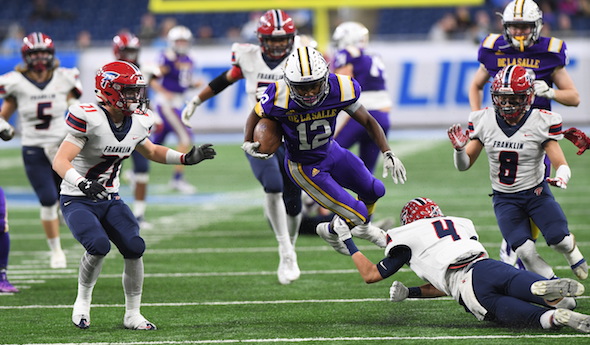
PHOTOS: (Top) Warren DeLaSalle’s Semaj Shelton (12) leaps past a defender's outstretched arm during Friday’s Division 2 Final. (Middle) Pilots quarterback Luke Pfromm rolls out looking for an open receiver.