

Drive for Detroit: Week 7 in Review
October 10, 2016
By Geoff Kimmerly
Second Half editor
Upsets rang out during Week 7 of the high school football season, as league races and playoff hopes were turned sideways by unexpected finishes that played out all over our state.
See below for notes on this week's batch of results and the twists and turns they provided with only two weeks left in the regular season.
Bay & Thumb
Lake Fenton 22, Corunna 20
Lake Fenton clinched its first league title since 2007 by winning this matchup of former co-leaders in the Genesee Area Conference Red. The Blue Devils (7-0) were outgained in yardage 293-286 but intercepted a pass and recovered a fumble, and got rushing and receiving touchdowns from Trent Hillger including the game-winner with 3:24 to play. Reigning league champ Corunna (6-1) led 20-14 heading into the fourth quarter but gave up a safety with 4:51 left in regulation; Lake Fenton went ahead on the ensuing possession. Click for more from the Flint Journal.
Also noted:
Davison 28, Lapeer 7 – It took an extra day to get done because of Friday’s storms, but Davison (7-0) held on to clinch a share of the Saginaw Valley League Red title while knocking the Lightning (5-2) into a second-place tie, one win back with a league game to play.
Brown City 24, Harbor Beach 16 – The Green Devils (3-4) are holding out hope for an at-large playoff bid, but did move into second place with Harbor Beach (4-3) in the Greater Thumb Conference East after knocking the Pirates out of first; Harbor Beach plays leader Ubly this week with a chance to create a three-way tie for the title.
Unionville-Sebewaing 28, Elkton-Pigeon-Bay Port Laker 21 – The Patriots (6-1) have rebounded off an opening night loss to Ubly to win six straight and claim a share of the GTC West title, with former co-leader Laker (6-1) now in second and hoping Vassar can beat USA this week.
Freeland 29, Saginaw Swan Valley 14 – The Falcons clinched a share of the Tri-Valley Conference Central title and with only winless Bullock Creek left on the league schedule; Swan Valley (4-3) sat a win back of Freeland (7-0) heading into the night but fell into third place with the loss.
Greater Detroit
Birmingham Groves 18, Rochester Adams 8
The Oakland Activities Association White has been one of the state’s most competitive conference this fall, which makes Groves’ success that much more impressive. The Falcons (7-0) clinched a share of the league title with this victory and can clinch outright this week against sixth-place Farmington; they were champions of the OAA Blue in 2015. Adams (5-2) fell into third place after having a chance to clinch a share instead; Oak Park still can take a share with a win this week against Seaholm combined with a Farmington upset Friday. Click for more from the Oakland Press.
Also noted:
Redford Union 22, Redford Thurston 15 – The Panthers clinched their best finish since at least 2007 with their first win over rival Thurston since 2008; Union is 5-2 and can clinch its first playoff berth since 2006 this week against Dearborn Heights Annapolis (1-6).
Madison Heights Madison 17, Warren Fitzgerald 15 – The Eagles (4-3) bounced back from two straight nonleague losses to hand Fitzgerald (6-1) its first defeat and create a three-way tie for first place in the Macomb Area Conference Silver between these two and South Lake and with one more league game to play.
Romeo 31, Warren Mott 8 – The reigning MHSAA Division 1 champion Bulldogs (5-2) may have two losses, but they are by a combined three points; handing Warren Mott (6-1) its first loss sets Romeo up with a chance to claim a share of the MAC Red title with a win over Dakota and and a Mott win this week over leader Utica Eisenhower.
Detroit Catholic Central 28, Orchard Lake St. Mary’s 7 – The Shamrocks (7-0) broke a two-game losing streak to now second-place St. Mary’s (4-3) to hold on to first in the Detroit Catholic League Central with Warren DeLaSalle up next in the final game before Prep Bowl weekend.
Mid-Michigan
Breckenridge 12, Merrill 0
Sure, Breckenridge (0-9 in 2015) impressed everyone with a 5-0 start this fall. But with the expected favorites in the Mid-State Activities Conference lined up for Weeks 6, 7 and 8, there was no way the Huskies could claim a share of their first league title since 1947, right? Breckenridge (7-0) has answered with two straight shutouts of Carson City-Crystal and now Merrill (5-2) to win the MSAC title outright, regardless of what happens this week against Vestaburg (5-2). Click for more from the Midland Daily News.
Also noted:
Clare 35, Roscommon 24 – The excitement in the Jack Pine Conference had been the surge of Roscommon (6-1), but old stand-by Clare (6-1) set itself up to reclaim the league title after missing last year by winning this matchup of what were the co-leaders heading into the night.
DeWitt 27, St. Johns 7 – The Panthers (6-1) added a 43rd-straight league win and claimed the Capital Area Activities Conference Red title outright against the Redwings (3-4), who fell into third with the loss.
East Lansing 21, Lansing Sexton 6 – By winning this matchup of what were the second-place teams in the CAAC Blue, the Trojans (5-2) gave themselves a chance to earn a share of the title with leader Grand Ledge up next; Sexton (4-3) will turn its focus to securing a playoff berth against two opponents who are a combined 2-12.
Fowler 16, Dansville 14 – The Eagles (5-2) can’t claim a share of the Central Michigan Athletic Conference title even with a win against rival Pewamo-Westphalia this week, but look a lot better for making the playoffs with undefeated P-W and two-loss Merrill left on the schedule; Dansville (4-3) still has a nice shot too needing wins against two opponents who are a combined 5-9.
Northern Lower Peninsula
Charlevoix 16, Onekama 9
The Northern Michigan Football Conference Leaders division has four teams (of five total) with records of at least 5-2; Charlevoix not only earned a playoff berth with this win after missing at 5-4 last fall, but also set itself up to play first-place Frankfort this week to earn a share of the league championship. The Red Rayders (6-1) scored all of their points during the first half and held Onekama (5-2) scoreless over the final 18 minutes. The Portagers might be out of the league race, but can still earn a third-straight playoff berth over the next two weeks and potentially play spoiler with Frankfort coming up in Week 9. Click for more from the Petoskey News-Review.
Also noted:
Hillman 56, Oscoda 42 – After opening 0-3, the Tigers have won four straight and have a shot to extend a 10-season playoff streak; Oscoda (3-4) has fallen in three straight and must win out and hope for an at-large bid.
Whittemore Prescott 22, Rogers City 12 – The Cardinals (4-3) kept themselves alive to add to a nine-season playoff streak, while putting Rogers City (3-4) also in a position of needing to win out and hope to get in at-large.
Traverse City West 16, Cadillac 14 – After losses to rival Central and Benton Harbor by five points or fewer, West (5-2) showed it could win close too and against another strong opponent; Cadillac also is 5-2 and looking for one more win to make the postseason.
Gaylord St. Mary 42, Johannesburg-Lewiston 14 – The Snowbirds (6-1) are one of the best turnaround stories of this season, going from 3-6 a year ago to earning their first playoff berth since 2009; the Cardinals (3-4) must win out for a chance to keep a five-year playoffs streak going.
Southwest Corridor
Coldwater 19, Battle Creek Harper Creek 7
This looked at first glance like the upset of the weekend, but on closer inspection maybe shouldn’t be because Coldwater (5-2) has remained pretty impressive despite a couple of losses. Those defeats were by a point in overtime to Jackson Lumen Christi and 10 points in Week 2 to Marshall, both teams among the top four in the Interstate 8 Athletic Conference. The reigning champ Cardinals need a few things to happen to claim a share of the league title this time – it would take a win over Hastings this week plus losses by Harper Creek (6-1) and Lumen Christi – but if nothing else, won’t be a desirable opponent come playoff time. Click for more from the Battle Creek Enquirer.
Also noted:
St. Joseph Lake Michigan Catholic 24, Bridgman 19 – After going 2-7 a year ago, the Lakers (6-1) have bounced back and earned a playoff berth and a share of the Berrien-Cass-St. Joseph Conference Blue title by avenging last season’s 28-0 loss to Bridgman (4-3).
Schoolcraft 42, Gobles 0 – The Eagles (7-0) repeated as Southwestern Athletic Conference Central champions by beating second-place Lawton and this weekend third-place Gobles (5-2) by a combined score of 98-7.
Berrien Springs 47, Parchment 13 – The Shamrocks (4-2) set up a championship game this week in the BCS Red by becoming the first team since opening night to hold Parchment (4-3) to fewer than 31 points.
Watervliet 64, Delton Kellogg 34 – No opponent has been able to completely shut down Watervliet (5-2), which has scored at least 30 in all seven games and earned a shared SAC Lakeshore title (with Constantine) by knocking Delton Kellogg (4-3) into third place in the final game of the league schedule.
Southeast & Border
Hudson 35, Ida 34
Ida’s 12-game winning streak in the Lenawee County Athletic Association is over thanks to Hudson, which bounced back from a Week 6 loss to Hillsdale to edge the Bluestreaks and move into a tie with them atop the league standings. But this conference title hardly is determined. Ida (6-1) now must play Hillsdale, and Hudson (6-1) has a Week 9 game left with Blissfield – which beat Hillsdale this week. Click for more from the Adrian Daily Telegram.
Also noted:
Blissfield 27, Hillsdale 7 – This first win over Hillsdale (4-3) by the Royals (3-4) in eight tries over the last two decades also helped throw the LCAA standings into a spin, with both of these teams now among five either in first place or a win out with two league games to play.
Concord 41, Quincy 24 – The Yellow Jackets’ title hopes remain alive as they stayed among three first-place teams in the Big 8 Conference (and moved to 6-1 overall) while sending Quincy (5-2) a win back.
Ottawa Lake Whiteford 30, Morenci 26 – The Bobcats (7-0) set up an unofficial Tri-County Conference championship game this week with Sand Creek by surviving Morenci (4-3), which has lost its three games by a combined eight points.
Monroe St. Mary Catholic Central 30, Milan 20 – Nemesis SMCC (4-3) struck again with Milan needing a win to clinch a share of the Huron League title; the Big Reds (6-1) are back in a first-place tie with Grosse Ile with the Falcons and New Boston Huron only a win back with one more league game to play.
Upper Peninsula
Negaunee 28, Ishpeming 16
Two losses to Ishpeming in games that decided Mid-Peninsula Athletic Conference titles over the last four seasons no doubt made this victory sweeter for Negaunee (7-0), even if the Hematites aren’t in the hunt this time around. The Miners did clinch a share of the conference championship with the win and put the Hematites (3-3) in a position of needing to win out to guarantee a 15th straight playoff appearance. Click for more from the Marquette Mining Journal.
Also noted:
Escanaba 19, Gladstone 12 – The Eskymos (6-1) clinched a playoff berth and guaranteed their best finish since 2011, but another win also will give Gladstone (3-4) its best record since 2010.
Gwinn 60, Hancock 32 – The Modeltowners (5-2) now have their best season since 2000 after going 3-6 a year ago, but a strong finish by Hancock (4-3) can net the Bulldogs their first playoff berth since 2006.
Lake Linden-Hubbell 28, Houghton 0 – The Lakes (7-0) took advantage of their break in the Mid-Eastern Conference schedule to put up their first shutout of the fall against a Houghton team that at 3-4 now must win out to have hopes of earning an at-large playoff bid.
Kingsford 35, Iron Mountain 0 – The Flivvers (5-2) put up their third shutout this season and fifth win in a row over Iron Mountain (5-2), which hadn’t been held scoreless since 2014.
West Michigan
Zeeland East 12, Hudsonville Unity Christian 7
Unity Christian (6-1) had looked close to unstoppable coming into Friday, having won key games close and others by big margins. But Zeeland East (6-1) – which had fallen this season only to Hamilton in Week 3 – won a defensive battle that saw both teams score their fewest points this fall. The Chix – who moved into the Ottawa-Kent Conference Green this season from the O-K Black – next get league leader Byron Center with a chance to further mash up a race that has seen a handful of teams emerge as the favorite at some point or another over the last few weeks. Click for more from the Holland Sentinel.
Also noted:
Zeeland West 42, Hamilton 24 – The Dux (5-2) aren’t too familiar with life in fifth place, but have started to climb as well in the O-K Green, handing former leader Hamilton (5-2) its second straight loss.
Ravenna 29, Whitehall 28 – Ravenna (5-2) handed Whitehall (4-3) a one-point loss for the second week in a row and by doing so got a win closer to locking up a playoff berth after going 3-6 in 2015.
Lowell 41, Grand Rapids Forest Hills Central 37 – Many eyes were tuned in to updates from this game Friday as Forest Hills Central (5-2) led by 17 with 11:30 to play – but Lowell went ahead less than 10 minutes later to remain atop the O-K White standings and undefeated at 7-0.
Grand Rapids Forest Hills Northern 36, Cedar Springs 29 – The Huskies (4-3) broke a three-game losing streak to Cedar Springs (3-4) to set up a title chance this week against the Red Arrows.
8-Player
Engadine 52, Cedarville 42
Engadine trailed into the second half, but one of the best wins in Eagles history only got better because of the dramatic finish. They moved to 7-0 for the first time since 1998 and earned a share of the Bridge-Alliance Football League title against a Cedarville program that has lost only five league games total in five seasons of 8-player football. The Trojans (6-1) hadn’t let an opponent get closer than 20 points this fall. Click for more from 9&10 News.
Also noted:
Wyoming Tri-unity Christian 53, Lawrence 14 – Make the Defenders (7-0) another contender for the MHSAA title next month, as this 39-point win over previously-undefeated Lawrence (6-1) was their closest game yet.
Portland St. Patrick 16, Webberville 12 – The Shamrocks (7-0) earned the first win of the Central Michigan 8-Man Conference schedule with Webberville (5-2) producing the toughest competition St. Patrick has seen so far.
Stephenson 52, Rapid River 8 – The Eagles (6-1) could be lurking in the Western Eight Conference, with this win over Rapid River (5-2) their most impressive and leader Powers North Central coming up in Week 9.
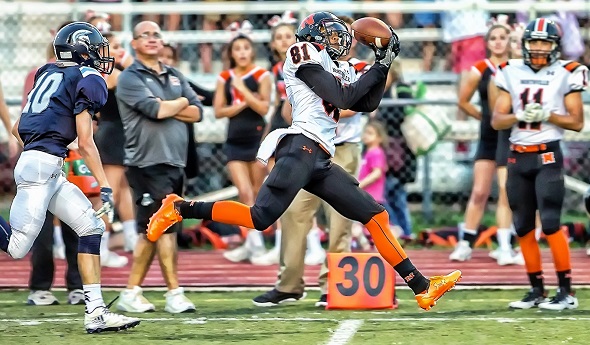
PHOTO: A Northville receiver hauls in a pass during his team's 30-24 win over Livonia Stevenson on Friday. (Click to see more from HighSchoolSportsScene.com.)

Fracassa's Remarkable Records Still Rule
By
Tom Markowski
Special for Second Half
June 24, 2020
As a senior at Sterling Heights Stevenson during the 2009 season, Jason Fracassa lit up the high school football world with his aerial display.
 Fracassa shattered the MHSAA career totals for passing yards and touchdowns held by Mill Coleman of Farmington Hills Harrison. Fracassa also etched his name into the national record book in three career passing categories before the remarkable run ended with a 31-21 loss to Detroit Catholic Central in the Division 1 Final at Ford Field.
The numbers he posted at Stevenson indeed were staggering. And just more than a decade later, after securing two undergraduate degrees and a masters in finance from Walsh University in Ohio, Fracassa lives in Auburn Hills and continues to crunch numbers – now for a development company in Birmingham – while also planning for a Sept. 12 wedding to fiancé Kelsey Torzy.
Fracassa has always been a highly-motivated person, and that held true in the classroom and as a three-sport varsity athlete and continues now in the business world. But while driven by success, Fracassa doesn’t dwell on what he accomplished in the sports world – which also included Division II college careers in both football and baseball. What was important then remains so now, and those are the relationships he built through trust, hard work and having a little fun.
“I miss going to practice each day and hanging out with my friends,” he said. “Just walking around school and trying to set an example to the kids, that’s what was important. I’ll go to the golf course now and I’m with all of my friends. That’s what it’s all about. That was the best part. We had the best relationships, no matter if we won or lost. Playing for Coach (Rick) Bye and your friends, that’s the best memories I have.”
A four-year varsity starter for Bye, Fracassa led Stevenson to a combined 23-3 record over his last two seasons, culminated by that fourth trip in program history to an MHSAA Final.
During his junior season, Fracassa threw for 3,353 yards and 34 touchdowns over 12 games. He then took aim at Coleman’s career passing records for touchdowns (77) and yards (7,464), records that had stood for 20 years.
 Fracassa and his teammates put on a show that 2009 season as he threw for 4,433 yards and 44 touchdowns. His career (10,615) and single season (4,433) passing yards remain MHSAA records, the career total by nearly 2,000 yards. Fracassa also continues to own the records for career passing attempts (1,104) and completions (656), accrued over 44 games, and he briefly held the MHSAA record for career TD passes with 97 before it was broken in 2013. The career attempts and yards and senior-season yardage all rank in the National Federation record book as well.
Fracassa credits the coaching staff at Stevenson for the success he and his teammates enjoyed. He couldn’t have imagined playing for anyone but Bye and his staff. Fracassa said he’s spoken with many of Bye’s former players, and they all agree playing for Stevenson and Bye was a phenomenal experience.
Like Fracassa, Bye – who retired after 2009 with a record of 268-94 over 35 seasons – also keeps tabs of his cronies by playing golf once a week with former assistants like Ken Fiott, Jerry Lajeunesse, Larry Zimmerman, Joe Emanuele and D.J. Hill among others. Bye is quick to point out that many of his former players, including Fracassa, keep in touch on a regular basis.
“I saw (Fracassa) at a Stevenson playoff game,” Bye said. “He calls me at least once every two months or so to see how I’m doing. I appreciate that. He was always a highly-respected kid. He’s not a kid anymore.”
Bye recalls hearing about Fracassa when Fracassa was in the eighth grade at St. Lawrence in Utica. Fracassa enrolled at Davis Junior High, Stevenson’s feeder school, for his ninth grade and tried out for the football team not knowing whether he’d make the varsity or not.
“His dad wasn’t pushy one bit,” Bye said. “(Rick Fracassa) asked if Jason was going to be on the JV. A big reason he wanted his son to come (to Stevenson) was Joe Emanuele, who was our baseball coach, and Rick knew Joe had a good program. He wanted Jason to play baseball, too.
“Jason came out and won the (quarterback) job. He proved himself. And he had to win over our seniors.”
Jason Fracassa said that was the hard part – convincing a group of seniors that a freshman could come in, start at quarterback and lead the team can be daunting.
“I knew I could compete at that level,” Fracassa said. “It was more of my getting to associate myself with the older players. That was the most difficult part. The coaches were always there to back me.”
 Stevenson made the playoffs that 2006 season finishing 5-5. The next season was rough as the Titans lost a number of close games and finished 2-7. Stevenson improved substantially to 10-2 in 2008, losing to Lake Orion, 38-36, in a Regional Final.
That all built up to the memorable 2009 season, which included a tense Semifinal game against Clarkston won by Stevenson 37-35 on a Fracassa scoring pass on the final play.
Emotions also ran high the game before when Stevenson took on Detroit Public School League power Detroit Southeastern, led by Michigan State-bound and now-NFL defensive end William Gholston. Fracassa threw for a career-high 494 yards, and Stevenson defeated Southeastern, 38-32.
After a busy and accomplished prep career, Fracassa maintained a hectic athletic schedule in college first at Northwood University – where he started on the baseball team for three seasons and was a member of the football team for two.
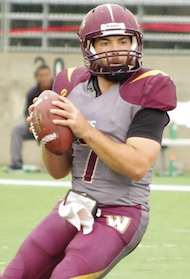
After sitting out a term, Fracassa transferred to Walsh, located in North Canton, Ohio. There he revived his football career starting at quarterback his last two years. Walsh, then a recent addition to the Great Lakes Intercollegiate Athletic Conference, nearly upset conference power and undefeated Ferris State in Fracassa’s final game. Fracassa threw his second touchdown pass of the game to give Walsh a 42-32 lead with 9:38 left before Ferris State came back with two touchdowns, the second with 36 seconds left, to win 46-42.
Fracassa hasn’t completely abandoned football since his last game at Walsh. He and his father coached the Oakland University club team in 2018 and that team reached a championship game. Jason was the offensive coordinator, his father the head coach – branches from the coaching tree rooted with Jason’s grandfather Al Fracassa, the second-winningest high school football coach in MHSAA history and Bloomfield Hills Brother Rice legend.
Jason’s competitive juices continue to flow.
“We had a great run,” Fracassa said, “and any other year could have taken the championship trophy.”
Made in Michigan 2020
June 16: Muskegon Grad Casts "Magic" in HBO Series - Read
 Tom Markowski is a correspondent for the State Champs! Sports Network and previously directed its web coverage. He also covered primarily high school sports for the The Detroit News from 1984-2014, focusing on the Detroit area and contributing to statewide coverage of football and basketball. Contact him at [email protected] with story ideas for Oakland, Macomb and Wayne counties.
PHOTOS: (Top) Jason Fracassa rolls out during the 2009 Division I championship game at Ford Field. (Middle) Fracassa and fiancé Kelsey Torzy. (Below) Fracassa drops back to pass while playing for Walsh. (Middle and below photos courtesy of Jason Fracassa.)