

Drive for Detroit: Week 7 in Review
October 9, 2017
By Geoff Kimmerly
Second Half editor
Be forewarned: There were more incredible and meaningful finishes in Michigan High School football this weekend than meet the parameters of our weekly “Drive for Detroit” report.
 A pair of incredible winning streaks ended on the west side of the state. Another Grand Rapids area game featured record book individual performances from both teams. The Upper Peninsula saw four undefeated teams fall. And the Detroit area had enough great games to fill half our weekly review – but of course we led with a legendary coach tying another for the career wins record.
Below are five results from each region that stuck out most (and we’ll be sure to catch up with the successes of Detroit Martin Luther King, Madison Heights Madison, Clarkston Everest Collegiate and others in reports to come). Drive for Detroit is powered by MI Student Aid.
Bay & Thumb
Frankenmuth 28, Millington 22
Given the similar numbers these rivals had put up this season, another close finish hardly was a surprise. The Eagles (7-0) took a 20-point lead into halftime and held off the Cardinals’ fourth-quarter comeback to clinch a share of the Tri-Valley Conference East title – and extend their winning streak over Millington (6-1) to three straight. Click for more from the Saginaw News.
Also noted:
Carrollton 26, Alma 14 – A week after Alma knocked reigning champion Freeland out of the TVC Central race, Carrollton (6-1) pushed its way in by handing the Panthers (6-1) their first league loss; both now chase Saginaw Swan Valley.
Fenton 52, Flushing 35 – The Tigers (7-0) clinched a share of their seventh straight Flint Metro League title with their fourth win in four seasons over the Raiders (5-2).
Davison 35, Lapeer 17 – The Cardinals (6-1) knocked Lapeer (5-2) out of a tie for first in the Saginaw Valley League Blue, but will now root for the Lightning to beat leader Midland this week so all three can share the championship.
Bay City John Glenn 28, Bay City Central 24 – John Glenn (4-3) kept its playoff hopes alive by winning the first meeting between these teams since 1990, while Central (3-4) may have seen its hopes dashed by a third loss of seven points or fewer.
Greater Detroit
Farmington Hills Harrison 17, Oak Park 14
It was considered inevitable that Harrison coach John Herrington would get his 430th win and tie Al Fracassa for the most football victories in state history. But maybe not against Oak Park (5-2), which was undefeated in the Oakland Activities Association White. Instead, the Hawks (5-2) moved into a three-way tie for first with the Knights and Birmingham Groves, and only last-place Berkley is left on the league schedule as Herrington looks to break the record this week. Click for more from MLive-Detroit.
VIDEO: Farmington Hills Harrison head coach John Herrington celebrates after tying Al Fracassa's @MHSAA career coaching wins record of 430! pic.twitter.com/79UUWif40b
— STATE CHAMPS! (@statechampsnet) October 7, 2017
Also noted:
Livonia Churchill 21, Grand Blanc 9 – The Chargers (6-1) won a matchup of teams previously undefeated in the Kensington Lakes Activities Association Gold to clinch a share of the league title, while Grand Blanc (6-1) suffered the first loss of what already is its best season since 2013.
Rochester Adams 21, Clarkston 14 – The Highlanders (6-1) cleared what looked to be the last major hurdle in at least sharing the OAA Red title; Clarkston (5-2) was tied for first with Adams and West Bloomfield, and Adams finishes the league schedule this week against winless Troy Athens.
Madison Heights Lamphere 28, Clinton Township Clintondale 20 – The Eagles (4-3) handed Clintondale (6-1) its first loss to finish a perfect run through the Macomb Area Conference Bronze and claim the outright title after going 0-9 last season.
Dearborn Divine Child 14, Ann Arbor Gabriel Richard 13 – Only a point separated these 6-1 teams, but that point gave Divine Child a share of the Detroit Catholic League AA championship.
Mid-Michigan
DeWitt 28, Haslett 0
It’s impossible to argue DeWitt isn’t the best team in the Lansing area this season, with its Week 2 win over Grand Ledge and now another outright Capital Area Activities Conference Red title with this victory over second-place Haslett (5-2). The Panthers (6-1) haven’t lost a league game since 2008 and will move into the CAAC Blue next season with Grand Ledge and the rest of the area’s largest schools. Haslett, meanwhile, can still finish with its best regular season since 2006 by winning out. Click for more from the Lansing State Journal.
TD DeWitt, Luke Hyde snags a 4-yd bullet from Blake Gatfield, sealing the CAAC Red for the Panthers. DeWitt 28, Haslett 0. 17 seconds left. pic.twitter.com/nU5BV41SNY
— Jake Atnip (@JakeAtnip) October 7, 2017
Also noted:
Belding 42, Wyoming Godwin Heights 35 – This win for the Knights (6-1) combined with Kelloggsville’s (see “West Michigan” below) makes this week’s matchup for a share of the Ottawa-Kent Conference Silver title; Godwin Heights (5-2) will turn its attention to earning a third straight playoff berth.
Lansing Sexton 18, Holt 16 – The Big Reds (5-2), with another win over one of the state’s largest schools, are looking powerful again as they project to slot into Division 4; Holt (3-4) must win out to have a shot at an at-large bid as it looks to get back to the playoffs for the first time since 2013.
Vermontville Maple Valley 38, Perry 13 – The Lions (4-3) have a tough road to win out with undefeated Kent City next, but control their ability to earn a first playoff berth since 2005; Perry (3-4) is hanging on to an at-large possibility as it looks to qualify for the first time ever.
Ithaca 51, Ovid-Elsie 16 – We don’t talk about Ithaca much during the regular season because its margins of victory usually are substantial and expected, but this time the Yellowjackets (7-0) clinched a share of another Tri-Valley Conference West title by beating the second-place Marauders (5-2) and while extending their regular-season win streak to 71 going back to 2009.
Northern Lower Peninsula
Gaylord St. Mary 34, Johannesburg-Lewiston 18
St. Mary improved to 7-0 to set up a matchup with Harbor Springs this week for a share of the Northern Michigan Football League Legacy title – and those seven wins also represent the Snowbirds’ most in a season since 2009. Johannesburg-Lewiston (4-3) still can figure into the league picture as it works to return to the playoffs after missing a year ago; the Cardinals face Harbor Springs in Week 9. Click for more from 9&10 News.
Also noted:
Elk Rapids 23, Grayling 8 – The Elks (6-1) tied their highest win total since 2010 by avenging last season’s 34-0 loss to the Vikings (4-3).
Lake City 26, Evart 14 – The Trojans (7-0) finished a perfect run through the Highland Conference after going 2-7 overall last season and 1-4 in league play; Evart (3-4) remains alive for an at-large playoff bid.
Hillman 35, Oscoda 21 – The Tigers (4-3) have bounced back from an 0-3 start as they try to extend their playoff streak to 12 seasons, but Oscoda (4-3) must bounce back from two straight losses to guarantee qualifying for the second straight.
Gaylord 24, Petoskey 7 – The Blue Devils (4-3) earned themselves a shot at a share of the Big North Conference title this week against first-place Traverse City West by downing a Petoskey team much better than its 2-5 record with a win over Escanaba and close losses to Marquette and Traverse City Central this fall.
Southeast & Border
Ida 16, Hudson 0
With two league games to play, these two are tied for first in the Lenawee County Athletic Association after sharing the championship a year ago. Ida (6-1) with this win avenged last year’s one-point loss to the Tigers (6-1) and also ran a shutout streak to two straight games; Hudson hadn’t been shut out since 2015. Both teams face Onsted (5-2) over the next two weeks, while Hudson also faces Blissfield (4-3) and Ida has Hillsdale (3-4). Click for more from the Adrian Daily Telegram.
Also noted:
Pinckney 42, Adrian 14 – In its first season in the Southeastern Conference White, Pinckney (6-1) won a share of its first league title since 1995 while sending Adrian (3-4) into at-large playoff territory.
Chelsea 14, Ypsilanti Community 7 – Chelsea (6-1) clinched the other share of the SEC White, getting by Ypsilanti Community (5-2) with a late score.
Pittsford 24, Athens 0 – Four of five teams in the Southern Central Athletic Association are poised to make the playoffs, but Pittsford (6-1) and Climax-Scotts are the leaders in league play although Athens (5-2) still has a shot at a shared title.
Addison 42, Grass Lake 12 – The Panthers (6-1) pulled within one more win of claiming at least a shared Cascades Conference title after going 3-4 in the league a year ago; reigning champ Grass Lake (4-3) needs to win out to guarantee a 13th straight playoff berth.
Southwest Corridor
Three Rivers 21, Edwardsburg 18
All streaks come to an end, of course, and Edwardsburg’s run of 34 straight Wolverine B Conference victories won’t soon be forgotten. Neither will Three Rivers’ persistence in breaking it. Three times the Wildcats trailed Friday, including late in the fourth quarter before prevailing and putting the league title up for grabs for the first time in a while. Edwardsburg, Three Rivers and Vicksburg all are 6-1 in the league (and overall) with two games to play. Click for more from the Kalamazoo Gazette.
Also noted:
Coloma 32, Schoolcraft 7 – The Comets (5-2) handed Schoolcraft its first league loss since 2014 and after falling to the Eagles (5-2) last season 48-7 and 41-7 in 2015.
Battle Creek Harper Creek 17, Coldwater 7 – The Beavers (7-0) claimed a share of the Interstate 8 Athletic Conference championship for the second year in a row by avenging last season’s only league loss, to Coldwater (4-3).
Cassopolis 45, Hartford 0 – The Rangers (7-0) set themselves up to face undefeated Mendon this week for a share of the Southwest 10 Conference title, while Hartford (5-2) has two chances left to pick up an automatic playoff bid after going 2-7 a year ago.
Watervliet 68, Constantine 24 – The Panthers’ output on offense is simply incredible; Watervliet (7-0) still hasn’t scored fewer than 50 this season, and Constantine (3-4) hadn’t given up more than 41 since facing the Panthers last season.
Upper Peninsula
Newberry 28, Norway 14
This will be remembered as one of the stunning wins north of the bridge this season. Norway (6-1) had been cruising along with all but one win this fall by at least two touchdowns (and the seven-pointer was against a team from Wisconsin). But Newberry didn’t have a game Week 6, and clearly was ready for a Knights team that could’ve clinched a share of the Mid-Eastern Conference title in its first season in the league. Newberry (4-2) instead has a share for sure, and the winner of this week’s Norway/Lake Linden-Hubbell game will claim one as well. Click for more from the Iron Mountain Daily News.
Also noted:
Escanaba 35, Gladstone 14 – While nonleague, winning this game gave the Eskymos (6-1) the unofficial “Best in the U.P.” title and rightfully so as its only loss was Week 2 to Petoskey and Gladstone (6-1) hadn’t been beaten.
Calumet 22, L’Anse 14 – The Copper Kings (4-3) had to win this one to keep a few playoff options open with two tough games left, and L’Anse (4-3) finds itself in must-win mode as well.
Bessemer Gogebic 14, Bark River-Harris 0 – The Miners (3-4) have put themselves back in the hunt with two straight wins over teams with playoff hopes; Bark River-Harris (3-4) now also must hope for an at-large bid.
Lake Linden-Hubbell 12, Houghton 8 – The Lakes (3-3) keep chipping away after their 0-3 start, with the greatest challenge yet coming this week against Norway.
West Michigan
Holland West Ottawa 35, Rockford 30
Holland West Ottawa earned a share of the O-K Red championship, an accomplishment with statewide impact regardless of how and against whom. But beating Rockford (4-3) for the first time since 2002 to do so – breaking a 16-game losing streak to the Rams – made this incredibly sweet as well. The Panthers (6-1) have lost this season only to undefeated Forest Hills Central, not bad after two straight 2-7 finishes. Click for more from the Holland Sentinel.
Also noted:
Grand Rapids Catholic Central 57, Comstock Park 50 – Nolan Fugate’s 477 rushing yards for GRCC (7-0) were the fourth-most in MHSAA history and needed to combat an MHSAA record-tying 18 receptions by Hunter Spence to lead Comstock Park (4-3).
Grand Rapids Forest Hills Central 35, Lowell 6 – The Rangers (7-0) earned the opportunity to face Cedar Springs this week with the O-K White title on the line by handing Lowell (4-3) its second straight loss; the Red Arrows must win out to guarantee adding to their 18-year playoff streak.
Wyoming Kelloggsville 36, Grand Rapids NorthPointe Christian 21 – See the Belding entry under “Mid-Michigan” for more explanation, but this win gave Kelloggsville (7-0) a spot in an unofficial O-K Silver championship game while NorthPointe (5-2) will try to make the playoffs against Godwin Heights this week.
Montague 40, Muskegon Oakridge 0 – The Wildcats (7-0) clinched a share of the West Michigan Conference title by handing rival Oakridge (5-2) its first shutout since opening night 2014 and after losing to the Eagles by three a year ago.
8-Player
Rapid River 16, Stephenson 14
These two have ruled the Western Eight Conference this season and were considered by some the best in all of the Upper Peninsula in 8-player. Those reputations were based in part on high-scoring offenses – so of course defense dominated, especially as Rapid River (7-0) held down a Stephenson attack averaging 55 points a game heading into the night (Rapid River had been averaging only 45 per). The Eagles (6-1) had beaten the Rockets 52-8 last season, and now must root for Powers North Central this week and beat the Jets in Week 9 in hopes of gaining a share of the league title. Click for more from the Escanaba Daily Press.
Also noted:
Engadine 30, Cedarville 26 – The Eagles (5-2) are among the few who have had Cedarville’s number lately, with this win their third in two years over the Trojans (6-1).
Kingston 30, Morrice 26 – A week after knocking Deckerville out of their first-place tie in the North Central Thumb League Stars division, Morrice (6-1) fell back into a tie with this upset by the Cardinals (5-2).
Deckerville 56, Flint International Academy 36 – The Eagles (6-1) took full advantage of Morrice’s loss to climb into an NCTL Stars tie for first while sending the Flames (5-2) into third place.
Tekonsha 14, Battle Creek St. Philip 12 – Tekonsha (4-3) had never beaten St. Philip (4-3) in 8-player and had scored 20 total points over five games against the Tigers.
Second Half’s weekly “Drive for Detroit” previews are powered by MI Student Aid, a part of the Student Financial Services Bureau located within the Michigan Department of Treasury. MI Student Aid encourages students to pursue postsecondary education by providing access to student financial resources and information, including various student financial assistance programs to help make college more affordable for Michigan students. MI Student Aid administers the state’s 529 savings programs (MET/MESP) and eight additional aid programs within its Student Scholarships and Grants division. Click for more information and connect with MI Student Aid on Facebook and Twitter @mistudentaid.
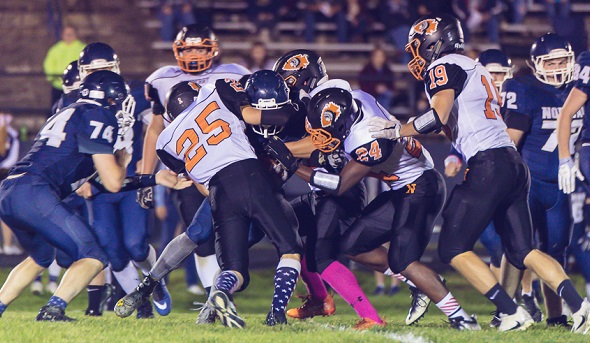
PHOTO: Newberry defenders swarm a Norway ball carrier in handing the Knights their first loss of the season Friday. (Photo by Jeff Rochefort.)
1st & Goal: 2021 Week 2 Preview
By
Geoff Kimmerly
MHSAA.com senior editor
September 1, 2021
Last week's return to "normal" football was as good as anticipated, if not better. And the good news is we're just getting started.
As we cruise into Labor Day weekend, the great majority of Week 2 games will again be played Thursday. Additionally, more than 150 games will be viewable live on MHSAA.tv, with Bally Sports Detroit broadcasting Friday's Detroit Cass Tech at Muskegon game on its PLUS cable channel and State Champs! Sports Network streaming live Saturday's Grand Rapids Catholic Central game against Merrillville (Ind.) Andrean. See the full schedule from the MHSAA Score Center.
In addition to our weekly glance at some of the games to watch in every corner of our state, we're also introducing a new feature for this season -- an "Unforgettable 5ive" of highlights from MHSAA.tv and media partner broadcasts. See below for our Week 1 5ive, which includes the following:
► Marquette's Jordan Demay with the Pick 6 in Marquette's 49-14 win over Alpena.
► Clinton Township Chippewa Valley's Cephus Harris with the 60-yard TD run in a 45-20 win over Detroit Catholic Central.
► Dearborn Fordson's Alex Osman connecting with Antonio Gates Jr. for a 37-yard TD in Fordson's 38-23 win over Canton.
► DeWitt's Tyler Holtz throwing a 30-yard touchdown pass to Bryce Kurncz in DeWitt's 47-27 win over Traverse City Central.
► Grand Blanc's Elijah Jackson-Anderson sealing a 40-34 win over East Lansing with a 40-yard TD run.
Bay & Thumb
Elkton-Pigeon-Bay Port Laker (1-0) at Ubly (1-0), Thursday
Both got off to solid starts last week, Laker downing Flint Beecher and Ubly upending Unionville-Sebewaing. By October, both could be contending for league championships as well. Ubly was third in the Greater Thumb Conference East last season, while Laker came in third in the GTC West.
Keep an eye on these: THURSDAY Saginaw Swan Valley (0-1) at Frankenmuth (1-0), Saginaw Nouvel (1-0) at Millington (1-0). FRIDAY North Branch (1-0) at Croswell-Lexington (0-1), Lapeer (0-1) at Midland (0-1).
Greater Detroit
Muskegon Mona Shores (1-0) at Detroit Martin Luther King (0-1), Friday
Mona Shores began its drive last week for a third-straight Division 2 championship with a 42-point win over Lowell, and they’ve lined up 2019 Finals foe King for a second-straight regular-season meeting. The Sailors have won both of those last two matchups, and the Crusaders also have plenty driving them from last week’s 42-40 loss to Indiana power Carmel – decided on a 35-yard touchdown catch on the game’s final play.
Keep an eye on these: FRIDAY Davison (0-1) at Detroit Catholic Central (0-1), West Bloomfield (0-1) at Oak Park (0-1), River Rouge (1-0) at Warren De La Salle Collegiate (1-0), Dearborn (1-0) at Belleville (1-0).
Mid-Michigan
Lansing Catholic (1-0) at Williamston (1-0), Thursday
Formerly league rivals until 2018, both again have league title aspirations after the Capital Area Activities Conference didn’t award championships last season due to the shortened schedule. Williamston, from the CAAC Red, set the tone coming off last year’s Division 4 Semifinal trip by doubling up Croswell-Lexington on the road last week. Lansing Catholic, in the CAAC White, made the Division 5 Semifinals last season and doubled up Lansing Waverly in its opener.
Keep an eye on these: THURSDAY Lansing Everett (1-0) at Lansing Eastern (1-0), DeWitt (1-0) at Portland (1-0), Pewamo-Westphalia (1-0) at Laingsburg (1-0), Jackson (1-0) at Grand Ledge (1-0).
Northern Lower Peninsula
Maple City Glen Lake (1-0) at Kingsley (1-0), Thursday
These are two more who could emerge as league champions over the next eight weeks. Kingsley – from the Northern Michigan Football Conference Legends division – has made the best of last year’s unfortunate circumstance, when the undefeated Stags were unable to take the field for their District Final. Kingsley opened with a 54-8 win over McBain, last season’s Highland Conference champion. Glen Lake was second in the NMFC Leaders last fall, ending a four-year league title streak, but opened last week with a 35-6 win over 2020 Highland co-runner-up Houghton Lake.
Keep an eye on these: THURSDAY Marquette (1-0) at Traverse City Central (0-1). FRIDAY Grand Haven (1-0) at Traverse City West (1-0), Escanaba (1-0) at Petoskey (1-0), Grayling (1-0) at Traverse City St. Francis (1-0).
Southeast & Border
Erie Mason (1-0) at Hudson (1-0), Thursday
The Eagles were one of the best stories of the 2020 season, breaking a string of 15 straight sub-.500 finishes to win the Tri-County Conference in their first season in the league. If this fall’s Week 1 is an indication, former Lenawee County Athletic Association foe Hudson could be a candidate for a similar 2021. The Tigers earned some statewide attention with a 59-14 opening win over annual power Ithaca.
Keep an eye on these: THURSDAY Jonesville (1-0) at Homer (0-1), Ida (1-0) at Ottawa Lake Whiteford (1-0), Michigan Center (1-0) at Hanover-Horton (1-0), Harper Woods (1-0) at Pinckney (1-0).
Southwest Corridor
Three Rivers (1-0) at Edwardsburg (1-0), Thursday
Even with reigning Division 6 champion Montague undergoing a bit of a fresh start, few results jumped off the page more last week than the Eddies’ 38-0 win in their opening matchup. A little more undercover but intriguing also was Three Rivers’ 36-34 overtime win over Paw Paw, the most frequent runner-up of late to Edwardsburg’s Wolverine Conference dominance. Three Rivers’ victory also gave it as many wins as it totaled all last season, and this week will be another opportunity to show what’s possible.
Keep an eye on these: THURSDAY Niles Brandywine (1-0) at Cassopolis (1-0), Schoolcraft (0-1) at Centreville (0-1), Battle Creek Pennfield (1-0) at Marshall (1-0), Kalamazoo Hackett Prep (0-1) at Stevensville Lakeshore (1-0).
Upper Peninsula
Ishpeming Westwood (1-0) at Iron Mountain (1-0), Thursday
The Mountaineers have a chance to stake a pretty serious claim as Western Peninsula Athletic Conference Copper favorites if they can add a win over Westwood to last week’s two-pointer over Negaunee. The Patriots similarly would enjoy a major boost with another Copper contender, Calumet, up next. Iron Mountain and Westwood have split their last four meetings on the field.
Keep an eye on these: THURSDAY Calumet (0-1) at Negaunee (1-0), Bark River-Harris (1-0) at West Iron County (0-0). FRIDAY Gladstone (1-0) at Kingsford (1-0), Marinette, Wis. (0-2) at Menominee (1-0).
West Michigan
Detroit Cass Tech at Muskegon, Friday
This was another anticipated matchup that couldn’t be played last fall because of the late start, but this would be a massive draw any season. Both are coming off big wins, and as in years past both feature plenty of future college players. The Technicians are riding a 10-game regular-season winning streak – but Muskegon has lost only twice at home over the last six seasons.
Keep an eye on these: THURSDAY Cedar Springs (1-0) at Rockford (1-0), Muskegon Oakridge (1-0) at Whitehall (1-0). FRIDAY Grand Blanc (1-0) at Grand Rapids Forest Hills Central (1-0), East Grand Rapids (0-1) at Grand Rapids South Christian (1-0).
8-Player
Hale (1-0) at Pellston (1-0), Friday
Pellston is a combined 15-3 over the last two seasons, and Hale is 12-6 over the same span of time – and Pellston won their league matchups in 2018 and 2019 before both moved into different conferences and didn’t play each other last season. This return of the series could feature strength on strength. Hale hasn’t given up more than 20 points in a game since last season’s opener, while Pellston’s 64 points last week followed the 45+ they scored six times a year ago.
Keep an eye on these: THURSDAY Marion (1-0) at Brethren (0-1), Mount Pleasant Sacred Heart (1-0) at Deckerville (0-0). FRIDAY Rapid River (0-1) at Lake Linden-Hubbell (1-0), Ironwood (1-0) at Ontonagon (1-0).
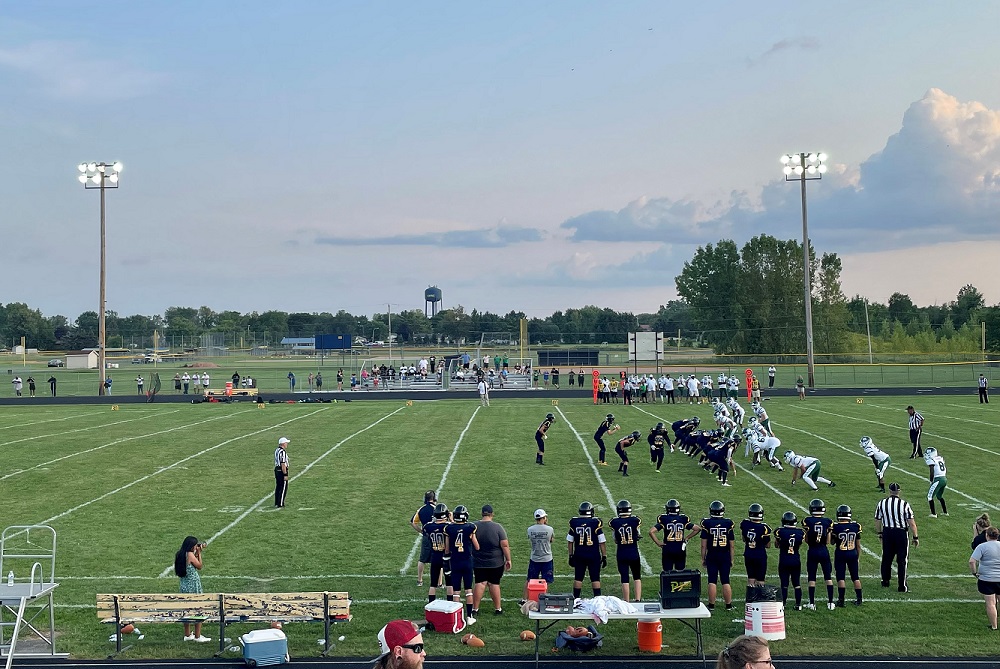
PHOTO: Capac and New Haven kicked off their season last week. Capac, returning after playing only one game a year ago, won 22-0. (Photo by Robert Batzloff.)