

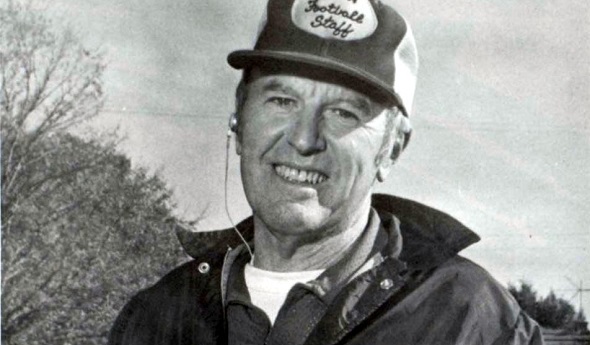
Early Wins Leader Maskill Built Champions
November 12, 2019
By Ron Pesch
Special for Second Half
The long shadows of “midcentury modern” coaching legends have mostly disappeared from the gridirons of Michigan.
One more vanished in late October at the age of 96.
Bill Maskill was once the winningest football coach in Michigan high school history, chalking up the majority of his victories at Galesburg-Augusta. One of only six who could claim such an honor – coaches are first counted after reaching 200 wins – he received his start in coaching at Sheridan High School (now known as Central Montcalm since the Sheridan and Stanton school districts merged in 1963). In 1980, he became only the second coach to compile 200 varsity victories as a coach, and in the fall of 1982 he surpassed Muskegon Heights’ coaching legend Oscar E. ‘Okie’ Johnson on the victory list.
Maskill’s coaching accomplishments – and their historic significance – are a reminder of a change in eras. Michigan prep sports in the pre-playoff days were filled with coaches with Swiss-Army like skills, as many were expected to coach multiple sports at their respective schools. The gridiron season was unlike today’s in many ways, and the differences are reflected in a variety of manners within the state record books.
Coaching and player season performances up to the creation of the MHSAA Playoffs in 1975 were constrained by the schedule. In general, nine games was the max. (With the playoffs, a season can extend up to 14 games.) Maskill’s victory total now ranks 16th overall in Michigan high school history, as there are 63 coaches with at least 200 varsity wins. Two coaches, John Herrington of Farmington Hills Harrison – the state’s current leader – and Al Fracassa, long of Bloomfield Hills Brother Rice, amassed more than 400 varsity victories during their careers. In both cases, more than 65 victories were earned during the postseason.
The MHSAA postseason was approaching its eighth year of existence when Maskill passed Johnson as the winningest football coach in state history. To that point, Maskill’s Rams had twice qualified for the playoffs – the first time in 1976, and again in 1980 – but had yet to win a game during the postseason.
But he stayed atop the state’s football wins list for more than a decade – and later found playoff successes as well, more crowning achievements for a coach whose many wins came after turning around both programs fortunate enough to employ him over a combined 44 seasons.
A Rough Start
Maskill’s career, at least in his eyes, was nearly derailed during his first season at the helm.
“The year was 1949, and Bill Maskill was in his first year as varsity football coach at Sheridan High, about 50 miles north of Lansing. He thought it would probably be his last. His team did not win a single game. ‘A couple of times, I thought of throwing in the towel,’” Maskill told Mick McCabe of the Detroit Free Press in October 1982, when he surpassed Johnson in victories.
There was little likelihood that Maskill would be dismissed as coach after that disappointing season. But it took a few years for his Redskins to become competitive.
“Previous to his work there, Sheridan had not played football and there was little interest in the game,” noted the Battle Creek Enquirer in the spring of 1957, when Maskill was announced as the new football and baseball coach at Galesburg-Augusta High School. “He built up interest to the point that during the past five years, Sheridan has won the Montcalm County League championship once and finished second for four years. During this period, the team’s overall record was 31 won, 9 lost and 2 tied. In baseball, he had one county championship, finished second twice and third twice.”
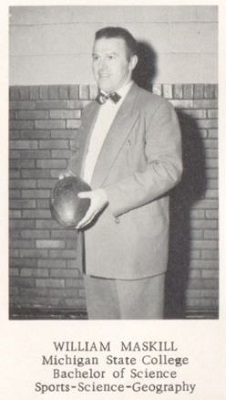
A 1941 graduate of Detroit DeLaSalle, Maskill had been a hard-plunging fullback on the football team who also boxed in Catholic Youth Organization tournaments. Following graduation, he initially enrolled at the University of Michigan in 1942, receiving his freshman numerals from coach Wally Weber, but only after a year at prep school near Pittsburgh.
“I screwed around a lot in high school and couldn’t get into Michigan,” he told McCabe years later, laughing. “They sent me to this prep school, and I couldn’t believe all the studying I had to do. It was the best thing to ever happen to me.”
He ended up at Michigan State, where he earned a varsity letter from coach Charlie Bachman in 1944 and his bachelor’s degree.
“He was hard of hearing; he had it bad,” recalled Bob Ludwig of Muskegon, a football teammate with Maskill in the backfield for the Spartans in 1945. “Our quarterback would mouth the words of the play to him.”
Over time, Maskill had multiple operations in hopes of correcting the issue.
The attempts improved his hearing, according to Maskill, “to about six percent. And that’s the truth. But there are some advantages. The kids can cuss at me and I don’t know it.”
The disability never stopped him. He told McCabe that the only thing he ever wanted to be in life was a football coach: “I just liked playing football, and that made me want to coach.”
Another Rough Start
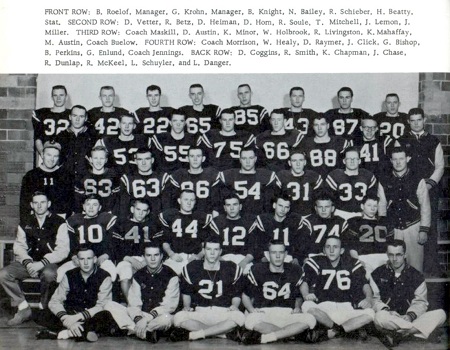
At Galesburg-Augusta, he inherited a team that finished with a single tie amid eight losses the year prior to his arrival. Improvement certainly wasn’t reflected in the standings in Maskill’s first year in charge. The Rams completed the eight-game season without a victory or a tie to show for their efforts. That changed in year two, as G-A finished with a 7-1 mark. The only loss was to unbeaten Bangor, 40-21, in the season finale. In 1959, Maskill and his stable of assistants had completely flipped the table, as the Rams ended with a perfect 8-0 mark.
“Galesburg-Augusta blasted Bangor, 27-0, before a crowd of more than 2,500 fans at jam-packed Angell Field in Kalamazoo … in a battle between the Kalamazoo Valley’s unbeaten football teams. Bangor’s great 21-game winning streak simply collapsed before the high-powered running attack as the Rams rolled to their seventh straight victory of the season,” wrote Dick Kishpaugh in his coverage for the Enquirer. Kishpaugh would later be known as Michigan’s authority on high school sports.
A week later, the Rams trounced a solid Paw Paw team on the road, 33-7. They finished third in the United Press International season-ending Class C-D rankings behind Charlevoix and Cassopolis.
Statewide Success
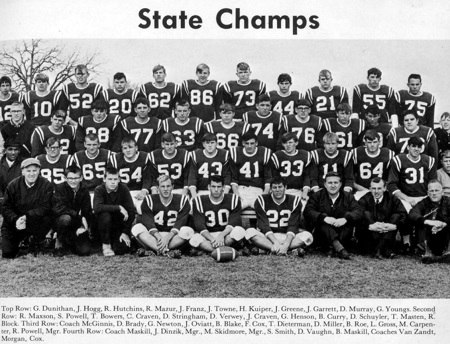
That was the first of eight G-A squads to finish the regular season undefeated for Maskill. The next four would each be named mythical state champions according to the polls.
His 1962 team allowed only 14 points across eight games to end the year as Class C-D champion ahead of St. Joseph Catholic according to The Associated Press poll of Michigan sportswriters and sportscasters.
Maskill’s 1966 and 1967 Rams squads each finished unbeaten and untied in nine contests. The 1967 team scored a school-record 389 points on the year, and held opponents to a mere seven points – a touchdown and an extra point scored by Springfield in a midseason 27-7 triumph. The 1970 team also finished with a flawless 9-0 mark, topping the 1967 team’s offensive output with 408 points on the season.
Maskill’s 1976 team ended the regular season 9-0 and was one of only four teams to advance to the Class C postseason in place during those earliest days of the MHSAA playoff system. G-A immediately was eliminated by Flat Rock, the eventual champion.
The media spotlight came to Galesburg-Augusta in 1980 for a regular season-ending contest with Constantine. A victory would give the veteran coach another perfect regular season and push Maskill’s career win total to 200. The week played out under television station coverage and multiple newspaper reports.
“More than 120 of Maskill’s former players were on hand, some wearing varsity letter jackets that were nearly 20 years old. All trotted onto the field, according to their graduation years, during halftime festivities,” said Bob Byington in the Enquirer. “… The warmest embrace and greeting were reserved for Maskill’s son, Bill Jr., an assistant coach at the University of Louisville. The younger Maskill drove in from Kentucky to surprise his dad …”
 The Rams won 28-6 to finish 9-0, qualifying for the MHSAA Playoffs for the second time in school history. The team ranked fifth in the final AP poll. A loss to White Pigeon in the opening round capped the season.
Despite impressive 8-1 records in 1981, 1982 and 1983, the Rams didn’t return to the playoffs until 1985. There, they won their first postseason contest, downing Hudson, 21-6, in a Pre-Regional. G-A fell the next weekend to eventual Class C titlist Lansing Catholic Central.
Lansing Catholic would again eliminate the Rams from the postseason the following year.
We Have a Lot of Heart
The MHSAA approved an expansion to the football playoff system in 1990, doubling the classifications from four to eight, which in turn doubled the number of annual qualifiers. While the Rams finished the regular season with a single defeat, they were unranked in the weekly press polls. Thanks to the changes to the playoff system, they were in the tournament, but weren’t expected to go far.
Rumors had circulated that this – Maskill’s 40th year as a head coach – would be the last go-around for the 67-year-old veteran coach. The first-round opponent was No. 4-ranked Dansville. With the Rams trailing 17-0 with 8:33 remaining in the third quarter, the result didn’t look promising.
But Jason Meek would have none of that. The Rams started their comeback with a trick play – a halfback pass by Meek off a lateral for a touchdown reception by Rusty Smith. It was followed on the next possession by a 27-yard TD reception by Meek from reserve quarterback Dave Lemmien. A pair of 2-point conversions by Rick Tyson had cut the lead to 17-16. Tyson scored the game winner on a one-yard touchdown run, set up by an interception by Meek that capped a 14-play, 59-yard drive – all rushes – that burned 6:53 off the clock. The defense shut down Dansville for the remaining six minutes of the contest.
A week later, the Rams lined up against No. 1 Schoolcraft, the two-time reigning Class C champion which was riding a 16-game win streak. The Eagles had lost only three of their last 57 games.
Galesburg-Augusta stunned all prognosticators with a 15-13 win before nearly 5,000 fans.
The Rams ran the ball 52 times, with Tyson handling the ball 28 occasions for 78 yards including a 19-yard TD that opened the game’s scoring. Schoolcraft tied the game at 7-7 just before the half, then opened a 13-7 lead on its second drive of the second half.
“It took all of us to do it,” said G-A junior fullback Paul Zimmerman, who scored the game-tying touchdown, and winning 2-point conversion on nearly identical plays with 4:01 remaining in the game.
Again, like the previous week, the Rams’ defense rose to the occasion, shutting down the Eagles for the remaining minutes.
“They kept the football,” said Larry Ledlow, coach of Schoolcraft about the second half. “Our defense was on the field much too long.”
G-A would win its Week 12 Semifinal contest with Clinton, 22-7, to advance to its first MHSAA Final. Corky Meinecke wrote a career-respective feature on Maskill that appeared in the Free Press on the day of the game:
“Just about everyone who loves, respects and admires Bill Maskill … figures he’ll announce his retirement sometime after the Rams play Muskegon Catholic Central … in the Class C championship game at the Silverdome. The timing couldn’t be better. Getting the Rams (11-1) to the Silverdome was the last notch on a heavyweight coaching belt that includes four mythical state titles … and five playoff appearances. He is the winningest football coach in state prep history …”
Weighing into the pending decision was a surprising aspect few ever considered.
“Maskill never figured he’d run out of players before he ran out of desire,” wrote Meinecke, “but that appears to be the case. Of G-A’s 24 players, only six are underclassmen. The school did not field a freshman team and the junior varsity – comprised of mostly freshmen – forfeited its last two games because it could not suit up enough players.”
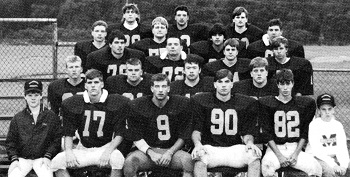 “A normal person would retire,” said Ken Buelow, Maskill’s assistant for all but three of the coach’s seasons at G-A and Sheridan. “But you have to remember, Bill is not a normal person. You’re talking about one hell of a human being here.”
“We don’t have size, we don’t have quickness and we don’t have speed,” Maskill said to Meinecke about this team that was perhaps the most satisfying of his career. “But we have a lot of heart.”
The Rams lost to MCC.
Changing landscapes
Maskill’s decision still took time. In August 1991, the G-A administration officially announced that the district would not field a varsity football team that coming fall.
“We do not have the numbers,” said athletic director Alex Forrester at the time. “It has nothing to do with money. … We do not have enough players.”
G-A chose to sponsor only a JV team that season. Instead of walking away, Maskill chose to stay on.
“I’ve never not coached a varsity,” he told Mark Bradley of the Enquirer. “I won’t know how to coach at the junior varsity level. But coaching is coaching, whether it be at the varsity or junior varsity level.”
He had retired from teaching following the 1980-81 school year and was one of 30 individuals inducted into the inaugural class of the Michigan High School Football Coaches Association’s Hall of Fame in April 1983. In October 1986, the school district honored him by naming the G-A football field in his honor. Without Maskill walking the halls and recruiting, fewer and fewer kids came out for football. After a year leading the JV, in July of 1992, he officially stepped aside from coaching. Forrester, one of his longtime assistants, took charge.
Maskill had purchased a tire company after he retired from teaching, and that became his focus.
In October 1994, over 12 years after Maskill had passed Johnson on the win list, Marysville’s Walt Braun passed Maskill in total wins. Leo “Smokey” Boyd of Saginaw Nouvel overtook Braun on the list in 1996. In turn, Fracassa topped Boyd in 2001, and Herrington bettered Fracassa’s total in 2017.
The “Ram Family”
The floor-to-ceiling mementos from his career that Maskill shared with Meinecke during their conversation were a feature of a party that Maskill would host annually.
“… It was not unusual to have 200-plus (former players, coaches, and new and old friends) there to celebrate the man they knew as ‘Coach’,” wrote Bill Broderick in a heartfelt article in the Enquirer, announcing Maskill’s passing.
Several years back, Buelow, his old assistant coach, had organized a group to create “a would-be Galesburg-Augusta football museum” in Maskill’s basement.
“… I was shocked when I heard,” said Bill Maskill, Jr., to Broderick concerning his Dad’s passing. Head football coach at Midwestern State University in Wichita Falls, Texas, since 2002, Bill Jr. had earned all-state honors at quarterback as a senior at G-A in 1966. "He went out and walked a mile on Monday. We all thought he would live forever."
 Ron Pesch has taken an active role in researching the history of MHSAA events since 1985 and began writing for MHSAA Finals programs in 1986, adding additional features and "flashbacks" in 1992. He inherited the title of MHSAA historian from the late Dick Kishpaugh following the 1993-94 school year, and resides in Muskegon. Contact him at [email protected] with ideas for historical articles.
PHOTOS: (Top) Bill Maskill Sr., here during the 1980-81 school year, was the state’s winningest high school football coach all-time after his final varsity season in 1991. (2) Maskill, shown here during the 1954-55 school year, played football and earned his bachelor’s degree from Michigan State. (3) The 1959 Galesburg-Augusta team finished 8-0. (4) The 1966 Galesburg-Augusta team was named a mythical state champion by media rankings. (5) Maskill took his team to the MHSAA Finals for the first time in 1990, when it finished Class C runner-up. (Photos gathered by Ron Pesch.)
1st & Goal: 2021 Week 5 Preview
By
Geoff Kimmerly
MHSAA.com senior editor
September 24, 2021
The football talk is turning up as we reach the midpoint of the 2021 regular season.
 Much of what’s coming to the MHSAA office these days concerns the first-time fully-implemented “enhanced strength-of-schedule” format for selecting this year’s playoff qualifiers. So as we prepare to look at some of the games that will shape the field, here’s a quick review of the process that eventually will get us to 256 teams for 11-player and 32 teams in the 8-player brackets.
Let’s start with 11-player and start with the most fundamental change. Teams no longer make the playoffs by winning a certain number of games. Six-wins-and-in is out. Just like for 8-player, the field will be selected solely based on playoff-point average accrued as a combination of success and opponents’ strength of schedule.
The calculation of playoff-point average actually changed last year – but because nearly every team made the postseason due to a temporary COVID-19 restructuring, the new math mostly went unnoticed. Simply put, the newer formula is designed to reward a team for scheduling strong opponents by giving it bonuses based on opponents’ successes throughout the season – no matter if that team won or lost when it played those opponents. Those bonuses also are assigned differently, with points awarded by Division instead of the former “Class” of an opponent. Click here for a further breakdown of the differences between old and new formats.
One more important thing to note: Playoff divisions for 11 and 8-player are determined before the season instead of after Week 9. So teams know every possible opponent long before the playoffs start and can follow their progress toward making the field every week on the MHSAA Website.
MHSAA.tv will carry more than 160 games live this weekend, with Bally Sports Detroit broadcasting Friday's DeWitt/Grand Ledge matchup on its PLUS cable channel and State Champs! Sports Network streaming games both Saturday (Paw Paw at South Lyon East) and Sunday (Bloomfield Hills Brother Rice at Detroit Catholic Central). See the full schedule from the MHSAA Score Center and see below for glances at some of the games that could impact league and playoff races the rest of the regular season. (Games are Friday unless noted.)
Bay & Thumb
Freeland (4-0) at Frankenmuth (4-0)
The Eagles have not lost a league game since Week 4 of 2014, a stretch of 42 consecutive conference wins including the first three of this fall’s Tri-Valley Conference East slate. Freeland could provide the greatest threat yet to that run. While Frankenmuth won last year’s matchup 41-3 in the delayed regular-season opener, the Falcons went on to make the Division 5 Semifinals as the Eagles advanced to the title game at Ford Field. (Freeland and Frankenmuth lost to eventual champion Grand Rapids Catholic Central in successive weeks.) That success has carried over for both. Freeland opened this season downing reigning Jack Pine Conference champion Clare, and last week’s 43-13 victory over Essexville Garber was similarly notable. The Eagles, meanwhile, are the only team to defeat Goodrich so far.
Keep an eye on these FRIDAY Midland Dow (2-2) at Bay City Western (4-0), Millington (4-0) at Carrollton (3-1), Richmond (3-1) at Croswell-Lexington (3-1), Mount Pleasant (4-0) at Midland (2-2), Harrison Township L'Anse Creuse (3-1) at Port Huron (3-1).
Greater Detroit
Warren De La Salle Collegiate (3-0) at Orchard Lake St. Mary's (4-0)
The way Detroit Catholic League Central teams have begun this season, it will be hard to not pick one of that league’s matchups as the Detroit area’s premier game over the next few weeks. This one gets the nod over Sunday’s Detroit Catholic Central/Bloomfield Hills Brother Rice showdown in part because De La Salle is coming off a 21-16 win over the Warriors and already has an important edge in the standings. But also making this intriguing is the bounce-back success of St. Mary’s, which finished 2-4 a year ago but has opened with a series of nice wins including over Hudsonville and Harper Woods.
Keep an eye on these FRIDAY Brownstown Woodhaven (4-0) at Allen Park (4-0), Belleville (3-1) at Dearborn Fordson (4-0), Clinton Township Chippewa Valley (3-1) at Romeo (4-0), South Lyon (4-0) at White Lake Lakeland (4-0).
Mid-Michigan
Jackson Lumen Christi (4-0) at Hastings (4-0)
The Saxons were among the best stories of the 2020 season, as they broke a string of seven straight sub-.500 finishes to win a share of the Interstate 8 Athletic Conference title. Hastings actually lost last year’s opener to Parma Western, but started its turnaround the next week by downing the Titans 14-13. The Saxons are up to nine straight regular-season wins, but get a Lumen Christi team this time that has an opening win over reigning Division 7 champion New Lothrop to its credit after putting everything back together to finish last fall with a Regional Finals run.
Keep an eye on these FRIDAY Evart (4-0) at Beal City (3-1), Grand Ledge (4-0) at DeWitt (3-1), Montrose (3-1) at New Lothrop (3-1), Fowler (2-2) at Pewamo-Westphalia (4-0).
Northern Lower Peninsula
Boyne City (4-0) at Traverse City St. Francis (4-0), Saturday
This means little in the short run as these two play in different divisions of the Northern Michigan Football Conference, but could say a lot if they continue on to win league championships and make playoff noise. They’ve long been rivals, playing together in multiple conferences including the NMFC’s Legends division through 2019, and they represent some of the best this region has to offer with Boyne City ranked No. 5 in Division 6 by playoff-point average and St. Francis No. 4 in Division 7. Boyne City is giving up only six points per contest and will try to match a Gladiators offense averaging 50 points and coming off two straight games scoring 63.
Keep an eye on these FRIDAY Grayling (3-1) at Kingsley (4-0), Traverse City Central (3-1) at Petoskey (3-1), Maple City Glen Lake (1-3) at Charlevoix (3-1), East Jordan (3-1) at Oscoda (2-2).
Southeast & Border
Riverview (4-0) at Monroe St. Mary's Catholic Central (4-0)
Monroe St. Mary and Milan often are the talk of the Huron League, but Riverview is looking again like possibly the team to beat after winning last season’s league title and opening this fall’s conference schedule by outscoring three opponents by a combined 116-17. The Pirates have won 11 straight league games going back to mid-2019, including 35-7 over St. Mary in last year’s opener. But the Falcons are surging as well and already have overcome a major league obstacle, defeating Milan last week 21-15.
Keep an eye on these FRIDAY Petersburg Summerfield (3-1) at Adrian Madison (2-2), Napoleon (3-1) at Hanover-Horton (2-2), Hudson (4-0) at Ida (3-1), Sand Creek (3-1) at Ottawa Lake Whiteford (3-1).
Southwest Corridor
Edwardsburg (4-0) at Plainwell (4-0)
It’s impossible to not marvel a bit at Edwardsburg’s work again this season. The Eddies have outscored their four opponents by a combined 203-7, and those four opponents are a combined 11-1 not counting their Edwardsburg defeats. Enter Plainwell, potentially headed toward an 11th-straight .500 or better season, riding its best start since 2013 and boasting a defense giving up just under nine points per game. The challenge is mighty, of course, but the Trojans can’t be overlooked.
Keep an eye on these FRIDAY Watervliet (4-0) at Berrien Springs (4-0), Constantine (4-0) at Parchment (3-1), Niles (3-1) at Vicksburg (3-1), Centreville (3-1) at White Pigeon (4-0).
Upper Peninsula
Hancock (2-2) at Houghton (3-1)
Go back probably to 2013 – when Houghton need to defeat Hancock in Week 9 to make the playoffs – for the last time this rivalry carried so many additional implications. Houghton is off to its best start since 2016 and would be part of the Division 6 playoff field if the season ended today, while Hancock can eclipse last season’s win total with another one tonight and could make up some ground in the Division 5 playoff race.
Keep an eye on these FRIDAY Iron Mountain (2-2) at Bark River-Harris (3-1), Marquette (3-1) at Gladstone (2-2), Manistique (2-2) at Ishpeming Westwood (3-1), Kingsford (3-1) at Escanaba (1-3).
West Michigan
Hudsonville (2-2) at Rockford (4-0)
The Eagles’ record requires the context of their losses being to Saline and Orchard Lake St. Mary’s – which are a combined 8-0 – and by just a combined six points. Hudsonville edged Jenison by just a point last week and make any feelings of early disappointment all but disappear with a similar result against the Rams. The Ottawa-Kent Conference Red powers missed their regular-season game against each other last season, but Rockford won their playoff matchup to run their streak in the rivalry to six.
Keep an eye on these FRIDAY Reed City (3-1) at Big Rapids (3-1), Grand Haven (3-1) at Caledonia (4-0), Byron Center (4-0) at Grand Rapids Northview (3-1), Muskegon Mona Shores (3-1) at Zeeland East (3-1).
8-Player
Adrian Lenawee Christian (4-0) at Colon (4-0)
This is another strong candidate for 8-player regular-season game of the year, combining storylines and successes. Colon will attempt to hand Lenawee Christian its first defeat in two seasons of 8-player football and was the only team to come close to slowing the Division 1 champion Cougars last season – Lenawee Christian won their matchup 24-6, but scored 47 or more points against their other 10 opponents and are up over 61 points per game this fall. The Magi – Division 1 champs two seasons ago – enter this meeting having posted two straight shutouts and averaging nearly 53 points per contest. But the Cougars aren’t just tough to stop; they also are giving up just under seven points per game.
Keep an eye on these FRIDAY Crystal Falls Forest Park (4-0) at Norway (3-1), Newberry (301) at Rudyard (4-0), Genesee (3-1) at Burton Atherton (3-1). SATURDAY Suttons Bay (4-0) at Munising (3-1).
Second Half’s weekly “1st & Goal” previews and reviews are powered by MI Student Aid, a part of the Office of Postsecondary Financial Planning located within the Michigan Department of Treasury. MI Student Aid encourages students to pursue postsecondary education by providing access to student financial resources and information. MI Student Aid administers the state’s 529 college savings programs (MET/MESP), as well as scholarship and grant programs that help make college Accessible, Affordable and Attainable for you. Connect with MI Student Aid at www.michigan.gov/mistudentaid and find more information on Facebook and Twitter @mistudentaid.
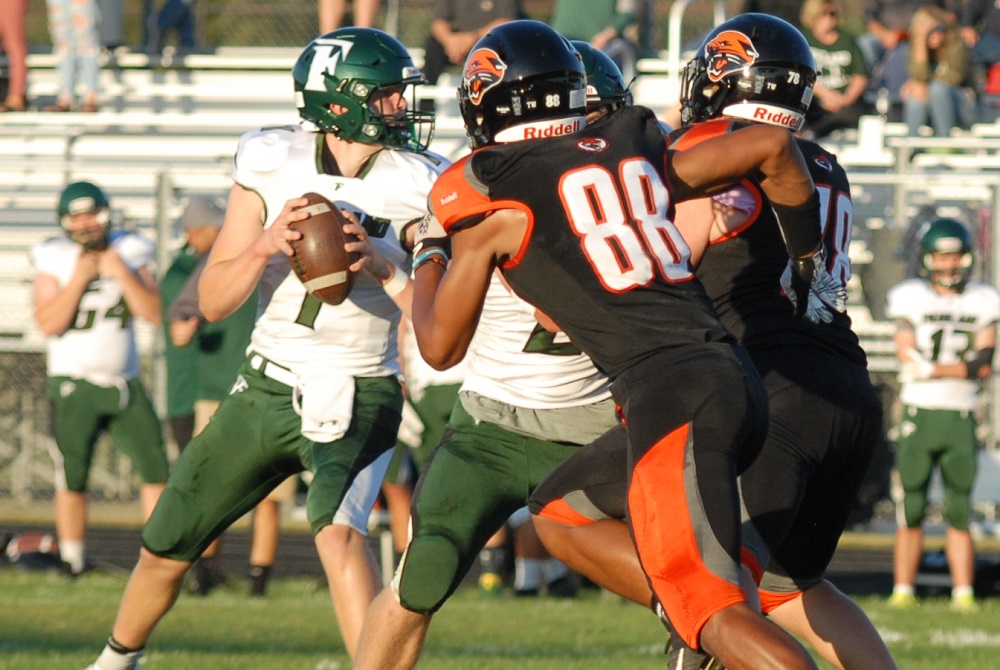
PHOTO: Alma defenders begin to collapse the pocked during Freeland’s Week 2 win over the Panthers. (Click for more from High School Sports Scene.)