

EGR 5-Year Title Run Remains Awe-Inspiring, Product of More Than Talent Alone
By
Steve Vedder
Special for MHSAA.com
November 25, 2022
It was Peter Stuursma's first year at East Grand Rapids and while the wolves weren't necessarily knocking at the door, they were definitely on the prowl.
The tradition-rich Pioneers football team had slumped to an uncharacteristic 3-6 record in Stuursma's first season as varsity head coach in 2000, and there were subtle signs a community used to winning was growing restless with the program's direction.
That's when Stuursma bumped into one of his players coming out of the weight room, and the two had a quick conversation which he clearly remembers 22 years later.
"It was this senior offensive lineman and all he said was, 'Don't worry about it Coach, it's not going to happen again. We got this,’" Stuursma said. "We had just gone 3-6, and I'm wondering how we're going to get this going and that they might get rid of me. You never underestimate what people can do."
East Grand Rapids, under legendary coach George Barcheski, had been the dominant football program in West Michigan with 28 winning seasons over 29 from 1970-99, and 38 victories in 39 games from 1993-95, along with Class B championships in 1976 and 1983. After Stuursma replaced the retiring Barcheski,, some in the community were expecting more of the same when it came to success.
Those fans never dreamed what they would see as the Pioneers promptly pieced together arguably the greatest decade-long stretch in Michigan high school football history – and without doubt one of the most incredible five-year runs of dominance.
Even that optimistic offensive lineman couldn't have imagined a remarkable 126-7 record over the next 11 years, a 40-3 MHSAA Tournament mark and seven Finals championships. Five of those titles (2006-10) came in a row, a feat accomplished just three times in the now 46-year history of the playoffs.
 The five straight championships were part of an amazing era that Stuursma and his players say has not diminished with time. They recall no single factor explained going 67-3 overall over those five seasons. There was talent, obviously, but coaching, tradition, confidence and strength of community all played vital parts. There were Thanksgiving practices attended by hundreds of former football alumni, dedicated fan support that included playing before more than 30,000 fans at least twice at Ford Field, and a program-wide attitude that, while some may call it a cliché, proved that success did indeed breed success.
"I'm in awe of the scope of things," said Stuursma, whose team used back-to-back Division 3 championships in 2002-03 as a springboard to later success. "Because we had won a couple times before it just started to feel normal. We had such support the community used to think Thanksgiving break ended at Ford Field."
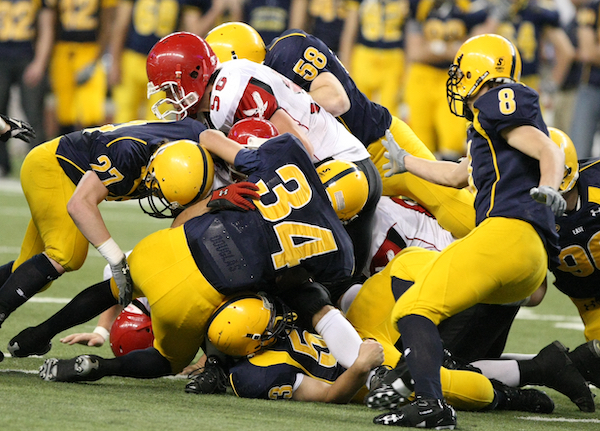
EGR teams would find all kinds of ways to win during the five-year title stretch. The 2009 team, for instance, barreled through its first four playoff opponents by a combined score of 164-29 until a 24-21 win over Orchard Lake St. Mary’s in the Final. The 2010 team had to win three playoff games by eight points or fewer to finish off its perfect 14-0 record. And then there was the wild 46-39 five-overtime win over St. Mary's in the 2007 Final during which the Pioneers had to score on all five possessions in overtime to outlast the Eaglets.
While teams always seemed to find ways to get the victory, former players remember what it was like to be part of a seemingly endless tradition of success on the football field.
"One of the things that was so special about East Grand Rapids were the expectations," said Luke Glendening, a running back on the 2006 team who has gone on to a long NHL career with the Detroit Red Wings and Dallas Stars. "During the game I'd look around and see guys who had played here a long time ago. I viewed it as a privilege to have the opportunity to play before the alumni and community."
Quarterback Ryan Elble, who completed a combined 34 passes for 483 yards and seven touchdowns during the 2008 and 2009 Finals, also used the word "honored" to describe his high school experience.
"The culture was to win. Coach Stuursma made it fun, and it always seemed to take shape on the field," said Elble, who went on to play baseball at Miami (Ohio) "I think each team had different skill sets, but at the end of the day it was our culture and putting in the work to spend Thanksgiving weekend at Ford Field."
The players point to that winning culture over talent. Elble said he played with only one eventual Division I college player in linebacker/running back Trent Voss, who went on to Toledo. Nobody wins without talent, of course, but they point to many other factors as being just as critical. Because EGR coaches would always work juniors into the lineup, Stuursma said the program faced only one major rebuild, in 2007. That team wound up 13-1 and the second of those five straight champions.
 "We had some incredible players," said Stuursma, who left EGR in 2016 to lead Hope College to two Michigan Intercollegiate Athletic Association titles, three second-place finishes and a 46-15 overall record over his seven seasons. "We returned only two starters (in 2007), but we still had good guys who wanted to win."
The players say the culture started with Barcheski and the program's tradition. As Hope College's coach, Stuursma said there’s a similar common thread among schools he sees on recruiting visits: a winning tradition that, in Stuursma's words "screams excellence," from every corner of the building. He sees it the minute he walks into some schools, and East Grand Rapids had the same culture before he arrived. The past players say it played a major part in their careers.
That tradition didn't start with the five straight titles, said former quarterback Kyle Cunningham, who played on the 2002-03 teams and went 46-0 over four years from his freshman to senior seasons. Those two championship teams’ most recognizable player was running back Kevin Grady, who still holds multiple MHSAA records including for career rush yardage and went on to play at University of Michigan.
"We worked hard and had a lot of pride," he said. "I remember watching film of earlier teams, and I remember hoping our team could stand up the same way."
While the players point to tradition and community, Ryan Blair, a tight end/defensive tackle on the 2006-08 champion clubs, said talent remained critical – but EGR was outmanned physically in some of those title games. That's when camaraderie and the confidence that someone was going to make a key play took over. The Pioneers' remarkable run was teeming with such plays.
"Certainly we were never one of the biggest teams there, we never had a big size advantage in any game," he said. "But we had this camaraderie on every team. We had guys who really liked playing with each other. When things got tight we stuck together, and we'd fight to the fourth quarter or beyond."
Despite the long odds of winning a single state title let alone repeating, Stuursma believes there could be a team one day which wins six straight. That team will have the same characteristics of those EGR teams – the talent, coaching, tradition and fortune of catching timely breaks – but it can be done, he said.
"Absolutely," Stuursma said. "The only record I can think of that won't be broken is Wayne Gretzky's (NHL) scoring record. It will take a lot, but records are made to be broken. I think high school football is on the upswing and there would have to be an emphasis on winning. You would have to have a good path to get there, but I can see someone getting six one day."
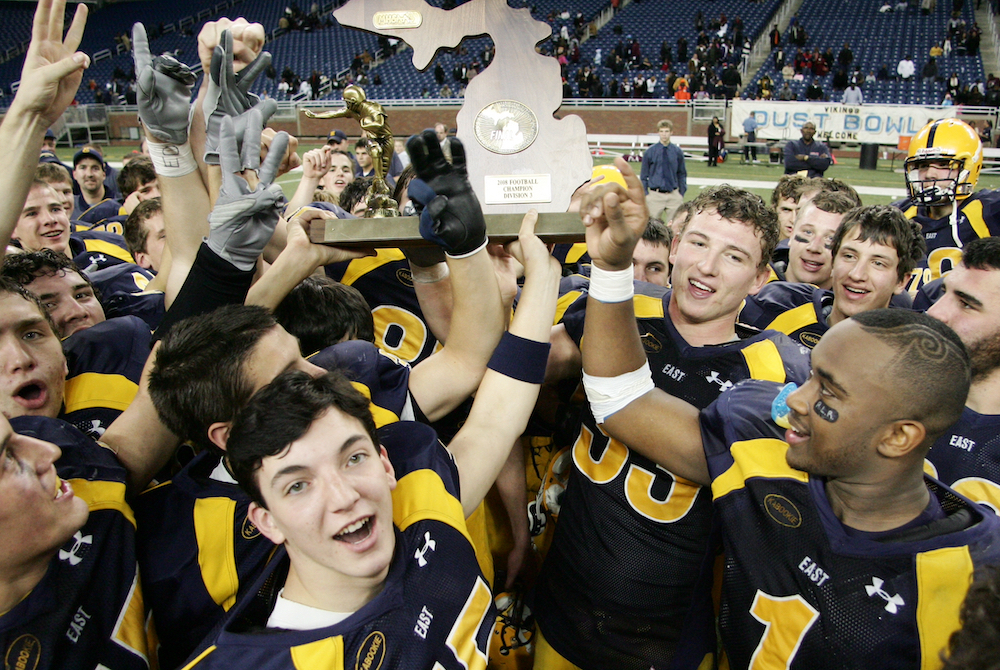
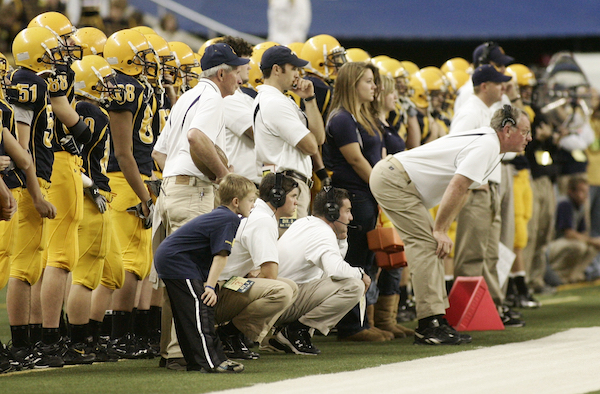
PHOTOS (Top) East Grand Rapids celebrates its third-straight Division 3 championship win in 2008. (Middle) Pioneers converge on an Orchard Lake St. Mary’s ball carrier during the 2007 five-overtime title decider. (Below) EGR coach Peter Stuursma, kneeling center, monitors the action during the 2010 championship game.
Off to Fast Start, Gunsells Aspiring to Assemble Lasting Ludington Legacy
By
Tom Kendra
Special for MHSAA.com
September 11, 2025
Cameron Gunsell has been building things at Ludington High School his entire life.
 “One of my earliest memories is making forts with the blocking dummies with my older brother during football practices,” recalled Gunsell of his and older brother Wilson’s adventures.
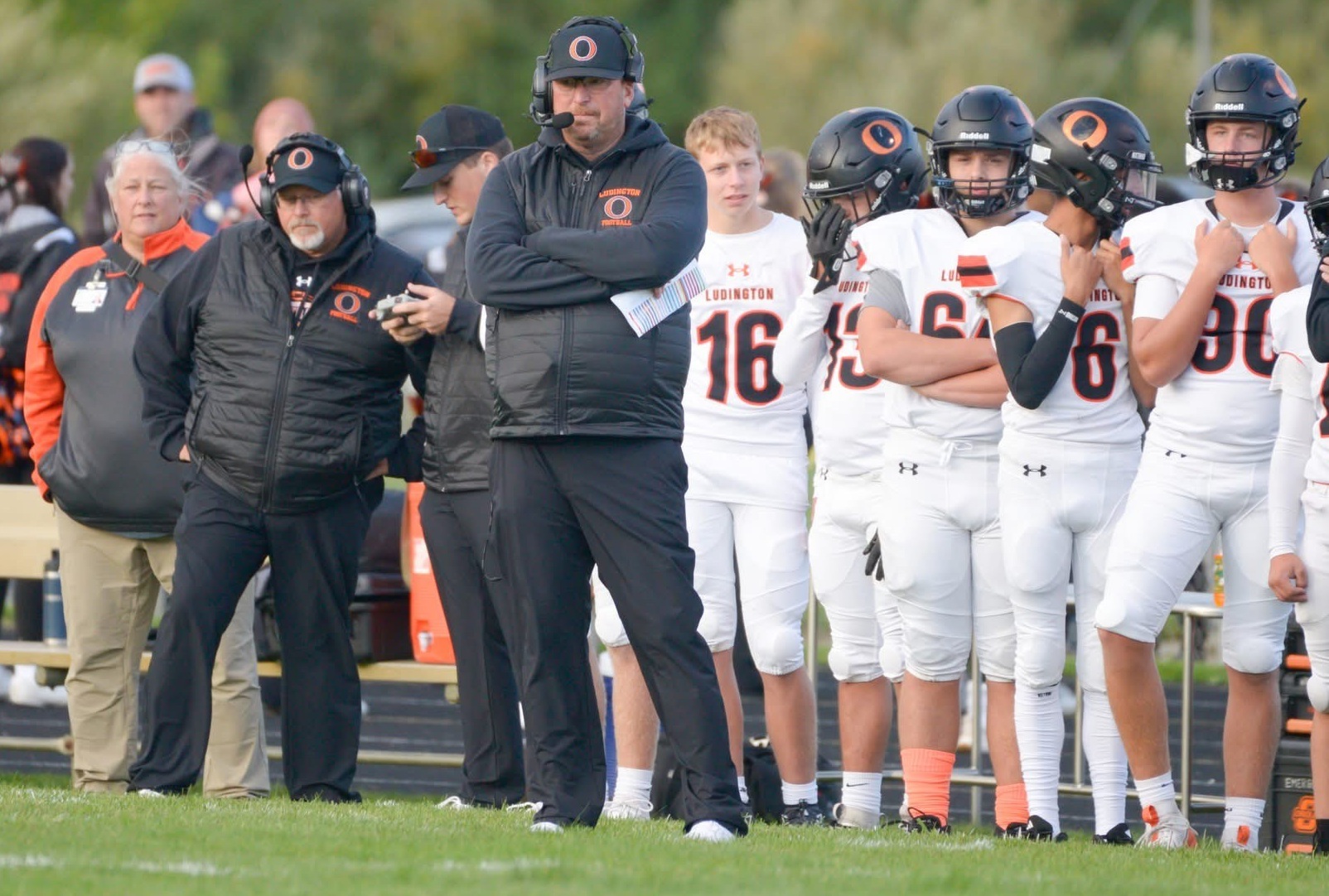
The Gunsells are now building something much bigger and more permanent at Ludington – with dad, Charlie Gunsell, in his 22nd and final year as the Orioles’ head football coach, Wilson an assistant coach and Cameron the team’s unquestioned leader and senior quarterback.
Cameron has rushed for nine touchdowns and thrown for three more over the first two weeks, leading Ludington to lopsided road wins over Coopersville and rival Mason County Central and heading into Friday’s home and West Michigan Conference Lakes opener against Fremont.
There is a buzz in this small town, best known for its Lake Michigan car ferries, which hasn’t won a football conference title since 1999 and has only one playoff victory in school history, which came during the COVID year of 2020.
“We definitely feel like this is our time,” said Cameron, 18, who is three years younger than his only sibling, Wilson. “Our motto this year is ‘Wake People Up.’ We brought back a ton of playmakers and had the best offseason in the weight room getting ready.”
The Orioles started making noise right away at Coopersville, where Cameron carried the ball 34 times for 246 yards and five touchdowns while completing 8-of-11 passes for 116 yards and a TD. He also made a team-high six tackles from his free safety position.
Last week, he was back at it against rival MCC in the Lumberman’s Cup, this time doing more damage through the air completing 8-of-15 passes for 245 yards and two scores while rushing 16 times for 161 yards and four TDs. He again led the team with eight tackles.
“It’s uncomfortable for me as the head coach talking about my son, but he is really good,” said Charlie Gunsell, a Caro native who was the starting quarterback at Ferris State in 1997. “Cam is so stinking competitive, and 80 percent of what we do offensively is a read through him. He is the guy who makes us click on both sides of the ball.”
 Cameron (6-foor-3, 190 pounds), in his third year as the starting quarterback, is closing in on 4,000 passing yards and 3,000 rushing yards for his career. His play caught the attention of college scouts, drawing scholarship offers from Grand Valley State, Davenport and reigning Division II national champion Ferris.
Gunsell announced last month that he would be following in his dad’s footsteps at Ferris, which he said was not an easy decision.
“I honestly was really close to choosing Grand Valley,” said Cameron, who completed 70 percent of his passes last season. “But, in the end, I have always wanted to be a Bulldog. Just like here at Ludington, I grew up going to football games at Ferris.”
With that choice behind him, Cameron is focused on the immediate goal of helping his team unseat Whitehall, which has won three straight WMC Lakes titles, and then making a run in the Division 4 playoffs.
He knows that defenses are going to be keying on him and stacking the box after his fast start.
“If they want to focus on me, that’s great for us,” explained Cameron, who lines up in the shotgun every play and distributes the ball to the Orioles’ four-wide skill players. “We have a lot of other weapons this year.”
The leading receiver is junior Taj Williams with seven catches for 142 yards over two games, while sophomore Kyle Himes has three catches for 122 yards.
Ludington actually features three Himes brothers, with freshman Mikie Himes the team’s second-leading rusher through two games with 88 yards. Junior Messiah Himes is a dangerous running and receiving threat from his slot position.
“We have a lot of kids who deserve touches, and they will get them as we get into our conference games and everyone tries to take Cam away,” said Gunsell, who is assisted by offensive coordinator Brent Gillett and defensive coordinator JP Deines.
Coach Gunsell points to conference foes like Oakridge, Montague, Orchard View and Whitehall as teams that have had the type of playoff success his team wants to emulate.
In order to make a run, he said the team must get the job done up front, where they are led by seniors Walt Autrey (6-4, 298), Colin Shelton and Connor Chaney.
“We have had talented players before, but our biggest thing up here is, are we tough enough?” said Gunsell. “These kids have worked so hard in the weight room to get stronger and to make that toughness our calling card.”
 Tom Kendra worked 23 years at The Muskegon Chronicle, including five as assistant sports editor and the final six as sports editor through 2011. E-mail him at [email protected] with story ideas for Muskegon, Oceana, Mason, Lake, Oceola, Mecosta and Newaygo counties.
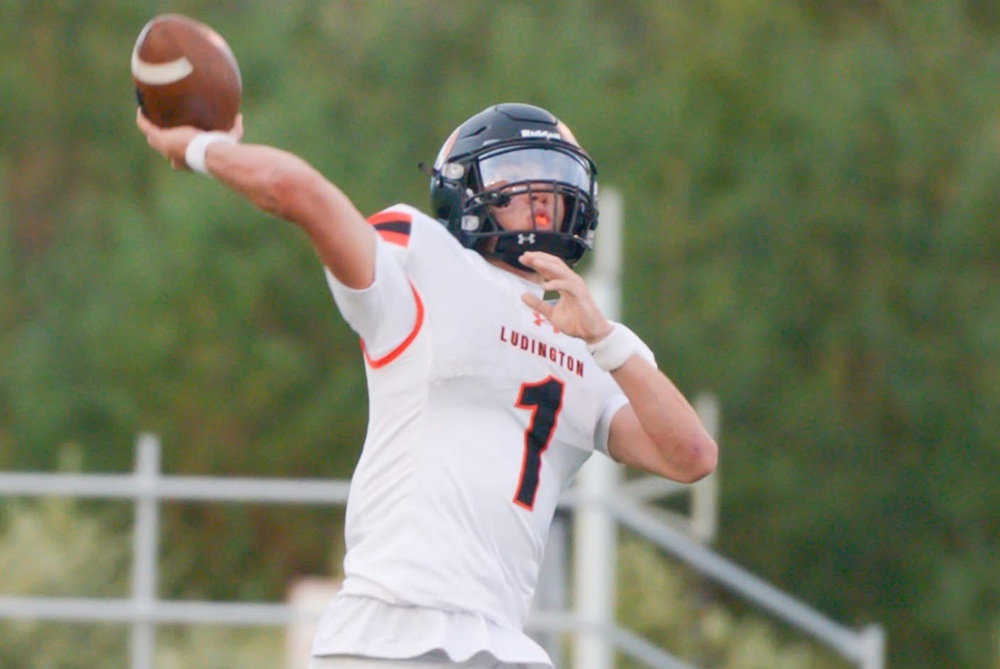
PHOTOS (Top) Ludington quarterback Cameron Gunsell launches a pass during his team’s win over Mason County Central last week. (Middle) Gunsell’s father and head coach, Charlie Gunsell (in headset) monitors the action from the sideline. (Photos by Jason Goorman/Local Sports Journal.)