

Eriksen, Clarkston Finish 'Dream' Run
November 30, 2013
By Bill Khan
Special to Second Half
DETROIT — Ian Eriksen's senior season was slipping away.
And so was his lifelong dream.
Eriksen and his football-playing buddies in Clarkston talked about earning an MHSAA championship back when they were in elementary school and winning the Super Bowl of the Northern Youth Football League in Oakland County.
But after rushing for 2,167 yards and 33 touchdowns as a junior, Eriksen came into his senior year with Achilles and ankle injuries, then underwent arthroscopic surgery for a partially torn meniscus in his right knee on Sept. 19.
Four Friday nights passed with Eriksen in street clothes, unsure of when — or if — he'd ever rejoin his teammates in pursuit of their shared dream.
"That was really tough, because I've never been injured that seriously," Eriksen said. "It could've been a lot worse. I tried to be positive. All you can do is be positive rather than mope over it."
One positive out of the situation may be that Eriksen was fresh enough by the end of the playoffs to take on a heavy workload and help carry the Wolves to their first MHSAA football title.
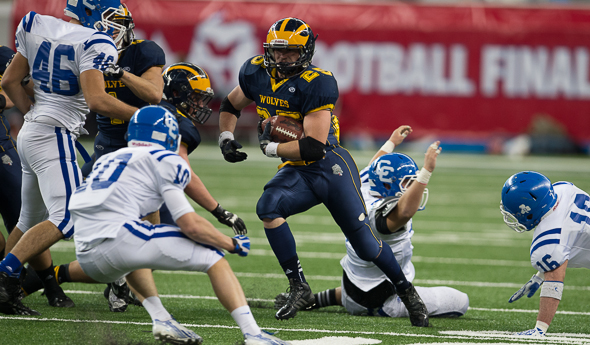
Eriksen ran 32 times for 237 yards and three touchdowns in Clarkston's 32-14 victory over perennial power Detroit Catholic Central in the MHSAA Division 1 championship game Saturday at Ford Field.
He also had a 30-yard catch to extend Clarkston's first touchdown drive, and a sack. In Clarkston's last two games, Eriksen ran 76 times for 592 yards and nine touchdowns.
"He gave us a lot of problems," said veteran Catholic Central coach Tom Mach, who has built a dynasty with the power-running game. "He was a very good running back. He would be a good running back in our program. We would've loved to have him. We had a lot of trouble tackling him. He got the extra yard and put in the extra effort.
“They kept the ball away from us, getting those first downs, getting those first downs, getting those first downs. That's frustrating on a team, especially when you do get the ball when you're a ball-control offense like us."
 Bringing Clarkston its first MHSAA championship was the fulfillment of a dream for Eriksen and his teammates after the program reached three Semifinals and made the postseason 16 times under 27-year coach Kurt Richardson.
"In Little League, there's a Super Bowl," Eriksen said. "We won the Super Bowl together in 2006 when we were in fourth and fifth grade. The next thing we started talking about was winning a high school championship if we could do it. We knew we could."
Eriksen and some of the players who delivered that championship were in the stands at Troy Athens four years ago when Clarkston lost by two points in a Semifinal to Sterling Heights Stevenson.
"I remember when that happened," Eriksen said. "Everyone in the community was just so upset about that. Me and the other guys were like, 'That's not going to happen to us when we get there.'"
Clarkston made Catholic Central settle for a third straight runner-up finish by stealing a page from the Shamrocks' script.
Led by Eriksen and an outstanding offensive line, the Wolves ground out 288 yards on 45 carries. They had a 27:58 to 20:02 advantage in time of possession.
"The offensive line doesn't get enough credit," Richardson said. "They deserve it for this one."
After a punt and interception ended Clarkston's first two drives, the Wolves scored touchdowns on their next five possessions.
Both teams had promising drives end with interceptions deep in the opponent's territory before Clarkston broke through for the game's first score with 13 seconds left in the first half.
Converting three times on third down and once on fourth, Clarkston moved 91 yards in 17 plays, taking 6:36 off the clock, before D.J. Zezula hit Shane Holler with a 15-yard touchdown pass on a post route. The extra point failed.
The key play on the drive was a 30-yard pass to Eriksen on third-and-12 from Clarkston's 15-yard line.
"We knew we had to score, because we got the ball to start the second half," Zezula said. "It was 0-0 and we knew we had to get up on CC. They brought in an extra (defensive back). The play-action with Ian helps me out a lot with time and the O-line helps me a lot with time. We knew the play-action would work."
Catholic Central's best drive of the first half came following the opening kickoff. The Shamrocks marched to the Clarkston 24 before Tim Cason intercepted a pass, only the second pick thrown by Catholic Central all season.
Jack Van Acker made two big plays to keep Clarkston out of the end zone on the Wolves' second possession. First, he made a touchdown-saving tackle on a 35-yard run by Eriksen to the Shamrocks' 10-yard line. Then, two plays later, he picked off a pass in the end zone after Clarkston moved to the 6.
A 63-yard punt by Zach Bock pinned Clarkston at its own 9-yard line with 6:49 left in the second quarter before the Wolves drove for the only touchdown of the first half. Clarkston's average starting field position on three first-half possessions was its own 10.
Armed with a lead and momentum, Clarkston took the opening kickoff of the second half and marched 80 yards in eight plays, taking a 12-0 lead on a 37-yard run by Eriksen with 8:18 left in the third quarter.
The lead reached 18-0 on a 1-yard run by Eriksen with 3:59 left in the third.
Catholic Central got on the board when Dylan Roney scored on a 2-yard run with 45 seconds left in the third quarter, cutting Clarkston's lead to 18-7.
The Wolves responded with a seven-play, 71-yard drive that ended on a 47-yard pass from Zezula to Caine Watlington with 8:35 left in the game.
The Shamrocks scored again on a 48-yard pass from Sean Birney to Alexander Bock with 5:46 left, but Clarkston again had an answer, with Eriksen scoring on a 12-yard run to cap the scoring with 4:06 left.
Zezula was 10 for 15 for 154 yards, two touchdowns and one interception. Birney was 13 for 23 for 166 yards, one touchdown and one interception.
Clarkston won its final 13 games after a season-opening loss to Rochester Adams, a loss the Wolves avenged in the playoffs.
"A lot of these kids have been playing together since fifth grade," Richardson said. "They've played Chiefs together, so they've come up through the junior ranks. We all felt this could be a special season. We had some issues at the start. We talked to the kids at the time about turning a negative into a positive. You're going to get slapped in the face in life. We got slapped in the face in the first game. They learned from it. It was a huge coming-together point for us as a team."
Catholic Central (11-3) became the third team to finish runner-up three straight years. Utica Eisenhower was the Division 1 runner-up from 1999-2001 and Crystal Falls Forest Park was the Division 8 runner-up from 2004-06.
The Shamrocks' 2012 runner-up team was led defensively by sophomore middle linebacker David Widzinski, who had a game-high 15 tackles. Less than two weeks later, he died in his sleep.
Tributes to Widzinski were visible at Ford Field. Catholic Central's uniforms had a patch with his No. 33 inside a shamrock. In the student section, some students wore white and formed a 33 within a field of blue shirts worn by the others. Widzinski's jersey hung on the wall on the Catholic Central sideline.
"We brought up David a lot," Mach said. "He was a force behind our team all year long. Every day after practice, we would say a prayer for him and the people in our community who are suffering. It was a real learning experience for our kids to put something bigger than themselves in place of winning and losing."
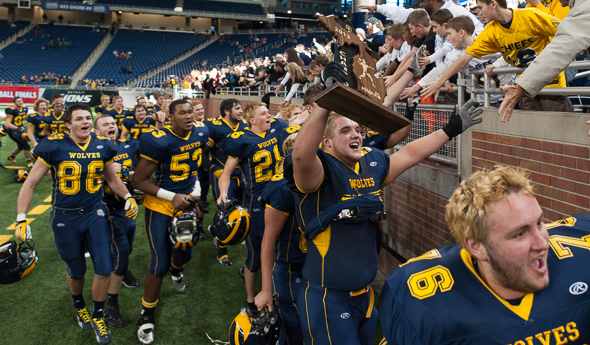
PHOTOS: (Top) Clarkston players trade high fives with fans as they march off the Ford Field turf with their first MHSAA championship trophy. (Middle) Clarkston running back Ian Eriksen runs through the reaching arms of Detroit Catholic Central defenders Saturday. (Click to see more from Terry McNamara Photography.)
Be the Referee: Dead Ball Penalty
By
Paige Winne
MHSAA Director of Brand Management
September 15, 2026
Be The Referee is a series of short messages designed to help educate people on the rules of different sports, to help them better understand the art of officiating, and to recruit officials.
Below is this week's segment – Dead Ball Penalty - Listen
We’ve got 4th-and-10 on the football field today. Team A has the ball on their own 40 and is going for it.
The quarterback scrambles and is pushed out of bounds at the 49-yard line, one yard short of a first down.
A defensive player from Team B hits the quarterback after he’s been pushed out of bounds and is flagged for a dead-ball personal foul. Where should the ball be marked and who has possession?
Is it 1st-and-10 for Team A at Team B’s 36-yard line? Or does the defense get the ball, 1st-and-10 for Team B at their own 36?
If you said Team B’s ball, you are correct. The personal foul was a dead-ball penalty that is enforced after the change of possession.
Previous 2026-27 editions
Sept. 8: Libero Ejected - Listen
Sept. 1: Soccer Foul After Shot on Goal - Listen
Aug. 25: Fumble Out of Bounds - Listen